I wasn’t going to post today. I wasn’t even going to take pictures. Mel and I had been out taking pictures both yesterday and the day before (my preferred outing), and it was Mel’s turn to choose the day’s activity— he wanted to go to the Bill Jackson’s Shop for Adventure to look for fishing stuff, so that’s where we went.
Blue Jay
Bill Jackson’s is a mega store for every conceivable piece of sporting equipment you can imagine—including ski equipment– for snow, not water (an odd item, I thought, given that you couldn’t find snow in Florida unless it came in on a refrigerated truck!). There was even an artificial ski slope and a swimming pool inside the store!
Male Mallard (although this one doesn’t look exactly like the ones I’m familiar with in Michigan)
Female Mallard
This one looks kind of like a mallard, but it’s the wrong color!
On my very brief run through the store, I found my escape route! (I’m not really much of a shopper, so when Mel goes shopping, I usually look for something else to do.) I could see a small lake out behind the store with a paved trail all the way around the perimeter. Knowing that Mel could easily spend all day in a store like this, I grabbed my camera and headed out the door!
Anhinga drying her wings
Female Anhinga
Along the water’s edge, or in the pond itself, there were cormorants, anhingas, egrets, great blue herons, tricolored herons, gallinules, mallards, and a very well-camouflaged green heron. Overhead in the trees I managed to spot a black and white warbler as well as several palm warblers. On the nearby power line, there was a mockingbird, and in the sky above me were several terns scanning the waters for fish. What a busy place this was!
Great Blue Heron
Green Heron
Cormorant
Palm Warbler
Northern Mockingbird
Black and White Warbler
At the end of the day, we had both managed to find what we wanted—fishing stuff for him, pictures for me!
I don’t usually take a camera with me when we walk to the coffee shop in the morning, but I did today because I was hoping to find the odd ducks we had seen yesterday on our walk– actual ducks that is, not peculiar people behaving oddly. I had never seen these particular feathered friends before and they were just wandering around in people’s yards! Mostly black with a little bit of white, and a touch of bumpy red warts, they weren’t particularly attractive birds–but definitely interesting. What could they be, I wondered? As it turns out, they were Muscovy Ducks! That’s what Merlin said– Merlin, the app, not Melvin, the husband!
Muscovy Duck
Muscovy Duck
Here’s what The Cornell Lab of Ornithology had to say about the Muscovy Duck:
“The strange, warty-faced Muscovy Duck causes confusion for some bird watchers, as it’s very distinctive and quite commonly seen, yet does not appear in some field guides. Truly wild individuals are restricted to south Texas and points south, but domesticated versions occur in parks and farms across much of North America. Wild Muscovy Ducks are glossy black with bold white wing patches and are forest dwellers that nest in tree cavities. Their range expanded into Texas in the 1980s; feral populations also exist in Florida.” https://www.allaboutbirds.org/guide/Muscovy_Duck/overview
Not far from the Muscovy Ducks was a small, man-made pond where we were surprised to find a few common gallinules and one very lovely hooded merganser –who were both nice enough to stay close to shore so that I could take a few pictures!
Hooded Merganser
Common Gallinule
Following our neighborhood bird encounters and our stint at the coffee shop, we headed over to the nearby Sawgrass Lake Park for more bird watching—and the requisite picture taking.
“Sawgrass Lake Park,
400 acres in size, allows people to walk through one of the largest maple
swamps on the Gulf Coast of Florida. The park’s mile-long boardwalk and
half-mile dirt trail provide opportunities to see birds, butterflies, plants
and animals in their natural settings within the most densely populated county
in Florida”. http://www.pinellascounty.org/park/16_Sawgrass.htm
And, if you’re not familiar with the term ‘sawgrass’, as I wasn’t
before visiting Florida, here’s a good description…
“Sawgrass
is a large sedge plant that thrives on water and can be found on riverbanks in
the southern United States, especially in Florida. Scientists consider sawgrass to be one of the oldest plant
species, and the plant has tough, edged leaves that can weather year-round
flooded conditions of the harsher swamps.”
Unidentified duck–maybe a cross between a mallard and a Muscovy??
Unidentified duck–even Merlin the app couldn’t tell me
American White Ibis
Tri-colored Heron
What a beautiful, beautiful park! As soon as we walked down to the water, we saw gallinules, ducks, ibises, turtles, grebes, coots, great blue herons, and a limpkin. Later in the day, we saw a tricolored heron, a cormorant, two armadillos, and a handful of alligators! The pictures of the armadillos and the alligators didn’t make the cut, however.
Limpkin
American Coot
Common Gallinule
My favorite part was watching the great blue heron catch a fish! My second favorite part came later along the boardwalk when I managed to catch sight of a few birds I’d never seen before– a blue headed vireo and a blue gray gnatcatcher– but they were both flitting around so quickly and erratically, that I only caught a good picture of the vireo. Maybe the gnatcatcher will be more patient next time!
Great Blue Heron with his catch of the day!A beautiful Blue Headed Vireo
I am so incredibly impressed with all the lovely
preserves and nature trails that we have found in Florida over the years –especially
the ones with boardwalks weaving through marshes and swamps where the landscape
would be otherwise inaccessible for all of us – with or without mobility
issues. Everybody wins!
Until a few years ago, I had never left the state of Michigan in the wintertime so I never really appreciated the fact that one could take a road trip to summer in the middle of a snowstorm. For my husband and I, the road trip to summer (aka Florida) takes three days—or about 1200 miles. And even though I’ve lived in this country my entire life, it’s still hard for me to believe that I can drive my car from winter to summer in a matter of a few days; that one day I can be scraping 6 inches of snow off my car and struggling to stay warm, then suddenly I’m not! It feels quite odd really—but it doesn’t take all that long to get used to!
Incoming Osprey
In less than 24 hours after our arrival, Mel and I headed out, cameras in hand, to the nearby Weedon Island Preserve for a late morning hike and photo shoot (http://www.weedonislandpreserve.org/). We hadn’t even gotten to the parking lot of the preserve, when the very best shot of the day captured our attention—a big, beautiful osprey perched overhead on the arm of a light post eating his catch of the day– a large spotted sea trout! We quickly parked our car, got out our cameras and started to shoot. Aside from the unsightly condition of the fish who was now missing most of his face, it was a great photo opportunity.
After our osprey encounter, Mel and I drove a little farther into the preserve and parked our car near the pier where we were delighted to see cormorants, pelicans, ibises, and a well-hidden yellow crowned night heron. Wow! But, there was much more to explore!
Yellow Crowned Night Heron
White Ibis
We took one of the nearby trails that led us to a boardwalk through the mangrove swamps that led us to a pond where we found one roseate spoonbill, one wood stork, one ibis, one tri-colored heron and one great egret! It seemed odd to me that there was just one of each bird, but it felt like a gold mine, nonetheless! For one reason or another, though, (mostly user error I suspect), most of our pictures didn’t turn out the way we had hoped. Nevertheless, it still felt like the best day ever—especially after leaving behind so many months of winter with so few birds.
January 21, 2019 When I started out on my walk today, it was only 4 chilly degrees —which was actually 8 degrees warmer than it had been when I woke up a few hours earlier!! It felt like Antarctica! But, I saw it as a challenge– could I dress warmly enough, and, if I could, how long could I stay out? Surprisingly, (or maybe not so surprisingly given all the layers I had on) I never got cold—even after four hours!
Tufted Titmouse eating snow
In spite of the frigid weather, though, the birds must have thought it was spring. For one thing, there were robins everywhere! I thought robins were spring birds! Apparently, they do not know this. They were singing and eating berries and pretending that we weren’t in the middle of our worst winter weather of the season. Maybe nobody told them. Maybe they don’t have a weather app. Whatever the reason, they hadn’t gotten the memo– and they were everywhere!
In addition to the robins, I saw bluebirds, goldfinches, nuthatches, titmice, downy woodpeckers, cardinals, sparrows, house finches, mallards, a mute swan and my biggest surprise, a ruby crowned kinglet! Unfortunately, I wasn’t able to get good pictures of all these lovely birds, mostly because I found it difficult to get the settings right to adjust for the bright sun and the bright snow– or the birds weren’t interested in sitting in an appropriate spot for a good picture!
This starling was another surprise and a very long shot with a not very long lens
American Goldfinch
Mute Swan with a little artistic rendering
Even though the temperature was in the single
digits today, it was an incredibly beautiful day for a leisurely walk through
the woods. The sky was blue, the sun was out and, mercifully, there was no
wind. Maybe that’s why I was able to stay out so long.
Yesterday and today I got the chance to explore two different nature preserves in two different towns, Kensington Metropark Nature Center in Milford and Howell Nature Center in Howell—both in Michigan. The first was on my way to visit my seven year old grandson and the second was on my way home. Both preserves are delightful, but Kensington is my favorite—mostly because of the songbirds who readily seek out humans for a handout—literally: if you’re hand is out, they’re on it!
The Handout
The trails through the Nature Center have so much to offer! In the warmer months, the nearby ponds are teeming with a wide variety of waterfowl—egrets, geese, mallards, great blue herons…you name it. But this time of year, with the ponds frozen over, it’s totally quiet–except for an occasional flock of geese or sandhill cranes squawking overhead.
Sandhill Cranes Overhead
As I walked past the ponds and into the woods, though, I could hear birds chirping everywhere. Whenever I would stop to listen more carefully, the chickadees, nuthatches and titmice magically appeared in the nearby trees and bushes expecting to be fed! Luckily, I had remembered to pack birdseed and peanuts before leaving home, but, I barely had time to fish them out of my pocket before the birds came zooming in to grab it out of my hand. Then, once the word got out that there was free food, the cardinals, bluejays and woodpeckers appeared. The smaller birds fed from my hand and the larger ones grabbed the seeds and nuts I had left nearby.
Tufted Titmouse
Red Bellied Woodpecker
White Breasted Nuthatch
When I feed the birds at Kensington, it’s always interesting to observe who’s the ‘bravest’ and who’s the most likely to grab the big, unshelled peanuts. The chickadees are, by far, the bravest and the boldest, I think, followed by the titmice, nuthatches and downies. As for the peanuts, I was not at all surprised that the bluejays, red bellies and cardinals wanted them, but I was totally surprised when the little downies and titmice did. Weighing in at less than one ounce, these little birds hardly weighed more than the nut they flew off with!
House Sparrow
Black Capped Chickadee
Dark Eyed Junco
Cardinal
Bluejay
American Tree Sparrow
At one point, I had so many birds gathered around me, (as well as a few cheeky squirrels), that I felt like I was standing on the set of a Snow White re-enactment. You know, the part where she has all those little birds flying around her head and all those little creatures looking up at her adoringly?? While I do not claim to bear even a passing resemblance to the lovely Snow White, the scene itself was, nonetheless, just as magical!
Snow White and Friends
When I visited the Howell Nature Center the following day, there was no shortage of birds flying around, but, unlike the Kensington birds, these birds were totally ‘untrained’ and had no idea that the large, two-legged creatures walking among them could be a source of free food! I had to enjoy them from afar.
Black Capped Chickadee
Male Cardinal
Female Cardinal
The interesting thing about the Howell Nature Center, though, is that it has a rehab facility for injured birds and small animals. I was especially interested in seeing the bald eagles. There were two of them in permanent residence at the Center who had already recovered from their injuries but were still unable to survive on their own. Both birds were housed in a large, outdoor enclosure surrounded by a thick, chain link fence. Surprisingly, I was able to get some good close ups in spite of the fence. I would have preferred, of course, to capture bald eagles in their natural habitat, but since that wasn’t likely to happen anytime soon, I did what I could.
Bald Eagle
Bald Eagle
Every time I get the chance to spend time in
nature, like I did these last two days, I try to remember how immensely lucky I
am to be able to do so.
It’s been a week since I’ve been able to go out and take pictures. A week! I think that’s been my longest stretch of ‘picture free’ days that I can remember– so I was getting very antsy. The primary reason for my picture hiatus was the weather. We’ve had rain, we’ve had snow, and we’ve had both at the same time. Not good, not good at all. Today, though, the weather forecast called for sunny, sunny skies —but below freezing temperatures. I could live with freezing. So I bundled myself up and headed out the door to one of the few nearby places that I would be guaranteed to see lots of birds—the Kellogg Bird Sanctuary!
Female Dark Eyed Junco
Female Dark Eyed Junco
Whenever I go to the bird sanctuary, I typically spend at least an hour near the Visitor’s Center trying to capture some of the local songbirds before I even go into to the sanctuary proper. Many of the birds here, like the chickadees, goldfinches and cardinals are drawn into to the area because of the numerous bird feeders that are maintained by sanctuary staff. Other small birds, like the pine siskins, flock to the nearby pine trees to gorge themselves on the seeds hidden in the pine cones or to the seeds hidden in the catkins dangling from surrounding deciduous trees ( “A catkin is a slim, cylindrical flower cluster”). In spite of the near empty bird feeders, there were more than enough birds to keep me busy for well over an hour.
Pine Siskin getting seeds from a catkin
Pine Siskin eating crab apples
Pine Siskin getting seeds from a pine cone
Because I had arrived at the sanctuary early in the morning, it was still well below freezing and my fingers kept turning into little icicles as I tried to take pictures—even though I had on a decent pair of gloves. Every twenty minutes or so, I scurried back to my car to re-heat! After I had taken every conceivable picture I thought I could possibly take on the outside of the sanctuary, I headed through the gates to the see the ‘big birds’. With my camera tucked up under my left arm and both hands shoved deep into my pockets, I was hoping I wouldn’t have to run back to the car anytime soon. Three hours and hundreds of pictures later, I still had all of my fingers!
Male Dark Eyed Junco
American Goldfinch
My happiest find for the day was the bluebirds. I’m still amazed when I see them in the wintertime because, prior to taking ‘picture walks’, I had assumed that bluebirds all went south for the winter. It’s just such a delight to see them this time of year!
Eastern Bluebird
Eastern Bluebird
My biggest surprise for the day was ‘capturing’ a yellow bellied sapsucker! Not only have I never seen one before, I found out later that they shouldn’t even be here at this time of year! “Yellow-bellied Sapsuckers depart their breeding range in September and early October for wintering grounds in the southern U.S., Mexico, West Indies, and Central America. They arrive back north in May.” I guess this little sapsucker forgot to mark her calendar when it was time to leave!
Female Yellow Bellied Sapsucker
I also saw the sanctuary ‘regulars’— Canadian Geese, mallards and trumpeter swans; plus the regular non-native residents– one mandarin duck, one black swan, and one red breasted goose.
Canadian Goose
Canadian Goose
Trumpeter Swan imitating whipped cream!
Mallard on Ice. Brrrrr.
Mandarin Duck
Red Breasted Goose
While I was taking pictures of the ‘regulars’ I spotted a swan that was not like the others. At first, I mistook it for a trumpeter swan, until I zoomed in and saw that the beak was not entirely black. There was a big patch of yellow on it. Hmm. I’d never seen that before! My research first led me to the conclusion that it was a tundra swan, after which I was informed that it was a Whooper Swan. A few days later, someone else pointed out the definitive answer based on information I had missed finding on the Kellogg Bird Sanctuary’s website! It’s a Trooper Swan!!
“Trooper swans are a Whooper x Trumpeter swan hybrid. Whooper swans are a European breed of swan with a large yellow triangular patch on their black bill. They have a wing span of approximately 6.7 – 7.7 feet and are closely related to the Trumpeter swan.”
In spite of the frigid temperatures, it was a beautiful, beautiful day to be outside–and just what I needed to regain my equilibrium after a week of bad weather and zero picture walks!
A breath of fresh air on a cold winter’s day, the Eastern Bluebird
The weather has been absolutely beautiful here for the last few days, sunny and spring-like with temperatures in the forties and fifties. Surprisingly, though, we haven’t seen many birds, even though we have been out for hours every day looking for them. So today, Mel and I decided to try a change of venue and head over to Lake Michigan (about an hour’s drive) to look for birds there. If nothing else, we’d enjoy a pleasant drive and a visit to our favorite South Haven coffee shop (Julia’s), and our favorite South Haven restaurant (Phoenix Street).
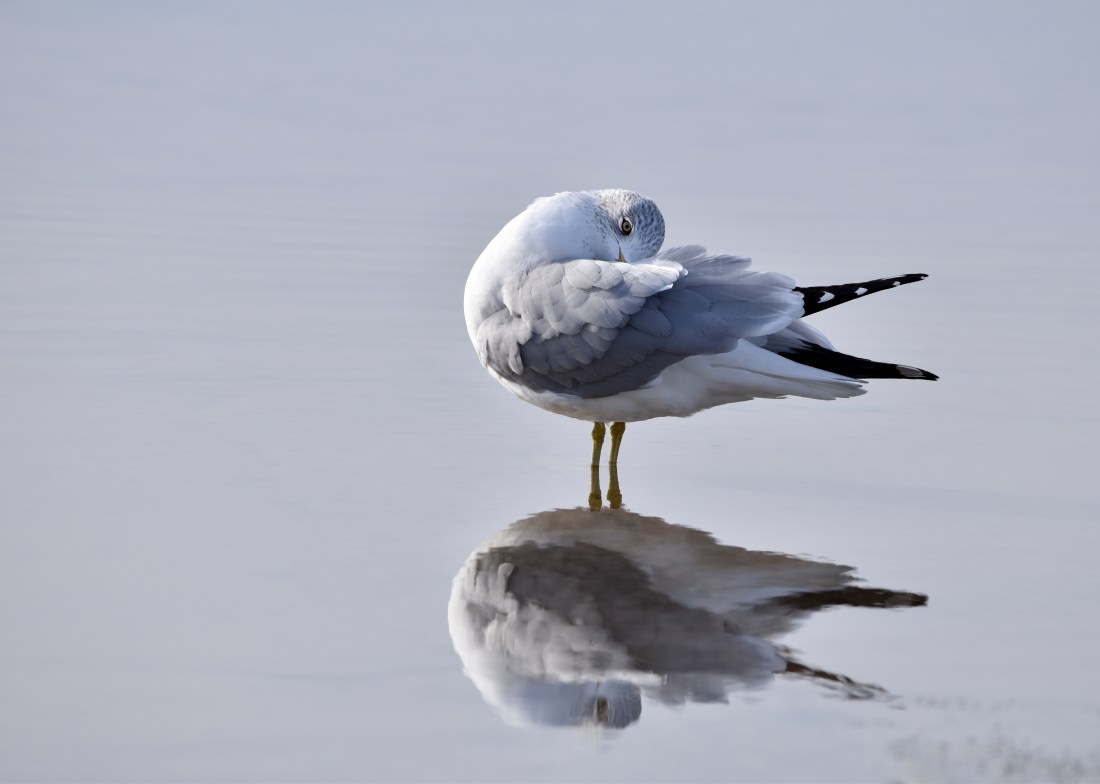
Ring-billed Gull
Ring-billed Gull
Even though our
birding adventure didn’t afford us much exercise, we had a great time standing on
the waterfront attempting to get interesting pictures of all the seagulls—on the
piers, on the beach, on the light posts, on the railings, in the water and
flying overhead. We were not at a loss for subject matter—although some might
argue that ‘interesting seagulls’ might be considered an oxymoron!
City Birds
Catching a few waves!
So, here are some of the interesting facts I found out about seagulls: Apparently, there are at least twenty-eight types of gull species in North America alone, and about 50 types throughout the world. Mel and I saw three different types today–the ring-billed gull, the herring gull and the lesser black-backed gull. Seagulls are everywhere! At least one gull species can be found on every single continent, including Antarctica! I didn’t know that! And, a flock of gulls is called a colony, or a squabble, or a flotilla, or a scavenging. I liked Squabble the best.
My biggest surprise was learning that gulls are considered (by some sources, anyway) to be “intelligent”! I would never have put ‘intelligent’ and ‘seagull’ in the same sentence! Scavengers yes, intelligent no. But, according to The Spruce: Fun Facts About Gulls: “Gulls are intelligent, curious birds that may play games, steal prey from other birds, harass other animals, and even take advantage of humans by stealing from picnic areas…always working to turn the tide in their favor.” Hmm.
Ring-billed gull coming in for a landing!
Ring-billed gull in flight
I was also surprised to learn that gulls, if they manage to survive to adulthood, can live more than 30 years, with an average life span of 10 to 15 years. They also mate for life—unless they can’t produce any healthy chicks, in which case they may get a ‘divorce’. “Many gull colonies appear to have a divorce stigma. A previously mated bird could be seen as less desirable for several nesting seasons after splitting from a partner.” (The Spruce) Who knew? Divorced Gulls!
Mel trying to get an interesting shot of a gull!
Like many other types of birds worldwide, all seabirds face threats to their existence– including risks from oil pollution, fishing line tangles, and plastic ingestion. “One legged gulls are not an uncommon sight.” At least one of the gulls we photographed today had only one leg. And while these birds are adaptable to this kind of injury, it is up to all of us to be conscientious consumers and make sure this doesn’t happen.
One legged gull (Mel’s pic)
So, it seems like even the ubiquitous gull can be an interesting bird– if you dig around long enough!!
Close-up of gull’s feet (Mel’s pic)
The South Haven Lighthouse
South Haven beach on a cool, windy day (I look kind of like the lighthouse!!)
The weather here in Michigan has been almost spring-like the last couple of days– with lots of sunshine and temperatures in the forties. Mel and I wanted to take full advantage of the good weather, so we grabbed our cameras and headed out for two long picture walks both yesterday and today–first to the nearby Gourdneck State Game Area, and then to the Woldumar Nature Center in Lansing—a little over an hour’s drive away.
Both walks were a special treat for us given that it was mid-winter and a time of year when we are often suffering from ‘cabin fever’. The down side of our mid-winter walk, though, was the paucity of birds. It was so beautiful out! Where were they?? With no cooperative birds available, Mel and I were reduced to taking pictures of random squirrels, solitary rocks and each other.
American Red Squirrel
Old Squirrel
So, I decided to re-visit what I had written about Woldumar Nature Center last September, and to take a look at the pictures I’d taken back then. What a difference! Even though the birds that I photographed back then are still hanging around now,September’s birds were more abundant and more willing to participate in photo shoots! Here’s what things looked like a few months ago…
September 21, 2018
Yesterday, I was driving home from the east side
of the state and decided to find a nature preserve along the way home where I
could take a picture walk. I settled on the Woldumar Nature Center in Lansing.
I had been drawn in by their online description: “Woldumar Nature Center sits
on 178 acres of woodland, prairie and wetland terrains, with over a mile of
shoreline on the Grand River.” It was
exactly what I was looking for and it did not disappoint. http://www.woldumar.org/
Northern Flicker
Less than five minutes into my walk, it seemed
like there was an explosion of northern flickers– a rather large, beautiful
woodpecker with a distinctive black bib and a spotted belly. You’ll typically
see them hopping around on the ground foraging –mostly for ants. According to
the Audubon website, Flickers probably eat more ants than any other North
American bird! They also eat beetles,
termites, caterpillars, and other insects as well as fruits and berries,
especially in fall and winter. Flickers will also eat seeds and nuts at times,
but, prefer to dine on ants and other critters more.
Northern Flicker
So, there they were! Flickers everywhere! I don’t
often see them, so that was a real treat. There were more flickers scattered
along my walk as well as Downy Woodpeckers, Hairy Woodpeckers and Red Bellied
Woodpeckers. It was Woodpecker heaven! The only other woodpecker I wished I
would have seen was the very large Pileated Woodpecker. He’s quite a sight to
see—and hear!
Red-bellied Woodpecker
Hairy Woodpecker
Downy Woodpecker
Another beautiful bird I saw along my walk was the starling. Some people consider them to be beneficial, others consider them to be a nuisance:
Common Starling
“Large flocks typical of this species can be
beneficial to agriculture by controlling invertebrate pests; however, starlings
can also be pests themselves when they feed on fruit and sprouting crops.
Common starlings may also be a nuisance through the noise and mess caused by
their large urban roosts.”
Also, according to the data from the North
American Breeding Bird Survey, the European Starlings are probably responsible
for the decline in the numbers of the Northern Flickers because they are in
competition with them for nest cavities. All very interesting, I thought.
On this first day of the New Year, Mel and I decided to try something new! We participated in a local version of National Audubon Society’s Christmas Bird Count. Since we had never done this activity before, we were paired with another couple who had a lot of experience identifying and counting birds.
European Starlings (picture taken November 2018)
Prior to today’s adventure, Mel and I didn’t know much at all about the Christmas Bird Count (CBC), so I felt the need to do a little research. Basically, the CBC is a census of birds in the Western Hemisphere. The census is done annually between December 14th and January 5th by volunteers — just like us! The census is administered by the National Audubon Society and the information gathered over the last 119 years has been critically important for determining the long-term status of bird populations across North America. The long term data gathered, in turn, has been vital to conservationists for determining what strategies are needed to protect birds and their habitat, and for determining which environmental issues have critical implicationsfor us. (Not unlike the canary in the coal mine scenario– if the canary dies, so do we!)
Rufous-sided Towhee (picture from the Internet)
What’s fascinating, I thought, was how this bird count originated. Prior to 1900, many North Americans participated in the tradition of Christmas “side hunts”, where sides were chosen and hunters competed to see how many birds they could kill– regardless of whether they had any use for the carcasses or whether the birds were beneficial, beautiful, or rare! In December 1900, all that changed when Frank Chapman, a U.S. ornithologist, proposed counting birds on Christmas instead of killing them! Brilliant, Frank, simply brilliant!
Red-tailed Hawk (picture taken January 2018)
You don’t have to be a bird expert in order to volunteer for the Christmas Bird Count, but you do need to comply with the rules and regulations set forth by the National Audubon Society to officially register your count. If you happen to live in a designated count area, you can just count the birds in your own backyard over a designated period of time on a specified date.
Rough-legged Hawk (picture taken from the Internet)
Our count today was similar to the Audubon CBC, but we were collecting our data for the Kalamazoo Nature Center. Sometimes the Nature Center counts are done on foot, sometimes by car. Since we had been assigned a very large geographical area (50-100 square miles maybe??), we went by car– and stopped frequently to roll down our windows to look (with binoculars and/or a viewing scope), listen and record data. The husband and wife team we were working with today was incredible! They could hear, see and identify birds that never even showed up on my radar!
Great Blue Heron (picture taken January 2018)
After finishing our 4 ½ hour bird tour, all of the volunteers for the count got together for lunch to tally our collective results. In our group of about a dozen observers, we had seen thousands of birds, (our tallies included large flocks as well individual birds) and 58 different species!
Brown-headed Cowbird (picture taken May 2018)
In our car alone, we saw red tailed hawks, a rough legged hawk, brown headed cowbirds, starlings, crows, chickadees, cardinals, blue jays, tree sparrows, song sparrows, a rufous sided towhee, nuthatches, juncos, crows, titmice, Canadian Geese, and a great blue heron. (Because this was a ‘count day’ instead of a ‘picture day’, I didn’t have my camera with me and the photographs in this post were taken at another time, or were borrowed from the Internet.)