Even though Mel and I went for a very short walk today in terms of distance (less than a mile), we spent an inordinate amount of time (hours) taking pictures– of butterflies, dragonflies, damselflies and turtles—but not a single bird!! We just didn’t see them!
Gopher Tortoise
Soft Shell Tortoise
Eastern Chicken Turtle
The most interesting thing we saw on our walk today was a pair of monarch butterflies down on the ground either killing each other or engaged in ‘coitus’ (as Sheldon on Big Bang would say!). Mel had seen these two butterflies flitting about just moments before he heard a ‘thump’, after which the two butterflies fell to the ground. (So much drama!) The butterfly on the bottom (probably the girl) was not moving, but the one on top (probably the boy) was quite active. When all was said and done, the boy flew off and the girl looked dead. She was flat on the ground stiff as a board. So I slowly approached to take a closer look, and suddenly she popped up and flew away! I must say, I have never seen butterflies mate in quite this fashion before! How fascinating!
Monarchs mating!
The female monarch looked dead after the male flew off
The other interesting activity I observed today was a large eastern pondhawk dragonfly devouring a damselfly! Wait what?? Cannabalistic dragonflies? What next? As it turns out, damselflies in love. I caught several of them in the act—which is not an easy thing to do! Damselflies aren’t much bigger than a large hat pin. They are hard to find even in the best of circumstances (unless you see them moving), but I’ve been trying to capture them using a 600mm telephoto lens and I have back up at least 6 feet just for the camera to achieve focus!! It’s kind of like looking for a needle in a haystack once I put the lens up to my eye and try to re-locate what I had barely seen with my naked eye just moments before.
Eastern Pondhawk eating a damselfly!Damselflies matingThree damselflies–two mating and one waiting!!
Blue Dasher dragonfly
Eastern Pondhawk dragonfly
Damselfly
Damselfly
Eastern Amberwing
Damselfly
Monarch
Monarch
All in all an exciting day of sex and cannibalism!
Mel and I have been out on so many picture walks since we arrived in Florida that it seems like we should be running out of new and interesting things to photograph. It’s definitely true that we’re finding it harder and harder to get pictures of things that we haven’t already seen– but it’s still possible! Today, for example, I saw two new dragonflies I hadn’t seen before (a Scarlett Skimmer and a Pin-tailed Pondhawk), one new butterfly (Horace’s Dusty Wing) and one new damselfly (Mel’s catch: a Rambur’s Forktail).*
Scarlett Skimmer, female
Scarlett Skimmer, male
Pin-tailed Pondhawk
Rambur’s Forktail Damselfly
Horace’s Dusky Wing butterfly–well camouflaged!
Another Scarlet Skimmer (female)
But, when neither of us can find something new, we look for ways to take pleasing or interesting pictures of the things we are already familiar with—like the ospreys, green herons, egrets, cormorants, moorhens–and honeybees! Mel and I both enjoy the challenge of seeing whether we can be successful in finding the right settings for the subject at hand– and then holding the camera steady enough to get a sharp picture! It feels like such an accomplishment when we do get it right!
Snowy Egret
White Ibis (I’m not used to seeing them high up in a tree!)
Osprey with his catch
Osprey coming in for a landing!
Green Heron with his neck in
Green Heron with his neck out!
There are so many things I’ve learned along the way just by trial and error—like anticipating my shots. I didn’t used to do that. If I’m walking into a shady area, I change my settings and then take a few practice shots so that I’m ready if a bird should flutter into view. Conversely, I change the settings again if I walk into sunlight. I’ve also learned that I need to keep checking the settings on my long lens –making sure that none of the controls have moved accidentally. Too many times I’ve come home gravely disappointed because the ‘sliders’ for Focal Length or Optical Stabilization have moved out of place and the pictures I thought might have been good, are really blurry.
Eastern Pondhawk, female
Eastern Pondhawk, male
Eastern Pondhawks mating
Of all my little reminders and rituals though, “Shoot the way your shadow goes!” is my favorite. I made it up as an easy and alliterative reminder to make sure that the sun is behind me and my shadow is in front of me for the best possible pictures.
Fiery Skipper butterfly
Mel’s honeybee
American Bird Grasshopper
Nanday Parakeet peeking out from a woodpecker hole in a palm tree.
Cormorant
Anhinga
*I identify the birds and bugs we find as best I can using the resources I have available, but if you see any errors, please let me know.
Sometimes, when Mel and I go out for a walk, we have to decide whether it will be a ‘regular walk’ or a ‘picture walk’; whether to take our cameras or leave them at home. Taking them means that there will probably be hours and hours worth of sorting, cropping and editing pictures later. Plus, the walk will be very slow and not exactly aerobic! But, not taking them means that we’ll miss out on examining all the interesting details of the things we find and joy of sharing what we find with others. So, we took them with us today on our long out of town trek to Ollie’s Pond in Port Charlotte, and the Venice Rookery in Venice.
I think this is a Cooper’s Hawk
Four Spotted Skimmer
To get to Port Charlotte, we battled 85 miles of glacially slow traffic. We went there mostly to check out our rental place for next year, but Ollie’s Pond is close by and is a place that Mel and I loved visiting last year. We hoped to at least find a great horned owl and her babies like we did last year.
Mockingbird with a deformed beak
Not long into our walk around the pond, that’s exactly what happened! Mel spotted a very large great horned owl high up in one of the trees near where we had seen one before! Unfortunately, though, we never found any babies.
Mel’s Great Horned Owl
From Port Charlotte, we drove to Englewood to track down a friend from Michigan who was running a new seafood business (Twin Lobsters), then on to visit the Venice Rookery–a favorite place of ours from our winter in Florida last year.
Great White Egret at the Venice Rookery
“A rookery is a colony
of breeding animals, generally birds. Rooks – northern-European and
central-Asian members of the crow family – nest in prominent colonies at the
tops of trees. The word applies to the nesting place of birds, such as crows
and rooks, the source of the term.”
This poor little Great Blue Heron was squawking all the time –to no avail it seems. He was the smallest of two babies in the nest and probably won’t survive. I felt sorry for him!!
The rookery in Venice is a small island in a small pond that’s teeming with great blue herons, egrets, cormorants, anhingas and all their noisy babies. The island is a beehive of activity with adult birds flying in and out bringing in nesting materials or food, cormorants, and anhingas swimming in the pond below looking for fish, and baby birds squawking to be fed (also the occasional alligator swimming below hoping one of the babies will fall in!) Needless to say, the rookery is very popular with birders and photographers alike, as well as casual observers who just come to walk around the pond or sit and watch from the nearby shelter.
Young Great Blue Heron
Glossy Ibis
Whistling Duck
Anhinga (with quite a twisted neck!)
Young Great Blue Heron
Beauty Berry
We didn’t get to stay at either Ollie’s Pond or the Rookery as
long as we would have liked because it was a long drive home and the dogs would
be waiting…
Today’s photo adventure/picture walk took Mel and I to the nearby
Boyd Hill Nature Preserve.
Boyd Hill Nature Preserve is a 245-acre protected area located on the shores of Lake Maggiore in south St. Petersburg, Florida. It includes the Boyd Hill Environmental Center, a bird of prey aviary, and more than three miles of trails through a variety of ecosystems.
Mel’s Blue DasherMel’s dragonfly (I’m not sure of the name)
We have been to Boyd Hill Preserve once before, but it was over a month ago, so we were hoping maybe there would be something new to see today. Even if we didn’t find anything to photograph, it would still be a lovely place for an afternoon walk— but pictures would make the walk infinitely more fun. We tend to be much more observant when there’s the possibility of finding something interesting or something beautiful to photograph–and we did.
Eastern Pondhawk, female
Eastern Pondhawk, male
Blue Dasher, male
Blue Dasher, female
The most interesting thing we found today was a ginormous alligator laying across a path that we had hoped to negotiate and its mouth was wide open. Should we take a picture or quietly retreat? The alligator appeared to be frozen in place. His eyes were open, his mouth was open, but he never moved. So, we took his picture. Multiple times. Mel even knelt down on the ground to get a better shot! The alligator never budged!
Mel’s alligator “capture”
The other interesting thing we found today was a juvenile bald eagle– high up in one of the trees. He was a bit difficult to photograph, though. Not only was he extremely high up in the tree, he was backlit and he blended in with the bark! But it was worth giving it a try given how seldom we even see bald eagles. Mel’s shot turned out the best.
Mel’s bald eagle (juvenile)Another bird of prey high up in a tree. I think this is a red shouldered hawk.
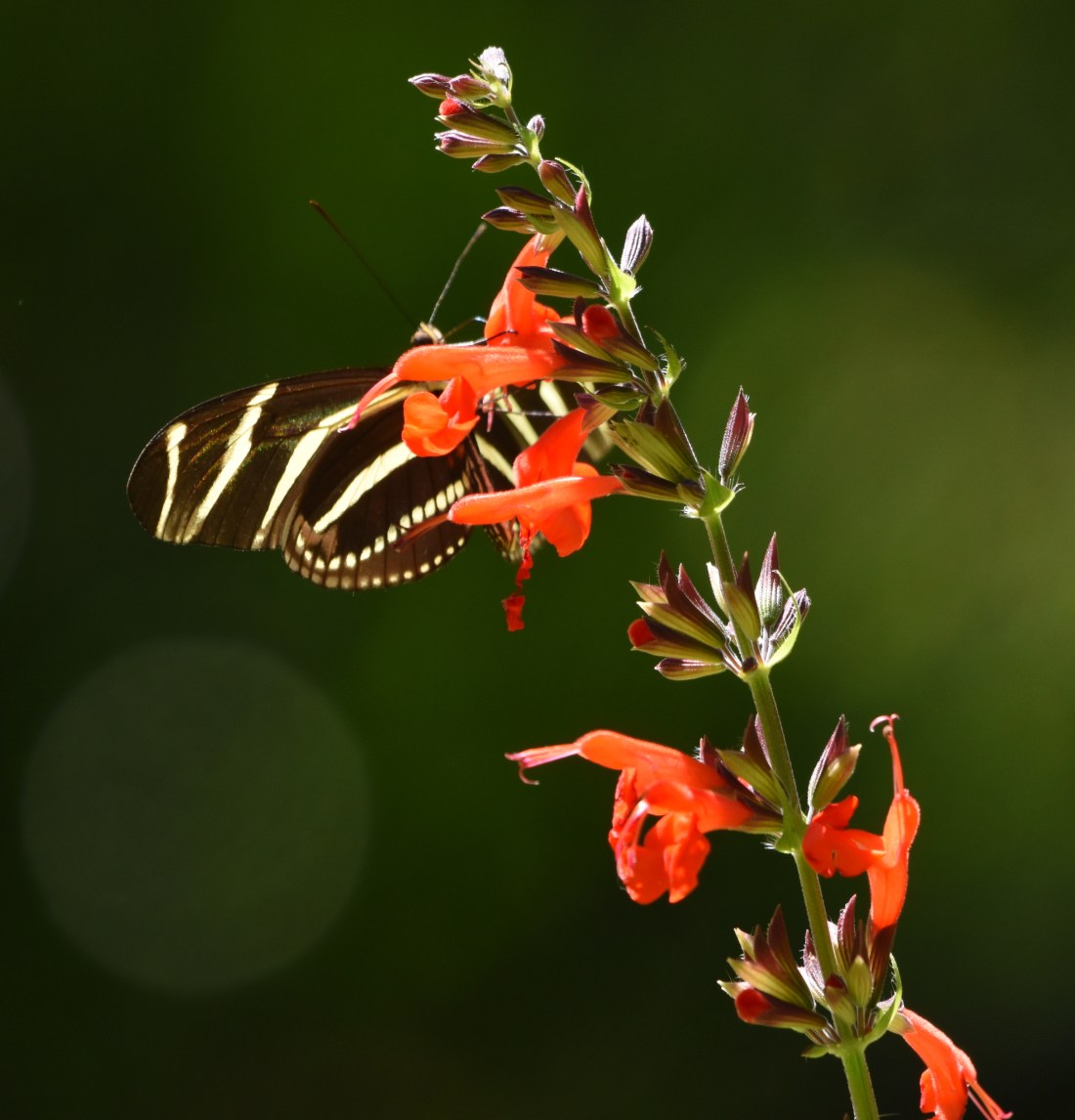
The most beautiful things we saw today were the butterflies! Much like the botanical gardens we had visited the other day, the butterflies were flitting about everywhere. At the gardens, it was mostly monarchs and swallowtails. Today, at Boyd Hill, it was mostly Zebra Longwings (the state butterfly of Florida) and Gulf Fritillaries. They are both quite beautiful! We took dozens of pictures trying to capture them as they landed in quick succession on one flower after another.
Zebra Longwing
Spicebush Swallowtail
Gulf Fritillary
Red Admiral and a bee!
I was quite happy with what we were able to find today!
Yesterday evening Mel and I decided to drive a few miles down the road to Coffee Pot Park for a walk along the Coffee Pot bayou and then along Tampa Bay. Even though it wasn’t really going to be a ‘picture walk’, I took my camera along anyway—just in case.
Marbled Godwit
Short Billed Dowitcher
Semipalmated Plover
There were just tons of different birds along the waterfront — but if Mel hadn’t had his binoculars, and I hadn’t had my camera with the long lens, it would have been impossible for us to discriminate all the different shapes that were out there! Even with our assistive devices in hand, we had no idea what many of the birds were. I was eager to know what we were seeing, so I took an excessive number of pictures—hoping I could identify them later.
Roseate Spoonbill
Great Blue Heron
Black Skimmer
Even with my handy bird app and my giant bird book and Google, I still had trouble identifying some of them! There are just so many birds that look similar, and many birds that look entirely different when they are adults from when they are juveniles!
Sanderling
Willet
Laughing Gull
Black Bellied Plover
After many hours of sorting through my pictures and consulting with my resources, I’ve determined that we saw all of the following birds: brown pelicans, laughing gulls, sanderlings, dunlins, short billed dowitchers, black bellied plovers, black skimmers, great blue herons, reddish egret (maybe), roseate spoonbills, willets, marbled godwits and semipalmated plovers. If I have misidentified any of these birds, I certainly welcome corrections!
On Saturday, Mel and I both went out in search of butterflies. On Sunday, I went out alone in search of pelicans. In both cases, I found much more than I had hoped for.
Monarch
Spicebush Swallowtail
Saturday’s hunt took us both to the Florida Botanical Gardens in Largo, Florida. We had last visited about a month ago and now wanted to see what was currently in bloom and what new butterflies had arrived.
White Peacock Butterfly
The butterfly garden was teeming —mostly with Monarchs and Spicebush Swallowtails, but other varieties as well. There were so many butterflies fluttering about that, for someone like me, with “ADND”, Attention Deficit Nature Disorder’, it was hard to keep my head from spinning off its axis. I am so easily distracted by things moving in my periphery that it took a herculean effort to concentrate on the butterfly in front of me!
Spicebush Swallowtail
Monarch
One of the flowers in the Succulent Garden
A Fiery Skipper Butterfly on a very small flower
The only frog I saw at the Botanical Gardens, but not the only one I heard!
White Ibis taking a leap of faith!
After the botanical gardens, we drove another few miles down the road to explore Eagle Lake Park which has a 2,000 foot boardwalk over some restored wetlands and a 12 ft wide recreation trail coursing through the park. We were particularly interested in the wetlands for picture opportunities, but were pleasantly surprised to find butterflies along the trail.
Happily, I wasn’t on the boardwalk more than a few minutes before I got my very best shot of the day—a brilliant Eastern Amberwing dragonfly perched on a limb in the shady water below me with just the right amount of sunshine highlighting its wings.
Eastern Amberwing Dragonfly at Eagle Lake ParkDamselfly
On Sunday, I went out on my own in search of pelicans by walking a mile or so downtown to Coffee Pot Park, which is situated along a bayou that leads out to Tampa Bay. Not far into the bayou is a large rookery, or bird preserve. Unfortunately, it’s an island and the only way to get close-ups of the birds would be to rent a canoe or a kayak.
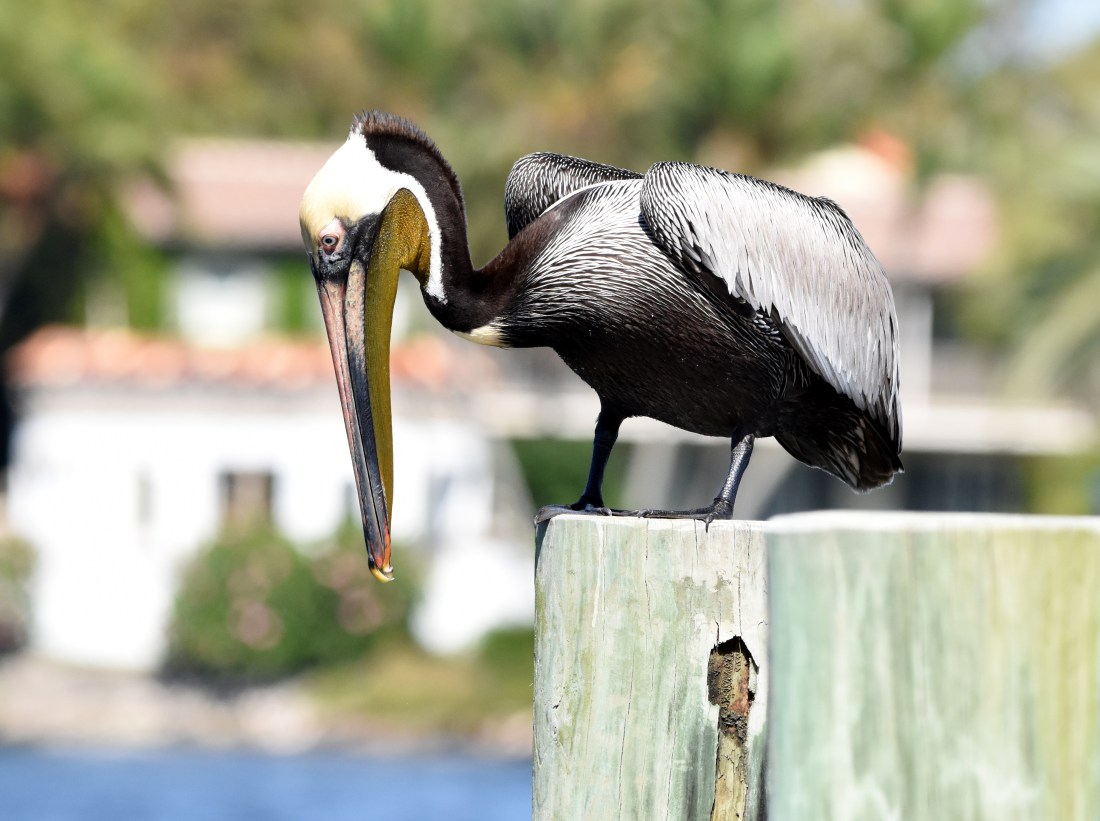
I was surprised to see this large pelican perched on these spindly branches high in a tree.
For this excursion, at least, I’d have to be content with taking pictures from the shoreline. Mostly, I wanted to capture shots of pelicans flying, but any bird that wanted to stop by would have been welcome to do so. A few actually did.
A funny little Laughing Gull who stopped by for a photo shoot!
After the bayou, I wanted to see if there were still any pelicans hanging out back at Crescent Lake–and I wanted to see how ‘my’ seven duck eggs were doing. But since I was still traveling on foot, it would take me awhile to get there.
Brown Pelican looking for lunch
Some fly high...
…and some fly low!
Some swim upright…
…and some swim squatty.
Once I arrived at Crescent Lake, the pelicans were easy to spot and so were many of the other ‘regulars’—like the great blue heron, the crested mallard, the cormorants and the limpkins. Sadly though, ‘my’ seven little eggs were all missing!! Kidnapped, I suspect. The nest was completely cleared but with no forensic evidence to identify who the culprit was. The lack of egg shell remains or guts made me think that the eggs had probably been taken by a person rather than an animal. But why? I was really disappointed and saddened to find them gone; I had really hoped to watch my little ducks grow up.
Great Blue Heron
Crested Mallard
Osprey overhead!White Ibises overhead!
On another note altogether, by the time I got home late in the day, my walking app said that I had chalked up over eleven miles or 27,515 steps—three miles for errands, eight for pictures! Surprisingly though, the calories it said I had burned along the way didn’t even cover the giant bowl of ice cream I gobbled down when I got home!
Mel and I both enjoy exploring all the different preserves, sanctuaries and nature centers wherever we are, but, sometimes, we are so frazzled by the process involved in getting there, that we are pretty well unglued by the time we arrive! There’s so much traffic! And the GPS, (otherwise known as ‘Gabby’) takes us to places unknown and tells us in a calm and reassuring voice that we have ‘arrived at our destination.’ “No we haven’t” I want to scream!! “We’re in the middle of an intersection in the middle of nowhere!!”
Yesterday, we tried to find a preserve that I had been to before, but Mel had not. The first time I went to this particular preserve, Gabby left me high and dry at a recreation complex. I had to go inside and ask for directions. Today, she left us at a park—but not the park I wanted. I had to go inside and ask for directions. This time, Gabby wasn’t entirely at fault, though. We had given her incomplete instructions and she took us to Largo Central Park instead of Largo Central Park Nature Preserve. Even when we corrected our error, she still she sent us off in the wrong direction! Good grief!
Look at the size of those feet on this Common Gallinule!!
Once Mel and I finally found the right preserve, we were so frustrated that it took us a short bit before we could actually enjoy our walk.
“Largo Central Park Nature Preserve is a 31-acre nature park virtually surrounded by water and is home to over 130 species of birds, otters, red fox, American alligator, marsh rabbits, wild turkey, and bats all feed or live within the park.”
Gray CatbirdI just loved the colors on this Common Grackle!
In addition to the many birds that we saw on our walk at Largo Preserve, Mel and I were both delighted to discover that several different dragonflies and damselflies had finally ‘arrived’. In fact, we were so engrossed in capturing pictures of all the dragonflies, that we almost missed the beautiful Northern Shovelers and Blue-winged Teals that were swimming by!
Dragonfly
Damselfly
Blue Dasher
Eastern Amberwing
Honeybee
Five Lined Skink
After a few hours of exploring the Largo Nature Preserve, I wanted to visit one more place while we were still in the area—thinking we might never come back given all the trouble we had getting here. Mel, on the other hand, just wanted to find coffee. So, after the stress of finding a restaurant that was no longer located where it was supposed to be located, we ate. With our bellies full then, he walked to Starbucks to relax and I drove to a preserve.
Northern Shoveler, male
Northern Shoveler, female
Blue-winged Teal
McGough Nature Preserve, where I spent the afternoon, is also known as the ‘turtle park’. It features a small pond with a large variety of turtles including snappers, red-ears, soft-shells and the Florida box turtle. Sometimes, Gopher tortoises can also be found near the pond, but I didn’t see any on today’s visit. Gopher Tortoises are considered a ‘keystone species’ because the deep burrows that they dig for shelter also provide a home to more than 350 other species. In Florida, the gopher tortoise is listed as Threatened and, along with its burrow, is protected under state law.
Turtle Pond
Look at the size of the feet on this soft shelled turtle!!
From a distance, this soft shelled turtle looked like he was laughing–and that he had buck teeth!!
In addition to the turtle park attraction, the McGough Nature Preserve is a rehabilitation center for a variety of birds including barred owls, screech owls, red tailed hawks and a bald eagle. Ironically, the birds that are being rehabilitated here also provide rehabilitation for local veterans through a program called Avian Veteran Alliance.
A little Screech Owl with an injury being held by a Veteran with Avian Veteran’s Alliance
Red tailed hawk
“Avian Veteran Alliance is a program dedicated to assisting veterans in their re-acclimation to life outside of the military. The birds of prey at The Narrows (part of McGough Nature Center) have all been deemed non- releasable, meaning each sustains some sort of handicap preventing them from surviving in the wild. As “Wounded Warriors” in their own right, these animals create a unique bond with local veterans providing a sense of hope and meaning to those that have sacrificed so much for our country.” http://www.playlargo.com/membership/nature/avain_veteran_alliance/index.php
So, aside from the ‘trauma’
of getting to and from Largo, we had a lovely day!