Bundle Up!

January 19, 2020

I’m sitting here in front of a warm fire looking out at the falling snow and the hungry birds flying into our feeders for a bite to eat, and trying to decide how many layers I would have to wear to stay warm on a picture walk today. It’s been snowing (or sleeting) on and off for the past two days and my weather app says the wind chill is below zero. I ultimately decided that the number of layers I would have to wear would probably exceed the number of steps I could take trying to walk– kind of like Ralphie in the movie A Christmas Story.

While contemplating the saneness of leaving my warm fire and my comfortable chair to go for a picture walk, I decided to sort through the pictures I’ve already taken in the last three weeks and then re-evaluate!

I’ll start with New Year’s Eve. The weather was relatively mild then and I was surprised to find so many robins out and about looking for something good to eat. I didn’t expect to even see robins because I had grown up believing that they left for the winter and returned in the spring; that they were, in fact, the ‘harbingers of spring’.

What I found out, though, was that most of our robins just stay put; that we don’t often see them in winter because they spend more time roosting in trees and less time rooting around in our yards. The robins I saw were doing both– roosting in the trees and rooting around on the ground. They had found berries up high and grubs down below.

It seemed like spring when I saw the robins out and about,
but it was still the middle of winter!

The berries that had attracted so many robins had also attracted Cedar Waxwings and Starlings. Interestingly enough, both Robins and Cedar Waxwings have been known to become intoxicated from eating too much fruit that has already become fermented!

This Cedar Waxwing looked a bit ‘tipsy’ as he grabbed for something good to eat!

A few days later, I decided to take advantage of an unusually sunny morning and headed over to the Wolf Lake State Fish Hatchery to catch what I could of the ‘golden hour’. It was a good thing I did because, for the next several days, the weather was gloomy, gray and wet.

Belted Kingfisher– a particularly hard bird to catch!
Trumpeter Swan flying over the Wolf Lake State Fish Hatchery

After enduring several days of dismal weather, I was eager to get out and take pictures again– but it was still raining! I couldn’t take pictures in the rain (my camera would suffer), so I settled for a ‘picture stand’ instead of a ‘picture walk’ by positioning myself under our second story deck and shooting the birds that were perched in the nearby trees.

For the next few days after that, the weather was fairly cooperative and I managed to visit several familiar places plus one new one, the Paw Paw Prairie Fen. My biggest surprise was finding a Great White Egret fishing in a pond near the fen! I rarely see them in the summer, let alone the middle of winter. I also found a Great Blue Heron, but he decided to fly away before I could get a close-up!

On my visit to the Kellogg Bird sanctuary, I was saddened to learn that two of the birds I loved to photograph had died the previous year– a beautiful Mandarin Duck and a rare Red-breasted Goose. Both birds were one-of-a-kind at the sanctuary, so it was particularly sad to lose them.

A lovely American Goldfinch at the Kellogg Bird Sanctuary

Once a month, I like to stop in at the Kensington Metropark Nature Center on my way across the state to babysit my grandson. The birds at Kensington are abundant and fearless. They eagerly anticipate all the visitors who come by and ply them with birdseed. If you stand still and hold out a handful of seeds or peanuts, the birds will land on your hand within a matter of seconds– chickadees, nuthatches, titmice, downies, and sometimes, even the bigger birds will land– like the red-bellied woodpeckers. It’s always delightful!

Red-bellied Woodpecker enjoying my stash of seeds at Kensington Nature Center
Bluejay scooping up the last peanut

In the time it’s taken to write this blog, the temperature outside has gone up one whole degree— time to bundle up and see what’s waiting for me out there!

Here’s what I found…

White-throated Sparrow

So, bundle up and get yourself outdoors!

Butterfly Ears and Other Surprises

January 7, 2020

I was looking back over my pictures from these last few years and was amazed at all the things I’ve seen, all the things I’ve learned, and all the things that have totally surprised me.

I was surprised to learn that only male painted turtles have these incredibly long nails!
They are used to grab on tight to the female during mating!

I’m not sure yet what my biggest surprise has been, but yesterday morning a memory popped up on my Facebook page from January of 2018 that started me thinking.

It was a very cold and snowy January day and I had been walking tentatively through deep snow across a semi-frozen creek near my home when I happened upon a Great Blue Heron! It was standing rigidly and alone in a large expanse of snow like a one-legged sentry keeping watch over the manor. Of all the things I expected to see that day, a Great Blue Heron was not one of them! I had assumed they had all left for the winter and were basking in the sun some place far south of here.

Great Blue Heron standing sentry in the snow

When I finished my picture walk that day, I immediately went to my computer to research ‘great blue herons in the snow’. I found out that they can, indeed, be here in Michigan in January, but “generally move away from the northern edge of their breeding range in winter.” Smart birds! If they do stay, Great Blue Herons will find patches of open water to feed on small fish or crustaceans that are hanging out along the edges. But, when the fish aren’t available, herons will eat mice, voles, and small birds. “One hungry heron was seen chowing down a litter of feral kittens.” Oh my.

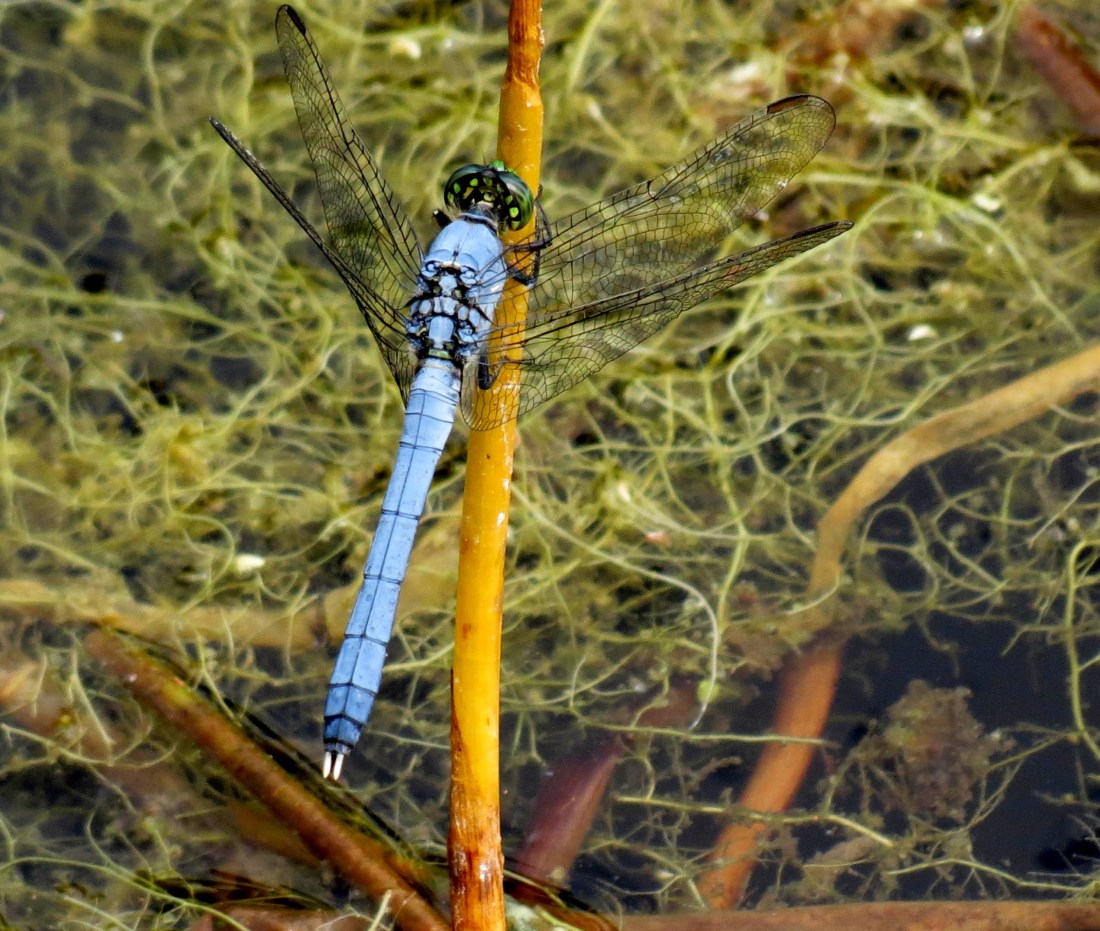
I was surprised to find out that dragonflies and damselflies could have mites, or parasites on their bodies– sometimes dozens of them! (Look for the small red dots on the underside of this dragonfly near its legs.)

Another thing that has surprised me over the years is how many different dragonflies and damselflies there are, how many different colors they display, and what unusual mating practices they engage in!

According to my research, there are about 5,000 species of Odonata (dragonflies and damselflies) worldwide; here in Michigan, there are about 162! I don’t know how many actual colors they come in, but I’ve seen green, blue, brown, black, white, red, pink, gold, yellow, orange and purple! Who knew?

During mating, the male dragonfly (or damselfly) grasps the female at the back of the head and the she curls her abdomen under his body to pick up sperm from the male’s secondary genitalia at the front of his abdomen, forming the “heart” or “wheel” posture. It’s a rather peculiar set up, I thought!

Another insect that surprised me was the butterfly. I didn’t know that they had taste receptors in their feet or ears in their wings!! “The ears consist of membranes that are stretched taut over oval holes, and that vibrate when incoming sounds hit them.” Before 1912, scientists thought all butterflies were deaf, but discovered that these insects respond to the human voice and to the sounds of birds during flight. The receptors, scientists discovered, were in the butterfly’s wings! What a handy skill to have if you didn’t want to be somebody’s lunch!

I was also amused to learn that a group of butterflies is called a ‘flutter” and that a group of butterflies gathered together to drink from a mud puddle is called a ‘puddle club’! Too funny!

One more surprise came while I was out taking pictures and came across a Black-capped Chickadee that looked as if it was injured. But, when I moved closer to see if I could help, the bird quickly flew away. My little chickadee was apparently engaged in a behavior called ‘sunning’ and did not need any help from me!

Black-capped Chickadee ‘sunning’ itself

“Bird sunning is the act of spreading out in full sunshine to expose plumage and skin to direct sunlight.” The main reason birds do this is to maintain the health of their feathers.  Sunning can dislodge parasites. If birds don’t rid themselves of these parasites, they can infect the bird’s  feathers and cause problems for flight, insulation, and appearance– all of which impact survival. Hundreds of different bird species engage in ‘sunning’ behaviors!

Every time I go for a ‘picture walk’, I learn something new!