I am a 79 year old retired teacher with an avid interest in hiking and photography. I am not a professional photographer, but spend almost every day exploring the natural world, taking pictures and honing my skills. When I review the pictures I have taken, I love researching information about the things I have found-- and then sharing my results with others. The time I have spent walking in the woods (including 4 months on the Appalachian Trail at 68) has always been somewhat therapeutic. When I added photography to the mix a few years ago, it quadrupled the therapeutic effect! Opening pictures on my computer at the end of the day is like opening presents. There are always surprises! It allows me to see so many details that were not visible to my naked eye! I have learned so many new things about birds and bugs, reptiles and mammals that I never knew before--and I have also found, that when I share with others, I invariably learn something new!
There are many things I am thankful for in this life; the love of family, our good health, food on the table, a roof over our heads, and a multitude of other blessings. Near the very bottom of that list, but certainly not last, I am thankful that flowers don’t fly! It may seem like a very strange thing to be thankful for, but I am a nature photographer, and things that don’t fly are so much easier to photograph than things that do!
A beautiful Purple Coneflower with a crown of jewels!
Obedient Plant and Jewelweed
Great Willowherb– which happens to be a very tiny flower!
I’m always a bit anxious when I photograph things that fly because there is just the tiniest window of opportunity to get things right before the winged creature disappears! Once I spot the bird, butterfly, or dragonfly, there’s rarely enough time to adjust the focus, let alone change the ISO, the f-stop and the shutter speed before they disappear!
Female Mallard who was gracious enough to let me take her picture and not fly away!
An American Goldfinch and a Cedar Waxwing. A Great Spangled Fritillary and a tiny Eastern Tailed Blue butterfly
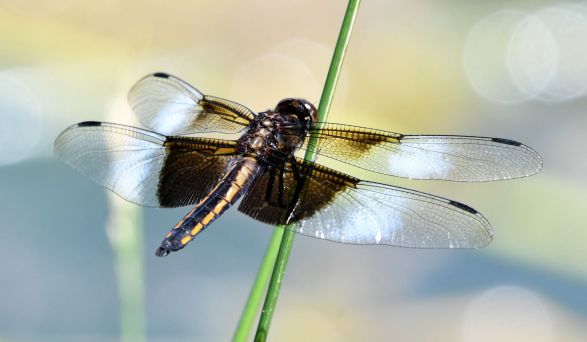
Male Widow Skimmer dragonfly
The other difficult thing about winged creatures is, they never let you know when they’re leaving! I remember the first time I was trying to take a picture of a butterfly. It was years ago, but it still comes back to me every time something flies away without a sound. For some reason, I kept thinking that the creatures I was taking pictures of would make some kind of noise when they left, like people do when they shuffle their feet, shut the door, or say goodbye. You definitely know when humans have left. Most of the time, you even know exactly where to find them! But not so much with birds and butterflies! They just silently flutter away without a sound and, most of the time, I have absolutely no idea where they’ve gone. I wish they all wore bells!
Pearl Crescent butterfly
A male Slaty Skimmer dragonfly and a female Indigo Bunting
Eastern Carpenter Bee that can also be difficult to capture!
A few bigger birds, like the great blue heron and the little green heron will, on occasion, let you know they’re leaving by blurting out a raspy squawk or two. Sometimes, I can even get a decent picture as they depart. Or, consider the lowly bullfrog, who doesn’t exactly have wings, but will at least let me know when it’s leaving by yelling, “YEEP!” as it jumps into the water. Unfortunately, by the time I hear the “YEEP”, it’s too late for a picture!
Great Blue HeronA Green Heron and a Narrow-headed Marsh FlyAmerican Bullfrog that will leap in fright if he notices me coming!
If turtles hear or feel my footfalls, or if they see me coming, they will dive under water as fast as they can!
That’s why I’m thankful for flowers. They don’t fly off and they don’t leap in fright when they hear me coming. I can walk right up and take a picture! I can take a hundred pictures if I like. I can change my settings a million times, take a break for lunch, make a phone call, and come back later. They never fly away!
Giant Sunflowers
A Black Gloss Snail and a Chinese Praying Mantis– almost as good as a flower for not moving!
Male Monarch Butterfly
An elm leaf and bottlebrush grass only move in the wind, but don’t fly away!
In a world where everything else disappears without so much as a polite goodbye, it’s a total luxury to photograph flowers –as well as anything else that doesn’t leap, fly, dive, or run away in fright!
As I approached a new hiking trail the other day, I was disappointed to see that I might just be walking through a dark woods all morning. Normally, I love walking through the woods, but not when I’m taking pictures. It’s usually too dark, or the light is too dappled for a good picture. I seriously contemplated going somewhere else, but gave myself a little pep talk instead. Even in the darkest of woods, I reasoned, there are patches of sunlight, and in those patches of sunlight, there could be a deer, or a chipmunk, or a shiny, new spiderweb! There’s always something, I thought. So off I went.
Chipmunk caught in a patch of sunlight, and a beautiful spiderweb highlighted by the sun
This White-tailed deer was grazing in an open meadow just beyond a wooded section of trail
Hedge Bindweed and an Eastern Comma Butterfly in a ray of sunshine
As I ambled along the trail looking for things to photograph, my thoughts kept turning back to my cousin’s young son who had recently been diagnosed with an inoperable brain tumor. I was envisioning the anguish and the heartbreak that comes with such a diagnosis and wishing there was some way to make everything all better. I thought about the dark woods ahead; the one that they were facing, and hoping they would find patches of sunlight along the way that would make their journey less difficult. An unexpected kindness, perhaps, or a hopeful word.
Rosinweed Sunflower catching the sun
Pileated Woodpecker highlighted by a ray of sunshine
Eastern Tiger Swallowtail butterfly and an Eastern Amberwing dragonfly
Sometimes, the path I take through a dark woods leads me to an open meadow, or a hill top, or a pond, where the sun washes gently over everything, and the world looks like a brighter, happier place. I love when that happens! Sunshine opens up all sorts of possibilities!
Flowers in an open meadow
Eastern Pondhawk and an Eastern Tiger Swallowtail in the sun
I loved the effect of the sunlight on this small pond
And, on one very rare occasion, as I stood quietly at the edge of a pond hidden in the woods, a bald eagle swooped down out of nowhere and captured a fish right in front of me!
Bald Eagle making a surprise catch right in front of me!
Even in the darkest of woods, there are always patches of sunlight, unexpected joys, and sometimes, glimmers of hope.
I almost didn’t go for a picture walk today. It was already beyond hot and well beyond humid. It was also the middle of the day and not the best time for pictures — or for humans. But, I was restless, and eager to be on the move, so I grabbed my camera and off I went. As I left our cool air-conditioned home and stepped out into a steamy summer day, I comforted myself with the thought that I might find lots of dragonflies and butterflies!
I headed out at 11:00 a.m. and photographed almost everything I saw for three enjoyable hours. It was just one walk, but I took so many pictures and observed so many creatures getting on with their lives, that I felt a bit like a teensy-weensy Jane Goodall or Diane Fossey out doing field work. All I had to do was swap out the chimpanzees and mountain gorillas for dragonflies, butterflies, birds and frogs and I was good to go! It was a huge stretch of the imagination, but it made for a more interesting walk! Here are my field notes!
Field Notes:
Date: July 19, 2022
Location: Wolf Lake State Fish Hatchery, Mattawan, Michigan
11:04 a.m.Eastern Tiger Swallowtail Butterfly When I spotted this beautiful Eastern Tiger Swallowtail flitting among the lavender-colored Bee Balm, it took my breath away! The conditions for getting a good picture were perfect–light shade, no harsh shadows.
Male Calico Pennant dragonfly
11: 24 a.m.Calico Pennant Dragonfly, male The dragonflies were plentiful today! Before taking up photography, I didn’t realize there were so many different dragonflies in so many different colors! Worldwide, there are about 7,000 species of dragonflies. Here in Michigan, there are about 160. This Calico Pennant is very common in our area.
Male Halloween Pennant dragonfly
11:34 a.m.Halloween Pennant Dragonfly, male I seem to see male dragonflies much more frequently than I do females. Perhaps because the males are generally more colorful and easier to spot. Halloween Pennants look very similar to Calico Pennants, but instead of small spots they typically have larger dark bands on their wings. Adult males have orange and black bodies, while females (and young males) have bodies that are yellow and black.
Viceroy Butterfly
11:37 a.m. Viceroy Butterfly The Viceroy Butterfly is often mistaken for a Monarch. The main visual difference between the Viceroy and Monarch is the black line across the viceroy’s hind wings, which monarch butterflies do not have. The viceroy is also smaller than the monarch. You can also tell them apart when they are in flight. Monarchs have a more floating flight pattern, while viceroys fly more quickly and more erratically.
Male Blue Dasher dragonfly
11:39 a.m. Blue Dasher Dragonfly, male This is a very small and a very common dragonfly. The male has a bright blue body with a dark tip, while the female has a black and yellow striped body, and tends to be browner in color. Males have green eyes while females have red eyes. They really look like two entirely different dragonflies, which is often true of other dragonflies.
Male Eastern Pondhawk dragonfly
11:52 a.m. Eastern Pondhawk dragonfly, male The Male Eastern Pondhawk dragonfly is almost the same chalky blue color as the Blue Dasher pictured above, but it is noticeably bigger than the Dasher and doesn’t have the same dark tip on its tail. The Pondhawk is 1.5 to 1.7 inches long while the Dasher is only 1 to 1.5 inches long. The female Eastern Pondhawk is green.
Male Twelve-spotted Skimmer
11:55 a.m. Twelve-spotted Skimmer, male I wanted to call this a Twenty-spotted Skimmer but, apparently, you’re only supposed to count the dark spots not the white ones! The twelve-spotted skimmer is a common North American dragonfly, found in southern Canada and in all 48 of the contiguous U.S. states. It is a large dragonfly at 2.0 inches in length.
Female Eastern Pondhawk
12:01 p.m. Eastern Pondhawk dragonfly, female Male and female dragonflies often look completely different from one another and the Eastern Pondhawks are a good example of this. The male (pictured above) is a dusty blue color, while the female is green and black.
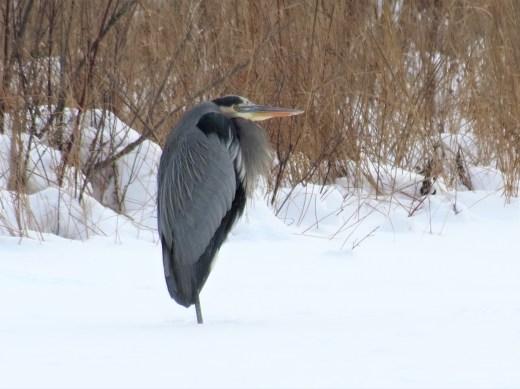
Great Blue Heron
12:06 p.m. Great Blue Heron The Great Blue Heron is the largest of our North American herons weighing in at around 5 pounds. They will eat nearly anything within striking distance, including fish, amphibians, reptiles, small mammals, insects, and other birds. Great Blue Herons can stand patiently like this for what seems like forever waiting to impale a fish with their dagger-like bills.
Male Widow Skimmer dragonfly
12:14 p.m. Widow Skimmer dragonfly, male This is my very favorite dragonfly to photograph! It makes for such a beautiful picture. The Widow Skimmer gets its name because the male dragonfly leaves the female by herself as she lays her eggs, thereby ‘widowing’ her. This behavior is unlike some other species where the male guards the egg-laying female.
Halloween Pennant dragonflies mating
12:16 p.m.Halloween Pennant dragonflies mating Dragonflies and damselflies both create what are called “mating wheels” when they mate. The male (upper dragonfly) grasps the female at the back of her head with the terminal appendages at the end of his abdomen and the female curls her abdomen forward until the tip of her abdomen reaches the male’s sex organs. (Notice the slight difference in coloration between the male and the female. The wings of the male are orange and brown, the female’s are yellow and brown.)
Silver-spotted Skipper butterfly
12:19 p.m.Silver-spotted Skipper butterfly The silver-spotted skipper, with its large white spot on the underside of each hind wing, is one of our largest, most widespread and most recognizable skippers. The silver-spotted skipper is found throughout most of the United States and into southern Canada. In the West, it is more restricted to mountainous areas.
Monarch Butterfly
12:22 Monarch Butterfly I was saddened, but not shocked, to learn that North America’s iconic Monarch Butterfly, after suffering from years of habitat loss and rising temperatures, was placed on a list of endangered species by the International Union for Conservation of Nature as of July 21, 2022.
Eastern Amberwing butterfly
12:49 p.m. Eastern Amberwing Dragonfly, male The Eastern Amberwing is a tiny species of dragonfly that only reaches about 1 inch in length. It is one of the smaller dragonflies in North America. Males have clear amber wings, so it is easy to see how this dragonfly got its name. Females have blotch-patterned wings. I usually find these dragonflies perched on lily pads or other plants along the edges of small ponds.
Eastern Kingbird
12:53 p.m. Eastern Kingbird The Kingbird gets its name from the aggressive behaviors it exhibits towards other kingbirds and other species. When defending their nests, kingbirds will attack much larger predators like hawks, crows, and squirrels. They have been known to knock unsuspecting Blue Jays out of trees.
Willow Flycatcher
12:56 Willow Flycatcher Flycatchers don’t learn their songs from their parents, as many other birds do. Instead flycatchers hatch knowing their songs. Scientists tested this by raising Willow Flycatchers in captivity while letting them listen to only the Alder Flycatcher song all day long. The Willow Flycatcher chicks grew up to sing their own species’ song!
Canada Goose
12:57 p.m. Canada Goose The Canada Goose was nearly driven to extinction in the early 1900s. Programs to reestablish the subspecies to its original range were, in many places, so successful that the geese have become a nuisance in many urban and suburban areas.
Male Slaty Skimmer dragonfly
1:30 p.m. Slaty Skimmer Dragonfly, male The Slaty Skimmer has a body that is about 2 inches long. Each of the four wings has a dark spot on the outer leading edge. Older males are all slate blue with black heads and eyes. Young males and females have brown abdomens and a dark stripe running down the back.
American Bullfrog
1:34p.m.American Bullfrog This is my very favorite amphibian! I love their big, bulgy eyes, and funny looking faces. I’m always looking for a new frog to photograph, hoping for a funnier face. Bullfrogs are the largest species of frog in the U.S. growing up to 8 inches long and weighing over a pound! Bullfrogs usually spend 2 winters as tadpoles and live around 8 years.
Barn Swallow
2:06 p.m. Barn Swallow The Barn Swallow is the most abundant and widely distributed swallow species in the world. It breeds throughout the Northern Hemisphere and winters in much of the Southern Hemisphere. I can’t help taking a picture every time I see one!
Female Red-winged Blackbird
2:09 p.m. Red-winged Blackbird, female The Red-winged Blackbirds are my harbingers of spring. When I hear them calling from the trees and the reeds along the ponds, I know that spring is not far away. I also know that when a male Red-winged Blackbird bombards me, his babies are nearby, but out of sight!
Female Wood Duck
2:10 p.m Wood Duck, female Wood Ducks usually nest in trees near water, but can sometimes be found nesting over a mile away. After hatching, the ducklings jump down from the nest tree and make their way to water. The mother calls them to her, but does not help them in any way. The ducklings may jump from heights of over 50 feet without injury.
Female Hooded Mergansers
2:12 p.m. Hooded Mergansers, female The Hooded Merganser is the second-smallest of the six living species of mergansers (only the Smew of Eurasia is smaller) and is the only one restricted to North America.
It was just one walk, but there was so much to see!
Before I started taking pictures, there was so much I didn’t know about the world outside my own front door. I didn’t know that dragonflies came in a rainbow of colors, that turtles shed parts of their shells, or that we had cuckoos in Michigan! I didn’t know that cedar waxwings could get drunk eating fermented berries, or that great blue herons would stay here throughout our cold Michigan winters. My enlightenment all started with a Christmas wish.
Blue Eastern Pondhawk dragonfly (male) and a Green Eastern Pondhawk dragonfly (female)
A brown, white and yellow Widow Skimmer dragonfly
An orange and brown Halloween Pennant dragonfly (male) and a red and black Calico Pennant dragonfly (male) Dragonflies come in a rainbow of colors!
In the Fall of 2013, my husband, Mel, started asking me what I wanted for Christmas. I gave his question a good deal of thought and came up with the idea that I’d like to have a better camera. All I had was a pocket-sized Canon PowerShot– a lightweight and easy to carry camera with very limited capabilities.
Michigan’s Black-billed Cuckoo
Northern Map Turtle shedding its scutes and a Cedar Waxwing gorging on berries
A Great Blue Heron that decided to stay in Michigan for the winter!
Once I told Mel what I wanted, he went to work doing the research and came up with a bigger, better version of the Canon PowerShot that he thought might work. I loved it– and ultimately, dubbed it my “gateway drug”.
Eastern Kingbird babies hoping for lunch!
A butterfly that landed on my hand while I was taking pictures of other butterflies! (pictured: Comma Butterfly and an Eastern Tiger Swallowtail)
A giant snapping turtle taking a break on a very hot day!
I happily used that camera on and off for the next three and a half years; taking the usual family photos and typical vacation shots. It wasn’t until we went to Florida in 2016 for our first extended stay that my addiction to nature photography really kicked in. There were so many rookeries, sanctuaries and preserves with new and unusual birds, mammals, and reptiles that I had absolutely no trouble feeding my ‘habit’!
Florida birds: Black-bellied Whistling Duck and a Reddish Egret
Florida alligator taking a siesta
Florida birds: A Purple Gallinule and a Limpkin
Eventually though, I started wanting more. I wanted a camera with a faster response time so that the bird on the limb would still be there once I pressed down the shutter button. I wanted to get pictures of the birds and butterflies that were farther and farther away, and I wanted sharper images. Mel went back to work looking for a camera that would do all those things—without causing us to re-finance our home! By July of 2017, I had my new camera, a Nikon D3400 and a detachable 70-300mm zoom lens. I was back in business!
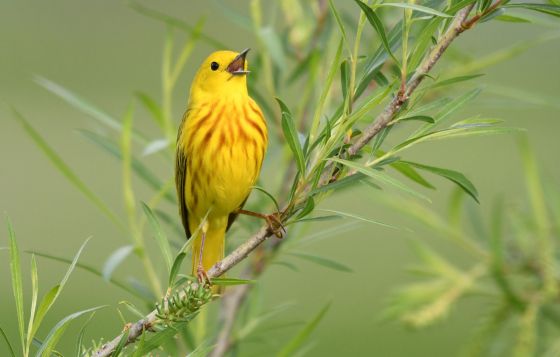
A bright-eyed Yellow Warbler
Musk Thistle and Coneflower
Common Yellowthroat
At some point along the way, Mel decided to take up his photography hobby again and assumed ownership of my D3400 after finding me a Nikon D5600 to take its place. We were both hooked!
Bell Peppers at the Farmer’s Market, and a Spiderwort flower
Spiny Softshell Turtle
Female Red-winged Blackbird, and a Silver-spotted Skipper butterfly on daisies
I loved all the beautiful pictures I could get with my D5600 and the 70-300mm lens, but there were birds and butterflies still out of reach that I wanted to capture! After a bit of research, Mel thought that a Sigma 150-600mm lens might do the trick. I was well aware of the size and weight of this lens based on what I had read, but when it actually arrived, I thought “What on earth have I done??” It looked huge! It felt heavier than I expected and I had serious reservations about my ability to carry it around for hours on end. But, I really, really wanted to take ‘far away pictures’ so off I went, camera and lens in hand.
My ginormous 150-600mm lens!
The BIG lens!
I used that set up for a year or so before my back started telling me that it might be better to add a monopod to my camera in order to support all that weight when I stood for hours taking pictures. Adding a monopod would mean I’d have a little more weight to carry as I walked along, but I wouldn’t have to hold the camera up to my eye unsupported as I patiently waited for the ‘perfect shot’ or tried to pan the movement of a bird in flight. My back has thanked me many, many times over.
Taking pictures using the camera mounted on a monopod– a good back-saver
I used the Nikon D5600 for two or three years along with the 150-600mm lens before totally exceeding the picture expectancy of my camera with over 100,000 shots!! I decided to trade it in for a Nikon D500, a camera that was highly rated for nature photography and has totally lived up to that assessment!
Blanding’s Turtle
Wild Black Raspberries and Salsify
Barn Swallow
Before taking pictures, I had already loved going on nature walks– but there was so much I didn’t see! With my camera in hand the world suddenly opened up!! I paid more attention. I noticed things I had never noticed before– like the subtle movement of a blade of grass that might mean a dragonfly had landed, or the tiny ‘bump’ at the top of a long-dead tree that might mean a hummingbird was resting; or the infinitesimal speck of blue on a shiny green leaf that might mean a damselfly was nearby.
Hagen’s Bluet Damselfy
All of those creatures had been there all along, but I never saw them —until I started taking pictures!
I have a mental checklist that I review every time I leave the house for a picture walk: Is my camera battery fully charged? Is my memory card inserted? Do I have an extra card and an extra battery? Do I have my phone and is it fully charged? Do I have my monopod? But, after what happened yesterday, I should probably switch my mental list to an real list!
Yellow Warbler
Palm Warbler and a Song Sparrow
Cedar Waxwing
I was off on another picture adventure and eager to see what surprises awaited me. My destination was a favorite nature center about an hour away from home. Whenever I go on a picture adventure, I feel an immediate sense of calm wash over me once I arrive. Yesterday was no exception. I drove into the parking lot, took a deep, relaxing breath, and prepared for my three-hour escape into nature’s arms– until I realized there was no memory card in my camera!!
Barn Swallow and a Robin
Canada Goose Gosling
Canada Goose on a nest and goose parents with their goslings
I had made this mistake before and had come prepared with an emergency back-up card! Perfect! Once the card was inserted, I happily set off into the ‘wild’ hoping for a day filled with beautiful little creatures and colorful flowers. My joy was short-lived.
Trumpeter Swan
Female Mallard and a Semi-palmated Plover
American Toad singing!
Forty-five minutes into my walk, after taking only three measly pictures, my memory card said ‘full’!! What??? How could that be?? I tried every ‘high tech’ solution I could think of to remedy the situation: pull the card out and put it back in; turn off the camera, turn it back on, and re-format the memory card–repeatedly. Nothing worked! It was time for plan B! Look for the nearest store!
American Bullfrog
Green Heron and a Spotted Sandpiper
Great Blue Heron shaking the water off
I hustled back to my car as fast as a marginally nimble 75 year-old can hustle on an uneven boardwalk with an expensive camera, a 600mm lens, and a 5 foot monopod! Once in my car, I drove as quickly as was legally possible to the nearest store to find another memory card– and hope that it worked. It didn’t. But I had already driven back to the nature center before I found out!
Columbine and Dame’s Rocket
Field Sparrow
Red-winged Blackbird and a Tree Swallow
At that point, I could have just thrown in the towel. I could have just gone for a ‘regular’ walk and not taken pictures. But it was completely impossible for me to do that! This particular nature center had a butterfly house. It was the perfect place for close-up shots of stunning and unusual butterflies. I had to stay!
White Peacock Butterfly in the Butterfly House at the Nature Center
Female Common Whitetail Dragonfly and a Hobomok Butterfly
Garden White Butterfly in the Butterfly House at the Nature Center
Monarch Butterfly in the Butterfly House at the Nature Center
So, I went back into town to a different store and looked for a different memory card. While standing in the aisle reading the descriptions on each of the various cards, I suddenly realized why the first card hadn’t work and dashed out of the store. Back to the nature center for my third and final attempt at trying to salvage what was left of an otherwise lovely day!
Pipevine Swallowtail Butterfly in the Butterfly House at the Nature Center
Lupine and Wild Geranium
Zebra Longwing Butterfly in the Butterfly House at the Nature Center
I had first arrived at the nature center at 9:00 a.m. It was now noon. The soft morning light was long gone, as was the cool morning air. It had been a frustrating start to what was supposed to have been a calm and relaxing day. I was totally frazzled.
Chipmunk and a Grackle
Rose-breasted Grosbeak
Killdeer and a Forster’s Tern
But, keeping things in perspective is everything. The day was still young. The weather was still great and, most of all, I was very much alive and well, doing something I dearly loved— three priceless gifts that not everyone gets to enjoy. It was all I really needed to remember and off I went…
I love going on picture walks! When I’m out on the trails looking for something beautiful or interesting to photograph, I am totally engrossed in what I am doing. Sometimes, though, my very best picture walks, aren’t walks at all. I just stand in one place for the longest time until I become invisible; no longer noticeable to birds or other nearby creatures: Hidden in plain sight.
Common Grackle along the Portage Creek
Blue Jay and a Northern Cardinal in our backyard
One of the very loud wild turkeys that I frequently hear across the creek as they try to attract a lady friend.
One of my favorite places to ‘hide’ has been my own backyard. There’s a quiet, inviting creek just down the hill where the wood ducks, mallards and geese come to swim and the white-tailed deer come to drink. There are tall, mature trees on both sides of the creek that provide both shelter and a place to nest for a wide variety of songbirds, and a small contingency of squirrels. Most days, there’s a delightful cacophony of birds singing and wild turkeys gobbling as they try to attract a mate. Interspersed with all the singing and gobbling, you will hear the rat-ta-tat-tat of the woodpeckers and, in early spring, there will be the soothing chorus of tree frogs.
Pileated Woodpecker in our backyard
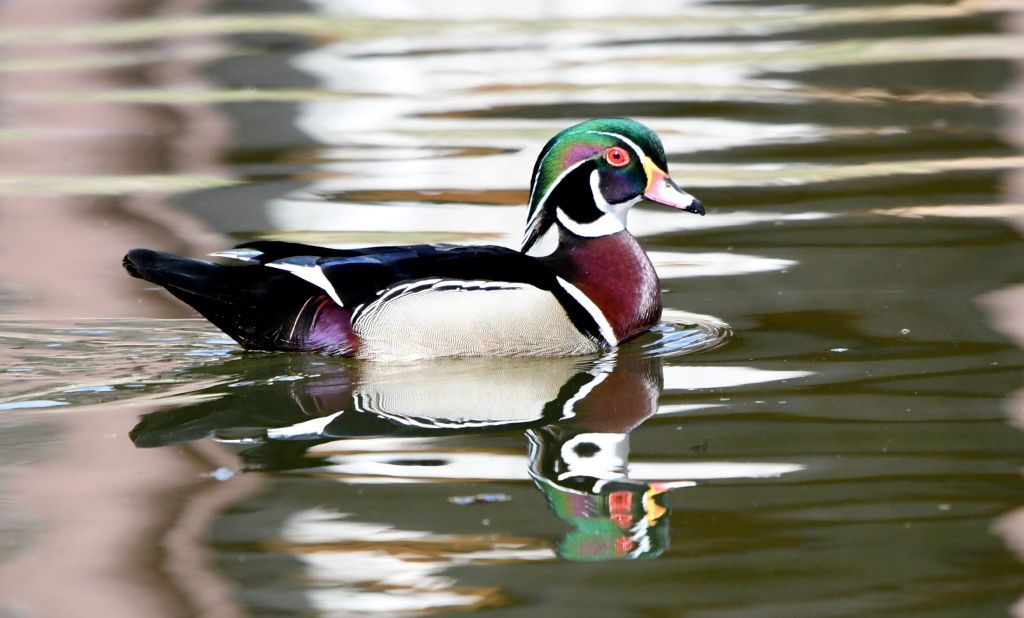
Male Wood Duck and a female Mallard in the creek behind our house
One of many, many Canada Geese roaming the grounds and swimming in the creek behind our house.
When I’m not on my home turf, my favorite hiding place is anywhere I can find a source of water, no matter how small. This past winter, when the creek was mostly frozen over, there was a very small opening in the ice where three thirsty robins had gathered for a drink. It made for a great shot! A few days ago, I was standing quietly among the cattails along the mucky edge of a very tiny pond, when a red-winged Blackbird landed directly in front of me! Another great photo opportunity!
Three beautiful American Robins on a cold winter day enjoying a drink from a small opening in the ice
Female and male Red-winged Blackbirds that landed right in front of me while I was standing in the cattails along the edge of a pond.
Golden-crowned Kinglet
As much as I enjoyed getting that close-up of a Red-winged Blackbird, it is not the most interesting or challenging bird I’ve attempted to photograph. The real picture prize for me has been the Belted Kingfisher. It’s virtually impossible for me to photograph unless I’ve been standing inconspicuously for a very long time! If the Kingfisher arrives before I do, I don’t stand a chance! It knows I am coming long before I even leave the house!
Belted Kingfisher who happened to land right in front of me!
My best ‘hiding in plain sight’ shot was not a Kingfisher or a Red-winged Blackbird, but a Bald Eagle! I had been standing in the tall grass along the edge of a lake when an impressively large Bald Eagle swooped down out of nowhere, grabbed a fish from the water in front of me and quickly flew off! Luckily, I was able to get in a few shots before he totally disappeared! It was the best catch of the day—at least for me!!
Bald Eagle who unexpectedly flew in and grabbed a fish right in front of me!
The secret to hiding in plain sight is simple: be quiet and be ready! It also helps to have your camera mounted on a tripod or a monopod so that the act of lifting the camera to your eye doesn’t scare away your subject. Once you find a place to stand, check your camera settings, take a few practice shots, and then be still! If you’re lucky, you’ll soon blend in to the landscape!
Red-bellied Woodpecker in our backyard
Yellow-rumped Warbler and a Yellow Warbler
A Mourning Cloak butterfly that was a very pleasant surprise in early April!
I never know what surprises await me, but I always feel a sense of accomplishment when I’ve been able to hide in plain sight and photograph all the critters who might otherwise disappear at the very sight of me!
Even though I wasn’t invisible to this beautiful red fox, it didn’t seemed concerned that I was standing nearby as long as I didn’t move!
Oftentimes, when I’m out taking pictures, I think about all the things I’ve learned along the way– about photography, about the critters I’ve seen, and about myself.
Mute Swan on quiet waters
There are so many things I didn’t know at the beginning of this photographic journey that I know now, and so many things I do differently as a result. When I first started taking pictures, I didn’t really have a plan and not much of a clue about what I was doing. I’d be walking along, see something pretty, and take a picture. Click! Now, I am more likely to plan ahead, to anticipate where a bird or a butterfly might land, or where the frogs and turtles might be hanging out—rather than just being surprised by random events!
Song Sparrow and a White-throated Sparrow in my backyardCanada Geese in a heated debateFox Sparrow and a Northern Cardinal in my backyard
While I’m out on a picture walk, I’m also thinking about the settings on my camera and whether I’ll be ready for the next shot. I walk more slowly, more quietly, and more deliberately than I used to, and pay closer attention to the all the sights, sounds and shadows around me. When there’s a faint rustling in the grass or the bushes nearby, I stop. It could be a baby bird– or it could be a giant turtle. When a small shadow passes by me on the ground, I look up in the sky to see what bird is on the wing; it could be an eagle, or it might be a red-tailed hawk. There are so many interesting things out there to photograph, but finding them and capturing them in pictures does take a fair amount of patience, and a good deal of time!
Common Grackle
Female Mallard and a Male Northern Shoveler
Eastern Fox Squirrel high up in a dead tree
After years and years of picture walks, often to the same local places, I’ve also gotten much better at noticing changes or ‘aberrations’ in the environment. The other day, for example, there was just the slightest hint of something small and round and ‘out of place’ across the pond. It caught my attention because it had a bluish cast to it. Blue isn’t a color I usually see this time of year and I wondered if it was just somebody’s litter—or something else. When I zoomed in, I discovered that it was a turtle—the first one I’d seen since last fall! A few days later, I saw a small ‘bump’ protruding from the top of a very tall, very dead tree. It looked out of place and it grabbed my attention The little ‘bump’ turned out to be a squirrel peeking out ever so slightly from a small hole in the tree where I would have expected to see a bird. There are surprises everywhere!
Over the years, I’ve also learned the art of standing still. Many times, my picture walks have become ‘picture stands’. I’ve learned that if I stand still long enough, I become invisible. The birds go about their usual business, and chipmunks scamper by so closely that I could almost touch them.
Canada Goose in quiet reflection
American Tree Sparrow and a Black-capped Chickadee
Red-bellied Woodpecker
When I’m not standing still, I’m barely moving; hoping not to disturb any of the creatures around me. Most of them, however, are hyper vigilant; worried that I might be a giant predator. Even the slightest movement on my part will send them scampering off. The belted kingfishers are particularly adept at knowing when I’m in the area, no matter how slowly I walk or how far away I stand. I swear they know I’m coming even before I leave the house!! The only reason I have any kingfisher shots at all is because I arrived on the scene before they did and never moved!
The elusive Belted Kingfisher
Turtles also know when I’m on the way, but they’re not quite as nervous as the kingfishers. Still, they can be twenty yards from shore, sitting on a log and jump overboard if I even start to lift my camera to my eye. Frogs, surprisingly, are much less ‘jumpy’ than turtles and will let me come in for a closer shot–but only if I move very slowly!
Painted Turtle and an American Bullfrog
In my non-photography life, I’m often rushing around quickly trying to do two or three things at a time thinking that I’m saving time or being more efficient. I am not. When I’m out taking pictures of birds, turtles and frogs, though, speed does not work. Speed scares the animals. Speed ruins pictures. I’ve learned to walk slowly, to stop often and to stay focused, usually for hours at a time. It’s a type of meditation, I think, and it has helped keep me on an even keel– especially during these difficult years of political upheaval and pandemic isolation.
As I sit writing this piece, long before sunrise, on another cold and windy February day, I am contemplating the advisability of even attempting a picture walk. The weather forecast calls for 15 to 25 mile an hour winds with gusts over 40! On the other hand, temperatures might exceed 40 degrees —quite balmy compared to the below zero wind chill conditions I was faced with the other day! Usually, I can put on enough layers to stay warm, even on the coldest of days, but strong winds make for a much bigger challenge.
Blue Jay stirring up snow in a pine treeFemale Northern Cardinal and a Northern Flicker weathering another winter stormSome Great Blue Herons will stay here throughout the winter, but many more will head south
Most days, I’m up for that challenge but, I must admit, I’m growing weary of it all. These long winter days, where I have to plan for so many weather contingencies, and have to wear so many layers, are weakening my resolve—especially during the past two years of this pandemic where we haven’t been able to venture far from home. The birds in my backyard are quite tired of me begging for a photo shoot.
Two of my backyard birds: A Dark-eyed Junco and a White-throated SparrowCarolina Wren near my backyard feederA Cedar Waxwing and an American Goldfinch add a splash of color to a mostly color-free landscape!
For the next few days, though, my backyard birds can take a break while I babysit my grand-dog on the opposite side of the state. There are lots of new places to explore here and once the sun is up, I expect I’ll venture out in spite of the wind and in spite of the cold! I’d much rather be outside searching for the possibility of something new than sitting here on the couch.
Some people believe that the Robin is a “harbinger of spring”, but large numbers of them stay here all winter feasting on berries.These two winter visitors were a first for me: a Horned Lark and a Snow Bunting!
After writing those first few paragraphs, I did, indeed venture out– first to a nearby nature center and then to a nearby park.
Black-capped Chickadees are delightful little birds that can be found in Michigan all year round. White-breasted Nuthatch and a female Northern Cardinal
I found the usual assortment of birds at the nature center—chickadees, finches, cardinals, nuthatches and goldfinches, but it was a brand-new setting! When I arrived at my second destination, I really hit the jackpot! Beaudette Park in Pontiac, Michigan, had a very large pond of open water and it was teeming with a wide variety of waterfowl, some of which I’d never seen before!
Canada Goose coming in for a landing!Red squirrel and white-tailed deerSome Sandhill Cranes stay here all year long
This time of year, it’s highly unusual to find open water in Michigan. Most lakes and ponds are frozen over. This particular body of water had the ubiquitous array of mallards, swans and geese, but it also had mergansers, buffleheads, redheads, ring-necked ducks, goldeneyes and canvasbacks!! It was the canvasbacks I’d never seen before. I couldn’t stop taking pictures!
Male Canvasback at Beaudette Park in Pontiac, MichiganMale Hooded Merganser and a Female Common Merganser at Beaudette ParkMale Ring-necked Duck
Days later, I was still sorting through all the hundreds of pictures I took that day!
Male Wood DuckPileated Woodpecker and a Downy WoodpeckerMallard Ducks are everywhere and they offer endless opportunities for interesting photographs!
In spite of all the inherent beauty to be found in a picture of freshly fallen snow and a colorful bird here and there, I am more than ready for the arrival of spring; ready to be free of these bulky winter clothes, grey skies, and frigid temperatures. I’m beyond hungry for the colors to return, for the sweet smell of a newly mowed lawn, and for the sheer delight of a warm patch of sun on my bare skin!
I am more than ready to shed these bulky winter clothes and trade this colorless landscape for green leaves and spring flowers!
A lone robin in a bare tree aptly symbolizes the starkness of a Michigan winter
Sometimes I struggle with finding a topic to write about. I can run down one rabbit hole after another looking for ideas and still come up empty handed. Sometimes, I’ll think of things while I’m out walking; other times, I have to browse through all the pictures I’ve taken during the last month or two before an idea pops into my head. As I looked through my December pictures, I was struck by both the hardiness and the loneliness of all the little creatures struggling to survive during our cold, inhospitable winters here in Michigan.
All bundled up and ready to brave the elements!
While I’m bundled up in layer upon layer of warm winter clothing taking pictures, I marvel at all the tiny little birds with their skinny twig-like legs and lightly feathered ‘coats’ braving these cold winter days with nary a mitten or a hat!! Not only do they struggle to stay warm, they have to keep foraging for food or they will die. Some birds will huddle together for warmth, and some will help each other gather food but, for the most part, survival is a solitary pursuit.
American Robin looking for berries in this heavily snow-laden Juniper Tree.The House Sparrows and Cedar Waxwings depend on an abundance of berries during our Michigan Winters
It wasn’t until just a few years ago, when I started taking pictures of birds, that I learned these Eastern Bluebirds stay in Michigan all winter!
In many ways, this pandemic has also felt like a solitary pursuit for survival. Instead of huddling together and weathering the storm with family and friends, we have had to distance ourselves from each other. We have had to stay isolated—even within our own homes sometimes! Luckily, though, we haven’t had to forage for food in the same way or with the same tenacity as birds. Granted, our favorite foods may be in short supply during this pandemic, but our very survival has not been dependent on the availability of ice cream and chocolate! (Although they have certainly helped!!)
Earlier in December, before the heavy snowfall, the Robins had a much easier time picking Juniper berries!The Downy Woodpeckers and the Black-capped Chickadees stay here all winter and we enjoy seeing them at our feeders.Some Great Blue Herons stay in Michigan throughout the winter. If they can’t find open water to catch fish, they will eat crustaceans, mice, voles and small birds!
Even though we have not lost any friends or family members during this pandemic, and even though we have always had food on the table and a roof over our heads, these past two years have been difficult. They have taken a toll. We have all lost something.
Eastern Chipmunk
A Golden-crowned Kinglet and a Dark-eyed Junco visit Michigan in the winter time
The Mallards always seem to have a smile on their face no matter how cold it is!!
What has made everything a bit more bearable for me during these long months of isolation have been my picture walks. Spending time outdoors in the active pursuit of beauty has been an almost perfect antidote for all the ugliness wrought by this pandemic. For a couple of hours each day, I’m lost in the happy pursuit of birds, bugs, and critters, followed by hours of pleasant distraction browsing through the resulting pictures. The final joy comes when I can share what I’ve found with others. Sharing has been a way of staying connected with friends and family.
A little Red Squirrel tucked in against the cold!
A Female Blue-winged Teal and a Male Gadwall enjoying a cold winter swim
A beautiful White-tailed Deer in our backyard with a crown of pine boughs
My picture walks have been a daily reminder for me that even in the darkest of times, beauty can still be found. Some days, though, it’s just harder to find than others.
One of my very favorite times to go for a picture walk is early in the morning just after sunrise when there is no wind, and the water on the pond is so perfectly still that the reflections of the birds can take my breath away. I rarely get a day like that, but when I do, the results seem magical.
Male Mallard on very still water
Male Gadwall and a Female Mallard
Canada Goose floating on ‘glass’
Northern Shoveler and a Hooded Merganser
Greater Yellowlegs
As we quickly move into the month of December, it will be harder and harder to find open water. Most of the ponds are already starting to freeze. Once frozen, though, they will offer up a whole different kind of magic!
Male Mallard doing an ice dance!
Female Mallards on thin ice
A few years ago, when I was out taking pictures around the ponds at our local fish hatchery, I kept hearing weird noises in the distance. My first thought was, “What kind of bird is THAT??” But then saw two people near one of the ponds who looked as if they might be throwing things across the frozen water. After watching and listening for quite awhile, I decided they must be skipping stones across the ice!! Maybe that’s where the sound was coming from!
Juvenile Trumpeter Swan trying out the new ice
When I tried skipping stones across the pond later in my walk, I was pleasantly surprised that I could replicate the very same sound! I also discovered that different sized stones would change the pitch. Fist-sized stones, however, broke through the ice. When I got home and could do a little research, I learned that this phenomenon is called “acoustic dispersion” and that others who have described the sound likened it to a “laser blast from a galaxy far, far away” or the “chirp of an exotic bird”. It was a little bit of both, I thought. If you’re interested in reading more about it, here’s a good link: https://science.howstuffworks.com/skipping-stones-on-ice-makes-crazy-sci-fi-sounds.htm
One more happy-looking mallard trying to walk on ice!
The frozen ponds also offer a great opportunity for photographing all the shore birds who are trying to cope with this drastic change in their watery environment! Sometimes, when the ice has just started to form, it looks as if all my web-footed friends are walking on water!
Canada Geese keeping one foot warm, and a Trumpeter Swan trying to walk on ice. I was surprised to see the big ‘toenails’ on the Trumpeter Swan.
As I sit here at home on this cold November day, looking out at all the little birds enjoying the food in our feeders, I’m secretly wishing for snow—lots of snow; the biggest, whitest, fluffy kind of snow that falls to the ground in no particular hurry and quickly turns a drab overcast day into a winter wonderland! If that happens, I’ll be out the door in a heartbeat!
Northern Cardinal on a very snowy dayMale House Finch and a White-throated Sparrow
Female Northern Cardinal
I love getting pictures of the birds sitting on the snowy limbs with their feathers all puffed up against the cold, surrounded by the gently falling snow. A few weeks ago, we had a very brief but spectacular snowfall like that and I hurried outside with my camera to capture as many birds as I could before the snow completely melted. There were Red-winged blackbirds, Northern Cardinals, Black-capped Chickadees, American Robins, Tufted Titmice, Dark-eyed Juncos, House Sparrows, American Goldfinches, and one big surprise, a Hermit Thrush– a bird I’d never seen before!
A Hermit Thrush in a nearby tree that I almost missed!White-breasted Nuthatch and a Red-breasted NuthatchBlack-capped Chickadee
As we enter into our second winter of a very long and heartbreaking pandemic, I am beyond thankful for this photography hobby. It has kept life interesting, and made these past two years of social isolation and constant uncertainty manageable. Photography gets me out the house and affords me the opportunity to look for all the beauty I can find in the most ordinary of things: quiet snowfalls, skipping stones on ice, and the unexpected loveliness of a little brown duck on still waters.