When the morning forecast says “sunny and calm,” I can’t get out the door fast enough to take pictures. ‘Sunny and calm’ means good reflection shots of birds on water. When the morning forecast also says “snow,” it feels like I’ve won the lottery! Even if the temperature drops to zero, I’m out the door! Zero degrees just means more layers!
Female Gadwall December 2024
Canada GooseMarch 2022
Mute Swan March 2022
When layering up for cold weather, my husband Mel, who has hiked the Appalachian trail many, many times, through all kinds of weather, occasionally warns me that “cotton kills.” The first layer of clothing should never be cotton! If you sweat, it won’t evaporate. If you stay wet, you’ll stay cold. You can even die —well, not when you’re out taking pictures and your car is a stone’s throw away, but certainly if you’re a hundred miles from help and hypothermia sets in! I don’t ever worry about hypothermia when I’m out taking pictures, but I do worry about being so cold I have to come home before I’m ready.
Belted Kingfisher January 2023
American Robins January 2022
Black-capped Chickadee November 2020
So, my first winter layer is always synthetic. After that, I throw on various layers of wool blends, more synthetics, and maybe fleece. If I think my feet will freeze, I wear toasty warm, re-chargeable socks that came as a gift from a very kind friend. On top of all those layers, I wear windproof or waterproof pants and a warm coat.
White-tailed Deer December 2024
Black Swan March 2022
Blue JayNovember 8, 2025
Even with all those layers and a good pair of gloves, it has taken me years to figure out how to keep my hands warm and still operate the buttons on my camera. Eventually, I found a lightweight pair of down mittens which are thin enough to feel the buttons but warm enough to keep my fingers from freezing—sort of. I still put rechargeable hand warmers in each of my pockets to make sure.
Carolina WrenJanuary 2022
Horned Lark February 2022
Female Mallard February 2022
Then there’s my head, neck, and feet to worry about. I start with a neck-warmer and sometimes a scarf; followed by a cozy warm hat, and sometimes the hood of my coat. Just before going out the door, I put on my hiking boots as well as a pair of waterproof over-boots if the snow is deep or it’s exceptionally cold.
It took me a long time to work out this multi-layer system where I can stay reasonably warm—and still move!
It isn’t quite zero degrees yet, but it will be at some point. On November 8th of this year, we had our first snowfall. A few days later, it was 50 degrees. This coming week, a snowstorm is expected. Such are the vagaries of a Michigan winter and the challenges of dressing for the occasion!
White-throated Sparrow November 2023
Red-bellied WoodpeckerJanuary 2022
Mute Swan January 2023
As much as I enjoy capturing a pretty picture of a bird in the snow, I am not a big fan of winter nor am I a glutton for punishment. I don’t like all the dreary, overcast days and the loss of color, I don’t like the freezing cold temperatures, and the lack of butterflies, dragonflies, or frogs. And I absolutely hate wearing all those stupid layers of clothes just to go outside!
Male Redheads February 2022
Bald Eagle February 2023Male Wood Duck January 2022
That said, I do love the challenge of taking pictures in the wintertime. I love how it feels to be dressed in all those layers on a really cold day with giant snowflakes stuck to my eyelashes and feeling invincible! I love being outdoors hoping for the best picture ever, then coming home after a long winter walk to stand in front of the fire and soak up its warmth.
Common Grackles April 2022White-tailed Deer December 2024
With all of the terrifying actions of this current administration, my picture walks have become more and more imperative to my mental health. When I’m out taking pictures, I am lost in my own world, focused on those fleeting moments of beauty and joy that, at least for a few hours, give me the illusion of a better world—but even that can be a struggle.
Yesterday, I left the house by 7:00 a.m., before the oppressive heat of the day was expected to settle in, and went for a picture walk hoping to find monarchs, viceroys, or swallowtails flitting about in the fields or perched on newly emerged flowers. They were nowhere to be found!
Monarch Butterfly September 2024
Viceroy Butterfly July 2024
Eastern Tiger Swallowtail July 2024
You don’t have to look hard or long to find proof that we are at a crisis point regarding our butterfly populations.
“A new study published today in Science has found that populations of butterflies across the United States are declining. In addition to dramatic declines for individual species, the study concluded that total abundance of butterflies has declined by 22% from 2000 to 2020. That means that for every five butterflies seen 20 years ago, now there are only four.”
Great Spangled Fritillary July 2023
Black Swallowtail September 2024
This is both disturbing and alarming. Sadly, the reasons for their decline are all too familiar: habitat loss, climate change, and pesticide use. Almost every creature I love to photograph faces these same challenges. We are stewards of this earth and bear the responsibility for those losses; either through the people we elect, the poisons we use in our own yards, or the habitats we desecrate. It’s on us.
This Blanding’s Turtle is just one of many creatures whose numbers are in decline due to habitat loss
On a happier note, my early morning walk was filled with a multitude of much smaller butterflies than the monarchs or the swallowtails– mostly little essex skippers and the slightly larger silver-spotted skippers. I was also delighted to find a large contingent of dragonflies– eight different types to be exact, and one damselfly!
A tiny Essex Skipper butterfly on Meadow Hawkweed
Silver-spotted Skipper on a small Oxeye Daisy
Small White butterflyon a tiny bit of clover
Male Spangled Skimmer dragonfly
Male Halloween Pennant dragonfly
The previous day, I had gone on an early evening walk, also trying to avoid the heat of the day and hoping to capitalize on the soft, warm light of the setting sun. Apart from the mosquitoes, early evening is a perfect time of day for nature shots! Everything seems quieter, more relaxed– even the colors quiet down! And there are creatures I rarely see, like sandhill cranes, skittish bunnies, and industrious little muskrats.
One of two Sandhill Cranes foraging in the early evening light
Eastern Cottontail that hadn’t yet noticed me
An industrious little muskrat
Mama Wood Duck and her eight obedient offspring
Sometimes, when the whole day stretches before me with no appointments or obligations, I pack myself a snack and go on a ‘field trip!’ Luckily for me, there are at least a half dozen nature preserves within an hour’s drive of where we live and I rotate through them on a regular basis. It’s always fun to go someplace ‘new’ even if I’ve been there before!
Canada Goose giving me the side eye
Green Heron ready to pounce
Male Red-winged Blackbird with a damselfly snack
In the long run, it doesn’t really matter where I take pictures, or what time of day I go, or even if I don’t find something out of the ordinary; it’s the walk itself that’s kept me sane throughout these troubled times, and the connections that have been forged as a result.
Yesterday, in a state of post-election grief, I went to the woods to find comfort, solace, and healing—as well as pictures! It’s my happy place, a place of refuge in both good times and bad.
One of the inviting trails at Kensington Metropark in Milford, Michigan
But yesterday it wasn’t just any woods, it was the Kensington woods in Milford, Michigan, where the songbirds are acclimated to people and expectantly perch in the trees along the trail hoping you will extend your arm and present them with a handful of birdseed. I knew the assignment and had come prepared. My pockets were bulging with sunflower seeds, raw peanuts, and dried mealworms—plus a red Tootsie Pop from one of the grandkids in case I got hungry. The tootsie pop, however, was not in the same pocket as the bird food!
Tufted Titmouse– one of many small birds willing to take food from my hand
Every time I stopped to take a picture, the songbirds would start flitting nearby expecting to be fed. At one of those stops, a chickadee landed on the far end of my telephoto lens and stared back at me waiting for his handout! (Unfortunately, I couldn’t get a picture!)
One of the beautiful little Black-capped Chickadees waiting to be fed
It was impossible for me to resist and I always reached into my pocket for more seeds. In order to get a picture or a video of the birds in my hand, though, I had to sling my ‘real’ camera, with its long 600mm lens and attached monopod over my shoulder, and pull out my cell phone. While I stood there with one hand outstretched with seed and the other trying to take a picture, I felt the occasional bounce of a little chickadee or a tufted titmouse landing on my monopod that was extended behind me like some sort of backwards fishing pole. I had to smile, knowing they were there waiting for me to feed them and trusting that I wouldn’t cause any harm.
Female Red-winged Blackbird waiting for a handout
As I stood there feeding the ‘littles’ (chickadees, titmice, and nuthatches), two very tall sandhill cranes came sauntering down the trail in my direction. They were in no apparent hurry, and probably knew that I wasn’t either. I expect they knew that a handout was a possibility, just like it was for the ‘littles’. It’s not particularly advisable to feed them, however, or the chipmunks for that matter. They can get a little too pushy if you don’t hand over the goods! For better or worse, virtually all the critters at Kensington know that humans come bearing gifts.
Two Sandhill Cranes sauntering down the trailSandhill Crane
The trail I was on at Kensington skirts a small lake called Wildwing. In the middle of that small lake were hundreds of migrating birds swimming about. They were not very close to shore and it was nearly impossible to get a decent picture, but with my 600mm lens, I was able to see American Wigeons, Ring-necked ducks, Red Heads, Buffleheads, Gadwalls, and a large contingent of mallards. It was a birding bonanza!
Male American WigeonMale Ring-necked DuckMale Red HeadMale Bufflehead Female GadwallMale Mallard
Along that very same trail, I was surprised to find a large flock of Rusty Blackbirds busily surveying the open ground for food and I quickly pointed my camera in their direction. It’s amazing how beautiful their feathers are when you can see them up close. Rusty Blackbirds get their name from the rusty coloration at the edge of their feather edges that shows up during the winter months.
Female Rusty Blackbird
Female Rusty Blackbird
Male Rusty Blackbird
The trail around Kensington’s Wildwing Lake is 1.75 miles long and, without the need to obsessively take pictures like I do, the average person could walk it in 40 minutes or less; maybe a little more if they stopped to feed the birds several times. I spent five blissful hours!
The Red Squirrels want handouts too!
For me, a walk in the woods is therapeutic. Taking pictures is therapeutic. Both are wonderful antidotes to the fear and anxiety that has consumed so many of us over the last several years. The walks in the woods and the picture-taking got me through COVID and hopefully they will get me through the next four years!
The Sandhill Cranes are always a joy to see!
White-breasted Nuthatch
Male Red-winged Blackbird
Sandhill Crane checking the ground for spilled seeds!
Some days it’s really hard for me to push myself out the door and go for a picture walk—even though it’s something I love to do. Today was one of those days. I’d already gone for a long, leisurely walk with friends earlier in the day, and I’d already taken enough pictures. There was no logical reason to go out again. But it was a perfectly beautiful day; not hot, not humid, not windy. It would be a shame to waste all that loveliness by sitting in the house– and I would always wonder what I’d missed if I didn’t go. As it turned out, I would have missed everything!
Black-eyed Susan
My walk started out, as it often does, down by the creek behind our house where the dragonflies gather. I’ve found blue dashers, familiar bluets, slaty skimmers, Eastern pondhawks, and Eastern amberwings at the creek all summer long, but today there was a surprise–an American rubyspot damselfly! It’s one of the prettiest little damselflies I’ve ever seen, but rarely find. My trip out the door had already paid off!
American Rubyspot Damselfly
Next on my route was the nearby WMU Business Technology and Research Park with its vast expanse of prairie grasses and wildflowers where I was hoping to find a few lingering butterflies or, perhaps, the first praying mantis of the season. There were so many possibilities! What first caught my attention, though, was a stunning green darner dragonfly, floating above the grasses looking for a place to land. I rarely see them, or get a picture, so I tracked its movements through the air hoping it would land somewhere that would be easy enough to photograph. Unfortunately, it chose a spot about 15 feet away and below my line of sight. I carefully picked my way through the high grass hoping to find it, hoping not to disturb it, and hoping not to acquire a few ticks along the way! I succeeded on all counts!
Female Common Green Darner Dragonfly
The fields of tall grass and wild flowers at the business park have beautifully mowed trails all the way through. One of those paths that I particularly like to walk has praying mantises along the way–and now is the time to find them!
WMU Business Technology and Research Park mowed path
They like hanging out on the tall stalks as they look for love. But they’re so well camouflaged that it’s almost impossible to find them! It’s like the ultimate Where’s Waldo challenge, but without the red and white striped hats to distinguish them! Sometimes, I’ll find 10 or more on a single walk; today I only found one, but it was almost as exciting as winning the lottery! And there were more surprises ahead!
Praying Mantis up close!
Praying Mantis from a distance!
After spotting the praying mantis, I very quietly and cautiously headed over to the small pond across the road where I once found a giant snapping turtle draped across a large rock. On rare occasions, I’ve also found a great blue heron standing motionlessly along the edges waiting for its his next meal to swim by.
Giant Snapping turtle that I found on a previous visit to the pond behind Floyd Hall
I’d barely crossed the road when I spotted the great blue heron! He was standing on the opposite side of the pond in his familiar stoic pose. From experience, I knew this bird might not move for a very long time. Great blue herons are extremely patient birds as they wait for their next meal. I took a few pictures as he stood there, and then I too waited, hoping for a better shot. Eventually, this magnificent bird very cautiously moved one of its legs, and then the other as it crept forward into the water. It occurred to me in that quiet moment of concentration that we were both doing the very same thing; standing quietly and watching our prey, then moving ever so slowly towards it, hoping to make the catch!
Great Blue Heron stalking his prey
From the pond behind Floyd Hall, I headed over to another pond where I hoped to find one of the green herons that visited regularly. What first caught my eye, though, was a mallard hybrid of some sort that had a wide band of white around its neck. It was wider than I what I usually see on a male mallard and I worried that it might be a piece of plastic. So, I zoomed in and quickly realized that this was just another goofy looking duck. Mallards breed with a wide variety of other ducks including domestic ducks, American black ducks and Northern pintails– all of which result in some very odd-looking offspring, including this one!
The odd duck with the wide white neck bandfemale mallardmale mallardTypical Male Mallard
But my best surprise was still waiting for me.
I went to the footbridge that crosses over the pond hoping to find the elusive green heron. As I stood at one end of the bridge with my camera pointed towards the pond, a red-tailed hawk landed on the railing to my left at the other end of the bridge– only 20 feet away! It took my breath away! I really, really wanted a picture but I didn’t know if my settings were right, and I knew if he saw me move, he’d fly away. So, I very, very slowly turned my camera in his direction and quickly took a burst of shots, hoping for the best. Perhaps he noticed my barely perceptible movements or heard the click of my camera; within fifteen seconds, he was gone! Wow! I’ve never been that close to a hawk before!
Red-tailed Hawk on the footbridge 20 feet from me!The hawk turned in my direction and took off as quickly as he came
After the hawk flew off, the green heron flew in and I got the shot!
Green Heron contemplating his next meal
On my slow amble towards home, a few butterflies posed politely for pictures and my picture walk was complete!
Monarch Butterfly on butterfly bushEastern Tiger Swallowtail on spotted knapweed
It was the best day ever– among a bucketful of best days where I’ve been lucky enough to still do all the things I love.
It’s another cold and rainy October day as I write this– not a day for pictures, but a day for bird watching from my easy chair! I am perfectly situated for this endeavor, with the fireplace in front of me, a large sliding glass door next to me, and a hot cup of tea snuggled between my hands. Just outside that sliding glass door is a second story deck where we have bird feeders filled with sunflower seeds, suet and peanuts. Today, there’s an entertaining assortment of sparrows, nuthatches, titmice, finches, grackles, blue jays, woodpeckers, cardinals, and black-capped chickadees taking full advantage of our all-you-can-eat buffet.
Our lovely fall colors before winter comes in earnest!
Dark-eyed Junco and an Eastern Phoebe
The Robins stick around all winter but we don’t often see them once the snow flies.
One of the last painted turtles I’ll see until spring, and a pied-billed grebe with its catch of the day!
Unfortunately, this rainy, gloomy weather has persisted for days on end now, with only intermittent bouts of sunshine, so it’s been difficult to squeeze in a picture walk. On the days where I have managed to get outdoors with my camera, it’s been so much harder to find things to photograph; gone are the colorful butterflies and dragonflies, gone are the beautiful fields of wildflowers, and gone are the fickle birds who only enjoy Michigan when it’s warm! What I am finding instead are the migrating birds, the ones just passing through on their way to Florida or other sunny havens—like the sandpipers, the northern shovelers, the greater yellowlegs, the gadwalls, and the white-crowned sparrows. Truth be told, I’m a fickle bird as well, and would scurry off to Florida in a heartbeat– were it not for this horrible pandemic!
Northern Shoveler
Greater Yellowlegs and a Killdeer on the mudflats at the Wolf Lake State Fish Hatchery
Solitary Sandpiper
Female Mallard and a Male Gadwall
White-crowned Sparrow
In spite of the colder, darker days ahead and the loss of so much color, I still look forward to my quiet, solitary forays into the ‘wild’ to see what Mother Nature has left for me. It will get bitterly cold in the days ahead and the snow will eventually blanket everything. I will have to dress warmer, look harder and wait longer for one bird or another to show up, so I give myself pep talks: “It’s good to be out in nature! It’s good to be out walking and breathing the fresh air! It’s good to have an outdoor hobby!” But sometimes, even the best pep talks in the world won’t stand a chance when the mercury drops below freezing and even my camera doesn’t want to go outside!
Swamp Sparrow and a Field Sparrow
My grandson feeding one of the friendly Black-capped Chickadees at Kensington Nature Center
Eastern Bluebird and a Yellow-rumped WarblerSandhill Cranes are a common sight (and sound) these October days.A Red-tailed Hawk on the hunt
Mel and I have just returned from a vacation in Colorado
where we both enjoyed pursuing our passions—fly fishing for him, nature
photography for me.
August 28-29
Hitchcock Nature Center, Honey Creek, Iowa
Our four day, twelve hundred mile car journey from Michigan to Colorado took us through the states of Indiana, Illinois, Iowa and Nebraska. According to Google Maps, it’s only a 16 hour journey— that is if you don’t stop to sleep or eat or go to the bathroom! We did all of the aforementioned, plus took a side trip to Honey Creek Iowa where we spent two days in a cozy little cabin on the grounds of the Hitchcock Nature Center. While at the nature center, we took pictures walks along the Fox Ridge Run Trail and the Boardwalk Trail.
Yelllow-billed Cuckoo (Mel’s shot)
Dickcissel
Great Spangled Fritillary on Field Thistle
Baltimore Oriole
Red-headed Woodpecker (Mel’s pic)
August 30- September 2
Ft. Collins, Colorado
From Honey Creek, Iowa we headed through Nebraska to Fort
Collins, our first Colorado destination.
Fort Collins is well known for its excellent fly fishing opportunities and a multitude of natural areas to explore. Over the course of our stay in Fort Collins, Mel went fishing several places along the Cache La Poudre River, while I took picture walks along the Hewlett Gulch Trail, the Fossil Creek Reservoir (twice) and at the Colorado State University Annual Trial Flower Garden. Mel joined me for picture walks on one of my visits to the reservoir and at the university flower garden.
Cache La Poudre River where Mel was fishing (He took this picture while he was fishing and you can see the tip of his rod in the lower right corner.)
Bumble Flower Beetle (something I’d never heard of!)
Rock cairn on the Cache La Poudre River
I was surprised to find White Pelicans in Colorado! This one, as well as hundreds of others were hanging out at the Fossil Creek Reservoir in Fort Collins
Pied-billed Grebe
Western Grebe
Red-legged Grasshopper– one of hundreds at the Fossil Creek Reservoir
Barn Swallows waiting to be fed!
Musk Thistle
Swainson’s Hawk
Fossil Creek Reservoir is a huge tract of land! That’s me in the lower left corner!
Beautiful flowers and butterflies from the Colorado State Annual Trial Garden…
Painted Lady butterfly
Aphrodite Fritillary (I think)
September 3-5
Estes Park, Colorado
As soon as we arrived in Estes Park, Mel headed to the fishing shops and I headed out looking for pictures to take. Surprisingly, the Knoll-Willows Nature Preserve is right in town and only a stone’s throw from where we parked! Within a minute or so of commencing my walk, I spotted a huge bull elk lounging in the underbrush along the edge of the preserve! A little farther down the sidewalk, were several of his girlfriends. Apparently, elk are a very common sight right in Estes Park!
Bull Elk lounging around right in downtown Estes Park!
The Girlfriends
Looking around for a snack
Hmmm. No dogs allowed. What’s up with that??
“Hey, good lookin’, what’s cookin’?”
Teenage boy in Estes Park
Bull Daddy in Estes Park
In front of the Visitor’s Center at Estes Park, the Hummingbird Moths and the Hummingbirds were a delight to watch…
White-lined Sphinx Moth or Hummingbird Moth
Broad-tailed Hummingbird
Sunset in the Rocky Mountains
Osprey with his catch of the day
Red-tailed Hawk
California Poppy
Barn Swallow
Pygmy Nuthatch
Least Chipmunk (look at the length of that tail!!)
Mountain Cottontail
September 5, 2019
Rocky Mountain National Park
to Steamboat Springs
We spent the day driving through the scenic, breathtaking Rocky Mountain National Park to reach our second Colorado destination, Steamboat Springs. Mel and I stopped several times through the mountain route to take in all the spectacular views– but I never took any scenery pictures (they tend to be disappointing compared to the real thing), preferring instead to look for the smaller things like birds and butterflies and mammals.
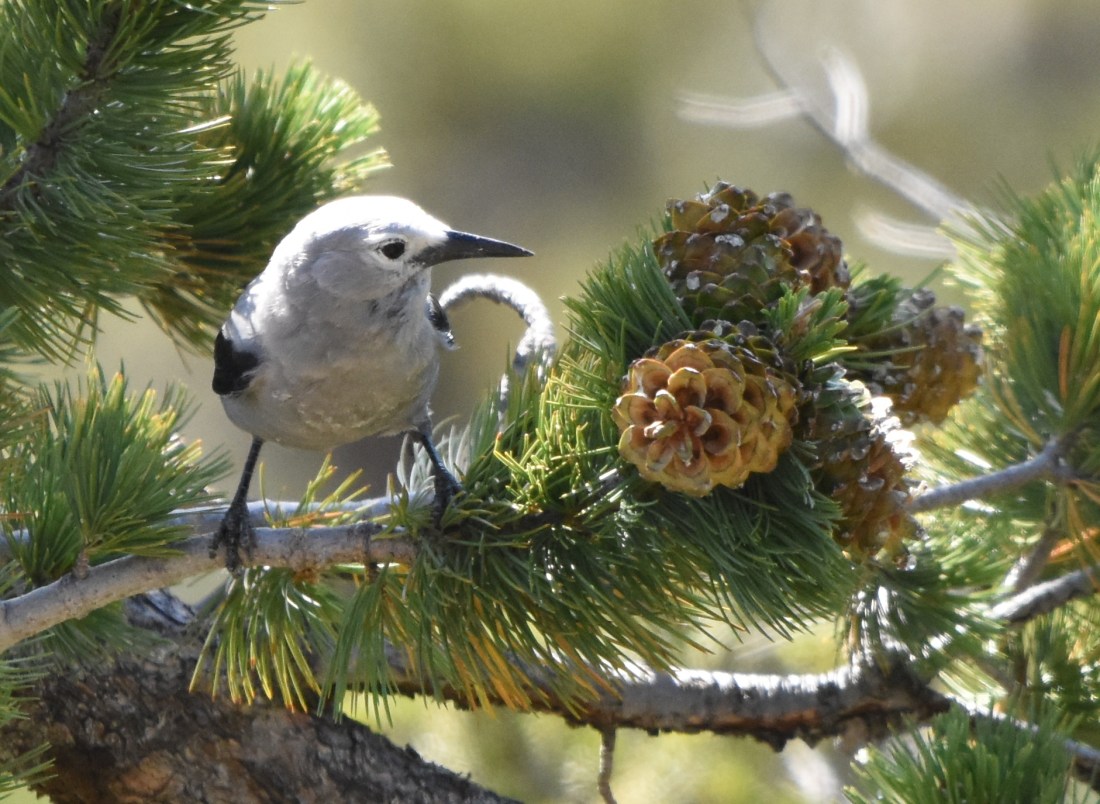
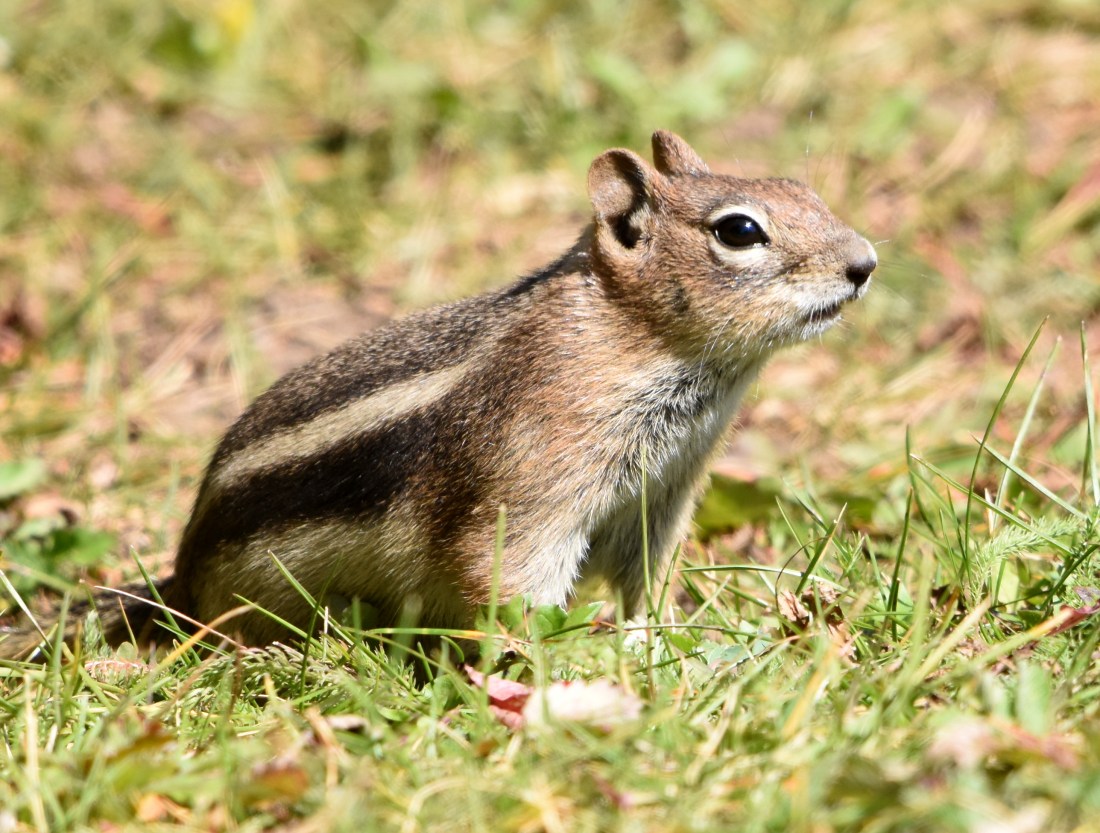
Clark’s Nutcracker (Clark’s Nutcrackers are mainly found in mountains at altitudes of 3,000–12,900 ft in conifer forests.)Gold-mantled Ground Squirrel in the Rocky Mountains This little critter looks a lot like a chipmunk but is much bigger– kind of like a chipmunk on steroids!
September 5-9
Steamboat Springs, Colorado
While Mel went fishing in the Yampa River, I went walking along the Yampa River Trail, a 7.5 mile multi-use trail that runs through the heart of Steamboat Springs and along the Yampa River. Along that trail, I found other points of interest like the Rotary Park Boardwalk and the Yampa Botanic Park, both of which were wonderful places for a quiet retreat as well as multiple picture opportunities.
Yampa River
Swift Moth
Two-striped Grasshopper
Black-billed Magpie along the Yampa River Trail
Cedar Waxwing
Osprey
Coronis Fritillary (I think) on coneflower
Yellow-rumped Warbler
bedraggled Robin
European Starling
Hollyhock
Yellow Warbler
Mourning Cloak butterfly
On one of the days that Mel didn’t go fishing,
we took a drive up to Fish Creek Falls
together for a picture walk and later spent hours at the Yampa Botanic Garden taking pictures of all the beautiful flowers,
birds and visiting insects.
White-lined Sphinx Moth (or Hummingbird Moth) in the Yampa Botanic Garden
Townsend’s Warbler up near Fish Creek Falls
Stunning flowers from the Yampa Botanic Garden…
Mel fishing the Yampa River
September 9-12
Colorado Springs, Colorado
Colorado
Springs was our last destination in Colorado and we made the best of the time
we had. As soon as we arrived on the afternoon of the 9th, we went for a
picture walk in Palmer Park on a
trail that turned out to be rockier and slipperier than we expected. Not many
pictures got taken—we were too busy watching our footing!
Cassin’s Vireo (I think) One of the few pictures I took at Palmer Park because I was too busy watching my footing!
The following morning we headed out to the Garden of the Gods, which is known for its enormous, awe-inspiring geologic
formations, including tall rock spires or hoodoos, and steep cliffs. It’s a
major tourist attraction and well worth the visit.
Garden of the Gods, Colorado Springs Garden of the Gods, Colorado Springs Garden of the Gods, Colorado Springs
After our visit to Garden of the Gods, Mel dropped me off at the Bear CreekNature Center to take pictures all afternoon while he explored the fishing shops, bookstores and coffee shops around Colorado Springs.
Vesper Sparrow
Woodhouse’s Scrub Jay
Rock Wren at Bear Creek Nature Center
Spotted Towhee
White-breasted Nuthatch
Scrub Jay
Lesser Goldfinch and Pine Siskin
On Wednesday, our last full day in Colorado, Mel dropped me off at the Cheyenne Mountain Zoo where I spent a delightful five and a half hours taking almost 800 pictures of the zoo animals and of the native birds that were flitting about in the nearby trees!
Baby Wallaby in his mama’s pouch– one of my favorite pictures from the zoo This baby wallaby is around 7 months old and barely fits in the pouch anymore! Here you see his head and legs sticking out!Mom and baby wallaby hanging out togetherThe Wallaby baby hopped around for a few minutes before scurrying back to the safety of his mother’s pouch.
Emu
Giraffe
The meerkats were great fun to watch. They are both curious and comical!
“What’s up, buttercup??”The meerkat on the right walked into the scene, laid down and decided to strike this rather suggestive pose! Their antics were so much fun to watch!Moose I had been hoping to see a moose in the wild in Colorado, but this is the closest I got!
Peacock wandering around in the zoo
Steller’s Jay at the zoo
Parakeets in the Budgie House at the zoo.Okapi Also known as the forest giraffe, Congolese giraffe, or zebra giraffe, native to Africa.
Male Wood Duck
Female Wood Duck
A young warthog (native of Africa)
Porcupine taking a nap
White-backed Vulture (Africa)
Red River Hog– native of Africa
The best part of going on vacation, besides getting away from every day routines, is finding things I’ve never seen before (and taking pictures!), eating things I’ve never tried before and meeting new people I’ve never met before.