All the things I did not know

July 18, 2026

There are so many things I didn’t know before falling into this nature photography hobby that it’s actually impossible to cover them all. Here is just a sampling of some of my favorite discoveries!

Out on a Picture Walk with a Nikon D500 camera, a Sigma 150-600mm lens,
and a monopod holding everything up!

It’s never been enough to just take a picture and move on. It’s never been enough to just know the names of the plants and creatures that show up in front of my lens. I’ve always needed to know what makes them special and why they do the things they do. Why do dragonflies point the tips of their ‘tails’ toward the sun on a hot summer day? Why do some birds flail around on the ground? Why do grackles puff out their chests and point their beaks upwards? Almost every picture I’ve taken needs an answer.

Eastern Amberwing dragonfly

Did you know that there are more than 5,000 species of dragonflies? That they were some of the first winged insects to evolve 300 million years ago and that they used to have wingspans of two feet or more? I had no idea!

Blue-eyed Darner dragonfly

It wasn’t until I started taking pictures that I learned dragonflies and damselflies come in multitude of colors; red, pink, blue, green, yellow, gold, purple, black… almost every color you can imagine.  I had barely paid them any notice before going on picture walks!

Common Green Darner dragonfly
Roseate Skimmer dragonfly
Spangled Skimmer Dragonfly

When I found a dragonfly pointing the tip of its tail toward the sun on a hot summer day, I wanted to know why.  What I found out was fascinating! This is how dragonflies regulate their body temperature and prevent overheating! Their handstand-like posture is known as an ‘obelisk pose’. By aligning their tails directly with the sun’s rays, a dragonfly minimizes the surface area of its body exposed to solar radiation!

Male Blue Dasher dragonfly in the ‘obelisk pose’
Female Blue Dasher dragonfly in the ‘obelisk pose’

When I first saw a bird flailing around on the ground like this Black-capped Chickadee, I thought it was injured. When I approached to see if I could help, it flew away! Why was it on the ground in the first place??

Black-capped Chickadee ‘anting’

The behavior this chickadee was engaged in is called “anting.” Birds will intentionally cover themselves with ants in order to benefit from the formic acid that ants release when they’re disturbed. The acid helps with controlling parasites, soothing irritated skin, and serves as a natural insecticide or fungicide!

A very beautiful Common Grackle

Before photography took over my life, I didn’t know that grackles could be so beautiful or that they could establish dominance, attract a mate, or settle a dispute by merely pointing their beaks in the air. It’s called ‘the grackle stance’, ‘sky pointing’, or ‘bill tilting’. Grackles tip their bills straight up, extend their neck as far as they can, and puff out their chests to look as large and as intimidating as possible. The one who holds that stance the longest, wins the dispute! If they’re trying to impress the females, the grackle who lasts the longest or looks the most fit, takes home the girl!

Common Grackles demonstrating the ‘grackle stance’

American Bullfrogs are my favorite amphibians and I’ve taken hundreds of pictures of them over the years.  It wasn’t until recently that I learned you could tell a boy frog from a girl frog by the size of their ears! Look for a circle next to the bullfrog’s big, bulgy eyes. It’s called a tympanic membrane, a tight patch of skin that acts like an eardrum. If that circle is bigger than the frog’s eye, it’s a boy!

Boy Bullfrog with a very big tympanic membrane!

Some butterflies, like monarchs, also have ears! They don’t look anything like our ears or a frog’s ears, but they do have specialized, drum-like membranes called tympanal organs located at the base of their forewings that allow them to ‘hear’ the vibrations of fluttering wingbeats made by approaching predatory birds!

Female Monarch butterfly

You can’t tell the sex of a butterfly by its ears like you can a bullfrog, but you can tell a boy monarch from a girl by two black dots. Male monarchs have two prominent black spots (scent glands) on their hind wings that are used to attract mates. Female monarchs do not.

Male Monarch butterfly

I had never seen a turtle like this one before (with its bright yellow neck) until I took a picture. It has a interesting life history, a threatened existence, and a compelling reason for us to protect it.

Blanding’s Turtle

This is a Blanding’s turtle and, unlike most other creatures, it shows virtually no signs of biological decline as it ages. A 90-year-old turtle remains as healthy, active, and reproductively viable as a 20-year-old! Researchers who have been studying this ‘fountain of youth’ feature of the Blanding’s turtle are looking for ways to delay age-related diseases in humans, such as hypertension, Type 2 diabetes, cataracts, macular degeneration, Alzheimer’s disease, and Parkinson’s.   

Blanding’s Turtle

Unfortunately, the Blanding’s turtle is listed as Endangered, Threatened, or a species of Special Concern in most of the areas where it resides. Sadly, it faces the same or similar threats as many other species with whom we share this planet: habitat loss and fragmentation, predation, climate change, and pesticide use. So many plants and animals that we destroy hold the secrets to a better life for us. What harms them, harms us.

Bee Balm

One of my favorite plant discoveries has been ‘bee balm’, also known as monarda. Given the right conditions, bee balm grows abundantly in the wild, but can also be grown in your garden. It’s a wonderful little plant for attracting hummingbirds, bees, and butterflies. But there’s another insect that loves bee balm just as much: a hummingbird moth! This fascinating insect is a little bigger than a bee but smaller than a hummingbird, and has been mistaken for both. It likes the same flowers as bees and hovers in front of them like a hummingbird to gather nectar.  

Hummingbird Clearwing Moth on Bee Balm

Before taking pictures, I didn’t know that some robins stayed here all winter. I thought, like everyone else, that they were the true ‘harbingers of spring’.  But, on my wintertime picture walks, I discovered them up in the trees eating berries! If robins can find enough berries over the winter, they won’t migrate. We tend to think of them as just spring and summer birds because that’s when we are more likely to see them; out on our lawns pulling up worms!

American Robin enjoying winter berries
American Robin enjoying juniper berries in the winter
Springtime Robin pulling up worms!

Surprisingly, Robins and other berry-eating birds, like Cedar Waxwings, can become intoxicated if the berries they’re gulping down are fermented!

Cedar Waxwing enjoying Juniper Berries

One of my biggest bird surprises was finding cuckoos in Michigan! I didn’t even know we had cuckoos anywhere in the United States, let alone Michigan (at least not the feathered kind)! My only ‘cuckoo’ experience had been in Scotland years ago! But Scotland and Michigan host completely different species. Scotland has a Common Cuckoo; Michigan has the Black-billed Cuckoo and the Yellow-billed Cuckoo.  Even though we rarely see these birds, cuckoos are good to have around. Our Michigan Cuckoos love eating spongy moth caterpillars (formally known as gypsy moth caterpillars) which defoliate our trees and kill the weakener ones.

Black-billed Cuckoo
Yellow-billed Cuckoo

In just a few weeks I’ll be on the hunt for one of my favorite insects, the Praying Mantis. I love finding them and taking their picture because, unlike any other insect on the planet, a Praying Mantis can turn its head 180 degrees and look me straight in the eye! How weird is that?

Praying Mantis staring back at me!

There seems to be an infinite number of plants and creatures that I never knew about before walking out my door ten years ago, camera in hand, to go on my first picture walk—and I expect there’s an infinite number left waiting to be discovered!

In search of another interesting subject!

I learn something new every time I go out!

Morning Surprises

June 18, 2024

Whenever I go out on a picture walk, I never know what I’m going to find. Sometimes it’s a new dragonfly or a new butterfly. Sometimes it’s just a robin with a mouthful of worms. Sometimes it’s a rare bird, like this black-billed cuckoo, or a shiny, iridescent dogbane leaf beetle. Almost everything captures my attention, no matter how small.  Today, it was a tiny barn swallow.

Black-billed Cuckoo, one of my biggest surprises ever! I didn’t even know we had cuckoos in Michigan!
Roseate Skimmer dragonfly, one of my surprise dragonflies I found in Florida. I had never seen a pink dragonfly before!

I was on an early morning ramble through the Wolf Lake State Fish Hatchery when I spotted this little ball of fluff sitting on a railing near one of the overgrown ponds. From a distance, it was barely noticeable, but with the help of my 600mm lens, I could see that the ball of fluff was a baby barn swallow, a fledgling. There were no adult birds nearby that I could see, but I knew that mom or dad would be back soon to feed their hungry little offspring, so I planted myself in a good spot for pictures, but not too close, and I waited. It wouldn’t take long for mom and dad to return with provisions.

Barn Swallow fledgling

I was totally focused in on the baby, but every time it opened its mouth, I knew mom and dad were flying around in my periphery ready to deliver food. What surprised me, though, were the ‘fly by deliveries,’ where mom and dad never landed; They flew in, hovered for a moment, stuffed the food in their baby’s gaping mouth, and flew off! It happened so quickly that I never really saw what was happening, I just kept taking pictures as quickly as I could. It wasn’t until I brought the pictures up on my computer that I could see how mom or dad rarely landed. I was also able to zoom in and see what they were feeding this little one. My favorite shot was the parent bird shoving in a mouthful of blue damselflies!

Barn Swallow parent delivering blue damselflies!

As I walked away an hour or so later, I was left wondering how this baby bird, with its underdeveloped wings and tail feathers, even made it to the top of this railing in the first place, and how it would return to a safe spot once evening set in. By the time I had to leave, that baby barn swallow had already been out on the railing for well over an hour. I hope it eventually made its way to safety.

Here are the most notable shots from today’s barn swallow surprise– with captions:

“I’m over here!!! FEED ME!!”
Parent bird: “Hold your horses!! I’m coming!”
Parent bird: “Here you go!! Down the hatch!”
“FEED ME! FEED ME!”
“Where’s my food?? Why are you ignoring me???
Parent bird: “Here you go!! Quit yelling at me!!”
Parent bird: “Here’s some tasty blue damselflies! Are you full yet??”
Parent bird: “There, there!! That should be enough!”
“BUT I WANT MORE!!!”

Before Pictures: A Photography Journey

July 4, 2022

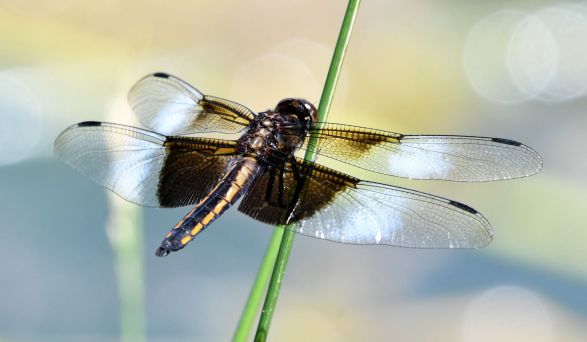
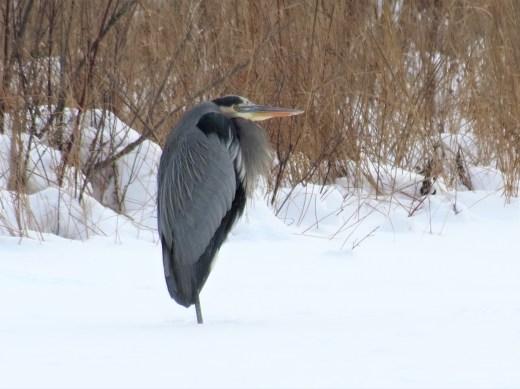
Before I started taking pictures, there was so much I didn’t know about the world outside my own front door. I didn’t know that dragonflies came in a rainbow of colors, that turtles shed parts of their shells, or that we had cuckoos in Michigan! I didn’t know that cedar waxwings could get drunk eating fermented berries, or that great blue herons would stay here throughout our cold Michigan winters. My enlightenment all started with a Christmas wish.

A brown, white and yellow Widow Skimmer dragonfly

In the Fall of 2013, my husband, Mel, started asking me what I wanted for Christmas. I gave his question a good deal of thought and came up with the idea that I’d like to have a better camera. All I had was a pocket-sized Canon PowerShot– a lightweight and easy to carry camera with very limited capabilities.

Michigan’s Black-billed Cuckoo
A Great Blue Heron that decided to stay in Michigan for the winter!

Once I told Mel what I wanted, he went to work doing the research and came up with a bigger, better version of the Canon PowerShot that he thought might work. I loved it– and ultimately, dubbed it my “gateway drug”.

Eastern Kingbird babies hoping for lunch!
A giant snapping turtle taking a break on a very hot day!

I happily used that camera on and off for the next three and a half years; taking the usual family photos and typical vacation shots. It wasn’t until we went to Florida in 2016 for our first extended stay that my addiction to nature photography really kicked in. There were so many rookeries, sanctuaries and preserves with new and unusual birds, mammals, and reptiles that I had absolutely no trouble feeding my ‘habit’!

Florida alligator taking a siesta

Eventually though, I started wanting more. I wanted a camera with a faster response time so that the bird on the limb would still be there once I pressed down the shutter button. I wanted to get pictures of the birds and butterflies that were farther and farther away, and I wanted sharper images. Mel went back to work looking for a camera that would do all those things—without causing us to re-finance our home! By July of 2017, I had my new camera, a Nikon D3400 and a detachable 70-300mm zoom lens. I was back in business!

A bright-eyed Yellow Warbler
Common Yellowthroat

At some point along the way, Mel decided to take up his photography hobby again and assumed ownership of my D3400 after finding me a Nikon D5600 to take its place. We were both hooked!

Spiny Softshell Turtle

I loved all the beautiful pictures I could get with my D5600 and the 70-300mm lens, but there were birds and butterflies still out of reach that I wanted to capture! After a bit of research, Mel thought that a Sigma 150-600mm lens might do the trick. I was well aware of the size and weight of this lens based on what I had read, but when it actually arrived, I thought “What on earth have I done??” It looked huge! It felt heavier than I expected and I had serious reservations about my ability to carry it around for hours on end. But, I really, really wanted to take ‘far away pictures’ so off I went, camera and lens in hand.

The BIG lens!

I used that set up for a year or so before my back started telling me that it might be better to add a monopod to my camera in order to support all that weight when I stood for hours taking pictures. Adding a monopod would mean I’d have a little more weight to carry as I walked along, but I wouldn’t have to hold the camera up to my eye unsupported as I patiently waited for the ‘perfect shot’ or tried to pan the movement of a bird in flight. My back has thanked me many, many times over.

Taking pictures using the camera mounted on a monopod– a good back-saver

I used the Nikon D5600 for two or three years along with the 150-600mm lens before totally exceeding the picture expectancy of my camera with over 100,000 shots!! I decided to trade it in for a Nikon D500, a camera that was highly rated for nature photography and has totally lived up to that assessment!

Blanding’s Turtle
Barn Swallow

Before taking pictures, I had already loved going on nature walks– but there was so much I didn’t see! With my camera in hand the world suddenly opened up!! I paid more attention.  I noticed things I had never noticed before– like the subtle movement of a blade of grass that might mean a dragonfly had landed, or the tiny ‘bump’ at the top of a long-dead tree that might mean a hummingbird was resting; or the infinitesimal speck of blue on a shiny green leaf that might mean a damselfly was nearby.

Hagen’s Bluet Damselfy

All of those creatures had been there all along, but I never saw them —until I started taking pictures!