The Four Survivors

October 22, 2024

As I was walking through one of my favorite birding spots, the Wolf Lake State Fish Hatchery, I was thinking about the four survivors; birds I have photographed many, many times over the years who have overcome challenges of one sort or another. I’ve spent so much time photographing these four that I feel a particular kinship with them.

Betty, the Blue-winged Teal

One of those birds, a female Blue-winged Teal, is a year-round resident at the fish hatchery, but shouldn’t be.  I see her at the hatchery almost every time I visit and have pictures of her throughout the four seasons. She has become so familiar to me that I named her Betty.

Betty, the Blue-winged Teal

When I realized that I had pictures of her for every single month of the year, I wondered why she had never gone south for the winter. Blue-winged Teals aren’t supposed to stay in Michigan throughout the winter months. According to the U.S. Fish and Wildlife Service, they “…are not able to endure the cold weather and are some of the first to migrate south in the fall and the last to head back north in the spring.” When I posted my quandary about Betty on Facebook, a birding friend replied, “Betty has a wing injury that prevents her from doing long distance flights. She is willing to fly very short distances to relocate to a different pond now and then.” That explained everything! She had no choice. But, given the missive from the U.S. Fish and Wildlife Service about the inability of these birds to survive the cold, I had a whole new sense of admiration for Betty and her ability to make the best of a bad situation. She’s a true survivor!

Betty on a very cold February day in Michigan

The other bird I always look for at the fish hatchery is the Great Blue Heron. I haven’t named him and I don’t see him as often as I do Betty, but I think he’s the same blue heron I’ve been seeing for many years at the hatchery. When I first started taking his picture, it looked as if he had sustained an injury to his neck at some point in his life. Maybe a predator tried to catch him when he was young, or maybe he got tangled up in a fishing line. There’s no way to know, but he obviously survived ! Whenever I visit the fish hatchery, I look for him in all of his favorite places. Sometimes he’s standing on a log at the edge of one of the ponds. Sometimes he’s perched in a tree or scouting the edges of the water looking for a fish. In the wintertime, I’ve even found him out on the ice! Wherever I happen to find him, it feels like my lucky day, and I always take a picture!

My Great Blue Heron in one of his favorite spots at the Wolf Lake State Fish Hatchery
My Great Blue Heron in a contemplative moment
My Great Blue Heron in the dead of winter!

The WMU Business Technology and Research Park next door to where we live is another one of my favorite places to walk and take pictures. There are mowed trails meandering through acres of wildflowers, tall grasses, and trees. No matter what the season, I always find something to photograph:  songbirds, wild turkeys, butterflies, dragonflies, praying mantids, white-tailed deer, and an abundance of chipmunks, squirrels, and rabbits. In addition to all the inviting grassy trails, there are three small ponds that provide refuge for mallards, swans, geese, green herons, turtles, frogs, and a few migrating ducks.  

A Fall walk through WMU’s Business Technology and Research Park

It’s also the place where I look for my Red-tailed Hawk. I scan the skies looking for him, and I search the tops of lampposts and trees hoping to get a glimpse. It’s a fun game trying to find him, but I don’t always win. Sometimes, he finds me!!

My Red-tailed Hawk overhead at the Business Park
My Red-tailed Hawk high in a tree
My Red-tailed Hawk on one of the lampposts

On the one eventful day that he found me, I was standing on a small footbridge taking pictures of mallards swimming in the pond and keeping my eye out for the green heron that sometimes perches on a branch along the edge. All of a sudden, that hawk flew in out of nowhere and landed on the railing of the footbridge less than 20 feet from where I was standing! He took my breath away!! But I slowly turned my camera in his direction, hoping my movements wouldn’t scare him. At the same time, he turned his head in my direction and we locked eyes through the lens of my camera. Before that magical moment passed, I quickly snapped a few pictures, and a millisecond later he was gone!

A close encounter with my Red-tailed Hawk

What I’ve learned about Red-tailed Hawks over time is their amazing ability to not only survive but to thrive!  They have achieved this success due to their adaptability, especially when it comes to food. Red-tailed hawks will eat almost anything, including rats, mice, squirrels, voles, rabbits, snakes, birds, bats, frogs, toads, insects, and even carrion. They are considered ‘generalist predators,’ a trait that has significantly contributed to their overall success and their widespread distribution. They are survivors!

My little Carolina Wren who visits the platform feeder on our deck all winter long

The last of my four survivors is the Carolina Wren that has been visiting the feeders on our back deck for many winters. Like the other survivors, I feel a kinship to this bird and consider him to be my Carolina wren because he keeps coming back and I keep feeding him—or perhaps more accurately, he keeps coming back because I keep feeding him!

My Carolina Wren on a snowy day in January

He likes the black-oiled sunflower seeds I leave in our platform feeder and carefully picks them out one by one, flutters down to the nearby doormat, tucks the seed into a crevice of the mat to stabilize it, and then cracks it open. The mat is just the other side of our sliding glass door, a few feet away from where sit. It’s such a treasure to see him return every year when the cold weather sets in.

My little wren just outside our window on a snowy day

It never ceases to amaze me that this tiny bird, or any bird for that matter, can survive the harsh winter months with just a handful of feathers to keep them warm, while I have to bundle up in layers upon layers of warm clothes, stuff hand-warmers into my pockets, and sometimes wear heated socks just to go out and take pictures! How do those little birds manage??

All layered up for winter photography!

There are so many wild animals out there that we never see struggling to survive through all kinds of weather and all kinds of circumstances. They have the marvelous ability to adapt and sometimes even thrive. But I continue to worry about how many of them we will lose over time due to our carelessness as human beings in our role as stewards of planet earth.  We’ve already lost too many.

Winter birding at Kensington Metro Park, Milford, Michigan

“The greatest threat to our planet is the belief that someone else will save it.” ~ Robert Swan British explorer and environmental activist 

The Best Day Ever

May 4, 2023

It was the best day ever– as good or better than all the other best days I’ve ever had taking pictures! After a long, cold, Michigan winter, and a wet, dreary spring, I was more than ready for a warm, sunny day. But it didn’t start out warm, or sunny. At seven o’clock in the morning, it was only 39 degrees and overcast. I had left the house thinking it was going to get warmer much faster than it did, and hadn’t dressed appropriately! Standing still taking pictures was bone-chilling cold. By mid-afternoon, though, the temperature had climbed to a blissful 65 degrees and I wrapped myself up in all its warmth.

American Robin: The first thing to greet me this morning

This particular picture walk started out down by the creek behind our house shortly after sunrise. I was hoping to get some good reflection shots of our resident wood ducks swimming along on the perfectly still waters, but it’s hard to catch a wood duck! They swim off in the opposite direction as soon as they catch a glimpse of me! Today, though, I was lucky. Either they didn’t notice I was there, or they didn’t care, and I took more than enough pictures to keep me happy—at least for a while!

Male Wood Duck
Female Wood Duck

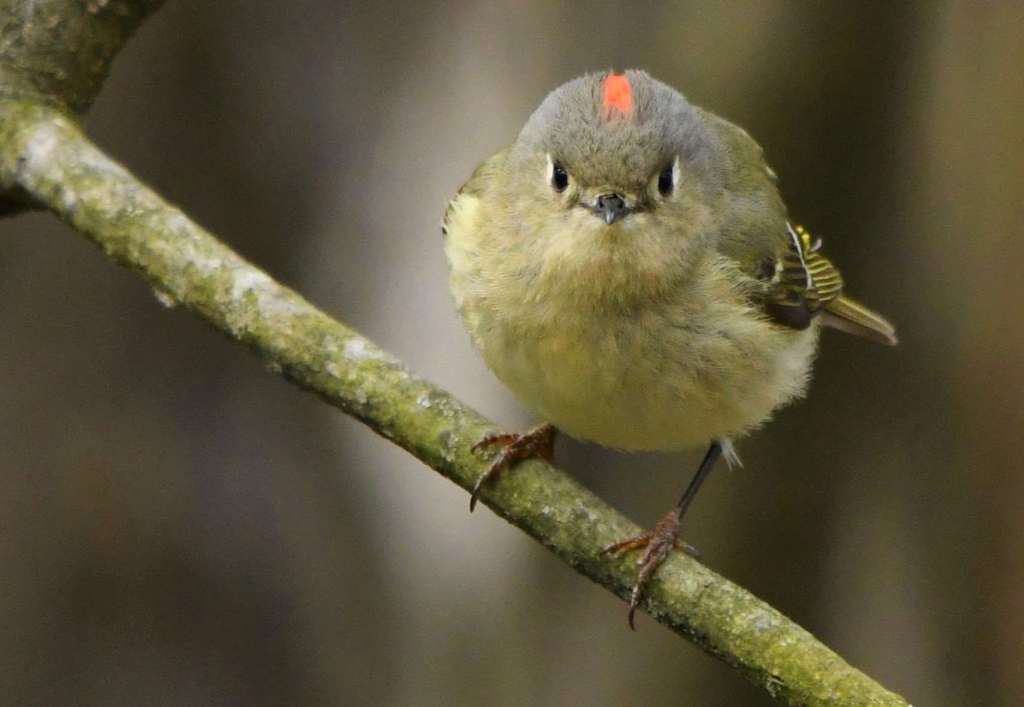
After an hour or so of wood ducks, I continued along a path that followed the creek into our nearby woods hoping to find yellow warblers or kinglets. The kinglets ultimately cooperated, but the warblers did not. I love finding kinglets, but they are an extremely challenging bird to photograph as they flit non-stop from one well-hidden branch to another. I took dozens of shots before pulling myself away and heading home for lunch.

Within an hour, I was off again to another small creek and more pictures! This creek, like the one behind our house, widens to form a small pond, and is an excellent place to find a wide variety of birds. To the naked eye, though, it often seems as if the pond has nothing much to offer.  With a telephoto lens, or a good pair of binoculars, a whole new world can open up!

Male Hooded Merganser

I have visited this pond many, many times over the years, but it wasn’t until fairly recently that I discovered the very best place to get good, clear pictures of the birds on the water. Unfortunately, that ‘very best place’ comes with a modicum of anxiety.

Female and Male Blue-winged Teal

In order to access my ‘very best place’, I have to go behind a small, private business along a very busy road. Once behind the building, I have to walk up their back steps to an attached deck where I quietly park myself under their lovely gazebo at the edge of the water. Every time I use this spot, which isn’t often, I fully expect someone to come out of the building and ask me to leave, or to at least ask me what I’m up to!

No one ever does.

Female and Male Northern Shovelers

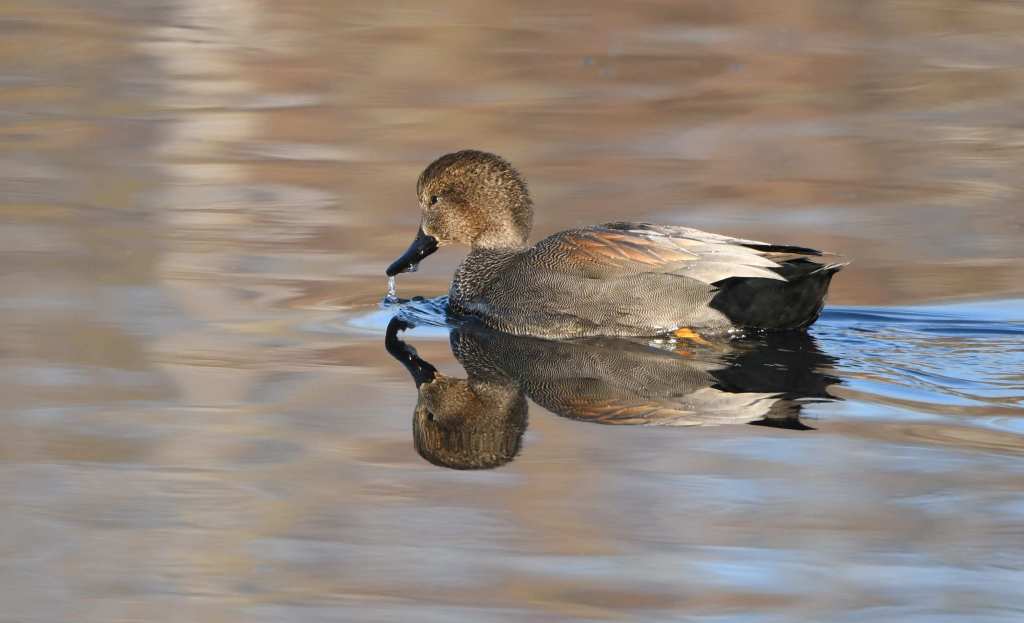
Today, however, I really, really wanted someone to come out!! I wanted somebody to ask me what I was doing so I could show them all the beautiful birds they were missing, like the Northern shoveler, the blue-winged teal, the gadwall, the hooded merganser, and the magnificent green heron catching a fish! I wanted to show them the hundreds of turtles sunning themselves on the rocks and logs, and I wanted them to hear the orchestra of birds playing right outside their back door!

But no one ever came.

A beautiful Green Heron waiting to pounce on a fish!
He makes the strike!!
And catches his fish!!

I was grateful, though, as I always am, to have this little slice of heaven to myself, to not be extricated from my perch, and to find so many beautiful creatures to photograph!

Two Canada Geese and a slew of Painted Turtles sunning themselves

It really was the best day ever!

A Dog Named Norman

April 10, 2023

One of the many joys of a picture walk is never knowing what I’ll find or who I’ll meet along the way. Yesterday, I met a dog named Norman. It brought a smile to my face. Why would anyone name a dog, Norman, I wondered? It seemed like a very formal moniker for such a small, scruffy little beast. So, I posed the question to the human attached to the other end of the leash, “Why Norman?”  

“Well,” she said, “I named him after my dad who recently passed away.”

Black-capped Chickadee
White-tailed deer, a common visitor on my walks

That was even funnier, I thought, to name a dog after your dead parent, but I kept my chuckle to myself.  Instead, I shared the fact that my own father was also deceased and was also named Norman! For the life of me, though, I couldn’t even imagine naming a dog after my dead parent! It just didn’t seem right–and it conjured up an unappealing visual in my head of walking my dad on a leash and cleaning up all his messes!

Male Wood Duck

Earlier in the day, long before I met up with Norman, I had been walking along the creek behind our house hoping to find a wood duck in the early morning light. I expected one to swim out from the cattails along the bank, but it splashed down suddenly in the water next to me and jolted me out of my quiet reverie! Later, I was pleasantly surprised to find a female northern shoveler and a male blue-winged teal swimming in close proximity to the newly-arrived wood duck. What a great find! Both the shoveler and the teal are rare visitors to our creek!

Once the early morning light started to change, and no longer had that soft golden glow, I wandered through the woods adjacent to the creek and headed over to a nearby preserve where I hoped to find a loon.  I had never seen a loon here in Michigan, but knew that one had recently been spotted on the lake at the preserve and hoped I’d get a picture!

Common Loon

It took me awhile to find the loon. It’s not a very colorful bird, and it does have a habit of swimming rather low in the water. Even on a relatively small body of water, like the one I was visiting, loons can be difficult to spot.

The painted turtles were out in droves!
Male Mallard flying by

While I had my camera focused on the loon, something in my peripheral vision distracted me. It was an Osprey flying towards me on the left with a good-sized fish in its talons!! I turned to take its picture and didn’t have time to change the settings on my camera. I just started shooting as fast as I could and hoping for the best! In photography, this method of shooting is often called ‘spray and pray!’ Sometimes it works, sometimes it doesn’t. But it’s always worth a try.

My ‘spray and pray’ shot of the Osprey with the fish!

As I continued walking around the lake, I was delighted to find two great blue herons in relatively close proximity to one other! I’ve never seen two blue herons at the same time except at a rookery. A short time later, I spotted a third!

Great Blue Heron

One of the birds that never takes me by surprise is the Canada goose! It’s absolutely everywhere, but quite easy to overlook as a desirable photography subject. Even the most mundane of subjects, like the Canada goose, though, can make for a beautiful photograph given the right circumstances and a little bit of ingenuity. If nothing else, Canada geese are great subjects for practicing one’s photography skills; they’re not hard to find, they’re easier to photograph than smaller, flightier birds, and they really are stunning in their own right.

Canada Goose in peaceful repose only a few feet from where I was taking pictures of the wood duck
A busy little muskrat taking a snack break along the edge of Asylum Lake

On this particularly warm spring day, I also saw swans, turtles, grackles, and one very busy muskrat chewing away on something tasty; totally oblivious to my presence. Up in the trees surrounding the lake, there was a musical assortment of robins, chickadees, bluebirds, red-winged blackbirds, golden-crowned kinglets, yellow-rumped warblers, and one little brown creeper scurrying up a tree.

Eastern Bluebird
Little Brown Creeper scurrying up a tree

I always head out on these picture walks wondering what kinds of surprises I’ll find or who I’ll meet along the way. Yesterday, my best surprise was the osprey with the fish, but the funniest surprise was the dog named Norman, and the story of his name. I’m still smiling!

Sandhill Crane