Some Days…

August 23, 2024

Some days it’s really hard for me to push myself out the door and go for a picture walk—even though it’s something I love to do. Today was one of those days. I’d already gone for a long, leisurely walk with friends earlier in the day, and I’d already taken enough pictures. There was no logical reason to go out again. But it was a perfectly beautiful day; not hot, not humid, not windy. It would be a shame to waste all that loveliness by sitting in the house– and I would always wonder what I’d missed if I didn’t go. As it turned out, I would have missed everything!

Black-eyed Susan

My walk started out, as it often does, down by the creek behind our house where the dragonflies gather. I’ve found blue dashers, familiar bluets, slaty skimmers, Eastern pondhawks, and Eastern amberwings at the creek all summer long, but today there was a surprise–an American rubyspot damselfly!  It’s one of the prettiest little damselflies I’ve ever seen, but rarely find. My trip out the door had already paid off!

American Rubyspot Damselfly

Next on my route was the nearby WMU Business Technology and Research Park with its vast expanse of prairie grasses and wildflowers where I was hoping to find a few lingering butterflies or, perhaps, the first praying mantis of the season. There were so many possibilities! What first caught my attention, though, was a stunning green darner dragonfly, floating above the grasses looking for a place to land. I rarely see them, or get a picture, so I tracked its movements through the air hoping it would land somewhere that would be easy enough to photograph. Unfortunately, it chose a spot about 15 feet away and below my line of sight. I carefully picked my way through the high grass hoping to find it, hoping not to disturb it, and hoping not to acquire a few ticks along the way! I succeeded on all counts!

Female Common Green Darner Dragonfly

The fields of tall grass and wild flowers at the business park have beautifully mowed trails all the way through. One of those paths that I particularly like to walk has praying mantises along the way–and now is the time to find them!

WMU Business Technology and Research Park mowed path

They like hanging out on the tall stalks as they look for love. But they’re so well camouflaged that it’s almost impossible to find them! It’s like the ultimate Where’s Waldo challenge, but without the red and white striped hats to distinguish them! Sometimes, I’ll find 10 or more on a single walk; today I only found one, but it was almost as exciting as winning the lottery! And there were more surprises ahead!

Praying Mantis up close!
Praying Mantis from a distance!

After spotting the praying mantis, I very quietly and cautiously headed over to the small pond across the road where I once found a giant snapping turtle draped across a large rock. On rare occasions, I’ve also found a great blue heron standing motionlessly along the edges waiting for its his next meal to swim by.

Giant Snapping turtle that I found on a previous visit to the pond behind Floyd Hall

I’d barely crossed the road when I spotted the great blue heron! He was standing on the opposite side of the pond in his familiar stoic pose. From experience, I knew this bird might not move for a very long time. Great blue herons are extremely patient birds as they wait for their next meal. I took a few pictures as he stood there, and then I too waited, hoping for a better shot. Eventually, this magnificent bird very cautiously moved one of its legs, and then the other as it crept forward into the water. It occurred to me in that quiet moment of concentration that we were both doing the very same thing; standing quietly and watching our prey, then moving ever so slowly towards it, hoping to make the catch!

Great Blue Heron stalking his prey

From the pond behind Floyd Hall, I headed over to another pond where I hoped to find one of the green herons that visited regularly. What first caught my eye, though, was a mallard hybrid of some sort that had a wide band of white around its neck. It was wider than I what I usually see on a male mallard and I worried that it might be a piece of plastic. So, I zoomed in and quickly realized that this was just another goofy looking duck. Mallards breed with a wide variety of other ducks including domestic ducks, American black ducks and Northern pintails– all of which result in some very odd-looking offspring, including this one!

The odd duck with the wide white neck band
Typical Male Mallard

But my best surprise was still waiting for me.

I went to the footbridge that crosses over the pond hoping to find the elusive green heron. As I stood at one end of the bridge with my camera pointed towards the pond, a red-tailed hawk landed on the railing to my left at the other end of the bridge– only 20 feet away! It took my breath away! I really, really wanted a picture but I didn’t know if my settings were right, and I knew if he saw me move, he’d fly away. So, I very, very slowly turned my camera in his direction and quickly took a burst of shots, hoping for the best. Perhaps he noticed my barely perceptible movements or heard the click of my camera; within fifteen seconds, he was gone! Wow! I’ve never been that close to a hawk before!

Red-tailed Hawk on the footbridge 20 feet from me!
The hawk turned in my direction and took off as quickly as he came

After the hawk flew off, the green heron flew in and I got the shot!

Green Heron contemplating his next meal

On my slow amble towards home, a few butterflies posed politely for pictures and my picture walk was complete!

Monarch Butterfly on butterfly bush
Eastern Tiger Swallowtail on spotted knapweed

It was the best day ever– among a bucketful of best days where I’ve been lucky enough to still do all the things I love.

Monarch Butterfly on spotted knapweed

On the Road Again

June 5, 2023

We just returned from our first real get-away adventure in almost three years. For the better part of the last three years, we had stayed close to home waiting for the pandemic to end. When it was mostly over, and we were ready to travel, our aging dog could no longer go with us or stay in a kennel. She needed a great deal of care. On April 18th of this year, we had to say our final goodbyes. It was a bittersweet moment in time. After a stressful, isolating pandemic and a heart-wrenching year of doggie hospice, we needed to cut loose.

Our dear, little dog, Brandy who had a long, slow decline.

We headed out to the Driftless Area of Wisconsin. My husband, Mel, had registered to attend a Tenkara fishing get-together/campout near Westby, Wisconsin and I tagged along to take pictures. After three years of home-grown subject matter, I was eager to explore a new environment.

A beautiful columbine growing along the roadside

The Driftless area is approximately 8500 square miles of land, mostly in Southwest Wisconsin, that was untouched by glaciers during the last ice age. The term “driftless” indicates a lack of glacial drift, the deposits of silt, gravel, and rock that retreating glaciers leave behind. As a result, the landscape is characterized by steep, limestone-based hills, spring fed waterfalls, deeply carved river valleys, and the largest concentration of cold-water trout streams in the world! It was a perfect place for Mel to go Tenkara fishing.

Viceroy Butterfly
Monarch Butterfly

Tenkara is a method of fly fishing that originated in the mountains of Japan. It uses very long rods with fixed lengths of casting line attached to the rod-tip, and simple, wet flies as lures. This method of fishing was developed to catch trout in free-flowing rivers like the ones found in the Driftless Areas of Wisconsin. I don’t fish, but I was happy enough to go wandering down the back roads near where Mel was fishing to look for birds, butterflies, dragonflies, and flowers; but not GNATS!

Male Eastern Bluebird

Those little buggers came at me with a vengeance! They were in my eyes, ears, nose, and mouth. They were on my sweaty skin. They landed wherever they could find moisture! Gnats are drawn to the carbon dioxide we exhale, as well as the sweet, fruity smells of our shampoos and lotions. There’s no way to get away from them! I was just one giant, sweet-smelling moisture buffet!

Deer on the edge of the road who was curious about my presence
American Toad looking grim!

I hustled back to the car as fast as I could to see if my insect repellent Buff would help. (https://www.buff.com/us/insect-shieldr-neckwear) A Buff is a long tube of thin material that you can pull over your head to cover everything but your eyes. My eyes were protected, at least somewhat, by my glasses. The Buff was a tremendous help; it allowed me take pictures, but it didn’t stop all the gnats who really wanted to get me from crawling into my Buff or going behind my glasses! I did have bug repellent on, but it was no match for these guys! Later, we went to a store and found a repellent that was recommended for gnats and it seemed to work for about an hour before needing to be replenished. It was a welcome relief!

Me and my Buff fending off the gnats!!

In spite of the gnats, and the unseasonably hot temperatures, it was good to be on the road again; to engage in our favorite hobbies in a new environment, to sleep outside in our tent and hear the barred owls calling, “Who cooks for you? Who cooks for you?” and to wake up in the morning to the sound of birds filling the air with their joyful noise. It was a welcome respite from the unwelcome ‘noise’ in our everyday lives.

Dot-tailed White-faced dragonfly in the obelisk position to cool off

In just a few days, we’ll be on the road again; to the Boundary Waters of northern Minnesota for a five-day canoe trip with friends.

Can’t wait!

Great Blue Heron overhead (note the shadow of its head on the lower wing!)
A teeny tiny Ruby-throated Hummingbird high up on a utility wire!
Snapping Turtle feasting on the tadpoles
Red-spotted Admiral butterfly

Before Pictures: A Photography Journey

July 4, 2022

Before I started taking pictures, there was so much I didn’t know about the world outside my own front door. I didn’t know that dragonflies came in a rainbow of colors, that turtles shed parts of their shells, or that we had cuckoos in Michigan! I didn’t know that cedar waxwings could get drunk eating fermented berries, or that great blue herons would stay here throughout our cold Michigan winters. My enlightenment all started with a Christmas wish.

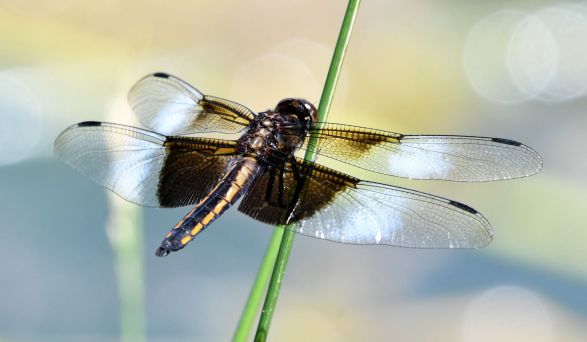
A brown, white and yellow Widow Skimmer dragonfly

In the Fall of 2013, my husband, Mel, started asking me what I wanted for Christmas. I gave his question a good deal of thought and came up with the idea that I’d like to have a better camera. All I had was a pocket-sized Canon PowerShot– a lightweight and easy to carry camera with very limited capabilities.

Michigan’s Black-billed Cuckoo
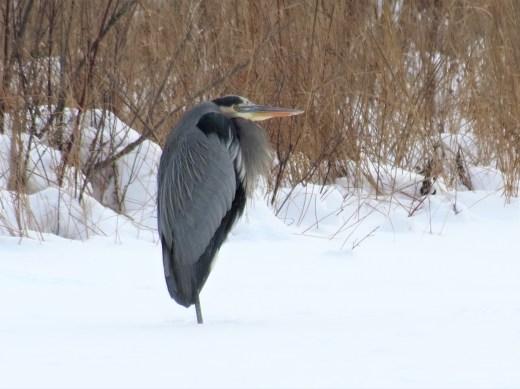
A Great Blue Heron that decided to stay in Michigan for the winter!

Once I told Mel what I wanted, he went to work doing the research and came up with a bigger, better version of the Canon PowerShot that he thought might work. I loved it– and ultimately, dubbed it my “gateway drug”.

Eastern Kingbird babies hoping for lunch!
A giant snapping turtle taking a break on a very hot day!

I happily used that camera on and off for the next three and a half years; taking the usual family photos and typical vacation shots. It wasn’t until we went to Florida in 2016 for our first extended stay that my addiction to nature photography really kicked in. There were so many rookeries, sanctuaries and preserves with new and unusual birds, mammals, and reptiles that I had absolutely no trouble feeding my ‘habit’!

Florida alligator taking a siesta

Eventually though, I started wanting more. I wanted a camera with a faster response time so that the bird on the limb would still be there once I pressed down the shutter button. I wanted to get pictures of the birds and butterflies that were farther and farther away, and I wanted sharper images. Mel went back to work looking for a camera that would do all those things—without causing us to re-finance our home! By July of 2017, I had my new camera, a Nikon D3400 and a detachable 70-300mm zoom lens. I was back in business!

A bright-eyed Yellow Warbler
Common Yellowthroat

At some point along the way, Mel decided to take up his photography hobby again and assumed ownership of my D3400 after finding me a Nikon D5600 to take its place. We were both hooked!

Spiny Softshell Turtle

I loved all the beautiful pictures I could get with my D5600 and the 70-300mm lens, but there were birds and butterflies still out of reach that I wanted to capture! After a bit of research, Mel thought that a Sigma 150-600mm lens might do the trick. I was well aware of the size and weight of this lens based on what I had read, but when it actually arrived, I thought “What on earth have I done??” It looked huge! It felt heavier than I expected and I had serious reservations about my ability to carry it around for hours on end. But, I really, really wanted to take ‘far away pictures’ so off I went, camera and lens in hand.

The BIG lens!

I used that set up for a year or so before my back started telling me that it might be better to add a monopod to my camera in order to support all that weight when I stood for hours taking pictures. Adding a monopod would mean I’d have a little more weight to carry as I walked along, but I wouldn’t have to hold the camera up to my eye unsupported as I patiently waited for the ‘perfect shot’ or tried to pan the movement of a bird in flight. My back has thanked me many, many times over.

Taking pictures using the camera mounted on a monopod– a good back-saver

I used the Nikon D5600 for two or three years along with the 150-600mm lens before totally exceeding the picture expectancy of my camera with over 100,000 shots!! I decided to trade it in for a Nikon D500, a camera that was highly rated for nature photography and has totally lived up to that assessment!

Blanding’s Turtle
Barn Swallow

Before taking pictures, I had already loved going on nature walks– but there was so much I didn’t see! With my camera in hand the world suddenly opened up!! I paid more attention.  I noticed things I had never noticed before– like the subtle movement of a blade of grass that might mean a dragonfly had landed, or the tiny ‘bump’ at the top of a long-dead tree that might mean a hummingbird was resting; or the infinitesimal speck of blue on a shiny green leaf that might mean a damselfly was nearby.

Hagen’s Bluet Damselfy

All of those creatures had been there all along, but I never saw them —until I started taking pictures!

Reason to Sing

June 18, 2020

Eastern Wood Peewee

I have been on so many picture walks since I last wrote that I’m having a hard time choosing which pictures to post and which ones to cast aside. At this time of year, there are so many beautiful things to photograph that it’s hard to stop taking pictures! The woods and the fields are bursting with new life, and so many colors!! I take hundreds of photos every time I’m out on a walk because almost everything grabs my attention!

Spiderwort

Sometimes, my husband, Mel, and I go on picture walks together. He often shoots with a close-up lens, while I almost always use a 600mm telephoto lens. When we go out together, it’s nice to have a mix of shots—he finding the tiniest of bugs or the finest of detail, and me zooming in on creatures well beyond the tip of my camera. We see the world around us through a different lens—both literally, figuratively!

Mel’s close-up of a female Blue Dasher
Female Blue Dasher

The pictures here were gleaned from 14 different photo shoots at seven different locations over the course of about two weeks. All these pictures were taken in relatively close proximity to where we live: Wolf Lake State Fish Hatchery (10 miles), Western Michigan University’s Business Technology and Research Park (.5 miles), West Lake Nature Preserve (10 miles), Chipman Preserve (14 miles), Pierce Cedar Creek Institute (35 miles), Kalamazoo Nature Center (10 miles) and downtown Kalamazoo for a Peregrine Falcon watch (2 miles). We’re lucky to have so many natural resources so close at hand!

Female Red-winged Blackbird

Wherever I take pictures, I tend to walk as slowly and as quietly as possible so that I don’t overlook anything, and so I don’t scare anything away! Surprisingly, even turtles out in a pond, far from where I am walking, will know that I’m coming long before I arrive and slip quietly into the water from wherever they are perched! Bullfrogs, sitting hidden in the grass along the shore, will leap in fright if they know I’m on my way. I’ve been startled out of my skin on more than one occasion as they catapult themselves into the nearby water and let out a loud ‘squawk’!  When I do happen upon an animal or an insect that hasn’t noticed my arrival, I feel as if I’ve really accomplished something!

Snapping Turtle making a run for it as I approached!
Shooting Butterflies in the wind!

No matter where I go or what I find, my picture walks are making this pandemic bearable. There is comfort in knowing that I have places nearby where the cycle of life quietly ambles on and the birds still find reason to sing.

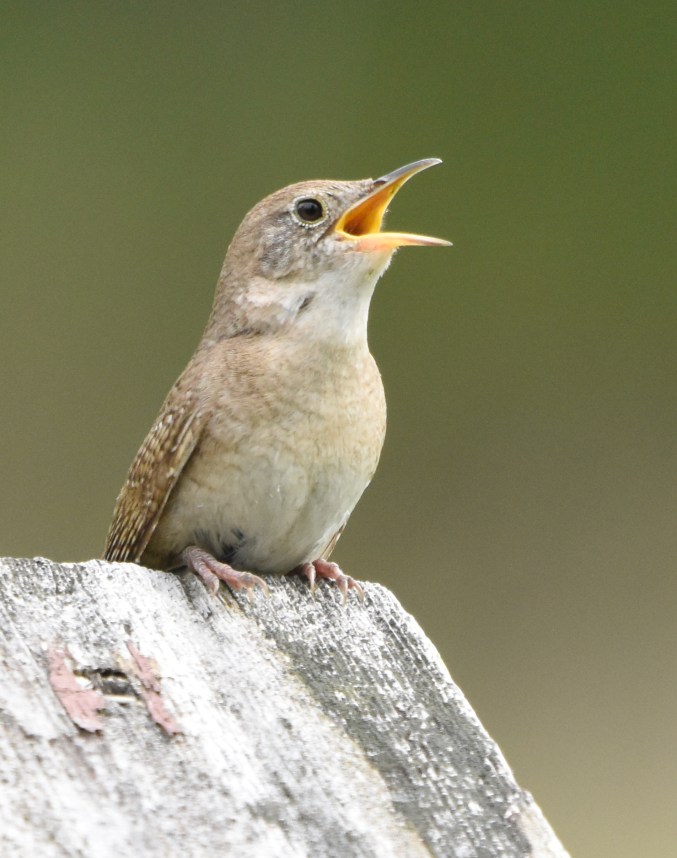
A cheerful little House Wren with lots of songs to sing!