For the Love of Dragonflies!

I love dragonflies! But I didn’t know this until I started taking pictures. Without my camera, and without the ability to bring up pictures on my computer, I had no idea that dragonflies were so beautiful, that they came in such a wide variety of sizes and colors, that their wings were such masterpieces of engineering, or that there were so many different kinds!

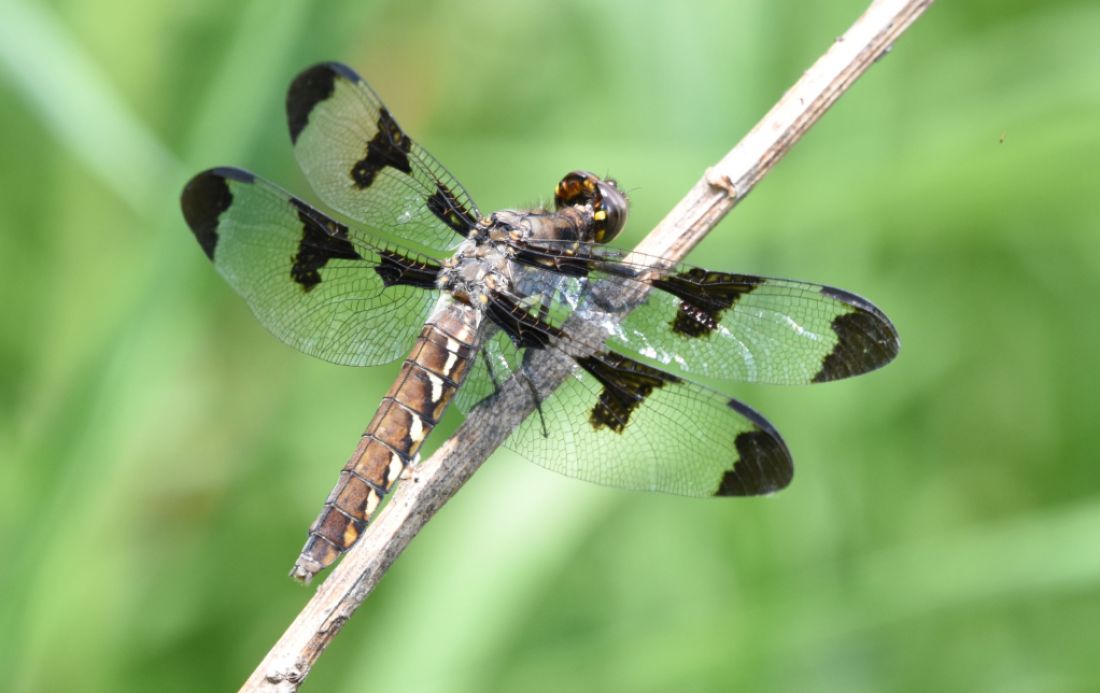
Black Saddlebags Dragonfly
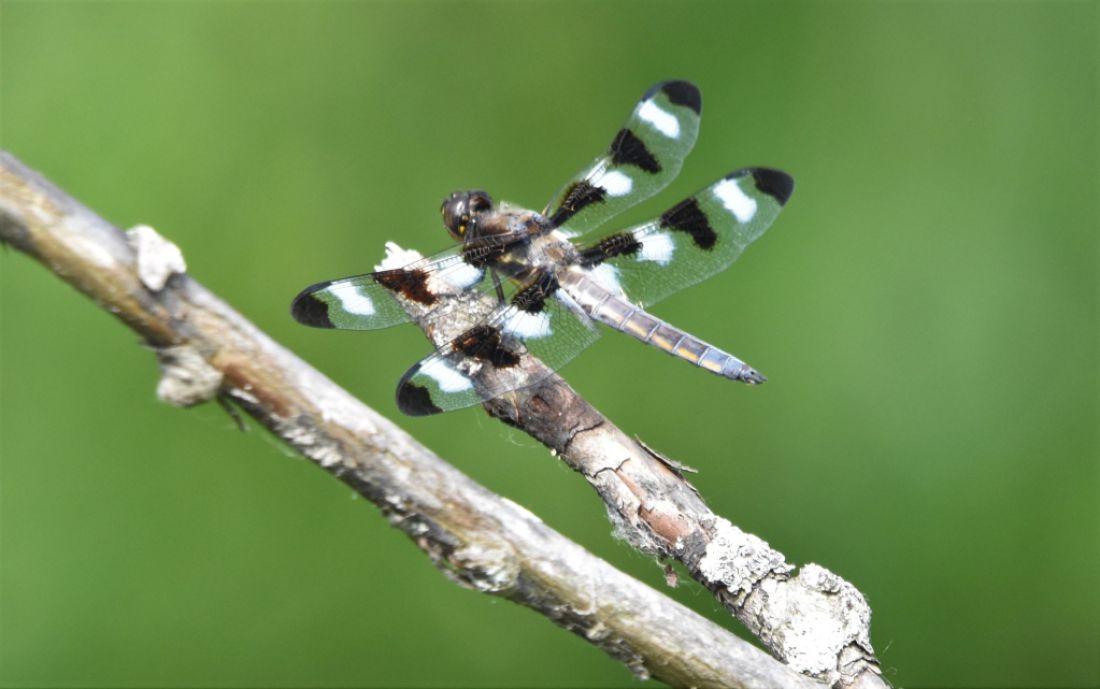
Twelve-spotted Skimmer Dragonfly

Over the course of my photography journey, I’ve found almost every color dragonfly imaginable including red, white, blue, green, purple, orange, black, brown, and pink!  These little creatures are not just candy for the eyes, they’re amazing acrobats as well; flying deftly in all directions like miniature helicopters!

Ruby Meadowhawk Dragonfly
Female Blue Dasher Dragonfly

For clarification, there are both dragonflies and damselflies. Collectively, they are known as Odonata. To the casual observer, dragonflies and damselflies probably look the same. They both have 6 legs, a head, and an abdomen; both have two pairs of transparent wings, bulgy eyes, and stick-like bodies. But there are a couple of features that help differentiate the two: body shape and wing position.

American Rubyspot Damselfly
Male Ebony Jewelwing Damselfly

Dragonflies have bodies that are much thicker and bulkier than damselflies and because of their heftier size, it’s more likely that you’ll notice a dragonfly long before you’ll ever see the tiny, delicate-looking damselflies. When dragonflies are at rest, they hold their wings perpendicular to their bodies like an airplane. Damselflies, on the other hand, fold their wings up and hold them together across the top of their backs.

Male Eastern Amberwing Dragonfly
Female Slaty Skimmer Dragonfly

I much prefer the dragonflies to the damselflies, mostly because they’re bigger and much easier to photograph, and because I can more readily capture the details in their wings. Had I been around 300 million years ago, when dragonflies were first evolving, it would have been even easier to get a picture! Those early insects had wingspans of two feet or more! Today’s dragonflies have wingspans of less than five inches!

Blue Dasher Dragonfly
Male Roseate Skimmer Dragonfly

Over the years, I’ve found so many different dragonflies that I’ve lost track of how many. Worldwide, there are at least 5000 different species, with dragonflies being much more common than damselflies. They are found on every continent except Antarctica. Here in the United States, there are about 450 different kinds of dragonflies and damselflies. In my home state of Michigan, we have about 165 different kinds, and I’m pretty sure I’ve found most of them!

Male Slaty Skimmer Dragonfly
Male Banded Pennant Dragonfly

What is most interesting to me is their life cycle, and their peculiar sex lives! Dragonflies have three life stages: egg, nymph, and adult. The female lays her eggs in the water throughout the summer where they hatch and grow into nymphs. Some of those nymphs will remain in the water over the winter and emerge as adults the following summer. Some will remain in the water for years! While underwater, the dragonfly nymph will eat just about anything it can grab —tadpoles, mosquitoes, fish, other insect larvae and even each other!

Female Common Whitetail Dragonfly depositing eggs in the water

When the nymph is ready to metamorphose into an adult, it stops eating and makes its way to the surface of the water where it climbs up a reed and crawls out of its larval skin or exoskeleton. Once it emerges from its exoskeleton, the dragonfly becomes a skillful and prolific predator. Nearly every minute of its day is spent devouring the insects that annoy us —like mosquitoes, gnats, cicadas, and flies! One dragonfly alone can eat hundreds of mosquitoes a day! Predators that like to eat dragonflies include birds, fish, frogs, bees, bats, spiders, and other dragonflies!

Eastern Kingbirds LOVE dragonflies
Eastern Kingbird feeding dragonflies to her babies

Dragonfly sex is a rough-and-tumble affair. Their sexual coupling requires the flexibility and acrobatic skill of a “Cirque de Soleil” performer. During mating, the male grasps the female at the back of the head, and the female curls her abdomen under her body to pick up sperm from the male’s secondary genitalia at the front of his abdomen, forming a “heart” or “wheel” shape. In the process, females get bitten, males get scratched, and sperm winds up all over the place! After the deed is done, mama dragonfly lays her eggs by tapping the surface of the water repeatedly with her abdomen, or by shaking the eggs out of her abdomen as she flies along, or by placing the eggs on vegetation.

Halloween Pennant Dragonflies mating (male at the top)
Female Shadow Darner Dragonfly depositing eggs

Unfortunately, loss of wetland habitat is a big threat to our dragonfly populations around the world. At least one in ten species of dragonfly are threatened with extinction, according to the first world survey of their numbers. The loss of a dragonfly population threatens the loss of other creatures in that food chain. Ultimately, the loss of any one species is a loss for all of us.

Dragonfly Eyes

Nearly all of the dragonfly’s head is eye, so they have incredible vision that encompasses almost every angle except right behind them. Their compound eyes have up to 50,000 individual lenses, and they can see a wider spectrum of colors than humans. (photo by Mel Church)

On the Road Again

June 5, 2023

We just returned from our first real get-away adventure in almost three years. For the better part of the last three years, we had stayed close to home waiting for the pandemic to end. When it was mostly over, and we were ready to travel, our aging dog could no longer go with us or stay in a kennel. She needed a great deal of care. On April 18th of this year, we had to say our final goodbyes. It was a bittersweet moment in time. After a stressful, isolating pandemic and a heart-wrenching year of doggie hospice, we needed to cut loose.

Our dear, little dog, Brandy who had a long, slow decline.

We headed out to the Driftless Area of Wisconsin. My husband, Mel, had registered to attend a Tenkara fishing get-together/campout near Westby, Wisconsin and I tagged along to take pictures. After three years of home-grown subject matter, I was eager to explore a new environment.

A beautiful columbine growing along the roadside

The Driftless area is approximately 8500 square miles of land, mostly in Southwest Wisconsin, that was untouched by glaciers during the last ice age. The term “driftless” indicates a lack of glacial drift, the deposits of silt, gravel, and rock that retreating glaciers leave behind. As a result, the landscape is characterized by steep, limestone-based hills, spring fed waterfalls, deeply carved river valleys, and the largest concentration of cold-water trout streams in the world! It was a perfect place for Mel to go Tenkara fishing.

Viceroy Butterfly
Monarch Butterfly

Tenkara is a method of fly fishing that originated in the mountains of Japan. It uses very long rods with fixed lengths of casting line attached to the rod-tip, and simple, wet flies as lures. This method of fishing was developed to catch trout in free-flowing rivers like the ones found in the Driftless Areas of Wisconsin. I don’t fish, but I was happy enough to go wandering down the back roads near where Mel was fishing to look for birds, butterflies, dragonflies, and flowers; but not GNATS!

Male Eastern Bluebird

Those little buggers came at me with a vengeance! They were in my eyes, ears, nose, and mouth. They were on my sweaty skin. They landed wherever they could find moisture! Gnats are drawn to the carbon dioxide we exhale, as well as the sweet, fruity smells of our shampoos and lotions. There’s no way to get away from them! I was just one giant, sweet-smelling moisture buffet!

Deer on the edge of the road who was curious about my presence
American Toad looking grim!

I hustled back to the car as fast as I could to see if my insect repellent Buff would help. (https://www.buff.com/us/insect-shieldr-neckwear) A Buff is a long tube of thin material that you can pull over your head to cover everything but your eyes. My eyes were protected, at least somewhat, by my glasses. The Buff was a tremendous help; it allowed me take pictures, but it didn’t stop all the gnats who really wanted to get me from crawling into my Buff or going behind my glasses! I did have bug repellent on, but it was no match for these guys! Later, we went to a store and found a repellent that was recommended for gnats and it seemed to work for about an hour before needing to be replenished. It was a welcome relief!

Me and my Buff fending off the gnats!!

In spite of the gnats, and the unseasonably hot temperatures, it was good to be on the road again; to engage in our favorite hobbies in a new environment, to sleep outside in our tent and hear the barred owls calling, “Who cooks for you? Who cooks for you?” and to wake up in the morning to the sound of birds filling the air with their joyful noise. It was a welcome respite from the unwelcome ‘noise’ in our everyday lives.

Dot-tailed White-faced dragonfly in the obelisk position to cool off

In just a few days, we’ll be on the road again; to the Boundary Waters of northern Minnesota for a five-day canoe trip with friends.

Can’t wait!

Great Blue Heron overhead (note the shadow of its head on the lower wing!)
A teeny tiny Ruby-throated Hummingbird high up on a utility wire!
Snapping Turtle feasting on the tadpoles
Red-spotted Admiral butterfly

Who Knew?

July 2, 2020

Every time I’m out on a Picture Walk I learn something new– sometimes it’s a new bug or a new plant; sometimes it’s a new animal behavior; and sometimes it’s just a matter of looking at familiar things in a new and different way.

White Tail Deer looking as curious about me as I was about him!

Let’s start with the dragonflies. Before my picture taking hobby began a few years ago, I didn’t know that there were over 5,000 different species in the world or that they have been around for over 300 million years! Back in the ‘old days’, dragonflies were enormous– with wingspans of nearly 30 inches! By comparison, the largest dragonfly in the world today has a wingspan of less than 8 inches, and most of the dragonflies that I have found have wingspans of 3 inches or less.

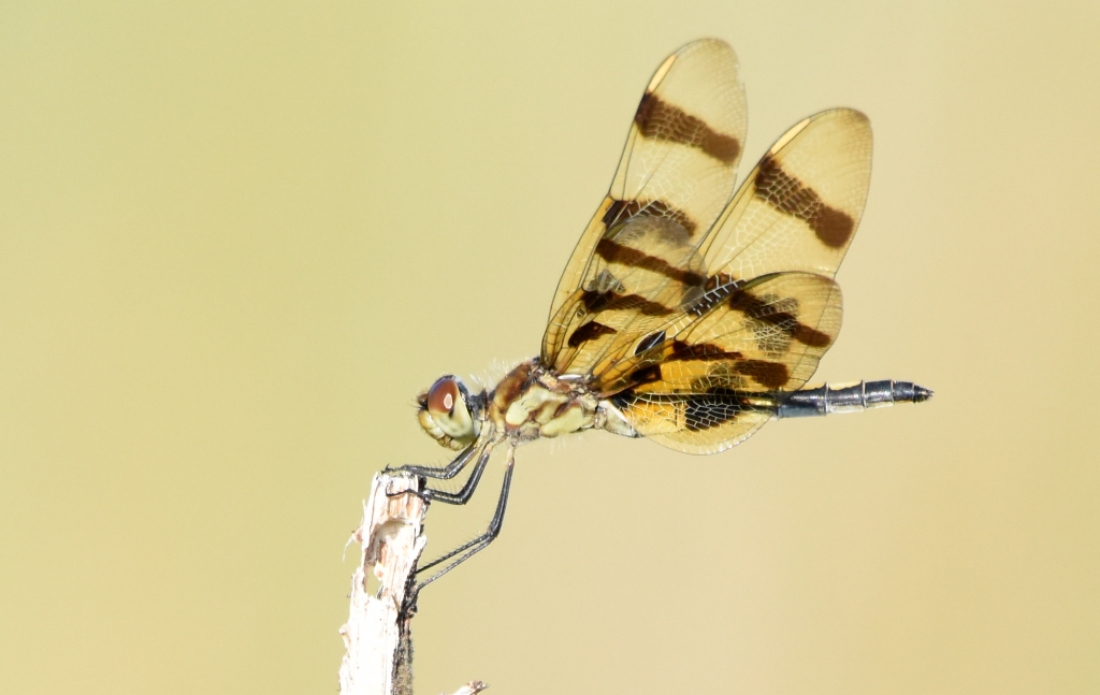
Halloween Pennant Dragonfly

The other thing I didn’t know about dragonflies, beside the fact that there are so many of them, is that male and female dragonflies often look distinctly different—they can even be different colors! Dragonflies, in fact, come in a wide variety of colors including blue, green, red, yellow, orange, black, pink, and brown. I never knew that before taking my picture walks!

Dot-tailed Whiteface Dragonfly

I’ve also had lots of bird surprises—the biggest one coming just a couple of days ago when a Common Grackle landed right in front of me with a very large tadpole in its beak. The tadpole was so big that I thought, at first, it was a fully grown frog–and then I noticed the long tail! I had no idea that Grackles were meat eaters! This prompted me to do a little research…

“The Common Grackle eats mostly insects, berries, seeds, fruit, and bird eggs, although it is also known to eat frogs, fish and snakes. You could say it will eat whatever food it can find!”

Common Grackle with giant tadpole for breakfast!

Then there’s the Robins. Even though I have seen Robins around me all my life, I really didn’t know much about them.  For starters, I had no idea they liked grape jelly! The other day, though, I caught one gulping it down at our Oriole feeder! What was going on? When I looked for answers, I was surprised to find out that Robins not only like jelly, some of them have even been known to bring worms to the feeder and dunk them in the jelly before swallowing them!! Who knew?

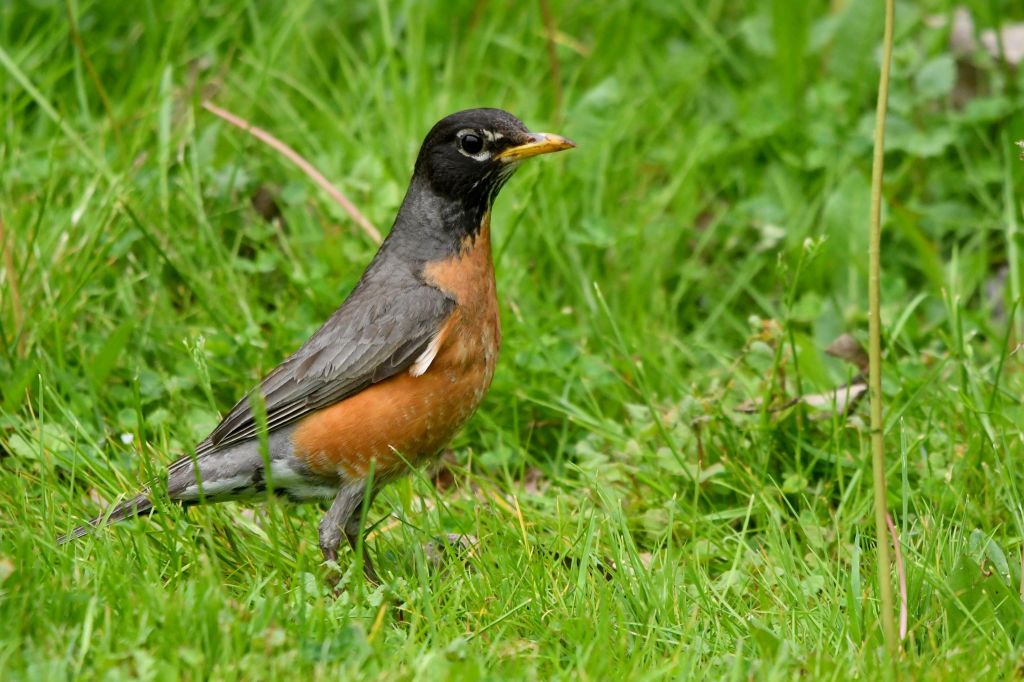
American Robin

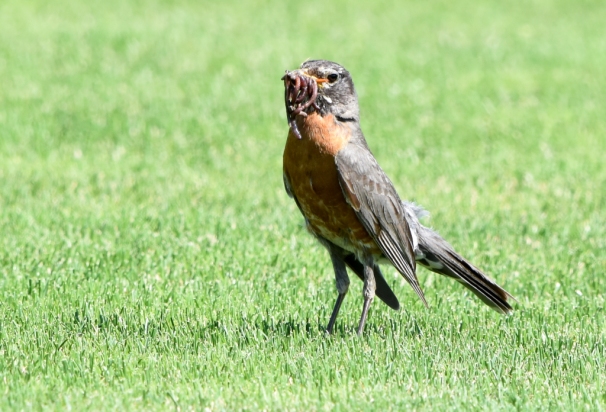
Speaking of worms, I also learned that even with a beak-ful of them, a Robin can dig for more and not lose the ones he already has! Like this!

American Robin

Another bird I’m familiar with, and have photographed often, is the Green Heron– but I knew little about them! The most amazing thing I found out along the way is that this bird is a tool user!! While I have not observed this behavior myself, I hope someday to have that opportunity!

“The Green Heron is one of the world’s few tool-using bird species. It often creates fishing lures with bread crusts, insects, and feathers, dropping them on the surface of the water to entice small fish.”

Green Heron

Last but not least, one of my favorite creatures of the pond, is the very large and very noisy, American Bullfrog. I love hearing them ‘croak’ (which has been described as a “deep, booming, Jug-o’-rummm!” sound), and I love seeing their goofy, expressive faces. What I didn’t know about them, though, is that they have teeth! Really! It’s not a full set of teeth like we have but “North American bullfrogs have teeth in the roof of their mouth and a muscular tongue capable of flipping prey into their mouth.

American Bullfrog

Who knew??