For the Love of Dragonflies!

I love dragonflies! But I didn’t know this until I started taking pictures. Without my camera, and without the ability to bring up pictures on my computer, I had no idea that dragonflies were so beautiful, that they came in such a wide variety of sizes and colors, that their wings were such masterpieces of engineering, or that there were so many different kinds!

Black Saddlebags Dragonfly
Twelve-spotted Skimmer Dragonfly

Over the course of my photography journey, I’ve found almost every color dragonfly imaginable including red, white, blue, green, purple, orange, black, brown, and pink!  These little creatures are not just candy for the eyes, they’re amazing acrobats as well; flying deftly in all directions like miniature helicopters!

Ruby Meadowhawk Dragonfly
Female Blue Dasher Dragonfly

For clarification, there are both dragonflies and damselflies. Collectively, they are known as Odonata. To the casual observer, dragonflies and damselflies probably look the same. They both have 6 legs, a head, and an abdomen; both have two pairs of transparent wings, bulgy eyes, and stick-like bodies. But there are a couple of features that help differentiate the two: body shape and wing position.

American Rubyspot Damselfly
Male Ebony Jewelwing Damselfly

Dragonflies have bodies that are much thicker and bulkier than damselflies and because of their heftier size, it’s more likely that you’ll notice a dragonfly long before you’ll ever see the tiny, delicate-looking damselflies. When dragonflies are at rest, they hold their wings perpendicular to their bodies like an airplane. Damselflies, on the other hand, fold their wings up and hold them together across the top of their backs.

Male Eastern Amberwing Dragonfly
Female Slaty Skimmer Dragonfly

I much prefer the dragonflies to the damselflies, mostly because they’re bigger and much easier to photograph, and because I can more readily capture the details in their wings. Had I been around 300 million years ago, when dragonflies were first evolving, it would have been even easier to get a picture! Those early insects had wingspans of two feet or more! Today’s dragonflies have wingspans of less than five inches!

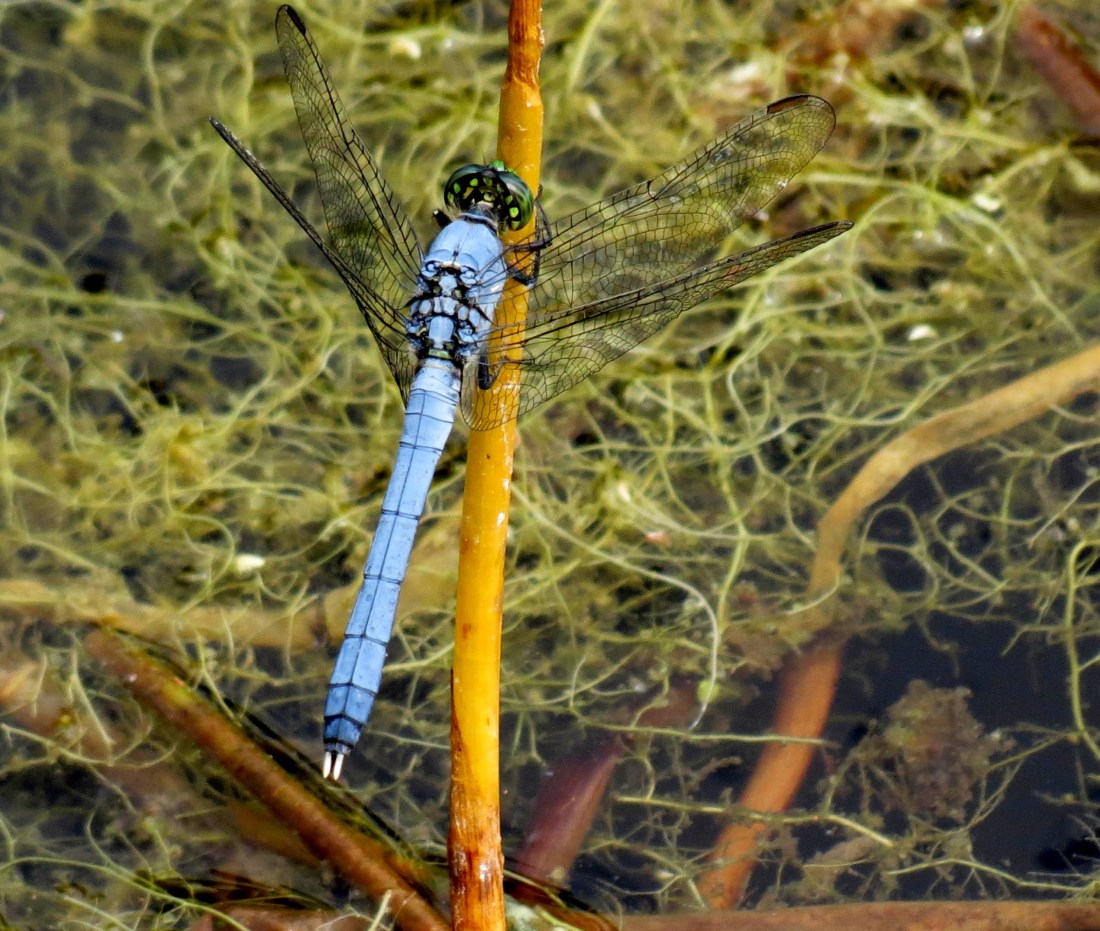
Blue Dasher Dragonfly
Male Roseate Skimmer Dragonfly

Over the years, I’ve found so many different dragonflies that I’ve lost track of how many. Worldwide, there are at least 5000 different species, with dragonflies being much more common than damselflies. They are found on every continent except Antarctica. Here in the United States, there are about 450 different kinds of dragonflies and damselflies. In my home state of Michigan, we have about 165 different kinds, and I’m pretty sure I’ve found most of them!

Male Slaty Skimmer Dragonfly
Male Banded Pennant Dragonfly

What is most interesting to me is their life cycle, and their peculiar sex lives! Dragonflies have three life stages: egg, nymph, and adult. The female lays her eggs in the water throughout the summer where they hatch and grow into nymphs. Some of those nymphs will remain in the water over the winter and emerge as adults the following summer. Some will remain in the water for years! While underwater, the dragonfly nymph will eat just about anything it can grab —tadpoles, mosquitoes, fish, other insect larvae and even each other!

Female Common Whitetail Dragonfly depositing eggs in the water

When the nymph is ready to metamorphose into an adult, it stops eating and makes its way to the surface of the water where it climbs up a reed and crawls out of its larval skin or exoskeleton. Once it emerges from its exoskeleton, the dragonfly becomes a skillful and prolific predator. Nearly every minute of its day is spent devouring the insects that annoy us —like mosquitoes, gnats, cicadas, and flies! One dragonfly alone can eat hundreds of mosquitoes a day! Predators that like to eat dragonflies include birds, fish, frogs, bees, bats, spiders, and other dragonflies!

Eastern Kingbirds LOVE dragonflies
Eastern Kingbird feeding dragonflies to her babies

Dragonfly sex is a rough-and-tumble affair. Their sexual coupling requires the flexibility and acrobatic skill of a “Cirque de Soleil” performer. During mating, the male grasps the female at the back of the head, and the female curls her abdomen under her body to pick up sperm from the male’s secondary genitalia at the front of his abdomen, forming a “heart” or “wheel” shape. In the process, females get bitten, males get scratched, and sperm winds up all over the place! After the deed is done, mama dragonfly lays her eggs by tapping the surface of the water repeatedly with her abdomen, or by shaking the eggs out of her abdomen as she flies along, or by placing the eggs on vegetation.

Halloween Pennant Dragonflies mating (male at the top)
Female Shadow Darner Dragonfly depositing eggs

Unfortunately, loss of wetland habitat is a big threat to our dragonfly populations around the world. At least one in ten species of dragonfly are threatened with extinction, according to the first world survey of their numbers. The loss of a dragonfly population threatens the loss of other creatures in that food chain. Ultimately, the loss of any one species is a loss for all of us.

Dragonfly Eyes

Nearly all of the dragonfly’s head is eye, so they have incredible vision that encompasses almost every angle except right behind them. Their compound eyes have up to 50,000 individual lenses, and they can see a wider spectrum of colors than humans. (photo by Mel Church)

Butterfly Ears and Other Surprises

January 7, 2020

I was looking back over my pictures from these last few years and was amazed at all the things I’ve seen, all the things I’ve learned, and all the things that have totally surprised me.

I was surprised to learn that only male painted turtles have these incredibly long nails!
They are used to grab on tight to the female during mating!

I’m not sure yet what my biggest surprise has been, but yesterday morning a memory popped up on my Facebook page from January of 2018 that started me thinking.

It was a very cold and snowy January day and I had been walking tentatively through deep snow across a semi-frozen creek near my home when I happened upon a Great Blue Heron! It was standing rigidly and alone in a large expanse of snow like a one-legged sentry keeping watch over the manor. Of all the things I expected to see that day, a Great Blue Heron was not one of them! I had assumed they had all left for the winter and were basking in the sun some place far south of here.

Great Blue Heron standing sentry in the snow

When I finished my picture walk that day, I immediately went to my computer to research ‘great blue herons in the snow’. I found out that they can, indeed, be here in Michigan in January, but “generally move away from the northern edge of their breeding range in winter.” Smart birds! If they do stay, Great Blue Herons will find patches of open water to feed on small fish or crustaceans that are hanging out along the edges. But, when the fish aren’t available, herons will eat mice, voles, and small birds. “One hungry heron was seen chowing down a litter of feral kittens.” Oh my.

I was surprised to find out that dragonflies and damselflies could have mites, or parasites on their bodies– sometimes dozens of them! (Look for the small red dots on the underside of this dragonfly near its legs.)

Another thing that has surprised me over the years is how many different dragonflies and damselflies there are, how many different colors they display, and what unusual mating practices they engage in!

According to my research, there are about 5,000 species of Odonata (dragonflies and damselflies) worldwide; here in Michigan, there are about 162! I don’t know how many actual colors they come in, but I’ve seen green, blue, brown, black, white, red, pink, gold, yellow, orange and purple! Who knew?

During mating, the male dragonfly (or damselfly) grasps the female at the back of the head and the she curls her abdomen under his body to pick up sperm from the male’s secondary genitalia at the front of his abdomen, forming the “heart” or “wheel” posture. It’s a rather peculiar set up, I thought!

Another insect that surprised me was the butterfly. I didn’t know that they had taste receptors in their feet or ears in their wings!! “The ears consist of membranes that are stretched taut over oval holes, and that vibrate when incoming sounds hit them.” Before 1912, scientists thought all butterflies were deaf, but discovered that these insects respond to the human voice and to the sounds of birds during flight. The receptors, scientists discovered, were in the butterfly’s wings! What a handy skill to have if you didn’t want to be somebody’s lunch!

I was also amused to learn that a group of butterflies is called a ‘flutter” and that a group of butterflies gathered together to drink from a mud puddle is called a ‘puddle club’! Too funny!

One more surprise came while I was out taking pictures and came across a Black-capped Chickadee that looked as if it was injured. But, when I moved closer to see if I could help, the bird quickly flew away. My little chickadee was apparently engaged in a behavior called ‘sunning’ and did not need any help from me!

Black-capped Chickadee ‘sunning’ itself

“Bird sunning is the act of spreading out in full sunshine to expose plumage and skin to direct sunlight.” The main reason birds do this is to maintain the health of their feathers.  Sunning can dislodge parasites. If birds don’t rid themselves of these parasites, they can infect the bird’s  feathers and cause problems for flight, insulation, and appearance– all of which impact survival. Hundreds of different bird species engage in ‘sunning’ behaviors!

Every time I go for a ‘picture walk’, I learn something new!