Backyard Birding in Winter

January 24, 2026

Most of the country is now in the midst of a huge winter storm. When I got up this morning, the temperature was -12°F! The wind chill factor yesterday was a whopping 19 degrees below zero!! But, hey, when the sun is shining, it doesn’t seem that cold– especially when you’re inside looking out!

Male Northern Cardinal on a frigid winter day!

When it’s this cold, I do love the challenge of trying to stay warm and taking pictures at the same time! I wear multiple layers of clothing, heated socks, clunky over-boots, a warm hat and mittens, and two hand warmers stuffed into my pockets. I don’t venture far from the house on days like this, though. I like to duck inside every once in a while for a warm-up. Besides, everything I need to see is right outside my back door.

Dressed for success!!

To bring the birds in a little closer to where I’m taking pictures, I sprinkle a handful or two of sunflower seeds, mealworms, and peanuts on a nearby tree stump. It’s fun for me to watch how long it takes the birds to find this stash, and to see who finds it first; usually it’s the Dark-eyed Juncos, or the Blue Jays.

Female Dark-eyed Junco waiting patiently for her turn at the seeds
blue Jay quickly scarfing down peanuts from our backyard tree stump

A little later, the Northern Cardinals show up on the stump, and sometimes the Common Grackles or the Red-bellied Woodpeckers. The Starlings are nearby raiding the peanuts from our platform feeder rather than the stump!

Female Northern Cardinal
Common Grackle
Red-bellied Woodpecker
Common Starling waiting for a turn on our platform feeder

In the nearby trees, I might also have the joy of finding a Pileated Woodpecker, a Northern Flicker or, on rare occasions, a Red-tailed Hawk or a Sharp-shinned Hawk!

Pileated Woodpecker
Yellow-shafted Northern Flicker
Red-tailed Hawk
Sharp-shinned Hawk that landed briefly

I love standing under the shelter of our second story deck and surveying our backyard for hours on end capturing the rhythm of the day; making mental notes about which birds are most likely to visit, who’s the bravest, what treat they like the best, and who’s the hardest to photograph.

Female Dark-eyed Junco on an empty stump!

The most common winter visitor to my tree stump is the Dark-eyed Junco. There are plenty of them around and they are ground feeders. They’re used to looking for food down below rather than up in the feeders overhead where most of the other birds like to go. Juncos also hop around in the snow next to the stump looking for seeds that other birds have dropped or knocked off the edge.

Male Dark-eyed Junco looking for seeds in the snow

One of the bravest birds, I think, is the Black-capped Chickadee. It seems fearless to me. On the rare occasions where I’ve tried feeding our backyard birds by hand, only the chickadees have taken me up on the offer. Surprisingly, the bigger birds have been much too wary. When I feed the birds by hand at the Kensington MetroPark in Milford, Michigan, the Chickadees are often the first to take food from my hand as well. Perhaps the bigger birds, like the Cardinals and the Blue Jays see my skinny little hand as too precarious a perch for them even with an offer of food!

The Black-capped Chickadees love peanuts!

The favorite food for most of the birds is definitely peanuts. Those disappear quickly, especially when the Blue Jays take over! They’ll grab 7 or 8 peanuts in quick succession and return for more! When they take this many peanuts at a time, most will be stored in their crop, an expandable pouch in the Jay’s esophagus that temporarily holds food. The crop allows Blue Jays to transport a large number of seeds or nuts to other locations and store them for future use. Before taking flight, I often see the Blue Jays carrying two or three additional peanuts in their beaks!

Blue Jay taking more than his fair share!

One of the potential ‘stump feeders’ that I love to see but rarely capture is the Carolina Wren. Every winter, except this one, I’ve had one come to the feeders on our deck where I could easily watch it from the comfort of my living room chair. This cute little wren came so regularly that I assumed it was the same bird year after year and I referred to it fondly as my Carolina Wren. I can’t say it ever landed on the stump, but it did occasionally sit nearby.

Carolina Wren sitting nearby

The most difficult birds for me to photograph have been the Black-capped Chickadees and the Tufted Titmice. They fly in, grab a seed, and disappear! I can barely spot them through the lens of my camera before they’re gone! I have dozens of ‘bird-less’ pictures to show for it! Once they’ve grabbed a seed, off they go to peck it open. If they land on an open branch, one that’s not obstructed by a tangle of other branches, I can sometimes get a decent shot. But these birds are small and quick and blend in perfectly with the trees. It’s so much easier to photograph a cardinal!

Black-capped Chickadee sitting on a limb that we attached to our deck for photo-ops like this!
Tufted Titmouse momentarily resting!

Most of the time when I’m backyard birding, only the ‘regulars’ show up (sparrows, juncos, jays etc.), but every once in a while, there’s a surprise, like the Sharp-shinned hawk that landed briefly, or the Cedar Waxwing that sat for a while in a nearby honeysuckle bush, or the Yellow-bellied Sapsucker that paused momentarily on our aging dogwood tree less than 10 feet from where I was standing! He was so close that I was afraid any movement on my part would scare him away.

Cedar Waxwing in the Honeysuckle Bush
Yellow-bellied Sapsucker on the Dogwood Tree

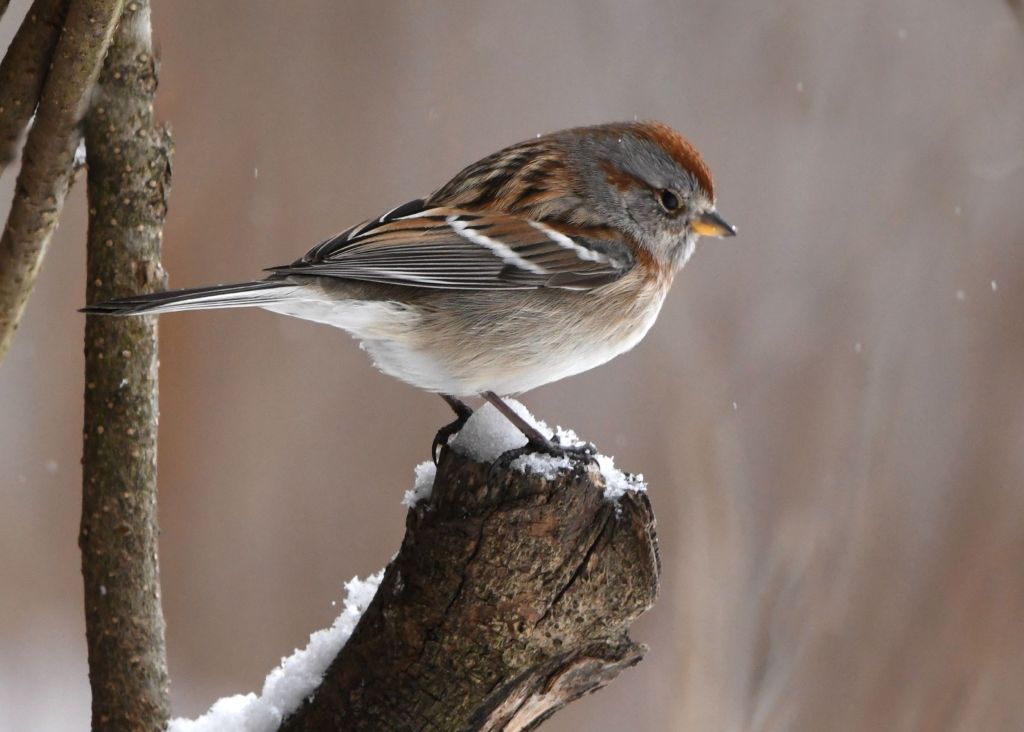
I’ve stood outside my back door taking pictures many, many times over the last several years through every season and all kinds of weather. It never ceases to amaze me how many different birds there are right in our own backyard; birds I’d never even heard of before, like White-throated Sparrows, American Tree Sparrows, Fox Sparrows, and White-crowned Sparrows!

White-throated Sparrow
American Tree Sparrow
Fox Sparrow
White-crowned Sparrow (May 2021)

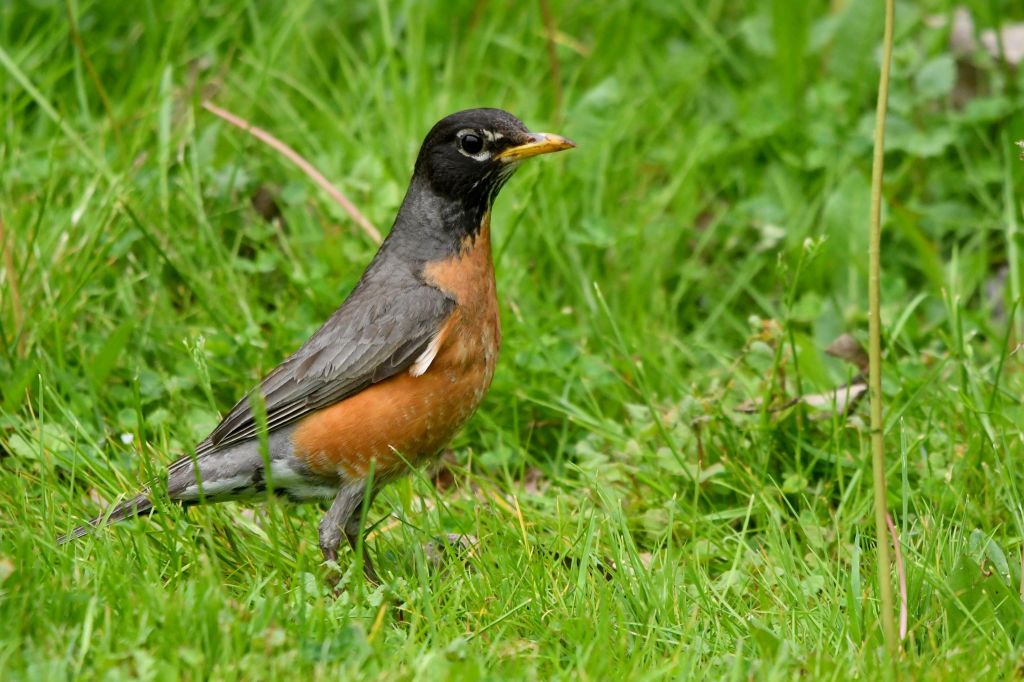
There are also birds that, early on in my photography life, I didn’t even know were here in the winter like the goldfinches, robins, and bluebirds.

American Goldfinch
American Robin
Eastern Bluebird

And there are the regular, everyday birds, like the House sparrows, House Finches and White-breasted Nuthatches that come to our yard, or the Downy and the Hairy Woodpeckers that regularly come to the feeders, or the occasional Red-breasted Nuthatch that I rarely ever see!

Female House Sparrow
Male House Finch
White-breasted Nuthatch
Male Downy Woodpecker
Male Hairy Woodpecker
Red-breasted Nuthatch

Once in a while, a few vagrants pass through our yard like this Oregon Junco I photographed in January of 2021, or this rare Orchard Oriole in May of 2021.

Oregon Dark-eyed Junco (January 2021)
Male Orchard Oriole (May 2021)

It never ceases to amaze me that so many different birds come to our backyard! It helps that we’re in a condo association where all of our yards are one big yard, where most of us have feeders hanging from our decks, where there are plenty of trees, and where a lovely little creek passes close by. In the warmer months, that creek is home to Wood Ducks, the occasional Northern Shoveler, and the usual mix of mallards and geese!

Enjoy!

Just Outside My Back Door

We’ve been back to our home state of Michigan for well over a month now after a three-month hiatus in Florida.  I haven’t returned to my usual photography routine of taking pictures every day like I did in Florida or like I did through most of the pandemic years when all my regular routines were put on hold and I had time to pursue this hobby full time.

Male Rose-breasted Grosbeak
Male House Finch

My picture taking days have taken a nose dive since returning to Michigan. It’s not that I’ve lost interest, or sustained an injury, or had a spate of bad weather. It’s pickleball. I’ve been distracted by pickleball.

Blue Jay
Male Barn Swallow

There are pickleball courts right next to our condo, and there’s a whole community of pickleball enthusiasts nearby who are readily available to play. It’s impossible for me to stay home if I know there’s a pickleball game going on.  As a result, I haven’t gone on any ‘field trips’ this spring or gone for many picture walks.

A male Grackle enjoying my peanuts and seeds
White-crowned Sparrow
European Starling

Mostly, I’ve been finding an hour or two here and there to stand outside our back door with my camera in hand to take pictures of all the usual suspects: woodchucks, woodpeckers, chipmunks, squirrels, white-tailed deer, and a wide variety of colorful songbirds.  They’re all back there carrying on with their busy, productive lives even when I’m not there to document it.

Eastern Cottontail
Young house sparrow begging for food!

The most interesting critter in our backyard has been the local woodchuck. I was standing outside our back door taking pictures of all the different birds landing in the nearby trees when I noticed movement about 50 feet from where I was standing. When I zoomed in on the mystery creature, I discovered it was a mama woodchuck transporting her little babies, one by one in her mouth from point A to point B. I’m not sure why she was moving them, but it was so much fun to watch! By the way, did you know that those little babies are called chucklings? I loved learning that little bit of trivia!

Mama woodchuck with one of her several babies

Then, the other day a red-headed woodpecker showed up! I rarely ever see them, and I’ve never seen one in our backyard! Getting a picture of a red-headed woodpecker was almost as exciting as getting one of a pileated woodpecker, but the pileateds are regular visitors to our yard, and the red-headed woodpecker was definitely not! So it was a great find!

Red-headed Woodpecker
Downy Woodpecker

The cutest little visitors are the chipmunks and the squirrels. They’re everywhere out there eating the fallen birdseed, digging holes everywhere in the grass, and constantly trying to steal birdseed from our second story feeders.  But, they’re so darned cute and so photogenic I’m inclined to think of them as entertainment rather than irritating pests.

Chipmunk
Hot squirrel!

Among the most stunning creatures in our backyard are the wood ducks, the Baltimore orioles, the white-tailed deer, the yellow warblers and, perhaps, even our resident turkey. In all fairness, though, all the creatures I photograph are beautiful to me.

Wood Duck on Cherry Creek behind our house
One of our local turkeys!

I feel quite lucky to have such a wide variety of interesting creatures right outside my back door and I treasure all the opportunities I have to photograph them.

White-tailed Deer wondering what I’m up to

There’s no need to travel far to be amazed.

White-tailed fawn at the edge of the small wooded area behind our row of condos

On the Road Again

June 5, 2023

We just returned from our first real get-away adventure in almost three years. For the better part of the last three years, we had stayed close to home waiting for the pandemic to end. When it was mostly over, and we were ready to travel, our aging dog could no longer go with us or stay in a kennel. She needed a great deal of care. On April 18th of this year, we had to say our final goodbyes. It was a bittersweet moment in time. After a stressful, isolating pandemic and a heart-wrenching year of doggie hospice, we needed to cut loose.

Our dear, little dog, Brandy who had a long, slow decline.

We headed out to the Driftless Area of Wisconsin. My husband, Mel, had registered to attend a Tenkara fishing get-together/campout near Westby, Wisconsin and I tagged along to take pictures. After three years of home-grown subject matter, I was eager to explore a new environment.

A beautiful columbine growing along the roadside

The Driftless area is approximately 8500 square miles of land, mostly in Southwest Wisconsin, that was untouched by glaciers during the last ice age. The term “driftless” indicates a lack of glacial drift, the deposits of silt, gravel, and rock that retreating glaciers leave behind. As a result, the landscape is characterized by steep, limestone-based hills, spring fed waterfalls, deeply carved river valleys, and the largest concentration of cold-water trout streams in the world! It was a perfect place for Mel to go Tenkara fishing.

Viceroy Butterfly
Monarch Butterfly

Tenkara is a method of fly fishing that originated in the mountains of Japan. It uses very long rods with fixed lengths of casting line attached to the rod-tip, and simple, wet flies as lures. This method of fishing was developed to catch trout in free-flowing rivers like the ones found in the Driftless Areas of Wisconsin. I don’t fish, but I was happy enough to go wandering down the back roads near where Mel was fishing to look for birds, butterflies, dragonflies, and flowers; but not GNATS!

Male Eastern Bluebird

Those little buggers came at me with a vengeance! They were in my eyes, ears, nose, and mouth. They were on my sweaty skin. They landed wherever they could find moisture! Gnats are drawn to the carbon dioxide we exhale, as well as the sweet, fruity smells of our shampoos and lotions. There’s no way to get away from them! I was just one giant, sweet-smelling moisture buffet!

Deer on the edge of the road who was curious about my presence
American Toad looking grim!

I hustled back to the car as fast as I could to see if my insect repellent Buff would help. (https://www.buff.com/us/insect-shieldr-neckwear) A Buff is a long tube of thin material that you can pull over your head to cover everything but your eyes. My eyes were protected, at least somewhat, by my glasses. The Buff was a tremendous help; it allowed me take pictures, but it didn’t stop all the gnats who really wanted to get me from crawling into my Buff or going behind my glasses! I did have bug repellent on, but it was no match for these guys! Later, we went to a store and found a repellent that was recommended for gnats and it seemed to work for about an hour before needing to be replenished. It was a welcome relief!

Me and my Buff fending off the gnats!!

In spite of the gnats, and the unseasonably hot temperatures, it was good to be on the road again; to engage in our favorite hobbies in a new environment, to sleep outside in our tent and hear the barred owls calling, “Who cooks for you? Who cooks for you?” and to wake up in the morning to the sound of birds filling the air with their joyful noise. It was a welcome respite from the unwelcome ‘noise’ in our everyday lives.

Dot-tailed White-faced dragonfly in the obelisk position to cool off

In just a few days, we’ll be on the road again; to the Boundary Waters of northern Minnesota for a five-day canoe trip with friends.

Can’t wait!

Great Blue Heron overhead (note the shadow of its head on the lower wing!)
A teeny tiny Ruby-throated Hummingbird high up on a utility wire!
Snapping Turtle feasting on the tadpoles
Red-spotted Admiral butterfly

A Dog Named Norman

April 10, 2023

One of the many joys of a picture walk is never knowing what I’ll find or who I’ll meet along the way. Yesterday, I met a dog named Norman. It brought a smile to my face. Why would anyone name a dog, Norman, I wondered? It seemed like a very formal moniker for such a small, scruffy little beast. So, I posed the question to the human attached to the other end of the leash, “Why Norman?”  

“Well,” she said, “I named him after my dad who recently passed away.”

Black-capped Chickadee
White-tailed deer, a common visitor on my walks

That was even funnier, I thought, to name a dog after your dead parent, but I kept my chuckle to myself.  Instead, I shared the fact that my own father was also deceased and was also named Norman! For the life of me, though, I couldn’t even imagine naming a dog after my dead parent! It just didn’t seem right–and it conjured up an unappealing visual in my head of walking my dad on a leash and cleaning up all his messes!

Male Wood Duck

Earlier in the day, long before I met up with Norman, I had been walking along the creek behind our house hoping to find a wood duck in the early morning light. I expected one to swim out from the cattails along the bank, but it splashed down suddenly in the water next to me and jolted me out of my quiet reverie! Later, I was pleasantly surprised to find a female northern shoveler and a male blue-winged teal swimming in close proximity to the newly-arrived wood duck. What a great find! Both the shoveler and the teal are rare visitors to our creek!

Once the early morning light started to change, and no longer had that soft golden glow, I wandered through the woods adjacent to the creek and headed over to a nearby preserve where I hoped to find a loon.  I had never seen a loon here in Michigan, but knew that one had recently been spotted on the lake at the preserve and hoped I’d get a picture!

Common Loon

It took me awhile to find the loon. It’s not a very colorful bird, and it does have a habit of swimming rather low in the water. Even on a relatively small body of water, like the one I was visiting, loons can be difficult to spot.

The painted turtles were out in droves!
Male Mallard flying by

While I had my camera focused on the loon, something in my peripheral vision distracted me. It was an Osprey flying towards me on the left with a good-sized fish in its talons!! I turned to take its picture and didn’t have time to change the settings on my camera. I just started shooting as fast as I could and hoping for the best! In photography, this method of shooting is often called ‘spray and pray!’ Sometimes it works, sometimes it doesn’t. But it’s always worth a try.

My ‘spray and pray’ shot of the Osprey with the fish!

As I continued walking around the lake, I was delighted to find two great blue herons in relatively close proximity to one other! I’ve never seen two blue herons at the same time except at a rookery. A short time later, I spotted a third!

Great Blue Heron

One of the birds that never takes me by surprise is the Canada goose! It’s absolutely everywhere, but quite easy to overlook as a desirable photography subject. Even the most mundane of subjects, like the Canada goose, though, can make for a beautiful photograph given the right circumstances and a little bit of ingenuity. If nothing else, Canada geese are great subjects for practicing one’s photography skills; they’re not hard to find, they’re easier to photograph than smaller, flightier birds, and they really are stunning in their own right.

Canada Goose in peaceful repose only a few feet from where I was taking pictures of the wood duck
A busy little muskrat taking a snack break along the edge of Asylum Lake

On this particularly warm spring day, I also saw swans, turtles, grackles, and one very busy muskrat chewing away on something tasty; totally oblivious to my presence. Up in the trees surrounding the lake, there was a musical assortment of robins, chickadees, bluebirds, red-winged blackbirds, golden-crowned kinglets, yellow-rumped warblers, and one little brown creeper scurrying up a tree.

Eastern Bluebird
Little Brown Creeper scurrying up a tree

I always head out on these picture walks wondering what kinds of surprises I’ll find or who I’ll meet along the way. Yesterday, my best surprise was the osprey with the fish, but the funniest surprise was the dog named Norman, and the story of his name. I’m still smiling!

Sandhill Crane

Waiting for Spring

February 22, 2023

Male Red-winged Blackbird

On February 12th, I saw my first red-winged blackbird for the season! It seemed too early, I thought. I didn’t expect them to return until March. Within a week, though, I heard a whole chorus of red-winged blackbirds singing in the cattails down by the creek behind our house. It’s the quintessential sound of spring and I love it!  I wanted to throw open all our windows and soak up that first glimmer of hope that spring would soon be here in earnest.

Backyard Blue Jay in the early morning light

But as I write this, I’m snuggled up in front of a fire, with a hot cup of tea close by, hoping we won’t lose power during the upcoming ice storm. All the schools are closed, and so are many businesses, hoping to avoid disaster. The ice storm might materialize, it might not. Such are the vagaries of winter in Michigan: one day it feels like spring, and the next day it feels like we’re living in Antarctica.

Canada Goose making a dramatic landing on the ice!
Male Mallard flying in close!

I basically have a love/hate relationship with winter. I love the snow, but hate the long overcast days that bring the snow. I love getting pictures of all the winter birds that migrate through Michigan, but hate all the layers and layers of clothing I have to wear to get those pictures. I love a bright, sunny winter day as an antidote to all the gloomy ones, but it’s hard to get a good picture on a brilliant sunny afternoon against a snowy background.

Me all bundled up against the cold!
A happy looking female Mallard on a cold winter day in Michigan

Most of all, I miss the colors and all the warm-weather critters I love to photograph, like the big yellow butterflies, the swampy green frogs, the multitudes of colorful dragonflies, and the iridescent blue swallowtails that nest under the bridge in a nearby park.

Male Hooded Merganser on a layover through Michigan

Before the pandemic and before we had an aging, incontinent dog to care for, we went to Florida for a few months where I could soak up all the colors and all the interesting critters we never see in Michigan.  I have taken pictures of the majestic roseate spoonbills, the brilliant purple gallinules, the pastel pink dragonflies, and a million different Florida flowers! It’s a wonderland of color that I had come to depend on to get me through the drab days of a Michigan winter.

Roseate Spoonbill in Florida
Periwinkle Pinwheel (I think)

In the meantime, I have been out looking for whatever beauty I can find wherever I can find it, and taking lots of pictures. Whether it’s a chickadee in a snowstorm, a woodpecker on a sunny day, a snow-covered deer in our backyard, or a ubiquitous brown fox squirrel peeking out around a tree in the early morning light, it’s all good, and it’s all fun.

Yellow-shafted Northern Flicker
White-tailed deer right outside our back door

I just wish winter didn’t last so long!

Find the Joy

November 21, 2022

“If you choose not to find joy in the snow, you will have less joy in your life but still the same amount of snow.” Anonymous

I love this quote– and the snow!

The Carolina Wren sings a very joyful song

It’s hard not to feel a certain child-like wonder when the first big flakes of snow fall from the sky and transform our world into a winter wonderland.  I love sitting by the fire with a hot cup of tea in my hands watching the snow pile up outside our window and marveling at the little songbirds as they fluff up their feathers to ward off the cold. I’d like to invite them in for a while to warm up. Instead, I put on three layers of pants, three shirts, a balaclava, a fuzzy hat, a down coat, a neck warmer, mittens, and boots, and join them, camera in hand.

American Robin on a snowy day enjoying a crabapple tree

For the last several days, the snow has been falling almost non-stop!  The birds don’t seem to mind, though, and are flitting about everywhere, enjoying the easy source of food in our feeders and occasionally taking sips of warm water from the birdbath. I’ve taken hundreds of pictures of them hoping to find among the mix, one of the ‘vagrants’ –birds who are part of a phenomenon known as an ‘irruption’ which is currently taking place across eastern North America.

Downy Woodpecker on a very snowy day!

An irruption is a sudden change in the population density of an organism. In the lives of our feathered friends, an irruption occurs when the birds who live farther north run out of food, and move farther south to find sustenance. Some of the irruptive species here in Michigan include purple finches, redpolls, evening grosbeaks, red-breasted nuthatches, pine grosbeaks, pine siskins, and bohemian waxwings.

These irruptions commonly occur every few years and mostly impact the finches and other species that winter in the boreal forests of Canada and further north. The primary food source for these birds comes from pine cones. When the pine cone crop is poor over the summer, it foreshadows a difficult winter for these birds. The shortage of seeds that the pine cones produce forces these birds to move beyond their normal range in search of food. If multiple types of trees fail to produce a seed crop during the same year, multiple species of birds will move further south.

Eastern Bluebird weathering the elements on a snowy winter’s day
Mourning Dove

Irruptions vary widely in size, frequency, and duration. Some birds will stay in an area for weeks at a time, while others might only stay for a day. Regardless of the size of the flock or the duration of their visit, it’s an exciting time for birders!

Dark-eyed Junco

I would love to see any one of these wayward birds on my picture walks, but I have been happy enough with my usual backyard visitors, as well as the interesting mix of migrating birds that visit Kalamazoo this time of year, like the fox sparrows, the white throated sparrows, the American wigeons and, the very peculiar, Wilson’s snipe.

Wilson’s Snipe, a migrating bird at the Wolf Lake State Fish Hatchery
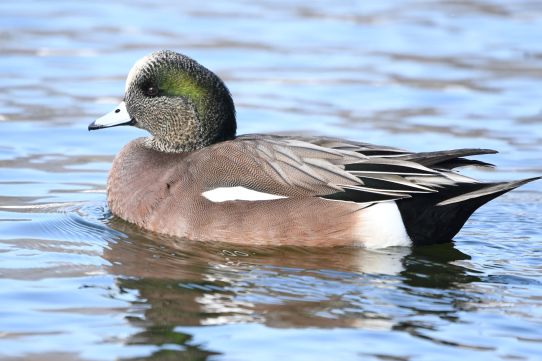
American Wigeon, a migrating bird that visits a nearby pond

I’ve been out in the snow several times recently looking for the evening grosbeaks, the red-breasted nuthatches, and the other ‘irrupters’ who might be passing through, but I have come up empty handed.  On any given picture walk, though, there is always the possibility that something new might come along, and ‘possibility‘ is always a great motivator!

Male Northern Cardinal

On these beautiful, winter days, I love the challenge of bundling up like a kid to stay warm and trudging through freshly fallen snow to photograph a bird, as I revel in the joy that, at age 75, I can still do this! 

Find the joy!

White-tailed deer, one of the other beautiful creatures I often see on my walks

Collateral Benefits

November 4, 2022

This time of year, when all the beautiful summer flowers have died back, when many of the birds and most of the butterflies have already left for the season, and when my favorite amphibian, the American bullfrog, sits in the muck at the bottom of a pond until spring, I’m often hard-pressed to find things to photograph.

My favorite amphibian, the American Bullfrog, before hibernating for the winter
Male Autumn Meadowhawk Dragonfly

On a recent picture walk, for example, I trudged around for hours with my heavy camera equipment slung across my shoulders hoping for at least one tiny bird or one late-season dragonfly to land nearby. But all I managed to capture that day was a chipmunk, a fungus, and a fern!! The fungus and the fern were mostly desperation shots (for lack of anything better to shoot), and the chipmunk, well, chipmunks are just cute. I had hoped for so much more!

Just one of a bazillion adorable chipmunks running around the woods!

As the world is slowly being drained of color, and the weather vacillates wildly from blissfully pleasant to bitterly disgusting, it takes a lot more motivation, and a whole lot more creative thinking on my part to go for a picture walk. It’s so much harder to find things to photograph! My slow deliberate rambles become even slower as I take more time to investigate whether some nondescript plant has any ‘picture potential’. I ponder the possibilities of a curled-up leaf, or a milkweed pod, as well as a host of other ubiquitous things, like mushrooms, mallards, and geese, to see if something ordinary can look extraordinary—or at least interesting! Usually, if I look hard enough and long enough, I’ll find something!

Milkweed Pod bursting forth with seeds

To keep the boredom from setting in, I rotate through a variety of different nature preserves, both near and far. They may have the same birds, and the same dying plants that I have near to home, but the setting is new! I also go out at different times of the day, in different kinds of weather, with one lens or the other, just to mix things up and to keep myself from losing interest.

Eastern Bluebird in a Juniper Tree
Mallard hybrid on a golden pond

Since I started this hobby several years ago, I’ve taken well over 200,000 pictures! I don’t really ‘need’ another mallard, goose, or chipmunk, but I do need all the collateral benefits that come with every walk in the woods, every amble through a field of goldenrod, and every contemplative moment I’ve spent beside a pond watching a bird glide effortlessly along, or a great blue heron stand motionless for hours waiting for lunch to swim by. When I’m out on a picture walk, totally immersed in the task at hand, there’s absolutely no room left in my head for anything else. It’s the perfect antidote to life’s worries.

Great Blue Heron
Lincoln’s Sparrow in a Juniper Tree

It’s those collateral benefits that keep me going back for more.

Everyday Surprises

November 5, 2021

Over the last several years, I’ve gone on hundreds of picture walks and taken thousands of pictures. I often visit the same preserves and nature centers over and over again and take pictures of the very same plants and creatures that I did before. On the surface, this might seem like an extremely boring thing to do; that I would run out of things to photograph that were interesting or novel or fun. The truth is, it never stops being fun. Every day is different and every walk brings new surprises —even if the subject matter is the same.

On rare occasions, the surprise will be a brand-new bird or a brand-new insect! More often than not, I photograph things that I’m already quite familiar with. The surprise comes when that familiar thing is in an unexpected place or shows up at an unexpected time of year. For example, I’ve taken an embarrassingly high number of bullfrog pictures. By any reasonable standard, I don’t need another bullfrog! But a few days ago, on a cool October afternoon, I was surprised to find a big green bullfrog perched comfortably on a log soaking in what little sun he could find. It was barely 50 degrees! I thought all the frogs would be hunkered down staying ‘warm’ under water! So I took his picture– to remind myself that frogs can tolerate much cooler temperatures than I had expected.

Last winter, in late January, I was surprised to find an Oregon Junco sitting in a tree not far from our back deck! Oregon Juncos aren’t usually found this far east, but there he was! After doing a little research, I discovered that on very rare occasions Oregon Juncos will show up in the western lower peninsula of Michigan! I learned something new!

Sometimes, the surprise I find is as simple as getting a picture at all!! Belted Kingfishers, for instance, are notoriously skittish birds. It is impossible to sneak up on one. They always see me coming no matter how carefully I approach. Whenever I’m lucky enough to actually get a picture of one, it’s because I had arrived first and the Belted Kingfisher came by later, totally unaware of my presence!

The secret to finding so many surprises, I think, is to stay curious and to expect the unexpected. Even the most ordinary things can yield extraordinary surprises.

All of the pictures here represent a surprise of one sort or another.

This is the American Bullfrog I found on a cool October day when it seemed much too chilly for any sensible frogs to be out and about!
This is the Oregon Junco that came to our backyard last January. Typically, these birds do not wander this far east. On rare occasions, though, Oregon Juncos will show up in the western lower peninsula of Michigan!
Here is one of the best pictures I’ve ever gotten of a Belted Kingfisher. He didn’t see me because I had gotten there first!
This injured Barn Owl was in an enclosure at a nature center and easy to photograph. The surprise was that the picture turned out at all– there were cage wires between my camera and the owl, but they didn’t show up in the picture!
This injured Juvenile Turkey Vulture was also at a nature center and behind cage wires. I was surprised that the wires didn’t show up in the picture and that I could see such fine detail in the Turkey Vulture’s Face.
This Virginia Giant Fly was a surprise for two reasons: I had never seen one before and it’s such a beautiful insect!
Eastern Bluebirds still surprise me because, for the longest time, I didn’t realize that many of them stay here in Michigan all winter, especially in the lower peninsula where I live.
I was really surprised to find this Monarch Butterfly out and about on a late October day. I thought they had all left!
These Common Mergansers took me by surprise because I rarely see them and they are such beautiful birds!
I always look for Praying Mantises in the late summer and early fall, but they are usually so well camouflaged, that I’m actually quite surprised if I find one– especially if it’s in a good position to photograph!
Dark-eyed Juncos are usually on the ground foraging for food and are hard to notice. This one surprised me by landing up in a tree with colorful leaves in the background making him much easier to spot!
Milkweed pods can disperse a surprisingly large number of seeds–sometimes as many as 200!

The Common Grackle, a bird many people dislike for its aggressive behavior,
is surprisingly beautiful bird in the right light.
I was surprised to learn that White-throated Sparrows sometimes cross-breed with Dark-eyed Juncos!
This Yellow-rumped Warbler was a very pleasant surprise when it landed right where I wanted it to– on this brightly colored stem of a Pokeweed plant.
Even though we see these beautiful Fall colors every year in Michigan, they never cease to surprise and delight me!

When you maintain a sense of curiosity and wonder about the natural world, there will always be surprises!

Winter Photography

February 1, 2020

I love going out on picture walks. It’s one of my favorite things to do! Even in the dead of winter!

Out for a lovely, snowy day in January

By all accounts, this has been a relatively mild winter here in Michigan, so I had been eagerly waiting for a really big snowfall to come along!  We did have a few short bouts of snow in December and January, but it melted quickly. Yesterday, though, on the very last day of January, it finally happened!! We had what I would call “a magnificent snowfall.” Huge, fluffy flakes swirling all around– giving the world that magical snow-globe kind of feeling! It was perfect! I had to get out the door!

Female Northern Cardinal with just a touch of snow
Eastern Bluebirds stay here all winter and enjoy berries like these

Getting out the door, though, was the easy part; trying to stay warm and take pictures at the same time, was not —especially when the wind chill was well below freezing. I can easily put on two or three layers of pants, sweaters, socks and hats, but I cannot do the same for my hands –not if I expect to be able to operate any of the tiny buttons and dials on my camera!  Over the years, I have tried various combinations of mittens and gloves and hand warmers to solve the problem with varying degrees of success –or lack thereof!

Black-capped Chickadee enjoying the snow!
A beautiful Bluejay waiting for his turn at the peanuts

As the weather got progressively colder this winter, I tried yet another new idea. Instead of gloves, I tried two layers of very thin mittens (along with my usual rechargeable hand warmers). I picked mittens instead of gloves so that my fingers could keep each other warm; and I chose thin ones so that I could still feel the buttons on the camera! The inner mitten was a wool blend and the outer one a wind-proof, water-proof shell. So far, this combination has been working at least as well as most I have tried –but the jury is still out. When I’m not actively engaged in taking pictures, I stuff my hands deep into my pockets and hold on to those toasty hand-warmers.

This lovely, little Fox Sparrow was a new bird for me! He was right in my own back yard!
Male Downy Woodpecker

The problem is, most of the birds I encounter are not particularly interested in seeing me with my hands in my pockets standing around doing nothing! As soon as my hands go in the pockets, they start badgering me to take another picture!

“Pick me! Pick me!” they chirp insistently. “I’m the prettiest! Pick me!

How can I resist??

White-breasted Nuthatch with two tiny snowflakes on its beak!
Red-breasted Nuthatch
Contrary to popular belief, many Robins stay here all winter.

So I continue to traipse about for hours on end, encumbered by multiple layers of hats, scarves and sweaters in happy pursuit of the ‘prettiest one’– all the while wondering how these tiny little creatures manage to stay warm with their skinny bare feet and tiny feathered bodies, while I, on the other hand, am barely staying warm.

White-throated Sparrow– another little bird that hangs out in our backyard
American Tree Sparrow on one of our snowiest days

It’s just one of the many fascinating mysteries of nature, I guess. Mysteries that keep drawing me in –and sending me back out for more!

Checking all the Boxes

October 12, 2020

The other day, I was talking with a friend about this hobby of mine that I love–nature photography; about picture walks, about writing a blog, about being outdoors every day. After listening to me ramble on enthusiastically, she said, “It really checks off all the boxes for you, doesn’t it?”

“Well, yes, I guess it does,” I replied.  And then proceeded to get lost in my head visualizing all of those tiny boxes…

Red-eyed Vireo

Box Number One is the ‘exercise box’. I get out and go for a picture walk almost every day. I may not walk fast and I may not walk far, but I do get up and out the door for three or four hours at a crack–sometimes more. At age 73, that might be considered an accomplishment!

Eastern Bluebird

Box Number Two is ‘connecting with nature’. As soon as I arrive at the woods or fields where I’ll be taking pictures, a sense of calm washes over me as I get ready to explore all the possibilities that lay ahead. I am so focused on looking for things to photograph, that I totally forget about anything that might have worried me before I left the house. A picture walk feels so much like a form of meditation that I decided to Google the words “photography as meditation” to see if anything came up.  I was quite surprised to find that not only had articles been written on this topic, there was actually a book with the same title,  ‘Photography as Meditation’!!

Bog Walk

Box Number Three is ‘making connections with others’. One of the things I really like to do after taking my pictures, is to share them with others. There are so many interesting things to see out there! When I share what I’ve found with others, it starts a conversation. Those pictures and those conversations lead to writing a story, such as this blog, which then leads to Box Number Four.

Eastern Phoebe
Great Blue Heron

I love to write. I love pulling my thoughts together and putting them down on ‘paper’. Writing things out forces me to clarify what I’ve seen and what I’ve learned. My hope is that those stories prove interesting or educational or somehow beneficial to someone else. If nothing else, though, the stories I write serve as ‘memory keepers’ for me when, years from now (or maybe next week!) the details of a particular walk will have eluded me!

Fox Squirrel

There are certainly other boxes that could be checked off, such as ‘picture walks vacation destinations’ and ‘picture walks creative projects’, but the four I’ve described are at the very top of my list and are all the motivation I need to get out the door for another day of exploration.

Eastern Bluebird