For the Love of Dragonflies!

I love dragonflies! But I didn’t know this until I started taking pictures. Without my camera, and without the ability to bring up pictures on my computer, I had no idea that dragonflies were so beautiful, that they came in such a wide variety of sizes and colors, that their wings were such masterpieces of engineering, or that there were so many different kinds!

Black Saddlebags Dragonfly
Twelve-spotted Skimmer Dragonfly

Over the course of my photography journey, I’ve found almost every color dragonfly imaginable including red, white, blue, green, purple, orange, black, brown, and pink!  These little creatures are not just candy for the eyes, they’re amazing acrobats as well; flying deftly in all directions like miniature helicopters!

Ruby Meadowhawk Dragonfly
Female Blue Dasher Dragonfly

For clarification, there are both dragonflies and damselflies. Collectively, they are known as Odonata. To the casual observer, dragonflies and damselflies probably look the same. They both have 6 legs, a head, and an abdomen; both have two pairs of transparent wings, bulgy eyes, and stick-like bodies. But there are a couple of features that help differentiate the two: body shape and wing position.

American Rubyspot Damselfly
Male Ebony Jewelwing Damselfly

Dragonflies have bodies that are much thicker and bulkier than damselflies and because of their heftier size, it’s more likely that you’ll notice a dragonfly long before you’ll ever see the tiny, delicate-looking damselflies. When dragonflies are at rest, they hold their wings perpendicular to their bodies like an airplane. Damselflies, on the other hand, fold their wings up and hold them together across the top of their backs.

Male Eastern Amberwing Dragonfly
Female Slaty Skimmer Dragonfly

I much prefer the dragonflies to the damselflies, mostly because they’re bigger and much easier to photograph, and because I can more readily capture the details in their wings. Had I been around 300 million years ago, when dragonflies were first evolving, it would have been even easier to get a picture! Those early insects had wingspans of two feet or more! Today’s dragonflies have wingspans of less than five inches!

Blue Dasher Dragonfly
Male Roseate Skimmer Dragonfly

Over the years, I’ve found so many different dragonflies that I’ve lost track of how many. Worldwide, there are at least 5000 different species, with dragonflies being much more common than damselflies. They are found on every continent except Antarctica. Here in the United States, there are about 450 different kinds of dragonflies and damselflies. In my home state of Michigan, we have about 165 different kinds, and I’m pretty sure I’ve found most of them!

Male Slaty Skimmer Dragonfly
Male Banded Pennant Dragonfly

What is most interesting to me is their life cycle, and their peculiar sex lives! Dragonflies have three life stages: egg, nymph, and adult. The female lays her eggs in the water throughout the summer where they hatch and grow into nymphs. Some of those nymphs will remain in the water over the winter and emerge as adults the following summer. Some will remain in the water for years! While underwater, the dragonfly nymph will eat just about anything it can grab —tadpoles, mosquitoes, fish, other insect larvae and even each other!

Female Common Whitetail Dragonfly depositing eggs in the water

When the nymph is ready to metamorphose into an adult, it stops eating and makes its way to the surface of the water where it climbs up a reed and crawls out of its larval skin or exoskeleton. Once it emerges from its exoskeleton, the dragonfly becomes a skillful and prolific predator. Nearly every minute of its day is spent devouring the insects that annoy us —like mosquitoes, gnats, cicadas, and flies! One dragonfly alone can eat hundreds of mosquitoes a day! Predators that like to eat dragonflies include birds, fish, frogs, bees, bats, spiders, and other dragonflies!

Eastern Kingbirds LOVE dragonflies
Eastern Kingbird feeding dragonflies to her babies

Dragonfly sex is a rough-and-tumble affair. Their sexual coupling requires the flexibility and acrobatic skill of a “Cirque de Soleil” performer. During mating, the male grasps the female at the back of the head, and the female curls her abdomen under her body to pick up sperm from the male’s secondary genitalia at the front of his abdomen, forming a “heart” or “wheel” shape. In the process, females get bitten, males get scratched, and sperm winds up all over the place! After the deed is done, mama dragonfly lays her eggs by tapping the surface of the water repeatedly with her abdomen, or by shaking the eggs out of her abdomen as she flies along, or by placing the eggs on vegetation.

Halloween Pennant Dragonflies mating (male at the top)
Female Shadow Darner Dragonfly depositing eggs

Unfortunately, loss of wetland habitat is a big threat to our dragonfly populations around the world. At least one in ten species of dragonfly are threatened with extinction, according to the first world survey of their numbers. The loss of a dragonfly population threatens the loss of other creatures in that food chain. Ultimately, the loss of any one species is a loss for all of us.

Dragonfly Eyes

Nearly all of the dragonfly’s head is eye, so they have incredible vision that encompasses almost every angle except right behind them. Their compound eyes have up to 50,000 individual lenses, and they can see a wider spectrum of colors than humans. (photo by Mel Church)

Before Pictures: A Photography Journey

July 4, 2022

Before I started taking pictures, there was so much I didn’t know about the world outside my own front door. I didn’t know that dragonflies came in a rainbow of colors, that turtles shed parts of their shells, or that we had cuckoos in Michigan! I didn’t know that cedar waxwings could get drunk eating fermented berries, or that great blue herons would stay here throughout our cold Michigan winters. My enlightenment all started with a Christmas wish.

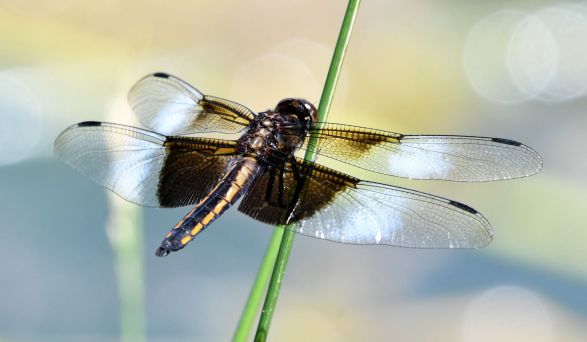
A brown, white and yellow Widow Skimmer dragonfly

In the Fall of 2013, my husband, Mel, started asking me what I wanted for Christmas. I gave his question a good deal of thought and came up with the idea that I’d like to have a better camera. All I had was a pocket-sized Canon PowerShot– a lightweight and easy to carry camera with very limited capabilities.

Michigan’s Black-billed Cuckoo
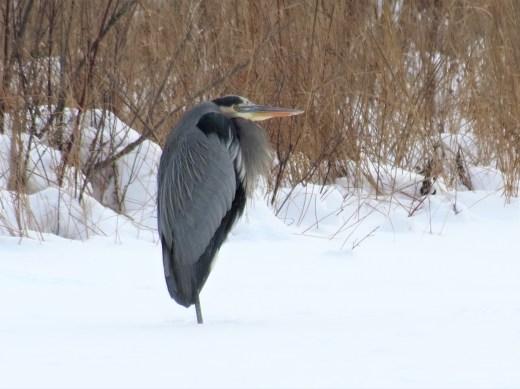
A Great Blue Heron that decided to stay in Michigan for the winter!

Once I told Mel what I wanted, he went to work doing the research and came up with a bigger, better version of the Canon PowerShot that he thought might work. I loved it– and ultimately, dubbed it my “gateway drug”.

Eastern Kingbird babies hoping for lunch!
A giant snapping turtle taking a break on a very hot day!

I happily used that camera on and off for the next three and a half years; taking the usual family photos and typical vacation shots. It wasn’t until we went to Florida in 2016 for our first extended stay that my addiction to nature photography really kicked in. There were so many rookeries, sanctuaries and preserves with new and unusual birds, mammals, and reptiles that I had absolutely no trouble feeding my ‘habit’!

Florida alligator taking a siesta

Eventually though, I started wanting more. I wanted a camera with a faster response time so that the bird on the limb would still be there once I pressed down the shutter button. I wanted to get pictures of the birds and butterflies that were farther and farther away, and I wanted sharper images. Mel went back to work looking for a camera that would do all those things—without causing us to re-finance our home! By July of 2017, I had my new camera, a Nikon D3400 and a detachable 70-300mm zoom lens. I was back in business!

A bright-eyed Yellow Warbler
Common Yellowthroat

At some point along the way, Mel decided to take up his photography hobby again and assumed ownership of my D3400 after finding me a Nikon D5600 to take its place. We were both hooked!

Spiny Softshell Turtle

I loved all the beautiful pictures I could get with my D5600 and the 70-300mm lens, but there were birds and butterflies still out of reach that I wanted to capture! After a bit of research, Mel thought that a Sigma 150-600mm lens might do the trick. I was well aware of the size and weight of this lens based on what I had read, but when it actually arrived, I thought “What on earth have I done??” It looked huge! It felt heavier than I expected and I had serious reservations about my ability to carry it around for hours on end. But, I really, really wanted to take ‘far away pictures’ so off I went, camera and lens in hand.

The BIG lens!

I used that set up for a year or so before my back started telling me that it might be better to add a monopod to my camera in order to support all that weight when I stood for hours taking pictures. Adding a monopod would mean I’d have a little more weight to carry as I walked along, but I wouldn’t have to hold the camera up to my eye unsupported as I patiently waited for the ‘perfect shot’ or tried to pan the movement of a bird in flight. My back has thanked me many, many times over.

Taking pictures using the camera mounted on a monopod– a good back-saver

I used the Nikon D5600 for two or three years along with the 150-600mm lens before totally exceeding the picture expectancy of my camera with over 100,000 shots!! I decided to trade it in for a Nikon D500, a camera that was highly rated for nature photography and has totally lived up to that assessment!

Blanding’s Turtle
Barn Swallow

Before taking pictures, I had already loved going on nature walks– but there was so much I didn’t see! With my camera in hand the world suddenly opened up!! I paid more attention.  I noticed things I had never noticed before– like the subtle movement of a blade of grass that might mean a dragonfly had landed, or the tiny ‘bump’ at the top of a long-dead tree that might mean a hummingbird was resting; or the infinitesimal speck of blue on a shiny green leaf that might mean a damselfly was nearby.

Hagen’s Bluet Damselfy

All of those creatures had been there all along, but I never saw them —until I started taking pictures!