Backyard Birding in Winter

January 24, 2026

Most of the country is now in the midst of a huge winter storm. When I got up this morning, the temperature was -12°F! The wind chill factor yesterday was a whopping 19 degrees below zero!! But, hey, when the sun is shining, it doesn’t seem that cold– especially when you’re inside looking out!

Male Northern Cardinal on a frigid winter day!

When it’s this cold, I do love the challenge of trying to stay warm and taking pictures at the same time! I wear multiple layers of clothing, heated socks, clunky over-boots, a warm hat and mittens, and two hand warmers stuffed into my pockets. I don’t venture far from the house on days like this, though. I like to duck inside every once in a while for a warm-up. Besides, everything I need to see is right outside my back door.

Dressed for success!!

To bring the birds in a little closer to where I’m taking pictures, I sprinkle a handful or two of sunflower seeds, mealworms, and peanuts on a nearby tree stump. It’s fun for me to watch how long it takes the birds to find this stash, and to see who finds it first; usually it’s the Dark-eyed Juncos, or the Blue Jays.

Female Dark-eyed Junco waiting patiently for her turn at the seeds
blue Jay quickly scarfing down peanuts from our backyard tree stump

A little later, the Northern Cardinals show up on the stump, and sometimes the Common Grackles or the Red-bellied Woodpeckers. The Starlings are nearby raiding the peanuts from our platform feeder rather than the stump!

Female Northern Cardinal
Common Grackle
Red-bellied Woodpecker
Common Starling waiting for a turn on our platform feeder

In the nearby trees, I might also have the joy of finding a Pileated Woodpecker, a Northern Flicker or, on rare occasions, a Red-tailed Hawk or a Sharp-shinned Hawk!

Pileated Woodpecker
Yellow-shafted Northern Flicker
Red-tailed Hawk
Sharp-shinned Hawk that landed briefly

I love standing under the shelter of our second story deck and surveying our backyard for hours on end capturing the rhythm of the day; making mental notes about which birds are most likely to visit, who’s the bravest, what treat they like the best, and who’s the hardest to photograph.

Female Dark-eyed Junco on an empty stump!

The most common winter visitor to my tree stump is the Dark-eyed Junco. There are plenty of them around and they are ground feeders. They’re used to looking for food down below rather than up in the feeders overhead where most of the other birds like to go. Juncos also hop around in the snow next to the stump looking for seeds that other birds have dropped or knocked off the edge.

Male Dark-eyed Junco looking for seeds in the snow

One of the bravest birds, I think, is the Black-capped Chickadee. It seems fearless to me. On the rare occasions where I’ve tried feeding our backyard birds by hand, only the chickadees have taken me up on the offer. Surprisingly, the bigger birds have been much too wary. When I feed the birds by hand at the Kensington MetroPark in Milford, Michigan, the Chickadees are often the first to take food from my hand as well. Perhaps the bigger birds, like the Cardinals and the Blue Jays see my skinny little hand as too precarious a perch for them even with an offer of food!

The Black-capped Chickadees love peanuts!

The favorite food for most of the birds is definitely peanuts. Those disappear quickly, especially when the Blue Jays take over! They’ll grab 7 or 8 peanuts in quick succession and return for more! When they take this many peanuts at a time, most will be stored in their crop, an expandable pouch in the Jay’s esophagus that temporarily holds food. The crop allows Blue Jays to transport a large number of seeds or nuts to other locations and store them for future use. Before taking flight, I often see the Blue Jays carrying two or three additional peanuts in their beaks!

Blue Jay taking more than his fair share!

One of the potential ‘stump feeders’ that I love to see but rarely capture is the Carolina Wren. Every winter, except this one, I’ve had one come to the feeders on our deck where I could easily watch it from the comfort of my living room chair. This cute little wren came so regularly that I assumed it was the same bird year after year and I referred to it fondly as my Carolina Wren. I can’t say it ever landed on the stump, but it did occasionally sit nearby.

Carolina Wren sitting nearby

The most difficult birds for me to photograph have been the Black-capped Chickadees and the Tufted Titmice. They fly in, grab a seed, and disappear! I can barely spot them through the lens of my camera before they’re gone! I have dozens of ‘bird-less’ pictures to show for it! Once they’ve grabbed a seed, off they go to peck it open. If they land on an open branch, one that’s not obstructed by a tangle of other branches, I can sometimes get a decent shot. But these birds are small and quick and blend in perfectly with the trees. It’s so much easier to photograph a cardinal!

Black-capped Chickadee sitting on a limb that we attached to our deck for photo-ops like this!
Tufted Titmouse momentarily resting!

Most of the time when I’m backyard birding, only the ‘regulars’ show up (sparrows, juncos, jays etc.), but every once in a while, there’s a surprise, like the Sharp-shinned hawk that landed briefly, or the Cedar Waxwing that sat for a while in a nearby honeysuckle bush, or the Yellow-bellied Sapsucker that paused momentarily on our aging dogwood tree less than 10 feet from where I was standing! He was so close that I was afraid any movement on my part would scare him away.

Cedar Waxwing in the Honeysuckle Bush
Yellow-bellied Sapsucker on the Dogwood Tree

I’ve stood outside my back door taking pictures many, many times over the last several years through every season and all kinds of weather. It never ceases to amaze me how many different birds there are right in our own backyard; birds I’d never even heard of before, like White-throated Sparrows, American Tree Sparrows, Fox Sparrows, and White-crowned Sparrows!

White-throated Sparrow
American Tree Sparrow
Fox Sparrow
White-crowned Sparrow (May 2021)

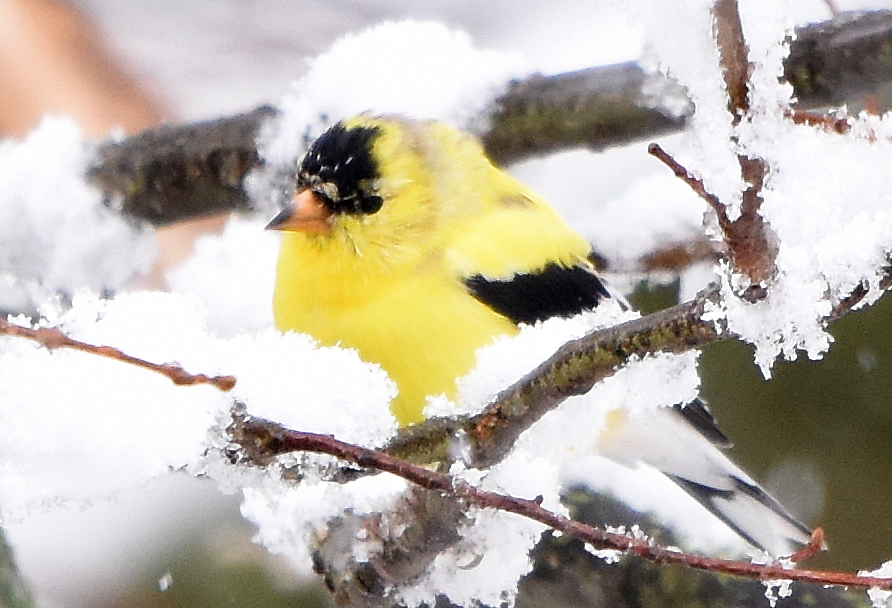
There are also birds that, early on in my photography life, I didn’t even know were here in the winter like the goldfinches, robins, and bluebirds.

American Goldfinch
American Robin
Eastern Bluebird

And there are the regular, everyday birds, like the House sparrows, House Finches and White-breasted Nuthatches that come to our yard, or the Downy and the Hairy Woodpeckers that regularly come to the feeders, or the occasional Red-breasted Nuthatch that I rarely ever see!

Female House Sparrow
Male House Finch
White-breasted Nuthatch
Male Downy Woodpecker
Male Hairy Woodpecker
Red-breasted Nuthatch

Once in a while, a few vagrants pass through our yard like this Oregon Junco I photographed in January of 2021, or this rare Orchard Oriole in May of 2021.

Oregon Dark-eyed Junco (January 2021)
Male Orchard Oriole (May 2021)

It never ceases to amaze me that so many different birds come to our backyard! It helps that we’re in a condo association where all of our yards are one big yard, where most of us have feeders hanging from our decks, where there are plenty of trees, and where a lovely little creek passes close by. In the warmer months, that creek is home to Wood Ducks, the occasional Northern Shoveler, and the usual mix of mallards and geese!

Enjoy!

Find the Joy

November 21, 2022

“If you choose not to find joy in the snow, you will have less joy in your life but still the same amount of snow.” Anonymous

I love this quote– and the snow!

The Carolina Wren sings a very joyful song

It’s hard not to feel a certain child-like wonder when the first big flakes of snow fall from the sky and transform our world into a winter wonderland.  I love sitting by the fire with a hot cup of tea in my hands watching the snow pile up outside our window and marveling at the little songbirds as they fluff up their feathers to ward off the cold. I’d like to invite them in for a while to warm up. Instead, I put on three layers of pants, three shirts, a balaclava, a fuzzy hat, a down coat, a neck warmer, mittens, and boots, and join them, camera in hand.

American Robin on a snowy day enjoying a crabapple tree

For the last several days, the snow has been falling almost non-stop!  The birds don’t seem to mind, though, and are flitting about everywhere, enjoying the easy source of food in our feeders and occasionally taking sips of warm water from the birdbath. I’ve taken hundreds of pictures of them hoping to find among the mix, one of the ‘vagrants’ –birds who are part of a phenomenon known as an ‘irruption’ which is currently taking place across eastern North America.

Downy Woodpecker on a very snowy day!

An irruption is a sudden change in the population density of an organism. In the lives of our feathered friends, an irruption occurs when the birds who live farther north run out of food, and move farther south to find sustenance. Some of the irruptive species here in Michigan include purple finches, redpolls, evening grosbeaks, red-breasted nuthatches, pine grosbeaks, pine siskins, and bohemian waxwings.

These irruptions commonly occur every few years and mostly impact the finches and other species that winter in the boreal forests of Canada and further north. The primary food source for these birds comes from pine cones. When the pine cone crop is poor over the summer, it foreshadows a difficult winter for these birds. The shortage of seeds that the pine cones produce forces these birds to move beyond their normal range in search of food. If multiple types of trees fail to produce a seed crop during the same year, multiple species of birds will move further south.

Eastern Bluebird weathering the elements on a snowy winter’s day
Mourning Dove

Irruptions vary widely in size, frequency, and duration. Some birds will stay in an area for weeks at a time, while others might only stay for a day. Regardless of the size of the flock or the duration of their visit, it’s an exciting time for birders!

Dark-eyed Junco

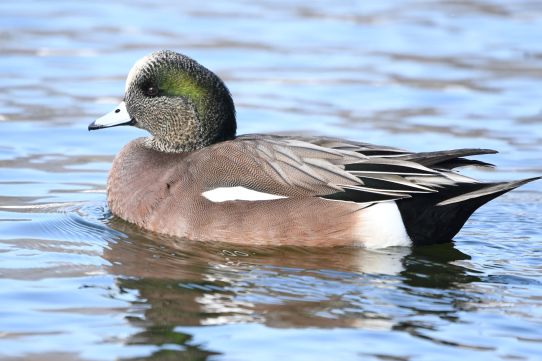
I would love to see any one of these wayward birds on my picture walks, but I have been happy enough with my usual backyard visitors, as well as the interesting mix of migrating birds that visit Kalamazoo this time of year, like the fox sparrows, the white throated sparrows, the American wigeons and, the very peculiar, Wilson’s snipe.

Wilson’s Snipe, a migrating bird at the Wolf Lake State Fish Hatchery
American Wigeon, a migrating bird that visits a nearby pond

I’ve been out in the snow several times recently looking for the evening grosbeaks, the red-breasted nuthatches, and the other ‘irrupters’ who might be passing through, but I have come up empty handed.  On any given picture walk, though, there is always the possibility that something new might come along, and ‘possibility‘ is always a great motivator!

Male Northern Cardinal

On these beautiful, winter days, I love the challenge of bundling up like a kid to stay warm and trudging through freshly fallen snow to photograph a bird, as I revel in the joy that, at age 75, I can still do this! 

Find the joy!

White-tailed deer, one of the other beautiful creatures I often see on my walks

Home Again

April 24, 2020

We are home.

A little over a week ago Mel and I and our two old dogs made a twenty-two hour, thirteen-hundred-mile drive from Florida to Michigan in our small over-stuffed car. We left Florida at 8:00 a.m. on a Tuesday and arrived home at 6:00 a.m. Wednesday morning!

White-throated Sparrow

Common Grackle

Because of the pandemic, we didn’t want to stay at any hotels along the way and we didn’t want to stop anywhere for food. So, prior to leaving Florida, we stocked up the car with ‘survival food’—cookies, muffins, apples, bagels, cheese and nuts. To stay awake, we loaded up a gallon of tea and a half gallon of coffee. To stay hydrated, we included two gallons of water (one for the humans, one for the dogs). With all that liquid to consume, though, we did have to stop occasionally for a bathroom break!

Canada Goose

We are happy to be back home to our familiar surroundings, familiar belongings and familiar routines, but after ten weeks of unrelenting sunshine, it has been an adjustment getting used to grey skies and cold weather. We have even had snow!!

House Finch
American Goldfinch
Black-capped Chickadee
White-tailed Deer

In spite of the weather, I have managed to get out and take pictures almost every day. Thankfully, the ‘stay at home’ orders from our governor have not restricted people from going outdoors as long as they abide by the 6 foot ‘social distancing’ recommendations. Keeping my distance while out on a walk has not been a problem—but having to worry about avoiding people has. It’s hard not to socialize when we are already so isolated!

Male Red-winged Blackbird

My picture walks have always been a source of comfort to me and they are even more so during this pandemic. As soon as I strap on my camera and walk out the door, I feel a sense of calmness wash over me.

Tree Swallows

Ring-billed Gull
Wood Ducks
Tree Swallows

As I amble through the woods and fields, I am so engrossed in looking for things to photograph that it’s easy to forget all the ugliness in the world around me.  And then, when I sort through my pictures at the end of the day, I am reminded of all the beauty that yet remains.

Be safe. Be well. Stay home!

Great Blue Heron

Bundle Up!

January 19, 2020

I’m sitting here in front of a warm fire looking out at the falling snow and the hungry birds flying into our feeders for a bite to eat, and trying to decide how many layers I would have to wear to stay warm on a picture walk today. It’s been snowing (or sleeting) on and off for the past two days and my weather app says the wind chill is below zero. I ultimately decided that the number of layers I would have to wear would probably exceed the number of steps I could take trying to walk– kind of like Ralphie in the movie A Christmas Story.

While contemplating the saneness of leaving my warm fire and my comfortable chair to go for a picture walk, I decided to sort through the pictures I’ve already taken in the last three weeks and then re-evaluate!

I’ll start with New Year’s Eve. The weather was relatively mild then and I was surprised to find so many robins out and about looking for something good to eat. I didn’t expect to even see robins because I had grown up believing that they left for the winter and returned in the spring; that they were, in fact, the ‘harbingers of spring’.

What I found out, though, was that most of our robins just stay put; that we don’t often see them in winter because they spend more time roosting in trees and less time rooting around in our yards. The robins I saw were doing both– roosting in the trees and rooting around on the ground. They had found berries up high and grubs down below.

It seemed like spring when I saw the robins out and about,
but it was still the middle of winter!

The berries that had attracted so many robins had also attracted Cedar Waxwings and Starlings. Interestingly enough, both Robins and Cedar Waxwings have been known to become intoxicated from eating too much fruit that has already become fermented!

This Cedar Waxwing looked a bit ‘tipsy’ as he grabbed for something good to eat!

A few days later, I decided to take advantage of an unusually sunny morning and headed over to the Wolf Lake State Fish Hatchery to catch what I could of the ‘golden hour’. It was a good thing I did because, for the next several days, the weather was gloomy, gray and wet.

Belted Kingfisher– a particularly hard bird to catch!
Trumpeter Swan flying over the Wolf Lake State Fish Hatchery

After enduring several days of dismal weather, I was eager to get out and take pictures again– but it was still raining! I couldn’t take pictures in the rain (my camera would suffer), so I settled for a ‘picture stand’ instead of a ‘picture walk’ by positioning myself under our second story deck and shooting the birds that were perched in the nearby trees.

For the next few days after that, the weather was fairly cooperative and I managed to visit several familiar places plus one new one, the Paw Paw Prairie Fen. My biggest surprise was finding a Great White Egret fishing in a pond near the fen! I rarely see them in the summer, let alone the middle of winter. I also found a Great Blue Heron, but he decided to fly away before I could get a close-up!

On my visit to the Kellogg Bird sanctuary, I was saddened to learn that two of the birds I loved to photograph had died the previous year– a beautiful Mandarin Duck and a rare Red-breasted Goose. Both birds were one-of-a-kind at the sanctuary, so it was particularly sad to lose them.

A lovely American Goldfinch at the Kellogg Bird Sanctuary

Once a month, I like to stop in at the Kensington Metropark Nature Center on my way across the state to babysit my grandson. The birds at Kensington are abundant and fearless. They eagerly anticipate all the visitors who come by and ply them with birdseed. If you stand still and hold out a handful of seeds or peanuts, the birds will land on your hand within a matter of seconds– chickadees, nuthatches, titmice, downies, and sometimes, even the bigger birds will land– like the red-bellied woodpeckers. It’s always delightful!

Red-bellied Woodpecker enjoying my stash of seeds at Kensington Nature Center
Bluejay scooping up the last peanut

In the time it’s taken to write this blog, the temperature outside has gone up one whole degree— time to bundle up and see what’s waiting for me out there!

Here’s what I found…

White-throated Sparrow

So, bundle up and get yourself outdoors!