Backyard Birding in Winter

January 24, 2026

Most of the country is now in the midst of a huge winter storm. When I got up this morning, the temperature was -12°F! The wind chill factor yesterday was a whopping 19 degrees below zero!! But, hey, when the sun is shining, it doesn’t seem that cold– especially when you’re inside looking out!

Male Northern Cardinal on a frigid winter day!

When it’s this cold, I do love the challenge of trying to stay warm and taking pictures at the same time! I wear multiple layers of clothing, heated socks, clunky over-boots, a warm hat and mittens, and two hand warmers stuffed into my pockets. I don’t venture far from the house on days like this, though. I like to duck inside every once in a while for a warm-up. Besides, everything I need to see is right outside my back door.

Dressed for success!!

To bring the birds in a little closer to where I’m taking pictures, I sprinkle a handful or two of sunflower seeds, mealworms, and peanuts on a nearby tree stump. It’s fun for me to watch how long it takes the birds to find this stash, and to see who finds it first; usually it’s the Dark-eyed Juncos, or the Blue Jays.

Female Dark-eyed Junco waiting patiently for her turn at the seeds
blue Jay quickly scarfing down peanuts from our backyard tree stump

A little later, the Northern Cardinals show up on the stump, and sometimes the Common Grackles or the Red-bellied Woodpeckers. The Starlings are nearby raiding the peanuts from our platform feeder rather than the stump!

Female Northern Cardinal
Common Grackle
Red-bellied Woodpecker
Common Starling waiting for a turn on our platform feeder

In the nearby trees, I might also have the joy of finding a Pileated Woodpecker, a Northern Flicker or, on rare occasions, a Red-tailed Hawk or a Sharp-shinned Hawk!

Pileated Woodpecker
Yellow-shafted Northern Flicker
Red-tailed Hawk
Sharp-shinned Hawk that landed briefly

I love standing under the shelter of our second story deck and surveying our backyard for hours on end capturing the rhythm of the day; making mental notes about which birds are most likely to visit, who’s the bravest, what treat they like the best, and who’s the hardest to photograph.

Female Dark-eyed Junco on an empty stump!

The most common winter visitor to my tree stump is the Dark-eyed Junco. There are plenty of them around and they are ground feeders. They’re used to looking for food down below rather than up in the feeders overhead where most of the other birds like to go. Juncos also hop around in the snow next to the stump looking for seeds that other birds have dropped or knocked off the edge.

Male Dark-eyed Junco looking for seeds in the snow

One of the bravest birds, I think, is the Black-capped Chickadee. It seems fearless to me. On the rare occasions where I’ve tried feeding our backyard birds by hand, only the chickadees have taken me up on the offer. Surprisingly, the bigger birds have been much too wary. When I feed the birds by hand at the Kensington MetroPark in Milford, Michigan, the Chickadees are often the first to take food from my hand as well. Perhaps the bigger birds, like the Cardinals and the Blue Jays see my skinny little hand as too precarious a perch for them even with an offer of food!

The Black-capped Chickadees love peanuts!

The favorite food for most of the birds is definitely peanuts. Those disappear quickly, especially when the Blue Jays take over! They’ll grab 7 or 8 peanuts in quick succession and return for more! When they take this many peanuts at a time, most will be stored in their crop, an expandable pouch in the Jay’s esophagus that temporarily holds food. The crop allows Blue Jays to transport a large number of seeds or nuts to other locations and store them for future use. Before taking flight, I often see the Blue Jays carrying two or three additional peanuts in their beaks!

Blue Jay taking more than his fair share!

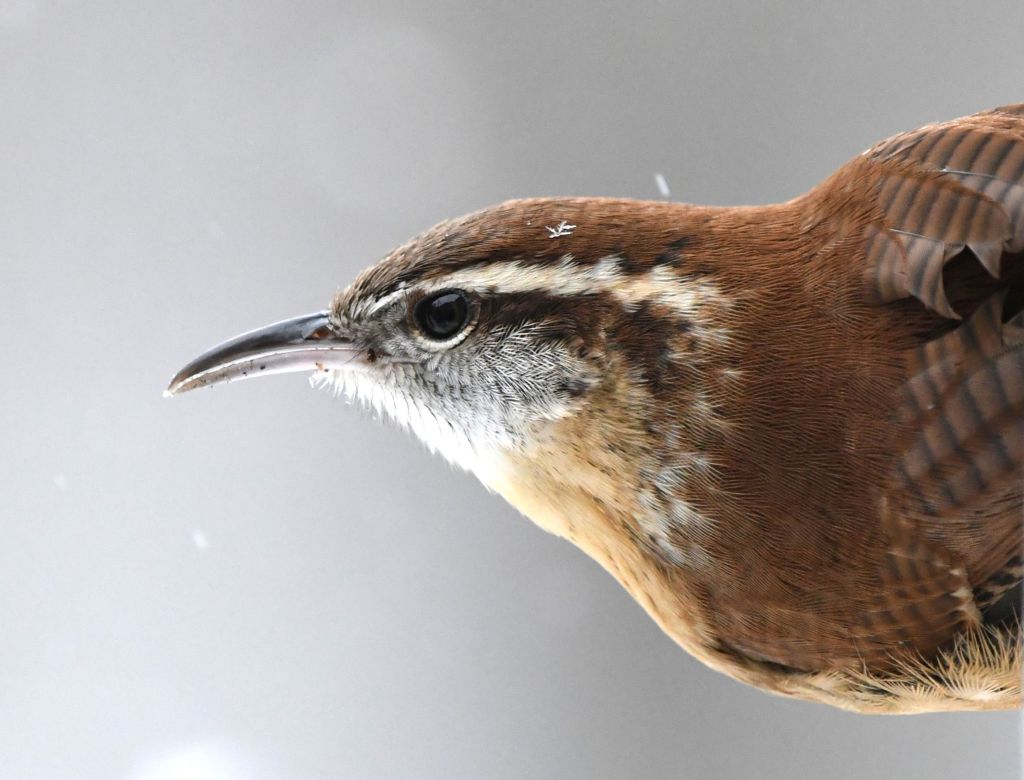
One of the potential ‘stump feeders’ that I love to see but rarely capture is the Carolina Wren. Every winter, except this one, I’ve had one come to the feeders on our deck where I could easily watch it from the comfort of my living room chair. This cute little wren came so regularly that I assumed it was the same bird year after year and I referred to it fondly as my Carolina Wren. I can’t say it ever landed on the stump, but it did occasionally sit nearby.

Carolina Wren sitting nearby

The most difficult birds for me to photograph have been the Black-capped Chickadees and the Tufted Titmice. They fly in, grab a seed, and disappear! I can barely spot them through the lens of my camera before they’re gone! I have dozens of ‘bird-less’ pictures to show for it! Once they’ve grabbed a seed, off they go to peck it open. If they land on an open branch, one that’s not obstructed by a tangle of other branches, I can sometimes get a decent shot. But these birds are small and quick and blend in perfectly with the trees. It’s so much easier to photograph a cardinal!

Black-capped Chickadee sitting on a limb that we attached to our deck for photo-ops like this!
Tufted Titmouse momentarily resting!

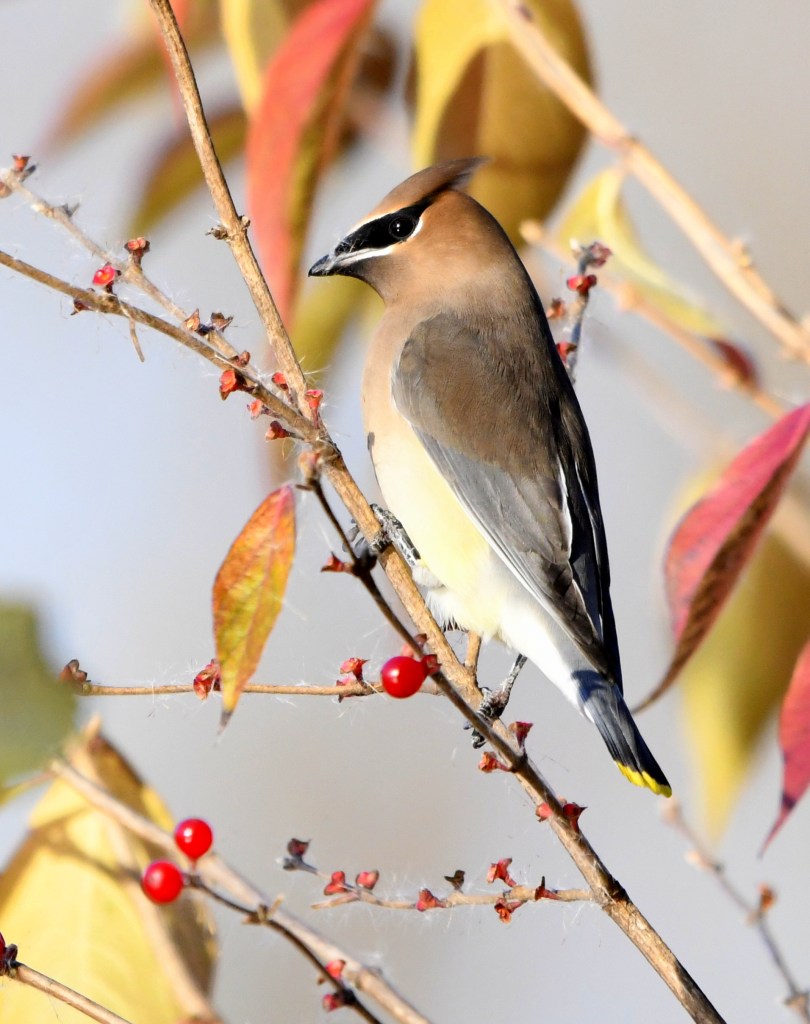
Most of the time when I’m backyard birding, only the ‘regulars’ show up (sparrows, juncos, jays etc.), but every once in a while, there’s a surprise, like the Sharp-shinned hawk that landed briefly, or the Cedar Waxwing that sat for a while in a nearby honeysuckle bush, or the Yellow-bellied Sapsucker that paused momentarily on our aging dogwood tree less than 10 feet from where I was standing! He was so close that I was afraid any movement on my part would scare him away.

Cedar Waxwing in the Honeysuckle Bush
Yellow-bellied Sapsucker on the Dogwood Tree

I’ve stood outside my back door taking pictures many, many times over the last several years through every season and all kinds of weather. It never ceases to amaze me how many different birds there are right in our own backyard; birds I’d never even heard of before, like White-throated Sparrows, American Tree Sparrows, Fox Sparrows, and White-crowned Sparrows!

White-throated Sparrow
American Tree Sparrow
Fox Sparrow
White-crowned Sparrow (May 2021)

There are also birds that, early on in my photography life, I didn’t even know were here in the winter like the goldfinches, robins, and bluebirds.

American Goldfinch
American Robin
Eastern Bluebird

And there are the regular, everyday birds, like the House sparrows, House Finches and White-breasted Nuthatches that come to our yard, or the Downy and the Hairy Woodpeckers that regularly come to the feeders, or the occasional Red-breasted Nuthatch that I rarely ever see!

Female House Sparrow
Male House Finch
White-breasted Nuthatch
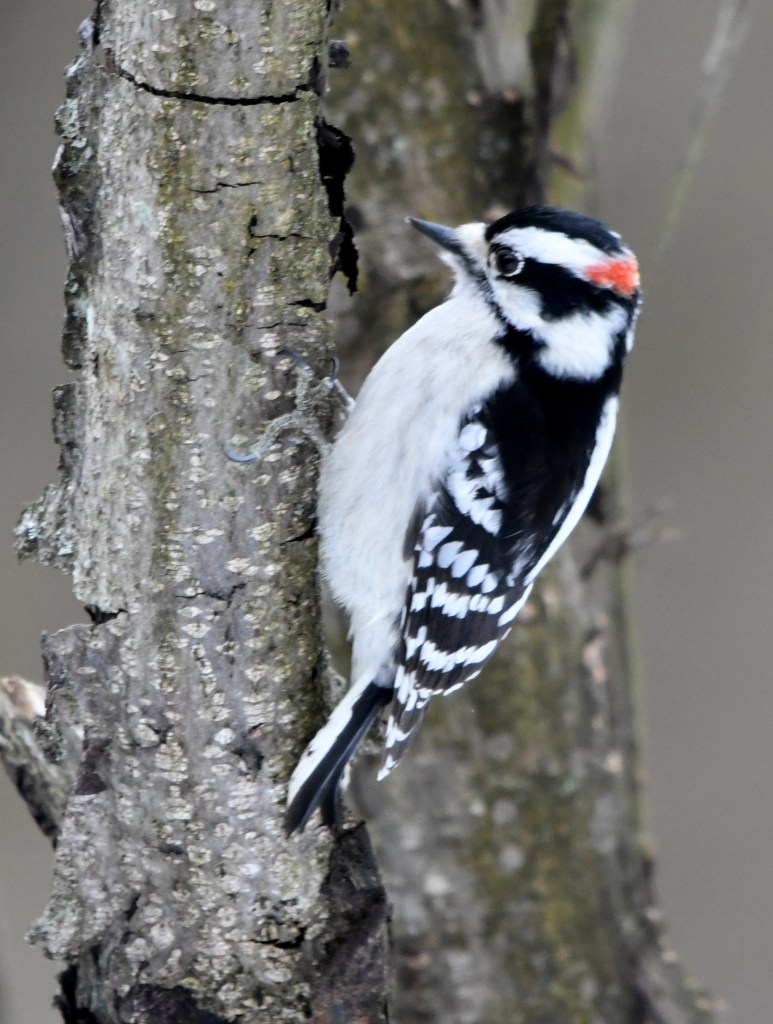
Male Downy Woodpecker
Male Hairy Woodpecker
Red-breasted Nuthatch

Once in a while, a few vagrants pass through our yard like this Oregon Junco I photographed in January of 2021, or this rare Orchard Oriole in May of 2021.

Oregon Dark-eyed Junco (January 2021)
Male Orchard Oriole (May 2021)

It never ceases to amaze me that so many different birds come to our backyard! It helps that we’re in a condo association where all of our yards are one big yard, where most of us have feeders hanging from our decks, where there are plenty of trees, and where a lovely little creek passes close by. In the warmer months, that creek is home to Wood Ducks, the occasional Northern Shoveler, and the usual mix of mallards and geese!

Enjoy!

Sometimes a Sparrow

September 9, 2025

I always enjoy finding house sparrows! And I love hearing their cheerful voices as they sing outside my kitchen window during the cold winter months. They are a pleasant reminder that there is joy to be found even on the dreariest of days. House sparrows, however, are not everyone’s favorite bird!

House Sparrow

Some people dislike them because they are an invasive species—but they didn’t come here on their own! Nicholas Pike, the director of the Brooklyn Institute, imported the first eight pairs of house sparrows from Liverpool, England in 1850 to control insect pests like the linden moth caterpillars that were damaging trees on the East Coast. Pike only released 16 birds but within 30 years those sparrows, as well as others that were released across the country, turned into thousands of birds and became a serious agricultural problem and a significant threat to our native birds.

House Sparrow

House Sparrows are known for taking over the nest boxes of native birds, evicting the birds who have already established nests in those boxes, destroying the existing eggs, killing the nestlings, and even killing the females who are incubating the eggs! They are not America’s favorite bird!

House Sparrow on a nest box

I like to keep in mind, though, that it wasn’t their idea to come here in the first place and, in spite of their ‘shortcomings’, house sparrows play a very beneficial role in our environment by controlling a wide variety of pests including caterpillars, aphids, moths, and ants. They also eat mollusks, crustaceans, earthworms, lizards, frogs, berries, fruits, nuts, and our discarded scraps of food! Let’s hear it for the house sparrows!!

House Sparrow

House sparrows are also an excellent model organism for many avian biological studies. They are abundant, easy to raise, and generally don’t fear humans. Because these little birds are so adaptable and easy to study, there have been at least 5,000 scientific papers published over the years using them as the study species!

House Sparrow in winter

I love the house sparrows for their chattiness and their social skills! They often gather in big groups and fill the trees with their cheerful song, a series of ‘cheeps,’ made mostly by the males, and repeated incessantly during much of the year to announce that they possess a nest and they want to attract a female. When dozens of these little birds are singing happily together, it’s music to my ears.

House Sparrow

When I hear house sparrows singing, I stop to listen and, if they’re not preening and fussing too much, take a few pictures. I don’t think many photographers have any interest in these birds, however. House sparrows lack the ‘pizazz’ of their more colorful cousins, like the bright red Northern cardinals, the stunningly blue indigo buntings, or the very, very orange Baltimore orioles!   I love a colorful bird as much as the next person, but sometimes a sparrow is all I need!

Northern Cardinal
Indigo Bunting
Baltimore Oriole

There have been so many times when I’ve stopped to take pictures of sparrows and ended up with so much more than I expected! The sparrows draw me in with all their chattiness, but the other birds, the more solitary ones, are often hiding nearby. Some birds, like the kingfishers, just stop by for a quick hello and disappear!

Belted Kingfisher

It happened again the other day! I was waiting to photograph a sparrow, in a tree full of sparrows, when an elusive belted kingfisher landed on a limb right above me! I only got one shot and he was gone! In the nearby trees, I saw the leaves rustling. There were three small warblers flitting about quietly; a Nashville, a Cape May, and a Yellow warbler. Warblers rarely sit still like the sparrows, but I still managed get a few pictures.

Cape May Warbler
Nashville Warbler
Yellow Warbler

If it hadn’t been for the chatty little sparrows, I never would have stopped for a picture. I never would have seen the warblers, or the kingfisher, or the beautiful wood duck that silently emerged from reeds in a nearby pond while I was still watching the sparrows!

Female Wood Duck in a nearby pond

Sometimes a sparrow is all I need get the ball rolling!

House Sparrow

Just Outside My Back Door

We’ve been back to our home state of Michigan for well over a month now after a three-month hiatus in Florida.  I haven’t returned to my usual photography routine of taking pictures every day like I did in Florida or like I did through most of the pandemic years when all my regular routines were put on hold and I had time to pursue this hobby full time.

Male Rose-breasted Grosbeak
Male House Finch

My picture taking days have taken a nose dive since returning to Michigan. It’s not that I’ve lost interest, or sustained an injury, or had a spate of bad weather. It’s pickleball. I’ve been distracted by pickleball.

Blue Jay
Male Barn Swallow

There are pickleball courts right next to our condo, and there’s a whole community of pickleball enthusiasts nearby who are readily available to play. It’s impossible for me to stay home if I know there’s a pickleball game going on.  As a result, I haven’t gone on any ‘field trips’ this spring or gone for many picture walks.

A male Grackle enjoying my peanuts and seeds
White-crowned Sparrow
European Starling

Mostly, I’ve been finding an hour or two here and there to stand outside our back door with my camera in hand to take pictures of all the usual suspects: woodchucks, woodpeckers, chipmunks, squirrels, white-tailed deer, and a wide variety of colorful songbirds.  They’re all back there carrying on with their busy, productive lives even when I’m not there to document it.

Eastern Cottontail
Young house sparrow begging for food!

The most interesting critter in our backyard has been the local woodchuck. I was standing outside our back door taking pictures of all the different birds landing in the nearby trees when I noticed movement about 50 feet from where I was standing. When I zoomed in on the mystery creature, I discovered it was a mama woodchuck transporting her little babies, one by one in her mouth from point A to point B. I’m not sure why she was moving them, but it was so much fun to watch! By the way, did you know that those little babies are called chucklings? I loved learning that little bit of trivia!

Mama woodchuck with one of her several babies

Then, the other day a red-headed woodpecker showed up! I rarely ever see them, and I’ve never seen one in our backyard! Getting a picture of a red-headed woodpecker was almost as exciting as getting one of a pileated woodpecker, but the pileateds are regular visitors to our yard, and the red-headed woodpecker was definitely not! So it was a great find!

Red-headed Woodpecker
Downy Woodpecker

The cutest little visitors are the chipmunks and the squirrels. They’re everywhere out there eating the fallen birdseed, digging holes everywhere in the grass, and constantly trying to steal birdseed from our second story feeders.  But, they’re so darned cute and so photogenic I’m inclined to think of them as entertainment rather than irritating pests.

Chipmunk
Hot squirrel!

Among the most stunning creatures in our backyard are the wood ducks, the Baltimore orioles, the white-tailed deer, the yellow warblers and, perhaps, even our resident turkey. In all fairness, though, all the creatures I photograph are beautiful to me.

Wood Duck on Cherry Creek behind our house
One of our local turkeys!

I feel quite lucky to have such a wide variety of interesting creatures right outside my back door and I treasure all the opportunities I have to photograph them.

White-tailed Deer wondering what I’m up to

There’s no need to travel far to be amazed.

White-tailed fawn at the edge of the small wooded area behind our row of condos

Morning Light

November 19, 2023

Note: Most of the pictures in this post were taken on earlier picture walks

I was sitting in my favorite chair at 5 a.m. on this cold November morning, enjoying a toasty fire, drinking a hot cup of tea, and contemplating the day ahead. Every once in a while, I’d look out the window to see if the sun had come up.

By 7:45, I could see just a hint of light on the very top of the trees along the far side of the creek behind our house. I wrestled with my choices for the day– stay warm and cozy inside the house, or go out into the cold November air and take pictures. The conditions were perfect: early morning light, no wind, and clear skies. I thought maybe a northern shoveler would unexpectedly drop by, or that a few wood ducks might swim out from the reeds as they sometimes do, or that a great blue heron would be scouting for fish along the opposite bank.  I might even see a rare mink scurrying by. Anything was possible!

Great Blue Heron
American Mink

There was no choice, really; whether to stay inside or to go outdoors. The morning light beckoned. It would be impossible for me to stay home on such a beautiful day! There was such promise in the air! But, it was only 32 degrees! I wasn’t ready to face the cold! And getting dressed would be a challenge– because cold weather photography, where I might not move for hours on end, takes careful planning. Should I wear two layers or three? Do I need mittens or gloves? Boots or shoes? There were too many decisions to be made this early in the morning!

All bundled up for the cold on an earlier picture walk

By 8:15, though, I was out the door. The sun had risen a little higher in the sky, the water in the creek was perfectly still, and I planted myself in the very best spot I could find where the sun would be at my back.

Cherry Creek in the early morning light

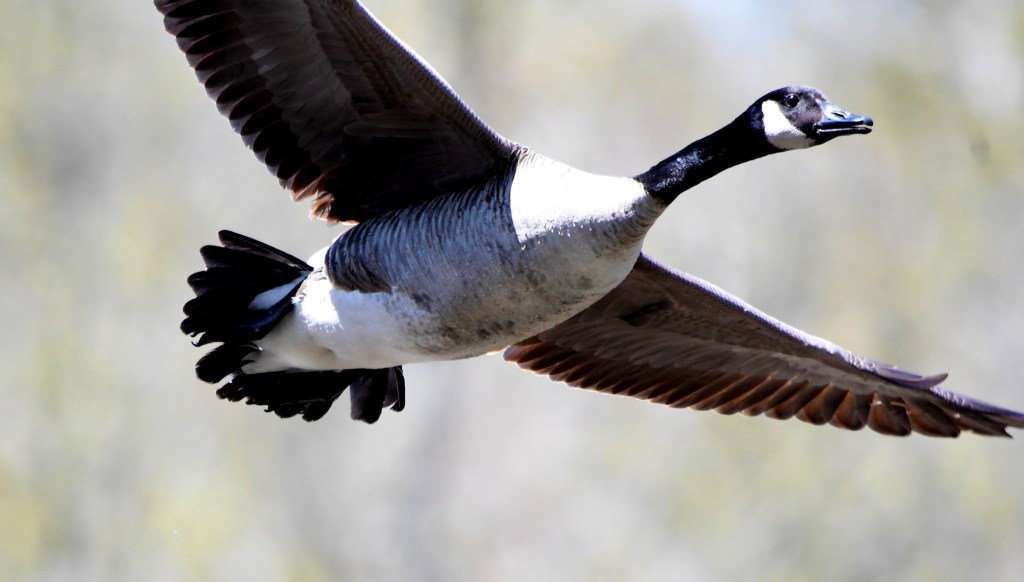
I stood quietly and waited. The squirrels were scampering through the leaves behind me and running across the branches overhead. Now and then, I’d hear a red-bellied woodpecker tapping on one of the nearby trees. A handful of birds were greeting the new day with their joyful song while a solitary goose flew by.

Canada Goose

Not far from where I was standing, I could hear the familiar sound of the male red-winged blackbirds as they flitted among the cattails. They have a short, one-second song that starts with an abrupt note and turns into a musical trill. The females usually respond to the singing males with a chit-chit-chit sound, but I never heard their replies. Perhaps, the females have already flown south for the winter.

Male Red-winged Blackbird in the reeds along Cherry Creek

After about an hour of standing and waiting, I took a seat on the bench next to me; my hopes slowly dwindling. There had been no signs of any shovelers, wood ducks, or herons. I would have been happy at that point if even a mallard had floated by!

Female Mallard from an earlier walk

Eventually, the cold air settled into my bones, and I had run out of things to talk to myself about. I tried, instead, to concentrate on all the different birds I could see or hear in the trees around me, like the chickadees, tufted titmice, cardinals, robins, cedar waxwings, woodpeckers, sparrows, and blue jays. They provided a symphony of songs and a bit of entertainment as I sat watching for the elusive ducks and herons to appear on the creek.

Downy Woodpecker

By 9:30, I was ready to throw in the towel and go for a walk in the sun so I could soak up some of its warmth. Before leaving my temporary roost, though, I moved closer to a nearby bush where I had been watching the cedar waxwings gobbling up berries, hoping I could maybe get a picture of them! With all the foliage obstructing my view, it was more of a challenge than I expected!

Cedar Waxwing enjoying the berries

After managing to get a few waxwing shots (and one fat robin), it was time to move on to more promising grounds. I headed over to the business park next door thinking I would find a red-tailed hawk, a migrating duck, or maybe even a bluebird. All I found were pigeons.

Three pigeons on a lamp post!

Where was everybody??

It was almost noon and the temperature had climbed from a chilly 32 degrees to a toasty 50. I was so HOT! I had taken off my hat, mittens, and scarf and stuffed them into the pockets of my coat; the pockets that were already jammed full with two rechargeable hand-warmers, one cell phone, and a set of keys. Eventually I had to take off the coat as well and tie it around my waist or I would totally disintegrate from the heat! It was time to head home.

A big fat Robin enjoying the same berry bush as the Cedar Waxwings

In the end, I didn’t have much to show for all my efforts: no wood ducks, no hawks, no shovelers, no mallards. It’s always disappointing when this happens, but I just can’t force the birds to show up when I want them to– or to get them to sit still in the right light while I adjust my settings.

On a particularly slow picture day, like this one, I have to remind myself that the most important thing is the walk itself, not the pictures. At my age (76), spending the day outdoors traipsing about is a gift; one that I treasure. Having my camera along, just makes all that exercise more interesting.

And that’s what keeps me going out the door–even on the least promising of days.

Cedar Waxwing

Down the Rabbit Hole

October 21, 2023

‘Down the rabbit hole’ is an English-language idiom which refers to getting deep into something, or ending up somewhere strange—or wonderful. Lewis Carroll introduced the phrase in 1865 as the title for Chapter One of Alice’s Adventures in Wonderland.

An adorable Eastern Cottontail Rabbit

I tumbled down the nature photography rabbit hole quite by accident and I fell in deep. It all started about seven years ago when my husband asked me what I wanted for Christmas. It took a while for me to come up with something I really wanted, but eventually I hit upon the idea of a camera. I wanted a better one than we had. My request came when we had two small grandchildren and I thought if I had a better camera, I could take better pictures of them. But that’s not what happened!

Male Mallard

We went to Florida for the first time that winter and visited some of the most amazing preserves with incredible wildlife. It gave me the opportunity to use my new camera for the very first time. It wasn’t a fancy camera, but it did have a built-in zoom lens and I could get much better shots of birds and other wildlife than I ever had before! I was hooked! (The pictures below were taken with more recent cameras.)

Limpkin in Florida
Roseate Spoonbill in Florida
Painted Bunting in Florida

Within a year or so, I was already yearning for a better camera and a longer lens; a camera with a quicker shutter response time, and a lens that could capture birds that were even farther away. Once I had the newer camera and the longer lens (thanks to my husband’s diligent research), I spent more and more time outdoors taking pictures, totally immersed in my own little world.

Fawn in the greenery near our house

It wasn’t long before I had exhausted the shutter life of that second camera, with well over 100,000 pictures, and started looking for yet another camera and an even longer lens!

Carolina Wren on our deck

To date, I’ve gone through four cameras in seven years, mostly because I exceed the recommended shutter life of each of them. My current camera is a Nikon D500 with a shutter life of 200,000 cycles; I’m well over 127,000 after only a couple of years! The lens I use most often is a Sigma 150-600mm.  The D500 camera and the Sigma lens have been the perfect combination for me and for the things I like to photograph.

Nikon camera with Sigma lens on a monopod

I go out almost every day in all kinds of weather, even if ‘going out’ means just standing on our deck or in our backyard. Some of my favorite shots have happened right outside our back door where I have a ‘designated tree stump,’ placed in the yard, and a ‘designated tree branch’ attached to the deck for bird and mammal ‘portraits’. Plus, we have a beautiful bank of trees nearby and a small creek behind the house, both of which are attractive to a variety birds and mammals.

Red-breasted Nuthatch on the ‘portrait branch’

I love going on picture walks! I love looking for interesting things to photograph, whether it’s a bald eagle or a green bottle fly! It’s all quite fascinating, especially when I bring up the pictures on my computer and can see so many amazing details—like the individual hairs on a fly, or the tiny red mites on a dragonfly!

American Bald Eagle
Male Monarch (males have two distinct black spots on the lower wings)

One of the things I also enjoy doing after taking all those pictures is finding interesting facts about the creatures I’ve photographed and then sharing what I’ve found on Facebook, our local newspaper, or this blog.

Two male grackles on my ‘designated stump’ engaging in ‘bill tilt’ behavior to establish dominance. Whichever bird can maintain this posture the longest wins!

The name ‘picture walks’ started years ago when I first fell down this rabbit hole and was heading out the front door for a walk. If I was leaving the house without my camera, I’d tell my husband I was going on a ‘regular walk’, which meant I’d be home in an hour. If I was leaving the house with my camera in hand, I’d say I was going on a ‘picture walk,’ which was code for “I won’t be home anytime soon!”

White-crowned Sparrow in our backyard
White-tailed Deer in our backyard only a few feet from where I was standing

Some of the rabbit holes we fall into can be disastrous.

This one has been quite delightful.

Waiting for Spring

February 22, 2023

Male Red-winged Blackbird

On February 12th, I saw my first red-winged blackbird for the season! It seemed too early, I thought. I didn’t expect them to return until March. Within a week, though, I heard a whole chorus of red-winged blackbirds singing in the cattails down by the creek behind our house. It’s the quintessential sound of spring and I love it!  I wanted to throw open all our windows and soak up that first glimmer of hope that spring would soon be here in earnest.

Backyard Blue Jay in the early morning light

But as I write this, I’m snuggled up in front of a fire, with a hot cup of tea close by, hoping we won’t lose power during the upcoming ice storm. All the schools are closed, and so are many businesses, hoping to avoid disaster. The ice storm might materialize, it might not. Such are the vagaries of winter in Michigan: one day it feels like spring, and the next day it feels like we’re living in Antarctica.

Canada Goose making a dramatic landing on the ice!
Male Mallard flying in close!

I basically have a love/hate relationship with winter. I love the snow, but hate the long overcast days that bring the snow. I love getting pictures of all the winter birds that migrate through Michigan, but hate all the layers and layers of clothing I have to wear to get those pictures. I love a bright, sunny winter day as an antidote to all the gloomy ones, but it’s hard to get a good picture on a brilliant sunny afternoon against a snowy background.

Me all bundled up against the cold!
A happy looking female Mallard on a cold winter day in Michigan

Most of all, I miss the colors and all the warm-weather critters I love to photograph, like the big yellow butterflies, the swampy green frogs, the multitudes of colorful dragonflies, and the iridescent blue swallowtails that nest under the bridge in a nearby park.

Male Hooded Merganser on a layover through Michigan

Before the pandemic and before we had an aging, incontinent dog to care for, we went to Florida for a few months where I could soak up all the colors and all the interesting critters we never see in Michigan.  I have taken pictures of the majestic roseate spoonbills, the brilliant purple gallinules, the pastel pink dragonflies, and a million different Florida flowers! It’s a wonderland of color that I had come to depend on to get me through the drab days of a Michigan winter.

Roseate Spoonbill in Florida
Periwinkle Pinwheel (I think)

In the meantime, I have been out looking for whatever beauty I can find wherever I can find it, and taking lots of pictures. Whether it’s a chickadee in a snowstorm, a woodpecker on a sunny day, a snow-covered deer in our backyard, or a ubiquitous brown fox squirrel peeking out around a tree in the early morning light, it’s all good, and it’s all fun.

Yellow-shafted Northern Flicker
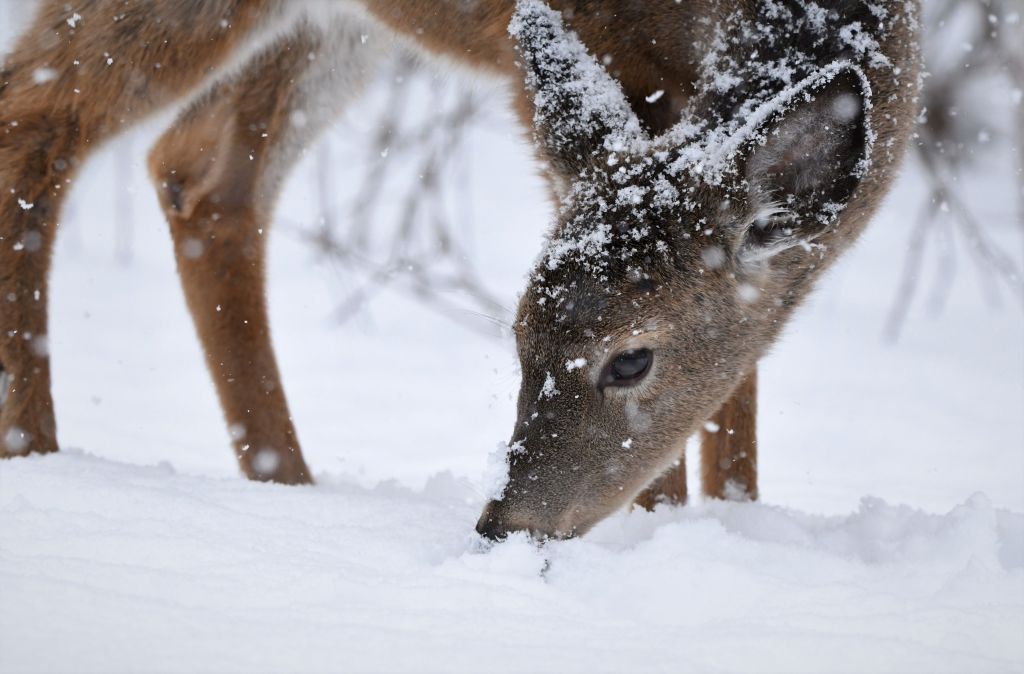
White-tailed deer right outside our back door

I just wish winter didn’t last so long!

Winter Morning Musings

December 27, 2022

As I sit here in the early morning darkness on a late December day with a hot cup of tea in my hand and a toasty fire in front of me, I’m thinking back to the warmer, brighter days of summer where I would have already left the house by now; where I would have had my camera slung across my shoulder as I rushed out the door, not wanting to miss that “golden hour” of photography just past sunrise. This time of year, though, there’s absolutely no need to rush. The sun won’t rise for another two hours and the golden hour (if the sun comes out at all), won’t happen for at least three!

Pileated Woodpecker during the ‘golden hour’ just before sunset
Female Ruddy Duck and a male Gadwall during an evening ‘golden hour’

We haven’t seen much of the sun this December. In fact, it’s been “mostly cloudy” or totally overcast every single day. When the forecast calls for partly cloudy skies rather than mostly cloudy, I’m elated! It means there will be at least a few moments of sunshine to enjoy during the day! But then I wondered: if there’s sunshine to be had on a partly cloudy day, what’s the definition of partly sunny day? According to the National Weather Service, they’re exactly the same thing! If I ran the circus, it would always be called a partly sunny day –a much happier outlook than cloudy!

Even on the sunniest of winter days, though, taking pictures is never easy, especially when it’s bitterly cold and the temperatures fall into the single digits, like they did this past week during our “blizzard of the century.” One day it was only 3 degrees above zero with a wind chill of minus 17! I went outside anyway, mostly to see if I could stay warm enough under multiple layers of clothing and still propel myself forward!

Testing the elements: Wind Chill minus 17 degrees!!

On that particularly frigid day, I went for a walk without my camera just to see how it would feel. Surprisingly, I was so hot under all those layers that I worked up a sweat!  It wasn’t so much the multiple layers of clothing that made me hot, but the act of walking.  If I had been standing still taking pictures, I would not have stayed warm for very long!  Luckily, whenever I do get the urge to take pictures on a bitterly cold day, I can just step out our back door, take a few shots, and pop back in as soon as I get cold. There’s plenty of wildlife right outside our door to keep me entertained for hours.

“Eh, what’s up, Doc?” (One of our backyard visitors)
The Red Squirrels provide plenty of entertainment on a daily basis!

Most of the time I can keep my body quite warm, but my fingers eventually freeze. I’ve tried a wide variety of mittens and gloves with varying degrees of success, but any mittens thick enough to keep my fingers from freezing, are too thick to operate the tiny buttons on a camera! It’s a frustrating dilemma that I’ve been trying to solve for quite some time.

I thought these Canada Geese looked beautiful in the late afternoon sun!
Great Blue Heron on a fishing expedition over the open ponds at a local fish hatchery

A few years ago, I started adding hand warmers to my pockets. They were a really big help initially, but none of them ever stayed warm enough, long enough to keep me happy. So, I went online to research what other outdoor enthusiasts were using and ultimately ordered a pair of Ocoopa Rechargeable Hand Warmers that would reportedly stay hot for 15 hours!! They will arrive just in time for an unseasonably warm break in the weather and a dismal forecast of rain. Perfect timing!

White-throated Sparrow in our backyard
Male Red-bellied Woodpecker

I love the challenge of winter photography and all the unique picture opportunities it affords, but I really miss all the colors, and all the creatures, and all the different ways that taking pictures in the warmer months is so much easier!!

Another one of the beautiful deer in our backyard
Male Downy Woodpecker in our backyard
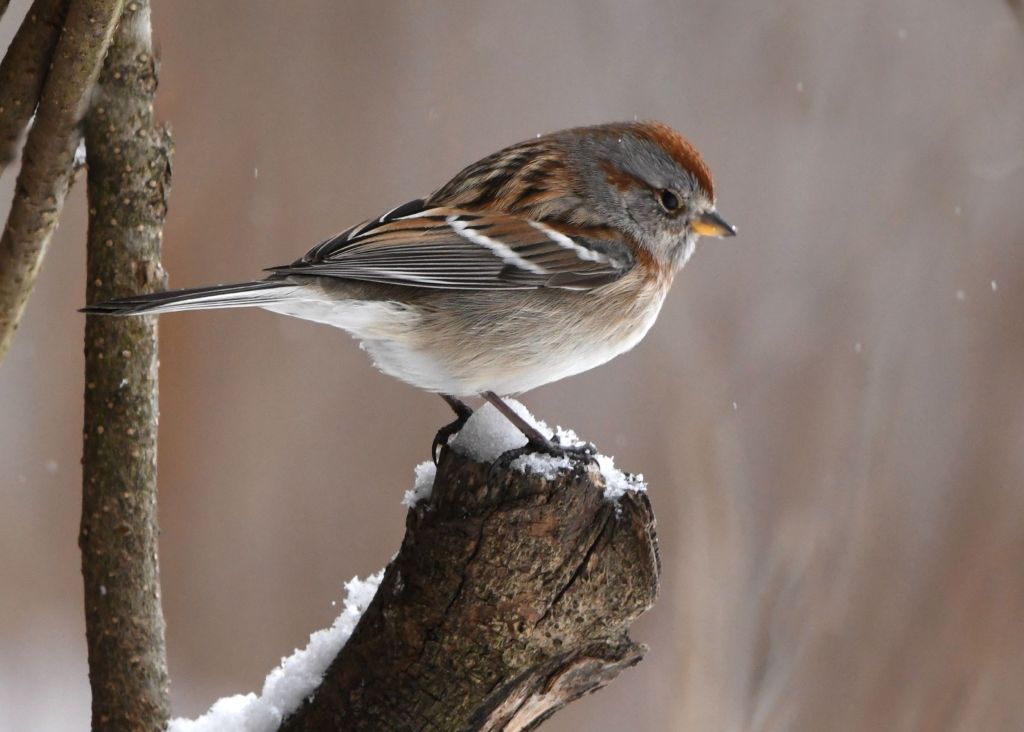
American Tree Sparrow on a very snowy day
Male Wood Duck on ice

Most of all, I miss the sunshine—and my warm fingers.

“That’s All, Folks!”

Find the Joy

November 21, 2022

“If you choose not to find joy in the snow, you will have less joy in your life but still the same amount of snow.” Anonymous

I love this quote– and the snow!

The Carolina Wren sings a very joyful song

It’s hard not to feel a certain child-like wonder when the first big flakes of snow fall from the sky and transform our world into a winter wonderland.  I love sitting by the fire with a hot cup of tea in my hands watching the snow pile up outside our window and marveling at the little songbirds as they fluff up their feathers to ward off the cold. I’d like to invite them in for a while to warm up. Instead, I put on three layers of pants, three shirts, a balaclava, a fuzzy hat, a down coat, a neck warmer, mittens, and boots, and join them, camera in hand.

American Robin on a snowy day enjoying a crabapple tree

For the last several days, the snow has been falling almost non-stop!  The birds don’t seem to mind, though, and are flitting about everywhere, enjoying the easy source of food in our feeders and occasionally taking sips of warm water from the birdbath. I’ve taken hundreds of pictures of them hoping to find among the mix, one of the ‘vagrants’ –birds who are part of a phenomenon known as an ‘irruption’ which is currently taking place across eastern North America.

Downy Woodpecker on a very snowy day!

An irruption is a sudden change in the population density of an organism. In the lives of our feathered friends, an irruption occurs when the birds who live farther north run out of food, and move farther south to find sustenance. Some of the irruptive species here in Michigan include purple finches, redpolls, evening grosbeaks, red-breasted nuthatches, pine grosbeaks, pine siskins, and bohemian waxwings.

These irruptions commonly occur every few years and mostly impact the finches and other species that winter in the boreal forests of Canada and further north. The primary food source for these birds comes from pine cones. When the pine cone crop is poor over the summer, it foreshadows a difficult winter for these birds. The shortage of seeds that the pine cones produce forces these birds to move beyond their normal range in search of food. If multiple types of trees fail to produce a seed crop during the same year, multiple species of birds will move further south.

Eastern Bluebird weathering the elements on a snowy winter’s day
Mourning Dove

Irruptions vary widely in size, frequency, and duration. Some birds will stay in an area for weeks at a time, while others might only stay for a day. Regardless of the size of the flock or the duration of their visit, it’s an exciting time for birders!

Dark-eyed Junco

I would love to see any one of these wayward birds on my picture walks, but I have been happy enough with my usual backyard visitors, as well as the interesting mix of migrating birds that visit Kalamazoo this time of year, like the fox sparrows, the white throated sparrows, the American wigeons and, the very peculiar, Wilson’s snipe.

Wilson’s Snipe, a migrating bird at the Wolf Lake State Fish Hatchery
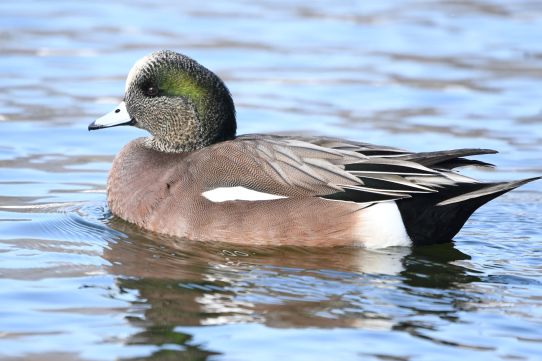
American Wigeon, a migrating bird that visits a nearby pond

I’ve been out in the snow several times recently looking for the evening grosbeaks, the red-breasted nuthatches, and the other ‘irrupters’ who might be passing through, but I have come up empty handed.  On any given picture walk, though, there is always the possibility that something new might come along, and ‘possibility‘ is always a great motivator!

Male Northern Cardinal

On these beautiful, winter days, I love the challenge of bundling up like a kid to stay warm and trudging through freshly fallen snow to photograph a bird, as I revel in the joy that, at age 75, I can still do this! 

Find the joy!

White-tailed deer, one of the other beautiful creatures I often see on my walks

Walk Slowly, Stop Often, Stay Focused

April 1, 2022

Oftentimes, when I’m out taking pictures, I think about all the things I’ve learned along the way– about photography, about the critters I’ve seen, and about myself.

Mute Swan on quiet waters

There are so many things I didn’t know at the beginning of this photographic journey that I know now, and so many things I do differently as a result. When I first started taking pictures, I didn’t really have a plan and not much of a clue about what I was doing. I’d be walking along, see something pretty, and take a picture. Click! Now, I am more likely to plan ahead, to anticipate where a bird or a butterfly might land, or where the frogs and turtles might be hanging out—rather than just being surprised by random events!

Canada Geese in a heated debate

While I’m out on a picture walk, I’m also thinking about the settings on my camera and whether I’ll be ready for the next shot. I walk more slowly, more quietly, and more deliberately than I used to, and pay closer attention to the all the sights, sounds and shadows around me. When there’s a faint rustling in the grass or the bushes nearby, I stop. It could be a baby bird– or it could be a giant turtle. When a small shadow passes by me on the ground, I look up in the sky to see what bird is on the wing; it could be an eagle, or it might be a red-tailed hawk. There are so many interesting things out there to photograph, but finding them and capturing them in pictures does take a fair amount of patience, and a good deal of time!

Common Grackle
Eastern Fox Squirrel high up in a dead tree

After years and years of picture walks, often to the same local places, I’ve also gotten much better at noticing changes or ‘aberrations’ in the environment. The other day, for example, there was just the slightest hint of something small and round and ‘out of place’ across the pond. It caught my attention because it had a bluish cast to it. Blue isn’t a color I usually see this time of year and I wondered if it was just somebody’s litter—or something else. When I zoomed in, I discovered that it was a turtle—the first one I’d seen since last fall! A few days later, I saw a small ‘bump’ protruding from the top of a very tall, very dead tree. It looked out of place and it grabbed my attention The little ‘bump’ turned out to be a squirrel peeking out ever so slightly from a small hole in the tree where I would have expected to see a bird. There are surprises everywhere!

Over the years, I’ve also learned the art of standing still. Many times, my picture walks have become ‘picture stands’. I’ve learned that if I stand still long enough, I become invisible. The birds go about their usual business, and chipmunks scamper by so closely that I could almost touch them.

Canada Goose in quiet reflection
Red-bellied Woodpecker

When I’m not standing still, I’m barely moving; hoping not to disturb any of the creatures around me. Most of them, however, are hyper vigilant; worried that I might be a giant predator. Even the slightest movement on my part will send them scampering off.  The belted kingfishers are particularly adept at knowing when I’m in the area, no matter how slowly I walk or how far away I stand.  I swear they know I’m coming even before I leave the house!! The only reason I have any kingfisher shots at all is because I arrived on the scene before they did and never moved!

The elusive Belted Kingfisher

Turtles also know when I’m on the way, but they’re not quite as nervous as the kingfishers. Still, they can be twenty yards from shore, sitting on a log and jump overboard if I even start to lift my camera to my eye. Frogs, surprisingly, are much less ‘jumpy’ than turtles and will let me come in for a closer shot–but only if I move very slowly!

In my non-photography life, I’m often rushing around quickly trying to do two or three things at a time thinking that I’m saving time or being more efficient. I am not. When I’m out taking pictures of birds, turtles and frogs, though, speed does not work. Speed scares the animals. Speed ruins pictures. I’ve learned to walk slowly, to stop often and to stay focused, usually for hours at a time. It’s a type of meditation, I think, and it has helped keep me on an even keel– especially during these difficult years of political upheaval and pandemic isolation.

Redhead Ducks on the wing

Hungry for Spring

February 24, 2022

Young Trumpeter Swan flying through a snow squall

As I sit writing this piece, long before sunrise, on another cold and windy February day, I am contemplating the advisability of even attempting a picture walk. The weather forecast calls for 15 to 25 mile an hour winds with gusts over 40! On the other hand, temperatures might exceed 40 degrees —quite balmy compared to the below zero wind chill conditions I was faced with the other day! Usually, I can put on enough layers to stay warm, even on the coldest of days, but strong winds make for a much bigger challenge.

Blue Jay stirring up snow in a pine tree
Some Great Blue Herons will stay here throughout the winter, but many more will head south

Most days, I’m up for that challenge but, I must admit, I’m growing weary of it all. These long winter days, where I have to plan for so many weather contingencies, and have to wear so many layers, are weakening my resolve—especially during the past two years of this pandemic where we haven’t been able to venture far from home. The birds in my backyard are quite tired of me begging for a photo shoot.

Carolina Wren near my backyard feeder

For the next few days, though, my backyard birds can take a break while I babysit my grand-dog on the opposite side of the state. There are lots of new places to explore here and once the sun is up, I expect I’ll venture out in spite of the wind and in spite of the cold! I’d much rather be outside searching for the possibility of something new than sitting here on the couch.

Some people believe that the Robin is a “harbinger of spring”, but large numbers of them stay here all winter feasting on berries.

After writing those first few paragraphs, I did, indeed venture out– first to a nearby nature center and then to a nearby park.

Black-capped Chickadees are delightful little birds that can be found in Michigan all year round.

I found the usual assortment of birds at the nature center—chickadees, finches, cardinals, nuthatches and goldfinches, but it was a brand-new setting! When I arrived at my second destination, I really hit the jackpot! Beaudette Park in Pontiac, Michigan, had a very large pond of open water and it was teeming with a wide variety of waterfowl, some of which I’d never seen before!

Canada Goose coming in for a landing!
Some Sandhill Cranes stay here all year long

This time of year, it’s highly unusual to find open water in Michigan. Most lakes and ponds are frozen over.  This particular body of water had the ubiquitous array of mallards, swans and geese, but it also had mergansers, buffleheads, redheads, ring-necked ducks, goldeneyes and canvasbacks!! It was the canvasbacks I’d never seen before. I couldn’t stop taking pictures!

Male Canvasback at Beaudette Park in Pontiac, Michigan
Male Ring-necked Duck

Days later, I was still sorting through all the hundreds of pictures I took that day!

Male Wood Duck

Mallard Ducks are everywhere and they offer endless opportunities for interesting photographs!

In spite of all the inherent beauty to be found in a picture of freshly fallen snow and a colorful bird here and there, I am more than ready for the arrival of spring; ready to be free of these bulky winter clothes, grey skies, and frigid temperatures.  I’m beyond hungry for the colors to return, for the sweet smell of a newly mowed lawn, and for the sheer delight of a warm patch of sun on my bare skin!

I am more than ready to shed these bulky winter clothes and trade this colorless landscape for green leaves and spring flowers!