In Pursuit of Wonder

July 21, 2023

Every time I set out on a picture walk, I wonder what I’ll find. I wonder if I’ll see something new, or something interesting, or something particularly beautiful. It doesn’t need to be a bald eagle, or a rare insect, or a breathtaking sunrise —although those things are certainly welcome; I mostly enjoy the pursuit of wonder, and the challenge of capturing just the right photo at just the right moment. I am as easily excited about finding a tiny snail on a stalk of a dead plant as I am about finding an exquisite bird I rarely see. It’s the pursuit itself that never grows old, and pushes me out the door every day.

A small Eastern Heath Snail that could easily go unnoticed
A rare sighting of an Indigo Bunting

Not long ago, I was house-sitting for a friend in a part of our state that I rarely visit. She lives on a seldom-traveled, unpaved country road that quietly meanders into the beautiful and expansive Manistee National Forest. I ventured out on that road early one morning wondering what I might find. The deep shade along the forest road was a welcome relief from the heat, but I wasn’t sure that it would be a good place for pictures. There just wasn’t much light peeking through the trees, except for small patches here and there where the occasional butterfly would land, and the columbines struggled to find sunlight.

The narrow gravel road into the Manistee National Forest
Eastern Tiger Swallowtail
Columbine in the sunlight

I was captivated by the sound of all the birds singing throughout the forest; their voices echoing melodically through the giant cathedral of trees. One of those birds was louder and more insistent than all the others and I wondered who it might be. Fortunately, Merlin* came to my rescue and identified the mystery vocalist as an ovenbird!
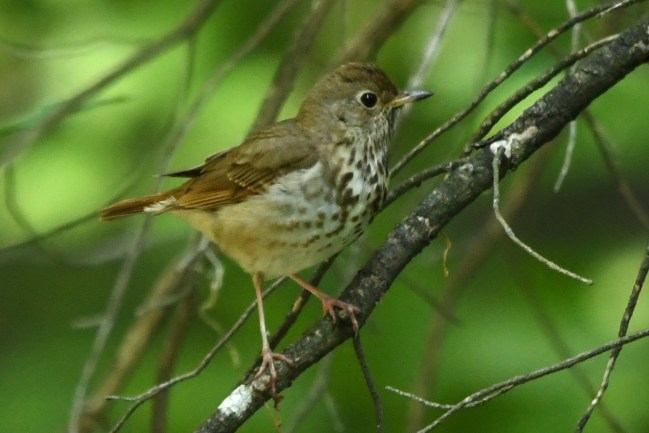
The elusive little Ovenbird

I had never seen or heard an ovenbird before, so I stood quietly on the edge of the road, waiting for any movement in the trees, hoping to get a glimpse of one. It didn’t take long, but the setting was so dark, and the bird moved so quickly, that I didn’t think I’d get a decent shot. Eventually, though, my patience paid off.

When I did some research on this elusive little bird, I was fascinated to find out that ovenbirds are smaller than sparrows, and they will only breed where there are large, undisturbed expanses of mature trees and a closed canopy. The forest canopy needs to be so dense that it severely inhibits underbrush from developing on the forest floor, and allows for a deep layer of leaf litter to accumulate.  Ovenbirds spend most of their time foraging in that leaf litter looking for things to eat like crickets, caterpillars, ants, spiders, slugs, and snails. They also need leaf litter to build their nests. This task is left to the female ovenbird who creates a comfy home on the forest floor using dead leaves, grasses, stems, bark, and hair. The finished dome-shaped nest, at 9 inches wide and 5 inches deep, has a squat oval side entrance and resembles a primitive outdoor oven, which is how this bird got its name!

An Ovenbird in the leaf litter with a tasty snack

Halfway through my walk, I came to a wide-open field at the edge of the forest, where an odd-looking bird flew overhead and landed on the top of a utility pole! Even from a distance, it didn’t look like a bird that would normally land on a tall, skinny pole! With long legs, a long neck, and a thin, straight bill, it had the appearance of a fairly typical shorebird. Luckily, the bird on the pole was singing its heart out and Merlin* quickly identified it as an Upland Sandpiper. This particular shorebird, however, loves the prairies, pastures, and croplands rather than the wetlands where its cousins like to hang out! It is also a shorebird that loves to perch on fence posts and perform memorable flight songs over its territories! This bird was behaving true to form!

The long-legged, long-necked Upland Sandpiper on a utility pole!

On my return trip through the forest, I had one more surprise waiting for me– a barred owl! It landed on a branch not far from where I was walking and posed for a few pictures before flying off. Even though barred owls are plentiful in Michigan, this was my first!

Barred Owl in the deep, dark woods!

In between these discoveries, there were butterflies and wildflowers quietly going about their business in the random patches of sunlight, waiting patiently to be noticed, and I obliged.

A very tiny Hobomok Skipper

It was just another ordinary day of small but incredible wonders that, more often than not, go completely unnoticed.    

Patches of sunlight

*Merlin is a free bird identification app

Heat Wave

July 21, 2019

It’s been a hot and steamy week with periodic bouts of rain, but I still managed to squeeze in a picture walk every day except Friday. It was just too hot to enjoy much of anything that day! The temperature peaked at 93 degrees and the heat index, or how it really felt outside, topped 100 degrees!  I expect even the birds and the bees thought twice about expending any extra energy flitting about in that heat!

Sunday July 14, 2019

Kalamazoo Nature Center, 7000 N Westnedge Ave, Kalamazoo, MI

The Kalamazoo Nature Center is one of my favorite places to go for a picture walk. There are so many different habitats to visit and more than 14 miles of hiking trails. For today’s picture walk, I spent all my time in the Tall Grass Prairie looking primarily for birds but finding mostly flowers, butterflies and dragonflies.

Silver Spotted Skipper on Bee Balm
1/1000 sec, f/7.1, ISO 500
Coneflower
1/1000 sec, f/7.1, ISO 500
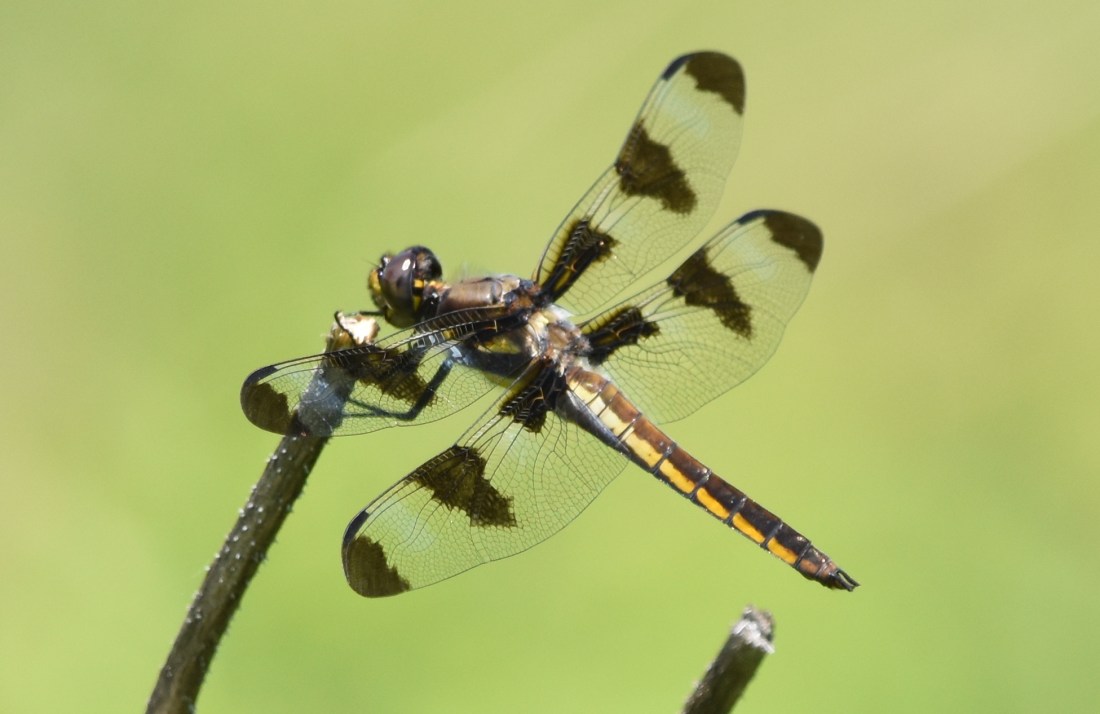
Twelve Spotted Skimmer, female
1/800 sec, f/7.1, ISO 400

Monday July 15, 2019

Al Sabo Land Preserve, 6310 Texas Drive, Kalamazoo MI

Ten days ago when Mel and I last visited the Al Sabo Preserve, we were blown away by how many different dragonflies there were: Blue Dashers, Calico Pennants, Common Whitetails, Dot-tailed Whitefaces, Eastern Pondhawks, Halloween Pennants, Spangled Skimmers, Twelve-spotted Skimmers and Widow Skimmers. That may not seem like enough to blow us away, but the male and female dragonflies of each type look totally different from each another so it always seems as if there are twice as many different types!

Dot-tailed Whiteface Dragonfly
1/500 sec, f/6.3, ISO 800
Spangled Skimmer
1/500 sec, f/8, ISO 800

There are apparently over 5000 different dragonflies and damselflies worldwide and about 162 different species in Michigan. I’ve found a wide variety of them, but nowhere near the state total!

Twelve Spotted Skimmer, male
1/640 sec, f/6.3, ISO 640
Widow Skimmer, male
1/800 sec, f/6.3, ISO 640

Today, though, when I walked the bike trail that skirts the woods and the meadows of Al Sabo preserve, there didn’t seem to be the same abundance of dragonflies as there had been a little over a week ago, but I still enjoyed my walk and was pleased to find an Eastern Comma butterfly, which I rarely see

Eastern Comma Butterfly
1/800 sec, f/6.3, ISO 1000

Tuesday July 16

Western Michigan University, Business Technology and Research Park, Intersection of Drake and Parkview Rd., Kalamazoo, MI

I particularly love this little ‘park’ –partly because it’s right next door and partly because I’m guaranteed to find something interesting –- Great Blue Herons and Swans, Barn Swallows and Tree swallows, Killdeer and ‘regular’ Deer, Frogs, Turtles, Geese and Goldfinches, and once upon a time, an elusive Green Heron. Even though it is not a ‘park’ in the strictest sense of the word, the green spaces around all the different buildings have been so well designed with an abundance of wildflowers and several ponds that it is a definite haven for a wide variety of birds, butterflies, amphibians and mammals.

Barn Swallow
1/640 sec, f/6.3, ISO 640
Cedar Waxwing
1/1000 sec, f/6.3, ISO 640
Local deer giving me the raspberries!
1/800 sec, f/6.3, ISO 500
Mute Swan
1/320 sec, f/6.3, ISO 800

Wednesday July 17

Kensington Metro Park Nature Center, 4570 Huron River Parkway
Milford, MI 48380

Kensington Metro Park is about 2 hours from our home, but since it is on the way to visiting our grandson, I make a point of stopping in for a picture walk every time I travel to that side of the state. It’s a unique environment with an active heron rookery, friendly Sandhill Cranes, fearless Songbirds, Red-winged Blackbirds and Woodpeckers who eagerly pester you to feed them out of hand, and an elusive white deer! I always find something of interest to photograph at Kensington.

Ruby-throated Hummingbird
1/1000 sec, f/6, ISO 640
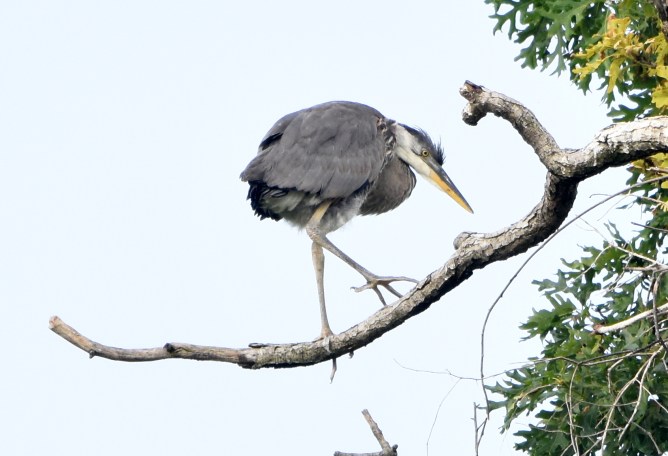
Great Blue Heron high up in the Rookery
1/500 sec, f/6.3, ISO 500
Thistle
1/640 sec, f/6.3, ISO 500

Thursday July 18

Asylum Lake Preserve, Intersection of Drake and Parkview Rd., Kalamazoo, MI

The Asylum Lake Preserve, like the WMU Business Technology and Research Park is within walking distance from my home.  Unlike the business park, though, the Asylum Lake Preserve is an undeveloped tract of land made up of prairies and woods and a small lake. I enjoy walking the trails through the tall grasses looking for new or unusual insects or looking up in the surrounding trees for a bird I haven’t seen before. On one very rare occasion,  I saw a Black-billed Cuckoo. Up until that day, I didn’t even know we had cuckoos in Michigan! Today I managed to capture a rarely seen hummingbird moth, a never seen Northern Pearly-eye butterfly and my very first Spicebush Swallowtail for the season.

Hummingbird Moth
1/1250 sec, f/6.3, ISO 800
Hummingbird Moth
1/1600 sec, f/6.3, ISO 1000
Northern Pearly-eye Butterfly
(shot with a flash)
Spicebush Swallowtail Butterfly
1/1250 sec., f/6, ISO 800
Common Whitetail, male
1/640 sec, f/9, ISO 640
Slaty Skimmer, female
1/800 sec., f/6.3, ISO 1250

Friday July 19, 2019

The heat index topped 100 degrees today! I never went out to take pictures!

Saturday July 20, 2019

Kalamazoo Nature Center, 7000 N Westnedge Ave, Kalamazoo, MI

Mel and I both went out for a picture walk early this morning before it got beastly hot. It still got hot, but not beastly so. Both of us had been hoping to find some of the beautiful Swallowtail butterflies like we had seen this time last year at the Nature Center. But, it was either too early in the day or too early in the season to find them, because we never spotted a single one. Last year at this time, there were dozens of Tiger Swallowtails and Giant Swallowtails flitting around here and there over all the beautiful wildflowers along the entry road. What we found instead was a Ruby-throated hummingbird, a Blue-grey Gnatcatcher, a House Wren, an Eastern Phoebe and a few Cedar Waxwings. I’ll have to go back in a few days to see if I can catch the butterflies again!

House Wren
1/800 sec., f/6.3, ISO 640
Ruby-throated Hummingbird taking a rest high in a tree
1/1000 sec., f/6.3, ISO 800