Backyard Birding in Winter

January 24, 2026

Most of the country is now in the midst of a huge winter storm. When I got up this morning, the temperature was -12°F! The wind chill factor yesterday was a whopping 19 degrees below zero!! But, hey, when the sun is shining, it doesn’t seem that cold– especially when you’re inside looking out!

Male Northern Cardinal on a frigid winter day!

When it’s this cold, I do love the challenge of trying to stay warm and taking pictures at the same time! I wear multiple layers of clothing, heated socks, clunky over-boots, a warm hat and mittens, and two hand warmers stuffed into my pockets. I don’t venture far from the house on days like this, though. I like to duck inside every once in a while for a warm-up. Besides, everything I need to see is right outside my back door.

Dressed for success!!

To bring the birds in a little closer to where I’m taking pictures, I sprinkle a handful or two of sunflower seeds, mealworms, and peanuts on a nearby tree stump. It’s fun for me to watch how long it takes the birds to find this stash, and to see who finds it first; usually it’s the Dark-eyed Juncos, or the Blue Jays.

Female Dark-eyed Junco waiting patiently for her turn at the seeds
blue Jay quickly scarfing down peanuts from our backyard tree stump

A little later, the Northern Cardinals show up on the stump, and sometimes the Common Grackles or the Red-bellied Woodpeckers. The Starlings are nearby raiding the peanuts from our platform feeder rather than the stump!

Female Northern Cardinal
Common Grackle
Red-bellied Woodpecker
Common Starling waiting for a turn on our platform feeder

In the nearby trees, I might also have the joy of finding a Pileated Woodpecker, a Northern Flicker or, on rare occasions, a Red-tailed Hawk or a Sharp-shinned Hawk!

Pileated Woodpecker
Yellow-shafted Northern Flicker
Red-tailed Hawk
Sharp-shinned Hawk that landed briefly

I love standing under the shelter of our second story deck and surveying our backyard for hours on end capturing the rhythm of the day; making mental notes about which birds are most likely to visit, who’s the bravest, what treat they like the best, and who’s the hardest to photograph.

Female Dark-eyed Junco on an empty stump!

The most common winter visitor to my tree stump is the Dark-eyed Junco. There are plenty of them around and they are ground feeders. They’re used to looking for food down below rather than up in the feeders overhead where most of the other birds like to go. Juncos also hop around in the snow next to the stump looking for seeds that other birds have dropped or knocked off the edge.

Male Dark-eyed Junco looking for seeds in the snow

One of the bravest birds, I think, is the Black-capped Chickadee. It seems fearless to me. On the rare occasions where I’ve tried feeding our backyard birds by hand, only the chickadees have taken me up on the offer. Surprisingly, the bigger birds have been much too wary. When I feed the birds by hand at the Kensington MetroPark in Milford, Michigan, the Chickadees are often the first to take food from my hand as well. Perhaps the bigger birds, like the Cardinals and the Blue Jays see my skinny little hand as too precarious a perch for them even with an offer of food!

The Black-capped Chickadees love peanuts!

The favorite food for most of the birds is definitely peanuts. Those disappear quickly, especially when the Blue Jays take over! They’ll grab 7 or 8 peanuts in quick succession and return for more! When they take this many peanuts at a time, most will be stored in their crop, an expandable pouch in the Jay’s esophagus that temporarily holds food. The crop allows Blue Jays to transport a large number of seeds or nuts to other locations and store them for future use. Before taking flight, I often see the Blue Jays carrying two or three additional peanuts in their beaks!

Blue Jay taking more than his fair share!

One of the potential ‘stump feeders’ that I love to see but rarely capture is the Carolina Wren. Every winter, except this one, I’ve had one come to the feeders on our deck where I could easily watch it from the comfort of my living room chair. This cute little wren came so regularly that I assumed it was the same bird year after year and I referred to it fondly as my Carolina Wren. I can’t say it ever landed on the stump, but it did occasionally sit nearby.

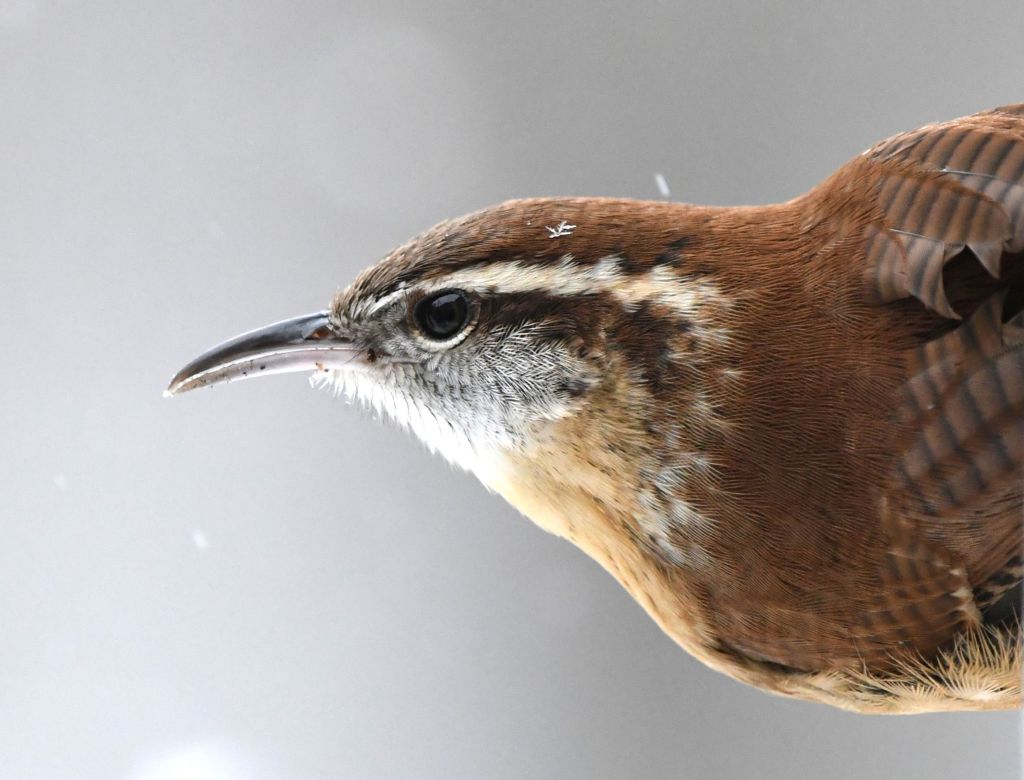
Carolina Wren sitting nearby

The most difficult birds for me to photograph have been the Black-capped Chickadees and the Tufted Titmice. They fly in, grab a seed, and disappear! I can barely spot them through the lens of my camera before they’re gone! I have dozens of ‘bird-less’ pictures to show for it! Once they’ve grabbed a seed, off they go to peck it open. If they land on an open branch, one that’s not obstructed by a tangle of other branches, I can sometimes get a decent shot. But these birds are small and quick and blend in perfectly with the trees. It’s so much easier to photograph a cardinal!

Black-capped Chickadee sitting on a limb that we attached to our deck for photo-ops like this!
Tufted Titmouse momentarily resting!

Most of the time when I’m backyard birding, only the ‘regulars’ show up (sparrows, juncos, jays etc.), but every once in a while, there’s a surprise, like the Sharp-shinned hawk that landed briefly, or the Cedar Waxwing that sat for a while in a nearby honeysuckle bush, or the Yellow-bellied Sapsucker that paused momentarily on our aging dogwood tree less than 10 feet from where I was standing! He was so close that I was afraid any movement on my part would scare him away.

Cedar Waxwing in the Honeysuckle Bush
Yellow-bellied Sapsucker on the Dogwood Tree

I’ve stood outside my back door taking pictures many, many times over the last several years through every season and all kinds of weather. It never ceases to amaze me how many different birds there are right in our own backyard; birds I’d never even heard of before, like White-throated Sparrows, American Tree Sparrows, Fox Sparrows, and White-crowned Sparrows!

White-throated Sparrow
American Tree Sparrow
Fox Sparrow
White-crowned Sparrow (May 2021)

There are also birds that, early on in my photography life, I didn’t even know were here in the winter like the goldfinches, robins, and bluebirds.

American Goldfinch
American Robin
Eastern Bluebird

And there are the regular, everyday birds, like the House sparrows, House Finches and White-breasted Nuthatches that come to our yard, or the Downy and the Hairy Woodpeckers that regularly come to the feeders, or the occasional Red-breasted Nuthatch that I rarely ever see!

Female House Sparrow
Male House Finch
White-breasted Nuthatch
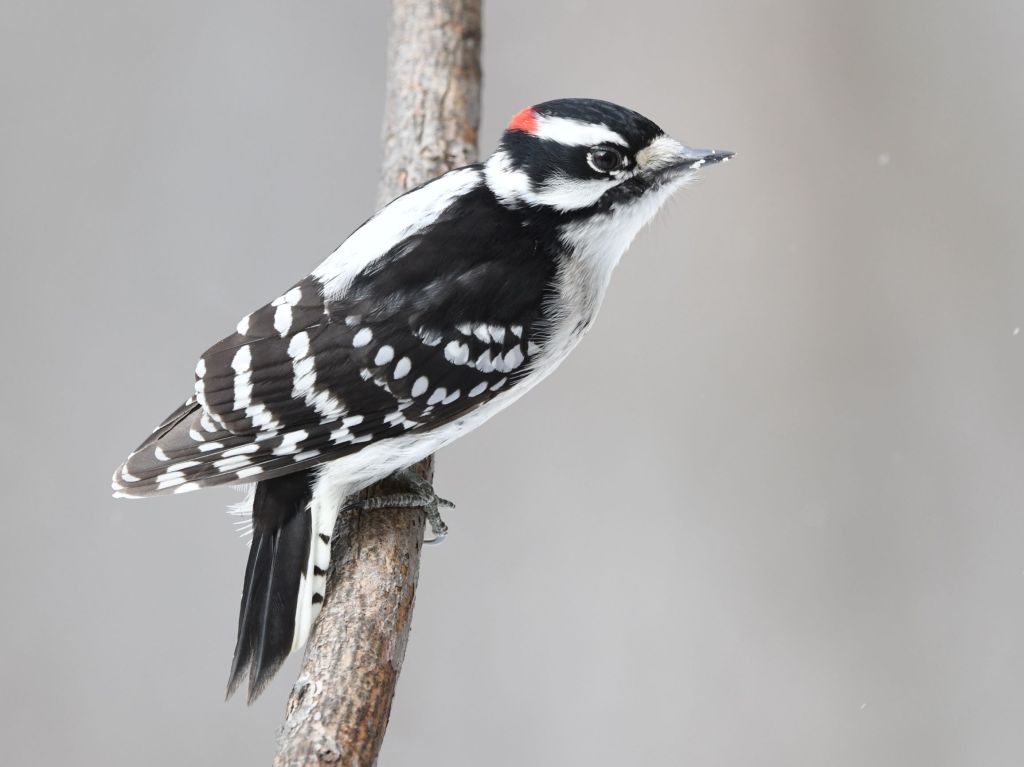
Male Downy Woodpecker
Male Hairy Woodpecker
Red-breasted Nuthatch

Once in a while, a few vagrants pass through our yard like this Oregon Junco I photographed in January of 2021, or this rare Orchard Oriole in May of 2021.

Oregon Dark-eyed Junco (January 2021)
Male Orchard Oriole (May 2021)

It never ceases to amaze me that so many different birds come to our backyard! It helps that we’re in a condo association where all of our yards are one big yard, where most of us have feeders hanging from our decks, where there are plenty of trees, and where a lovely little creek passes close by. In the warmer months, that creek is home to Wood Ducks, the occasional Northern Shoveler, and the usual mix of mallards and geese!

Enjoy!

Down the Rabbit Hole

October 21, 2023

‘Down the rabbit hole’ is an English-language idiom which refers to getting deep into something, or ending up somewhere strange—or wonderful. Lewis Carroll introduced the phrase in 1865 as the title for Chapter One of Alice’s Adventures in Wonderland.

An adorable Eastern Cottontail Rabbit

I tumbled down the nature photography rabbit hole quite by accident and I fell in deep. It all started about seven years ago when my husband asked me what I wanted for Christmas. It took a while for me to come up with something I really wanted, but eventually I hit upon the idea of a camera. I wanted a better one than we had. My request came when we had two small grandchildren and I thought if I had a better camera, I could take better pictures of them. But that’s not what happened!

Male Mallard

We went to Florida for the first time that winter and visited some of the most amazing preserves with incredible wildlife. It gave me the opportunity to use my new camera for the very first time. It wasn’t a fancy camera, but it did have a built-in zoom lens and I could get much better shots of birds and other wildlife than I ever had before! I was hooked! (The pictures below were taken with more recent cameras.)

Limpkin in Florida
Roseate Spoonbill in Florida
Painted Bunting in Florida

Within a year or so, I was already yearning for a better camera and a longer lens; a camera with a quicker shutter response time, and a lens that could capture birds that were even farther away. Once I had the newer camera and the longer lens (thanks to my husband’s diligent research), I spent more and more time outdoors taking pictures, totally immersed in my own little world.

Fawn in the greenery near our house

It wasn’t long before I had exhausted the shutter life of that second camera, with well over 100,000 pictures, and started looking for yet another camera and an even longer lens!

Carolina Wren on our deck

To date, I’ve gone through four cameras in seven years, mostly because I exceed the recommended shutter life of each of them. My current camera is a Nikon D500 with a shutter life of 200,000 cycles; I’m well over 127,000 after only a couple of years! The lens I use most often is a Sigma 150-600mm.  The D500 camera and the Sigma lens have been the perfect combination for me and for the things I like to photograph.

Nikon camera with Sigma lens on a monopod

I go out almost every day in all kinds of weather, even if ‘going out’ means just standing on our deck or in our backyard. Some of my favorite shots have happened right outside our back door where I have a ‘designated tree stump,’ placed in the yard, and a ‘designated tree branch’ attached to the deck for bird and mammal ‘portraits’. Plus, we have a beautiful bank of trees nearby and a small creek behind the house, both of which are attractive to a variety birds and mammals.

Red-breasted Nuthatch on the ‘portrait branch’

I love going on picture walks! I love looking for interesting things to photograph, whether it’s a bald eagle or a green bottle fly! It’s all quite fascinating, especially when I bring up the pictures on my computer and can see so many amazing details—like the individual hairs on a fly, or the tiny red mites on a dragonfly!

American Bald Eagle
Male Monarch (males have two distinct black spots on the lower wings)

One of the things I also enjoy doing after taking all those pictures is finding interesting facts about the creatures I’ve photographed and then sharing what I’ve found on Facebook, our local newspaper, or this blog.

Two male grackles on my ‘designated stump’ engaging in ‘bill tilt’ behavior to establish dominance. Whichever bird can maintain this posture the longest wins!

The name ‘picture walks’ started years ago when I first fell down this rabbit hole and was heading out the front door for a walk. If I was leaving the house without my camera, I’d tell my husband I was going on a ‘regular walk’, which meant I’d be home in an hour. If I was leaving the house with my camera in hand, I’d say I was going on a ‘picture walk,’ which was code for “I won’t be home anytime soon!”

White-crowned Sparrow in our backyard
White-tailed Deer in our backyard only a few feet from where I was standing

Some of the rabbit holes we fall into can be disastrous.

This one has been quite delightful.

Childhood Memories

January 25, 2023

A friend of mine, Jen Herro, recently posted her first blog, A Carpenter’s Garden, and it struck a chord with me. She is a watercolor artist with a passion for the natural world.  Our lives first became entwined when Jen asked if she could use one of the photographs I had posted on The Naturalist’s Notebook Facebook page as a reference piece for one of her paintings. We have never met in person, but through our shared passion for nature and art, it feels as if we’ve been friends forever.

In her introductory post, Jen tells about how her love for the outdoors began in childhood while visiting her grandparents’ cabin in the big north woods of Minnesota. Her grandfather, a naturalist, taught her how to “appreciate the wildness of the land,” how to paddle a canoe, start a campfire and make baked beans in a pot buried in the ground. It sounded like an idyllic childhood, and it made me wonder where my own love for the outdoors had come from.

Mute Swan Cygnet during a recent snowstorm

I didn’t have a grandfather who taught me how to canoe or build campfires, but I did have a dad who took me fishing. He was also the person who gently told my mother to “let her be” when I wanted to climb trees, play baseball, and wear blue jeans. Her preference would have been to see me in dresses, playing with dolls, and not running amok through puddles!

Six year old me worried about holding a fish I recently caught

My parents did make one grand and loving attempt at giving my brother and I outdoor experiences, though, by taking us camping.

We left home on a hot and humid summer day during the biggest mosquito convention ever, and drove ‘up north’ to find a campsite, pitch a tent, and spend a fun weekend away from home! Mother Nature had other plans. She wanted rain, lots of rain–so much rain that our borrowed tent leaked like a sieve. We were miserable.

I don’t remember going on any nature hikes that weekend, roasting marshmallows, or fishing with my dad, but I do remember slogging through the rain and mud with my nature-weary mother at 2:00 in the morning hoping to find an outhouse! That’s what stayed with me all these years, the rain and the outhouse! It wasn’t the camping experience any of us had hoped for, but it was, nonetheless, memorable!

Carolina Wren in our backyard
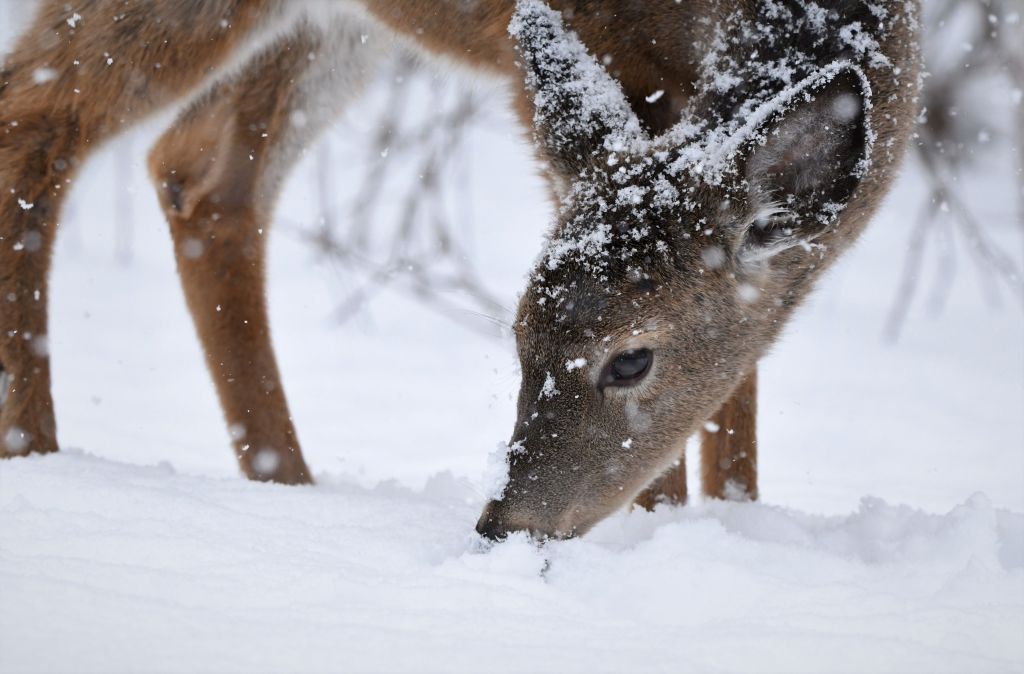
A sweet white-tailed deer in our backyard

So, it’s probably safe to say that my love of the outdoors didn’t come from my parents or even my grandparents, at least not in the way that it did for Jen.

What I had was the joy of growing up during the 1950s, when we spent our summer days playing outside with friends, climbing trees, catching bugs, looking for snakes, and exploring the nearby woods. We didn’t have cell phones or iPads to keep us entertained; we barely had a television! What we did have was each other, and the wide-open spaces of our neighborhood, and the nearby parks.  The true origins of my interest in Mother Nature remains a mystery, but the freedom I had as a kid to spend all day exploring and interacting with her, kept the love alive.

Belted Kingfisher during a recent snowfall

As an adult, I’ve mostly chosen outdoor adventure vacations, rather than leisurely indoor ones.   My husband and I have hiked in Scotland, England and Wales, and have backpacked more than a thousand miles on the Appalachian Trail. We’ve also enjoyed a good deal of biking, canoeing, and kayaking along the way.  But it wasn’t until I took up photography a few years ago, that the natural world really opened up for me. I found birds I’d never seen before, took close-ups of butterflies I’d only known from a distance, and examined the details of a thousand little dragonflies that only a good camera and a long lens could afford me.

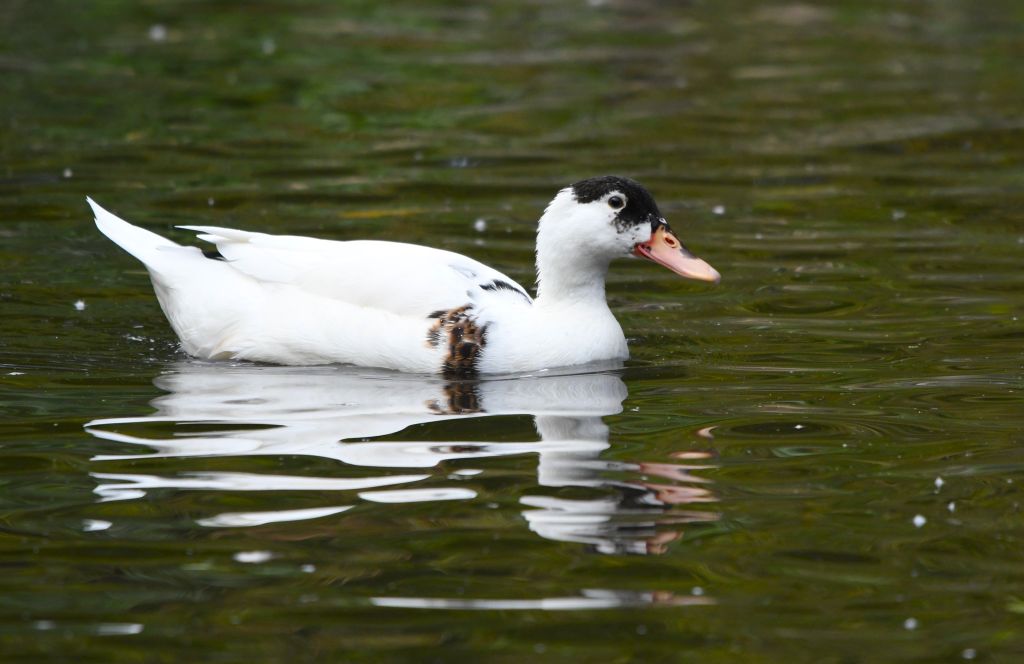
A bird I’d never seen before! (some sort of Mallard Hybrid)
Eastern Tiger Swallowtail on Butterfly Bush (taken last summer)

It doesn’t really matter where my love of nature ultimately came from, whether it was a father who took me fishing, or a mother who just let me be, I have reaped its benefits my entire life. The countless hours I have spent outdoors have always brought me joy; being able to photograph what I love has been an unexpected bonus!

That’s all, folks!

Find the Joy

November 21, 2022

“If you choose not to find joy in the snow, you will have less joy in your life but still the same amount of snow.” Anonymous

I love this quote– and the snow!

The Carolina Wren sings a very joyful song

It’s hard not to feel a certain child-like wonder when the first big flakes of snow fall from the sky and transform our world into a winter wonderland.  I love sitting by the fire with a hot cup of tea in my hands watching the snow pile up outside our window and marveling at the little songbirds as they fluff up their feathers to ward off the cold. I’d like to invite them in for a while to warm up. Instead, I put on three layers of pants, three shirts, a balaclava, a fuzzy hat, a down coat, a neck warmer, mittens, and boots, and join them, camera in hand.

American Robin on a snowy day enjoying a crabapple tree

For the last several days, the snow has been falling almost non-stop!  The birds don’t seem to mind, though, and are flitting about everywhere, enjoying the easy source of food in our feeders and occasionally taking sips of warm water from the birdbath. I’ve taken hundreds of pictures of them hoping to find among the mix, one of the ‘vagrants’ –birds who are part of a phenomenon known as an ‘irruption’ which is currently taking place across eastern North America.

Downy Woodpecker on a very snowy day!

An irruption is a sudden change in the population density of an organism. In the lives of our feathered friends, an irruption occurs when the birds who live farther north run out of food, and move farther south to find sustenance. Some of the irruptive species here in Michigan include purple finches, redpolls, evening grosbeaks, red-breasted nuthatches, pine grosbeaks, pine siskins, and bohemian waxwings.

These irruptions commonly occur every few years and mostly impact the finches and other species that winter in the boreal forests of Canada and further north. The primary food source for these birds comes from pine cones. When the pine cone crop is poor over the summer, it foreshadows a difficult winter for these birds. The shortage of seeds that the pine cones produce forces these birds to move beyond their normal range in search of food. If multiple types of trees fail to produce a seed crop during the same year, multiple species of birds will move further south.

Eastern Bluebird weathering the elements on a snowy winter’s day
Mourning Dove

Irruptions vary widely in size, frequency, and duration. Some birds will stay in an area for weeks at a time, while others might only stay for a day. Regardless of the size of the flock or the duration of their visit, it’s an exciting time for birders!

Dark-eyed Junco

I would love to see any one of these wayward birds on my picture walks, but I have been happy enough with my usual backyard visitors, as well as the interesting mix of migrating birds that visit Kalamazoo this time of year, like the fox sparrows, the white throated sparrows, the American wigeons and, the very peculiar, Wilson’s snipe.

Wilson’s Snipe, a migrating bird at the Wolf Lake State Fish Hatchery
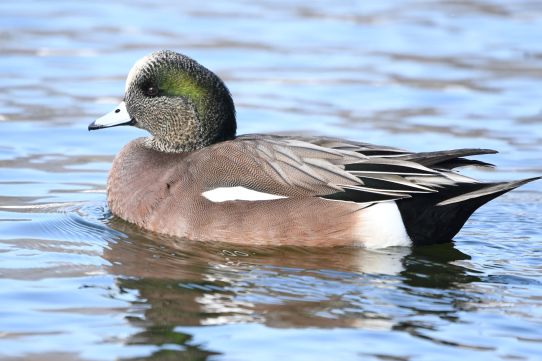
American Wigeon, a migrating bird that visits a nearby pond

I’ve been out in the snow several times recently looking for the evening grosbeaks, the red-breasted nuthatches, and the other ‘irrupters’ who might be passing through, but I have come up empty handed.  On any given picture walk, though, there is always the possibility that something new might come along, and ‘possibility‘ is always a great motivator!

Male Northern Cardinal

On these beautiful, winter days, I love the challenge of bundling up like a kid to stay warm and trudging through freshly fallen snow to photograph a bird, as I revel in the joy that, at age 75, I can still do this! 

Find the joy!

White-tailed deer, one of the other beautiful creatures I often see on my walks

Still Waters

November 29, 2021

One of my very favorite times to go for a picture walk is early in the morning just after sunrise when there is no wind, and the water on the pond is so perfectly still that the reflections of the birds can take my breath away. I rarely get a day like that, but when I do, the results seem magical.

Male Mallard on very still water
Canada Goose floating on ‘glass’
Greater Yellowlegs

As we quickly move into the month of December, it will be harder and harder to find open water. Most of the ponds are already starting to freeze. Once frozen, though, they will offer up a whole different kind of magic!

Male Mallard doing an ice dance!

A few years ago, when I was out taking pictures around the ponds at our local fish hatchery, I kept hearing weird noises in the distance. My first thought was, “What kind of bird is THAT??”  But then saw two people near one of the ponds who looked as if they might be throwing things across the frozen water. After watching and listening for quite awhile, I decided they must be skipping stones across the ice!! Maybe that’s where the sound was coming from!

Juvenile Trumpeter Swan trying out the new ice

When I tried skipping stones across the pond later in my walk, I was pleasantly surprised that I could replicate the very same sound! I also discovered that different sized stones would change the pitch. Fist-sized stones, however, broke through the ice. When I got home and could do a little research, I learned that this phenomenon is called “acoustic dispersion” and that others who have described the sound likened it to a “laser blast from a galaxy far, far away” or the “chirp of an exotic bird”. It was a little bit of both, I thought. If you’re interested in reading more about it, here’s a good link: https://science.howstuffworks.com/skipping-stones-on-ice-makes-crazy-sci-fi-sounds.htm

One more happy-looking mallard trying to walk on ice!

The frozen ponds also offer a great opportunity for photographing all the shore birds who are trying to cope with this drastic change in their watery environment! Sometimes, when the ice has just started to form, it looks as if all my web-footed friends are walking on water!

As I sit here at home on this cold November day, looking out at all the little birds enjoying the food in our feeders, I’m secretly wishing for snow—lots of snow; the biggest, whitest, fluffy kind of snow that falls to the ground in no particular hurry and quickly turns a drab overcast day into a winter wonderland! If that happens, I’ll be out the door in a heartbeat!

Northern Cardinal on a very snowy day
Female Northern Cardinal

I love getting pictures of the birds sitting on the snowy limbs with their feathers all puffed up against the cold, surrounded by the gently falling snow. A few weeks ago, we had a very brief but spectacular snowfall like that and I hurried outside with my camera to capture as many birds as I could before the snow completely melted. There were Red-winged blackbirds, Northern Cardinals, Black-capped Chickadees, American Robins, Tufted Titmice, Dark-eyed Juncos, House Sparrows, American Goldfinches, and one big surprise, a Hermit Thrush– a bird I’d never seen before!

A Hermit Thrush in a nearby tree that I almost missed!
Black-capped Chickadee

As we enter into our second winter of a very long and heartbreaking pandemic, I am beyond thankful for this photography hobby. It has kept life interesting, and made these past two years of social isolation and constant uncertainty manageable. Photography gets me out the house and affords me the opportunity to look for all the beauty I can find in the most ordinary of things: quiet snowfalls, skipping stones on ice, and the unexpected loveliness of a little brown duck on still waters.

Female Mallard

Great Backyard Bird Count

February 16, 2021

The 24th annual, four-day, Great Backyard Bird Count just ended yesterday. I had never participated in this event before and I’m not quite sure why. Maybe I thought it would be too time-consuming or that only experienced birders would be able to do it. Maybe I thought it would be too complicated. Whatever the reasons, none of them proved true. Over the course of four days, I counted most of the birds from the comfort of my easy chair, the rest by standing in our back yard, camera in hand!

American Robin
Cedar Waxwing enjoying berries

“The Great Backyard Bird Count (GBBC) is a free, fun, and easy event that engages bird watchers of all ages in counting birds to create a real-time snapshot of bird populations.” www.audubon.org

Blue Jay

“The massive international community science project, held over four days every February, collects data that provides scientists with a long-term record of bird distribution and numbers over time, helping to identify trends that might be associated with urbanization or climate change.” https://news.wttw.com/2021/02/12/global-great-backyard-bird-count-underway

Fox Sparrow

“By participating in the Great Backyard Bird Count, community scientists contribute data that we use to protect birds and the places they need, today and tomorrow. In return, studies tell us that pausing to observe birds, their sounds and movements, improve human health. Participating in the Great Backyard Bird Count is a win-win for birds and people.” https://earthsky.org/earth/register-participate-great-backyard-bird-count

Downy Woodpecker

“During the 2020 count, more than 250,000 checklists were submitted from over 100 countries, and a record 6,942 species were counted. That is a large proportion of the estimated 10,000 bird species that live on Earth today.” https://earthsky.org/earth/register-participate-great-backyard-bird-count

American Robin

The Northern Cardinal nearly always tops the list as the number one bird reported followed by Dark-eyed Juncos, Mourning Doves, Downy Woodpeckers, Blue Jays, House Sparrows, House Finches, American Crows, Black-capped Chickadees and Red-bellied Woodpeckers.

White-throated Sparrow

With the exception of the Black Crows, all of those birds were on my list but in a different order of frequency. I also found Robins, Goldfinches, Cedar Waxwings, Brown Creepers, Northern Flickers, Tufted Titmice, White-breasted and Red-breasted Nuthatches, Hairy Woodpeckers, White-throated Sparrows, Fox Sparrows, and one new addition, a Yellow-bellied Sapsucker!

Yellow-bellied Sapsucker

Even though it’s called a ‘backyard bird count’, you don’t really have to be in your own backyard. You can go for a walk and count the birds along the way or you can go to a park and sit on a bench with a hot cup of tea in your hand. But for this, my first ever Great Backyard Bird Count, I actually counted the birds in my own backyard. In terms of variety, it was probably the very best place for me to be. Over the course of the four day event, I identified eighteen different species of birds!

American Goldfinch

If you haven’t already participated in the Great Backyard Bird Count, put it on your calendar for February 2022. It’s easy and fun– and an immensely good thing for all our feathered friends!

American Robin

Happy birding!

Winter Photography

February 1, 2020

I love going out on picture walks. It’s one of my favorite things to do! Even in the dead of winter!

Out for a lovely, snowy day in January

By all accounts, this has been a relatively mild winter here in Michigan, so I had been eagerly waiting for a really big snowfall to come along!  We did have a few short bouts of snow in December and January, but it melted quickly. Yesterday, though, on the very last day of January, it finally happened!! We had what I would call “a magnificent snowfall.” Huge, fluffy flakes swirling all around– giving the world that magical snow-globe kind of feeling! It was perfect! I had to get out the door!

Female Northern Cardinal with just a touch of snow
Eastern Bluebirds stay here all winter and enjoy berries like these

Getting out the door, though, was the easy part; trying to stay warm and take pictures at the same time, was not —especially when the wind chill was well below freezing. I can easily put on two or three layers of pants, sweaters, socks and hats, but I cannot do the same for my hands –not if I expect to be able to operate any of the tiny buttons and dials on my camera!  Over the years, I have tried various combinations of mittens and gloves and hand warmers to solve the problem with varying degrees of success –or lack thereof!

Black-capped Chickadee enjoying the snow!
A beautiful Bluejay waiting for his turn at the peanuts

As the weather got progressively colder this winter, I tried yet another new idea. Instead of gloves, I tried two layers of very thin mittens (along with my usual rechargeable hand warmers). I picked mittens instead of gloves so that my fingers could keep each other warm; and I chose thin ones so that I could still feel the buttons on the camera! The inner mitten was a wool blend and the outer one a wind-proof, water-proof shell. So far, this combination has been working at least as well as most I have tried –but the jury is still out. When I’m not actively engaged in taking pictures, I stuff my hands deep into my pockets and hold on to those toasty hand-warmers.

This lovely, little Fox Sparrow was a new bird for me! He was right in my own back yard!
Male Downy Woodpecker

The problem is, most of the birds I encounter are not particularly interested in seeing me with my hands in my pockets standing around doing nothing! As soon as my hands go in the pockets, they start badgering me to take another picture!

“Pick me! Pick me!” they chirp insistently. “I’m the prettiest! Pick me!

How can I resist??

White-breasted Nuthatch with two tiny snowflakes on its beak!
Red-breasted Nuthatch
Contrary to popular belief, many Robins stay here all winter.

So I continue to traipse about for hours on end, encumbered by multiple layers of hats, scarves and sweaters in happy pursuit of the ‘prettiest one’– all the while wondering how these tiny little creatures manage to stay warm with their skinny bare feet and tiny feathered bodies, while I, on the other hand, am barely staying warm.

White-throated Sparrow– another little bird that hangs out in our backyard
American Tree Sparrow on one of our snowiest days

It’s just one of the many fascinating mysteries of nature, I guess. Mysteries that keep drawing me in –and sending me back out for more!