Backyard Birding in Winter

January 24, 2026

Most of the country is now in the midst of a huge winter storm. When I got up this morning, the temperature was -12°F! The wind chill factor yesterday was a whopping 19 degrees below zero!! But, hey, when the sun is shining, it doesn’t seem that cold– especially when you’re inside looking out!

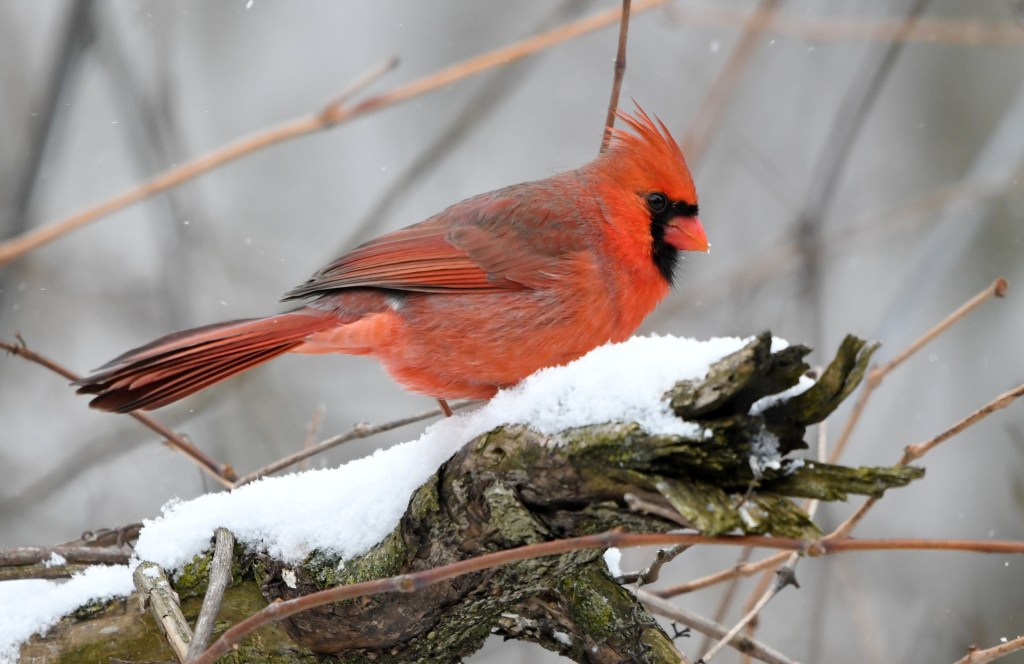
Male Northern Cardinal on a frigid winter day!

When it’s this cold, I do love the challenge of trying to stay warm and taking pictures at the same time! I wear multiple layers of clothing, heated socks, clunky over-boots, a warm hat and mittens, and two hand warmers stuffed into my pockets. I don’t venture far from the house on days like this, though. I like to duck inside every once in a while for a warm-up. Besides, everything I need to see is right outside my back door.

Dressed for success!!

To bring the birds in a little closer to where I’m taking pictures, I sprinkle a handful or two of sunflower seeds, mealworms, and peanuts on a nearby tree stump. It’s fun for me to watch how long it takes the birds to find this stash, and to see who finds it first; usually it’s the Dark-eyed Juncos, or the Blue Jays.

Female Dark-eyed Junco waiting patiently for her turn at the seeds
blue Jay quickly scarfing down peanuts from our backyard tree stump

A little later, the Northern Cardinals show up on the stump, and sometimes the Common Grackles or the Red-bellied Woodpeckers. The Starlings are nearby raiding the peanuts from our platform feeder rather than the stump!

Female Northern Cardinal
Common Grackle
Red-bellied Woodpecker
Common Starling waiting for a turn on our platform feeder

In the nearby trees, I might also have the joy of finding a Pileated Woodpecker, a Northern Flicker or, on rare occasions, a Red-tailed Hawk or a Sharp-shinned Hawk!

Pileated Woodpecker
Yellow-shafted Northern Flicker
Red-tailed Hawk
Sharp-shinned Hawk that landed briefly

I love standing under the shelter of our second story deck and surveying our backyard for hours on end capturing the rhythm of the day; making mental notes about which birds are most likely to visit, who’s the bravest, what treat they like the best, and who’s the hardest to photograph.

Female Dark-eyed Junco on an empty stump!

The most common winter visitor to my tree stump is the Dark-eyed Junco. There are plenty of them around and they are ground feeders. They’re used to looking for food down below rather than up in the feeders overhead where most of the other birds like to go. Juncos also hop around in the snow next to the stump looking for seeds that other birds have dropped or knocked off the edge.

Male Dark-eyed Junco looking for seeds in the snow

One of the bravest birds, I think, is the Black-capped Chickadee. It seems fearless to me. On the rare occasions where I’ve tried feeding our backyard birds by hand, only the chickadees have taken me up on the offer. Surprisingly, the bigger birds have been much too wary. When I feed the birds by hand at the Kensington MetroPark in Milford, Michigan, the Chickadees are often the first to take food from my hand as well. Perhaps the bigger birds, like the Cardinals and the Blue Jays see my skinny little hand as too precarious a perch for them even with an offer of food!

The Black-capped Chickadees love peanuts!

The favorite food for most of the birds is definitely peanuts. Those disappear quickly, especially when the Blue Jays take over! They’ll grab 7 or 8 peanuts in quick succession and return for more! When they take this many peanuts at a time, most will be stored in their crop, an expandable pouch in the Jay’s esophagus that temporarily holds food. The crop allows Blue Jays to transport a large number of seeds or nuts to other locations and store them for future use. Before taking flight, I often see the Blue Jays carrying two or three additional peanuts in their beaks!

Blue Jay taking more than his fair share!

One of the potential ‘stump feeders’ that I love to see but rarely capture is the Carolina Wren. Every winter, except this one, I’ve had one come to the feeders on our deck where I could easily watch it from the comfort of my living room chair. This cute little wren came so regularly that I assumed it was the same bird year after year and I referred to it fondly as my Carolina Wren. I can’t say it ever landed on the stump, but it did occasionally sit nearby.

Carolina Wren sitting nearby

The most difficult birds for me to photograph have been the Black-capped Chickadees and the Tufted Titmice. They fly in, grab a seed, and disappear! I can barely spot them through the lens of my camera before they’re gone! I have dozens of ‘bird-less’ pictures to show for it! Once they’ve grabbed a seed, off they go to peck it open. If they land on an open branch, one that’s not obstructed by a tangle of other branches, I can sometimes get a decent shot. But these birds are small and quick and blend in perfectly with the trees. It’s so much easier to photograph a cardinal!

Black-capped Chickadee sitting on a limb that we attached to our deck for photo-ops like this!
Tufted Titmouse momentarily resting!

Most of the time when I’m backyard birding, only the ‘regulars’ show up (sparrows, juncos, jays etc.), but every once in a while, there’s a surprise, like the Sharp-shinned hawk that landed briefly, or the Cedar Waxwing that sat for a while in a nearby honeysuckle bush, or the Yellow-bellied Sapsucker that paused momentarily on our aging dogwood tree less than 10 feet from where I was standing! He was so close that I was afraid any movement on my part would scare him away.

Cedar Waxwing in the Honeysuckle Bush
Yellow-bellied Sapsucker on the Dogwood Tree

I’ve stood outside my back door taking pictures many, many times over the last several years through every season and all kinds of weather. It never ceases to amaze me how many different birds there are right in our own backyard; birds I’d never even heard of before, like White-throated Sparrows, American Tree Sparrows, Fox Sparrows, and White-crowned Sparrows!

White-throated Sparrow
American Tree Sparrow
Fox Sparrow
White-crowned Sparrow (May 2021)

There are also birds that, early on in my photography life, I didn’t even know were here in the winter like the goldfinches, robins, and bluebirds.

American Goldfinch
American Robin
Eastern Bluebird

And there are the regular, everyday birds, like the House sparrows, House Finches and White-breasted Nuthatches that come to our yard, or the Downy and the Hairy Woodpeckers that regularly come to the feeders, or the occasional Red-breasted Nuthatch that I rarely ever see!

Female House Sparrow
Male House Finch
White-breasted Nuthatch
Male Downy Woodpecker
Male Hairy Woodpecker
Red-breasted Nuthatch

Once in a while, a few vagrants pass through our yard like this Oregon Junco I photographed in January of 2021, or this rare Orchard Oriole in May of 2021.

Oregon Dark-eyed Junco (January 2021)
Male Orchard Oriole (May 2021)

It never ceases to amaze me that so many different birds come to our backyard! It helps that we’re in a condo association where all of our yards are one big yard, where most of us have feeders hanging from our decks, where there are plenty of trees, and where a lovely little creek passes close by. In the warmer months, that creek is home to Wood Ducks, the occasional Northern Shoveler, and the usual mix of mallards and geese!

Enjoy!

The Four Survivors

October 22, 2024

As I was walking through one of my favorite birding spots, the Wolf Lake State Fish Hatchery, I was thinking about the four survivors; birds I have photographed many, many times over the years who have overcome challenges of one sort or another. I’ve spent so much time photographing these four that I feel a particular kinship with them.

Betty, the Blue-winged Teal

One of those birds, a female Blue-winged Teal, is a year-round resident at the fish hatchery, but shouldn’t be.  I see her at the hatchery almost every time I visit and have pictures of her throughout the four seasons. She has become so familiar to me that I named her Betty.

Betty, the Blue-winged Teal

When I realized that I had pictures of her for every single month of the year, I wondered why she had never gone south for the winter. Blue-winged Teals aren’t supposed to stay in Michigan throughout the winter months. According to the U.S. Fish and Wildlife Service, they “…are not able to endure the cold weather and are some of the first to migrate south in the fall and the last to head back north in the spring.” When I posted my quandary about Betty on Facebook, a birding friend replied, “Betty has a wing injury that prevents her from doing long distance flights. She is willing to fly very short distances to relocate to a different pond now and then.” That explained everything! She had no choice. But, given the missive from the U.S. Fish and Wildlife Service about the inability of these birds to survive the cold, I had a whole new sense of admiration for Betty and her ability to make the best of a bad situation. She’s a true survivor!

Betty on a very cold February day in Michigan

The other bird I always look for at the fish hatchery is the Great Blue Heron. I haven’t named him and I don’t see him as often as I do Betty, but I think he’s the same blue heron I’ve been seeing for many years at the hatchery. When I first started taking his picture, it looked as if he had sustained an injury to his neck at some point in his life. Maybe a predator tried to catch him when he was young, or maybe he got tangled up in a fishing line. There’s no way to know, but he obviously survived ! Whenever I visit the fish hatchery, I look for him in all of his favorite places. Sometimes he’s standing on a log at the edge of one of the ponds. Sometimes he’s perched in a tree or scouting the edges of the water looking for a fish. In the wintertime, I’ve even found him out on the ice! Wherever I happen to find him, it feels like my lucky day, and I always take a picture!

My Great Blue Heron in one of his favorite spots at the Wolf Lake State Fish Hatchery
My Great Blue Heron in a contemplative moment
My Great Blue Heron in the dead of winter!

The WMU Business Technology and Research Park next door to where we live is another one of my favorite places to walk and take pictures. There are mowed trails meandering through acres of wildflowers, tall grasses, and trees. No matter what the season, I always find something to photograph:  songbirds, wild turkeys, butterflies, dragonflies, praying mantids, white-tailed deer, and an abundance of chipmunks, squirrels, and rabbits. In addition to all the inviting grassy trails, there are three small ponds that provide refuge for mallards, swans, geese, green herons, turtles, frogs, and a few migrating ducks.  

A Fall walk through WMU’s Business Technology and Research Park

It’s also the place where I look for my Red-tailed Hawk. I scan the skies looking for him, and I search the tops of lampposts and trees hoping to get a glimpse. It’s a fun game trying to find him, but I don’t always win. Sometimes, he finds me!!

My Red-tailed Hawk overhead at the Business Park
My Red-tailed Hawk high in a tree
My Red-tailed Hawk on one of the lampposts

On the one eventful day that he found me, I was standing on a small footbridge taking pictures of mallards swimming in the pond and keeping my eye out for the green heron that sometimes perches on a branch along the edge. All of a sudden, that hawk flew in out of nowhere and landed on the railing of the footbridge less than 20 feet from where I was standing! He took my breath away!! But I slowly turned my camera in his direction, hoping my movements wouldn’t scare him. At the same time, he turned his head in my direction and we locked eyes through the lens of my camera. Before that magical moment passed, I quickly snapped a few pictures, and a millisecond later he was gone!

A close encounter with my Red-tailed Hawk

What I’ve learned about Red-tailed Hawks over time is their amazing ability to not only survive but to thrive!  They have achieved this success due to their adaptability, especially when it comes to food. Red-tailed hawks will eat almost anything, including rats, mice, squirrels, voles, rabbits, snakes, birds, bats, frogs, toads, insects, and even carrion. They are considered ‘generalist predators,’ a trait that has significantly contributed to their overall success and their widespread distribution. They are survivors!

My little Carolina Wren who visits the platform feeder on our deck all winter long

The last of my four survivors is the Carolina Wren that has been visiting the feeders on our back deck for many winters. Like the other survivors, I feel a kinship to this bird and consider him to be my Carolina wren because he keeps coming back and I keep feeding him—or perhaps more accurately, he keeps coming back because I keep feeding him!

My Carolina Wren on a snowy day in January

He likes the black-oiled sunflower seeds I leave in our platform feeder and carefully picks them out one by one, flutters down to the nearby doormat, tucks the seed into a crevice of the mat to stabilize it, and then cracks it open. The mat is just the other side of our sliding glass door, a few feet away from where sit. It’s such a treasure to see him return every year when the cold weather sets in.

My little wren just outside our window on a snowy day

It never ceases to amaze me that this tiny bird, or any bird for that matter, can survive the harsh winter months with just a handful of feathers to keep them warm, while I have to bundle up in layers upon layers of warm clothes, stuff hand-warmers into my pockets, and sometimes wear heated socks just to go out and take pictures! How do those little birds manage??

All layered up for winter photography!

There are so many wild animals out there that we never see struggling to survive through all kinds of weather and all kinds of circumstances. They have the marvelous ability to adapt and sometimes even thrive. But I continue to worry about how many of them we will lose over time due to our carelessness as human beings in our role as stewards of planet earth.  We’ve already lost too many.

Winter birding at Kensington Metro Park, Milford, Michigan

“The greatest threat to our planet is the belief that someone else will save it.” ~ Robert Swan British explorer and environmental activist 

Some Days…

August 23, 2024

Some days it’s really hard for me to push myself out the door and go for a picture walk—even though it’s something I love to do. Today was one of those days. I’d already gone for a long, leisurely walk with friends earlier in the day, and I’d already taken enough pictures. There was no logical reason to go out again. But it was a perfectly beautiful day; not hot, not humid, not windy. It would be a shame to waste all that loveliness by sitting in the house– and I would always wonder what I’d missed if I didn’t go. As it turned out, I would have missed everything!

Black-eyed Susan

My walk started out, as it often does, down by the creek behind our house where the dragonflies gather. I’ve found blue dashers, familiar bluets, slaty skimmers, Eastern pondhawks, and Eastern amberwings at the creek all summer long, but today there was a surprise–an American rubyspot damselfly!  It’s one of the prettiest little damselflies I’ve ever seen, but rarely find. My trip out the door had already paid off!

American Rubyspot Damselfly

Next on my route was the nearby WMU Business Technology and Research Park with its vast expanse of prairie grasses and wildflowers where I was hoping to find a few lingering butterflies or, perhaps, the first praying mantis of the season. There were so many possibilities! What first caught my attention, though, was a stunning green darner dragonfly, floating above the grasses looking for a place to land. I rarely see them, or get a picture, so I tracked its movements through the air hoping it would land somewhere that would be easy enough to photograph. Unfortunately, it chose a spot about 15 feet away and below my line of sight. I carefully picked my way through the high grass hoping to find it, hoping not to disturb it, and hoping not to acquire a few ticks along the way! I succeeded on all counts!

Female Common Green Darner Dragonfly

The fields of tall grass and wild flowers at the business park have beautifully mowed trails all the way through. One of those paths that I particularly like to walk has praying mantises along the way–and now is the time to find them!

WMU Business Technology and Research Park mowed path

They like hanging out on the tall stalks as they look for love. But they’re so well camouflaged that it’s almost impossible to find them! It’s like the ultimate Where’s Waldo challenge, but without the red and white striped hats to distinguish them! Sometimes, I’ll find 10 or more on a single walk; today I only found one, but it was almost as exciting as winning the lottery! And there were more surprises ahead!

Praying Mantis up close!
Praying Mantis from a distance!

After spotting the praying mantis, I very quietly and cautiously headed over to the small pond across the road where I once found a giant snapping turtle draped across a large rock. On rare occasions, I’ve also found a great blue heron standing motionlessly along the edges waiting for its his next meal to swim by.

Giant Snapping turtle that I found on a previous visit to the pond behind Floyd Hall

I’d barely crossed the road when I spotted the great blue heron! He was standing on the opposite side of the pond in his familiar stoic pose. From experience, I knew this bird might not move for a very long time. Great blue herons are extremely patient birds as they wait for their next meal. I took a few pictures as he stood there, and then I too waited, hoping for a better shot. Eventually, this magnificent bird very cautiously moved one of its legs, and then the other as it crept forward into the water. It occurred to me in that quiet moment of concentration that we were both doing the very same thing; standing quietly and watching our prey, then moving ever so slowly towards it, hoping to make the catch!

Great Blue Heron stalking his prey

From the pond behind Floyd Hall, I headed over to another pond where I hoped to find one of the green herons that visited regularly. What first caught my eye, though, was a mallard hybrid of some sort that had a wide band of white around its neck. It was wider than I what I usually see on a male mallard and I worried that it might be a piece of plastic. So, I zoomed in and quickly realized that this was just another goofy looking duck. Mallards breed with a wide variety of other ducks including domestic ducks, American black ducks and Northern pintails– all of which result in some very odd-looking offspring, including this one!

The odd duck with the wide white neck band
Typical Male Mallard

But my best surprise was still waiting for me.

I went to the footbridge that crosses over the pond hoping to find the elusive green heron. As I stood at one end of the bridge with my camera pointed towards the pond, a red-tailed hawk landed on the railing to my left at the other end of the bridge– only 20 feet away! It took my breath away! I really, really wanted a picture but I didn’t know if my settings were right, and I knew if he saw me move, he’d fly away. So, I very, very slowly turned my camera in his direction and quickly took a burst of shots, hoping for the best. Perhaps he noticed my barely perceptible movements or heard the click of my camera; within fifteen seconds, he was gone! Wow! I’ve never been that close to a hawk before!

Red-tailed Hawk on the footbridge 20 feet from me!
The hawk turned in my direction and took off as quickly as he came

After the hawk flew off, the green heron flew in and I got the shot!

Green Heron contemplating his next meal

On my slow amble towards home, a few butterflies posed politely for pictures and my picture walk was complete!

Monarch Butterfly on butterfly bush
Eastern Tiger Swallowtail on spotted knapweed

It was the best day ever– among a bucketful of best days where I’ve been lucky enough to still do all the things I love.

Monarch Butterfly on spotted knapweed

Wandering with a Sense of Wonder

December 28, 2020

I came across the phrase, wandering with a sense of wonder, while researching ideas for my previous blog, Photography as Meditation. Alice Donovan Rouse, in her blog titled Photography and Meditation wrote, “I realized that wandering with a sense of wonder embodies the same methodology as yoga—it’s an exercise in focus and acceptance of whatever it is we may encounter along the way.”

I found this pretty, little Dark-eyed Junco as I wandered through the Blandford Nature Center in Grand Rapids, Michigan on an unusually warm and sunny winter day

That’s exactly how I envision my ‘picture walks’ –as wandering with a sense of wonder.  On most of my ventures, I set out with no particular goal in mind other than to find whatever it is that I think is pretty or interesting– and take a picture. It might be a beautiful bird or butterfly, but it might just as easily be a rock or a fungus. It might even be a single sound that catches my attention and sends me off in a different direction.

Rocks in a thin layer of ice at Western Michigan University, Kalamazoo, Michigan
An interesting looking fungus on a cool winter day in our nearby woods

About two weeks ago, I was out taking pictures at the Wolf Lake State Fish Hatchery in Mattawan, Michigan, and was mystified by a sound in the distance, a sound I had never heard before. At first, I thought it might be a bird or maybe even an injured animal, but quickly divested myself of that idea when I decided it didn’t sound like any living thing on this planet! It sounded more like something from outer space!

This strikingly handsome Red-tailed Hawk at the Blandford Nature Center in Grand Rapids, was keeping a close eye on me as I tried to take his picture.
A Juvenile Bald Eagle flew overhead as I was taking pictures below at the Fish Hatchery.

My curiosity was getting the better of me when I spotted two people in the distance bending down close to the ground as if they were examining something quite small. When they stood up, it appeared as if they were throwing these things into the pond— and that’s when the strange noises began! It happened again and again as they threw stuff into the pond. They were far too distant for me to see exactly what they were throwing, but the most likely answer was rocks. All of a sudden, the proverbial light went off in my head! They were throwing stones across an ice-covered pond!! Fascinating!

A Northern Flicker at the Kalamazoo Nature Center that kept scurrying ahead of me down a path

Once the couple had moved out of range, I started experimenting for myself. The first rock I found was too small and made a disappointing ‘click-click-click’ sound across the pond. The second stone was too big and crashed unceremoniously through the thin ice. After a dozen or so rocks of various sizes and two small ponds with varying degrees of ice, I decided that a rock that was a little smaller than my fist made the best ‘pew-pew-pew’ sound as it skittered across the ice. Take a listen…

A very short video of one of my successful rock tosses across an icy pond at the Wolf Lake State Fish Hatchery

Once I returned home and could do a little research on the subject, I found an article by Mark Mancini titled, Skipping Stones on Ice Makes Crazy Sci-Fi Sounds, where he describes the sounds of this phenomenon perfectly “Skip a stone across a frozen lake and you might hear a high-pitched sound that’s both familiar and otherworldly. It’s like the chirp of an exotic bird or a laser blast from a galaxy far, far away.”

https://science.howstuffworks.com/skipping-stones-on-ice-makes-crazy-sci-fi-sounds.htm

Male Cardinals certainly brighten up the landscape on these long, colorless winter days.

I also learned that the phenomenon itself is “… a classic example of acoustic dispersion. Sound waves are made up of multiple frequencies, including high ones and low ones. When a sound travels through air, its component frequencies usually travel together at the same rate, so they all reach the human ear more or less simultaneously. But sometimes, when a sound wave passes through a solid medium (like ice), those high and low frequencies get separated. Being faster, the high-frequency wavelengths zip ahead of their low-frequency counterparts. As a result, you may hear a gap between the high notes and the low notes contained within the same sound. That’s acoustic dispersion in a nutshell.” How interesting!

A Blue Jay who landed way too close as he waited for a turn at one of our feeders!

If you ultimately decide that you’d like to try chucking rocks yourself, I’ve read that extra-large expanses of ice lend themselves particularly well to acoustic dispersion, and that you should probably stand a good distance away from the iced-over body of water for the very best effect.

A beautiful American Goldfinch on Oriental Bittersweet

If you want to see the ultimate in stone skipping across ice, watch this video by Cory Williams as he tosses rocks onto an ice-covered lake in Alaska. He apparently struck internet gold when he posted this video in 2014. (Fast forward the video to the 3:50 mark if you want to skip the intro and just see him throwing the rocks.)

https://www.youtube.com/watch?list=UUqEZdtqi4IlzmASqAjHGiHg&v=ZIHF5EoEixc

One of my very favorite little birds, the Black-capped Chickadee

If you wander with a sense of wonder, you’ll never be disappointed!

A young White-tailed deer that came almost close enough to pet!

A Photography Journey

August 4, 2020

As I pondered what to write today, I was thinking back on my short but immensely gratifying photography journey.

Juvenile Barn Swallow

It started innocently enough in the fall of 2016, when my husband asked me what I wanted for Christmas. I had no idea!  But, he likes finding things that surprise me, so I gave it some thought. What I came up with was “a better camera”. For many, many years, all I had was a very small, pocket-sized, Canon Powershot.

Willow Flycatcher

Once I told Mel about my ‘better camera’ idea, he went to work researching it. What he came up with was another model of the Canon Powershot –but a bigger, better version with a built-in zoom lens. I now refer to this camera as my ‘gateway drug’! As soon as I realized what was possible with a better camera, I was hooked!

Eastern Tiger Swallowtail on Butterfly Bush

It wasn’t long before I was outdoors nearly every day taking pictures of birds, butterflies, frogs, turtles– anything I could find that grabbed my attention. Eventually, though, I started musing about what I might be able to do with an even better camera—one that could capture the birds that were even farther away, and would also have a faster response time.

Slaty Skimmer

Male Eastern Pondhawk

Since Mel enjoys doing the research and I do not, he’s the one who went to work looking for another camera, one that would take a detachable telephoto lens. What he came up with was a Nikon D3400 and a 75-300mm lens. Once it arrived, I was out the door!

Painted Turtle

I think another year went by, maybe less, and I found myself wanting to capture creatures that were even farther away. Mel took off on another search and came up with a 150-600mm lens from Sigma that would probably do the trick. But it was much longer and much heavier than the one I currently had and I was hesitant. When it arrived, I was still hesitant. It just seemed too big and too heavy for me to handle comfortably. But I was eager to take close-ups and quickly overcame my reluctance. I have not put it down since!

Eventually, the constant lifting and focusing with a lens that size made my back ache and I reluctantly added a monopod to my set up.  It’s a bit of a bother sometimes to have the monopod attached, but I can now focus on a subject for an indefinite amount of time without having to give my back a break.

This insect was a huge surprise! It’s a female BOTFLY laying an egg on a blade of grass. I’ve never seen one before and didn’t know we even had them in the U.S.!

After the Nikon D3400, came a Nikon D5600, which is what I have been using for the last couple of years. This camera and I have gone on a picture walk together nearly every day and I have taken hundreds of pictures with it on each of those walks. Periodically, I have checked to see how much ‘shutter life’ it had left.

My D5600 had been given a shutter life of 100,000 shots. When I last checked, I had taken well over 151,000 pictures! I felt as if we were on borrowed time and decided to start looking for a new one.

Red-tailed Hawk

Once again, Mel returned to the drawing board to find a camera that was well suited for wildlife photography. What he found was a Nikon D500. It arrived a just a few days ago and we have already become fast friends!

With a shutter life of 200,000 shots, I’m looking forward to many years and many pleasant journeys with my newest walking companion!

Butterfly Weed

Colorado Rocky Mountain High

Mel and I have just returned from a vacation in Colorado where we both enjoyed pursuing our passions—fly fishing for him, nature photography for me.

August 28-29

Hitchcock Nature Center, Honey Creek, Iowa

Our four day, twelve hundred mile car journey from Michigan to Colorado took us through the states of  Indiana, Illinois, Iowa and Nebraska. According to Google Maps, it’s only a 16 hour journey— that is if you don’t stop to sleep or eat or go to the bathroom! We did all of the aforementioned, plus took a side trip to Honey Creek Iowa where we spent two days in a cozy little cabin on the grounds of the Hitchcock Nature Center. While at the nature center, we took pictures walks along the  Fox Ridge Run Trail and the Boardwalk Trail.

Great Spangled Fritillary on Field Thistle

August 30- September 2

Ft. Collins, Colorado

From Honey Creek, Iowa we headed through Nebraska to Fort Collins, our first Colorado destination.

Fort Collins is well known for its excellent fly fishing opportunities and a multitude of natural areas to explore. Over the course of our stay in Fort Collins, Mel went fishing several places along the Cache La Poudre River, while I took picture walks along the Hewlett Gulch Trail, the Fossil Creek Reservoir (twice) and at the Colorado State University Annual Trial Flower Garden. Mel joined me for picture walks on one of my visits to the reservoir and at the university flower garden.

Cache La Poudre River where Mel was fishing
(He took this picture while he was fishing and you can see the tip of his rod in the lower right corner.)
I was surprised to find White Pelicans in Colorado!
This one, as well as hundreds of others were hanging out at the Fossil Creek Reservoir in Fort Collins
Red-legged Grasshopper– one of hundreds at the Fossil Creek Reservoir
Barn Swallows waiting to be fed!
Fossil Creek Reservoir is a huge tract of land! That’s me in the lower left corner!

Beautiful flowers and butterflies from the Colorado State Annual Trial Garden…

Painted Lady butterfly

September 3-5

Estes Park, Colorado

As soon as we arrived in Estes Park, Mel headed to the fishing shops and I headed out looking for pictures to take. Surprisingly, the Knoll-Willows Nature Preserve is right in town and only a stone’s throw from where we parked! Within a minute or so of commencing my walk, I spotted a huge bull elk lounging in the underbrush along the edge of the preserve! A little farther down the sidewalk, were several of his girlfriends. Apparently, elk are a very common sight right in Estes Park!

Bull Elk lounging around right in downtown Estes Park!
Hmmm. No dogs allowed. What’s up with that??
“Hey, good lookin’, what’s cookin’?”

In front of the Visitor’s Center at Estes Park, the Hummingbird Moths and the Hummingbirds were a delight to watch…

Sunset in the Rocky Mountains
California Poppy

September 5, 2019

Rocky Mountain National Park to Steamboat Springs

We spent the day driving through the scenic, breathtaking Rocky Mountain National Park to reach our second Colorado destination, Steamboat Springs. Mel and I stopped several times through the mountain route to take in all the spectacular views– but I never took any scenery pictures (they tend to be disappointing compared to the real thing), preferring instead to look for the smaller things like birds and butterflies and mammals.

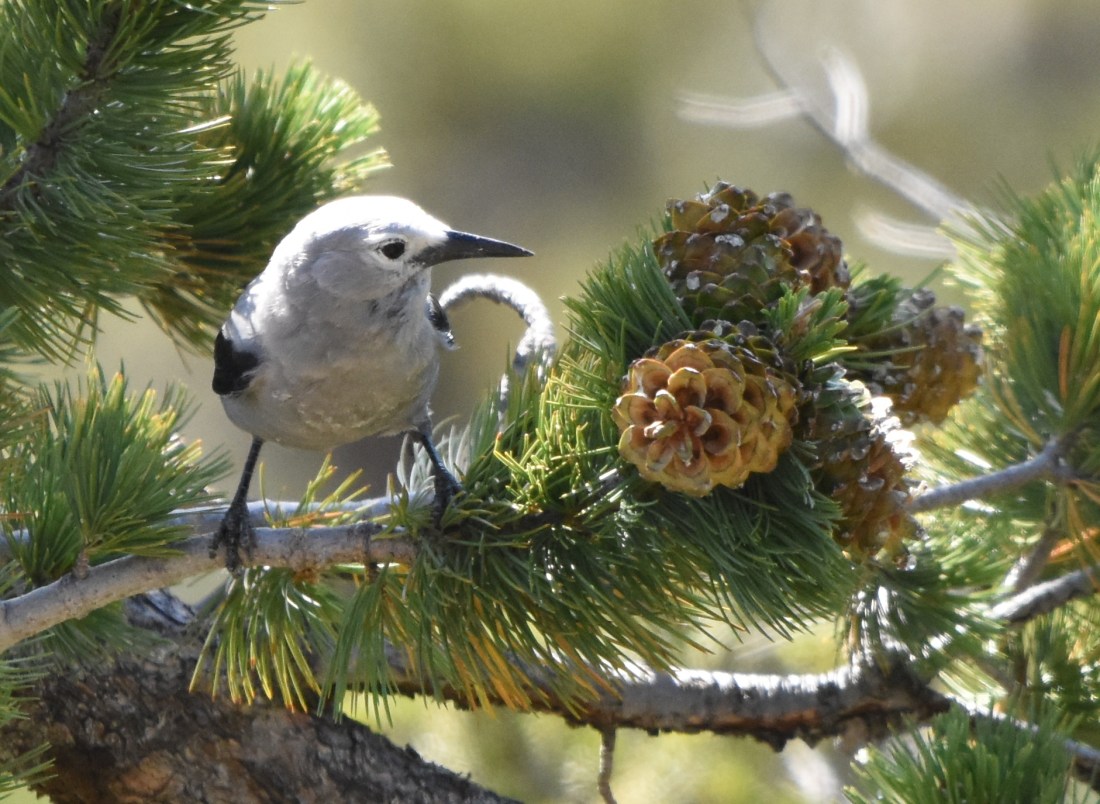
Clark’s Nutcracker
(Clark’s Nutcrackers are mainly found in mountains at altitudes of 3,000–12,900 ft in conifer forests.)
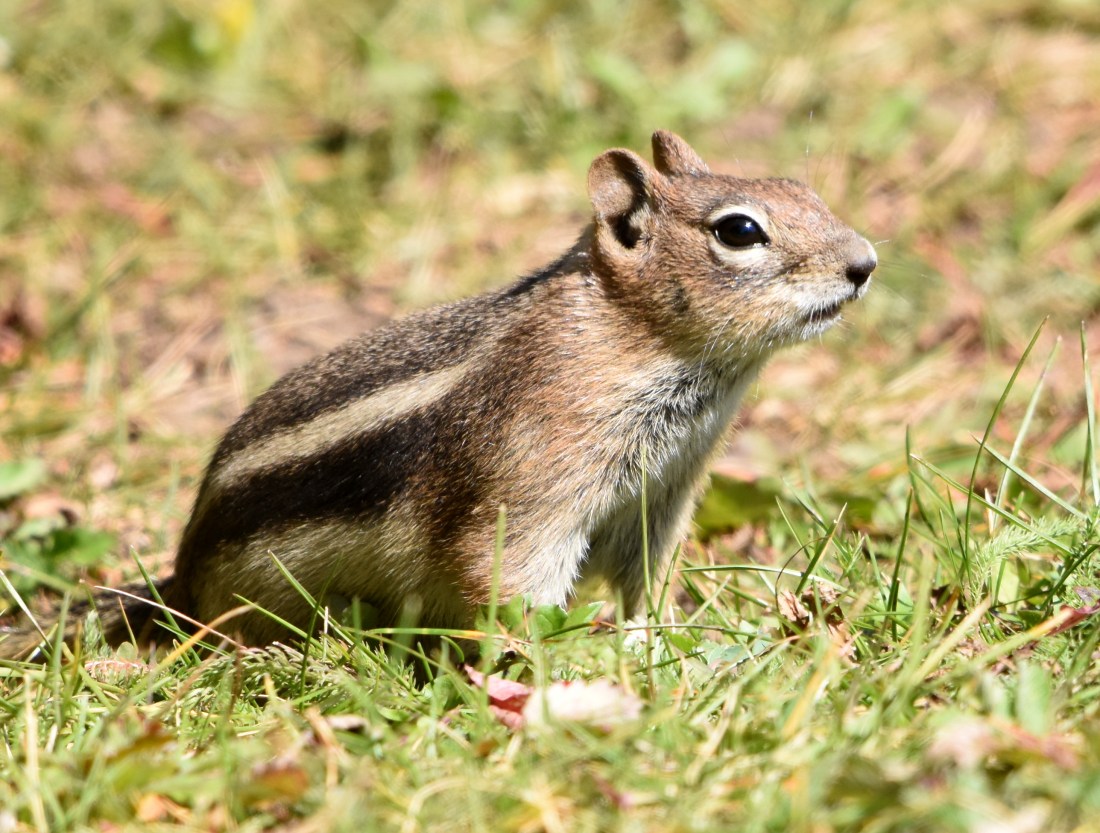
Gold-mantled Ground Squirrel in the Rocky Mountains
This little critter looks a lot like a chipmunk but is much bigger– kind of like a chipmunk on steroids!

September 5-9

Steamboat Springs, Colorado

While Mel went fishing in the Yampa River, I went walking along the Yampa River Trail, a 7.5 mile multi-use trail that runs through the heart of Steamboat Springs and along the Yampa River. Along that trail, I found other points of interest like the Rotary Park Boardwalk and the Yampa Botanic Park, both of which were wonderful places for a quiet retreat as well as multiple picture opportunities.

Yampa River
Black-billed Magpie along the Yampa River Trail
Coronis Fritillary (I think) on coneflower

On one of the days that Mel didn’t go fishing, we took a drive up to Fish Creek Falls together for a picture walk and later spent hours at the Yampa Botanic Garden taking pictures of all the beautiful flowers, birds and visiting insects.

White-lined Sphinx Moth (or Hummingbird Moth) in the Yampa Botanic Garden
Townsend’s Warbler up near Fish Creek Falls

Stunning flowers from the Yampa Botanic Garden…

Mel fishing the Yampa River

September 9-12

Colorado Springs, Colorado

Colorado Springs was our last destination in Colorado and we made the best of the time we had. As soon as we arrived on the afternoon of the 9th, we went for a picture walk in Palmer Park on a trail that turned out to be rockier and slipperier than we expected. Not many pictures got taken—we were too busy watching our footing!

Cassin’s Vireo (I think)
One of the few pictures I took at Palmer Park because I was too busy watching my footing!

The following morning we headed out to the Garden of the Gods, which is known for its enormous, awe-inspiring geologic formations, including tall rock spires or hoodoos, and steep cliffs. It’s a major tourist attraction and well worth the visit.

Garden of the Gods, Colorado Springs

After our visit to Garden of the Gods, Mel dropped me off at the Bear Creek Nature Center to take pictures all afternoon while he explored the fishing shops, bookstores and coffee shops around Colorado Springs.

Rock Wren at Bear Creek Nature Center

On Wednesday, our last full day in Colorado, Mel dropped me off at the Cheyenne Mountain Zoo where I spent a delightful five and a half hours taking almost 800 pictures of the zoo animals and of the native birds that were flitting about in the nearby trees!

Baby Wallaby in his mama’s pouch– one of my favorite pictures from the zoo
This baby wallaby is around 7 months old and barely fits in the pouch anymore!
Here you see his head and legs sticking out!
Mom and baby wallaby hanging out together
The Wallaby baby hopped around for a few minutes before scurrying back to the safety of his mother’s pouch.

The meerkats were great fun to watch. They are both curious and comical!

“What’s up, buttercup??”
The meerkat on the right walked into the scene, laid down and decided to strike this rather suggestive pose!
Their antics were so much fun to watch!
Moose
I had been hoping to see a moose in the wild in Colorado, but this is the closest I got!
Parakeets in the Budgie House at the zoo.
Okapi
Also known as the forest giraffe, Congolese giraffe, or zebra giraffe, native to Africa.
A young warthog (native of Africa)
Red River Hog– native of Africa

The best part of going on vacation, besides getting away from every day routines, is finding things I’ve never seen before (and taking pictures!), eating things I’ve never tried before and meeting new people I’ve never met before.