With all of the terrifying actions of this current administration, my picture walks have become more and more imperative to my mental health. When I’m out taking pictures, I am lost in my own world, focused on those fleeting moments of beauty and joy that, at least for a few hours, give me the illusion of a better world—but even that can be a struggle.
Yesterday, I left the house by 7:00 a.m., before the oppressive heat of the day was expected to settle in, and went for a picture walk hoping to find monarchs, viceroys, or swallowtails flitting about in the fields or perched on newly emerged flowers. They were nowhere to be found!
Monarch Butterfly September 2024
Viceroy Butterfly July 2024
Eastern Tiger Swallowtail July 2024
You don’t have to look hard or long to find proof that we are at a crisis point regarding our butterfly populations.
“A new study published today in Science has found that populations of butterflies across the United States are declining. In addition to dramatic declines for individual species, the study concluded that total abundance of butterflies has declined by 22% from 2000 to 2020. That means that for every five butterflies seen 20 years ago, now there are only four.”
Great Spangled Fritillary July 2023
Black Swallowtail September 2024
This is both disturbing and alarming. Sadly, the reasons for their decline are all too familiar: habitat loss, climate change, and pesticide use. Almost every creature I love to photograph faces these same challenges. We are stewards of this earth and bear the responsibility for those losses; either through the people we elect, the poisons we use in our own yards, or the habitats we desecrate. It’s on us.
This Blanding’s Turtle is just one of many creatures whose numbers are in decline due to habitat loss
On a happier note, my early morning walk was filled with a multitude of much smaller butterflies than the monarchs or the swallowtails– mostly little essex skippers and the slightly larger silver-spotted skippers. I was also delighted to find a large contingent of dragonflies– eight different types to be exact, and one damselfly!
A tiny Essex Skipper butterfly on Meadow Hawkweed
Silver-spotted Skipper on a small Oxeye Daisy
Small White butterflyon a tiny bit of clover
Male Spangled Skimmer dragonfly
Male Halloween Pennant dragonfly
The previous day, I had gone on an early evening walk, also trying to avoid the heat of the day and hoping to capitalize on the soft, warm light of the setting sun. Apart from the mosquitoes, early evening is a perfect time of day for nature shots! Everything seems quieter, more relaxed– even the colors quiet down! And there are creatures I rarely see, like sandhill cranes, skittish bunnies, and industrious little muskrats.
One of two Sandhill Cranes foraging in the early evening light
Eastern Cottontail that hadn’t yet noticed me
An industrious little muskrat
Mama Wood Duck and her eight obedient offspring
Sometimes, when the whole day stretches before me with no appointments or obligations, I pack myself a snack and go on a ‘field trip!’ Luckily for me, there are at least a half dozen nature preserves within an hour’s drive of where we live and I rotate through them on a regular basis. It’s always fun to go someplace ‘new’ even if I’ve been there before!
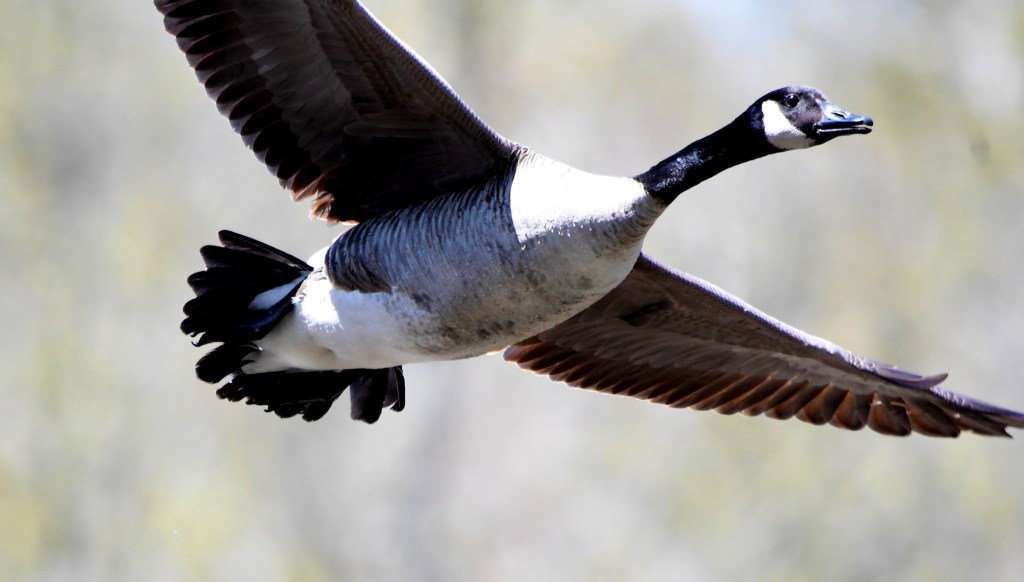
Canada Goose giving me the side eye
Green Heron ready to pounce
Male Red-winged Blackbird with a damselfly snack
In the long run, it doesn’t really matter where I take pictures, or what time of day I go, or even if I don’t find something out of the ordinary; it’s the walk itself that’s kept me sane throughout these troubled times, and the connections that have been forged as a result.
I was standing in muck along the edge of a small marsh, knee deep in tick-laden reeds, hoping the Wood Ducks I had heard earlier would return. It was a chilly spring morning and I had underestimated how cold I might get just standing still. Sometimes, though, the sun would peek through the clouds, giving me a brief illusion of warmth, but the cold breeze still cut through me. I pulled the hood of my sweatshirt up over my head, tried not to worry about ticks that might be crawling up my legs, stuffed my hands deep into my pockets, and waited for the Wood Ducks to return.
The marsh was alive with the sound of birds, most noticeable among them were the Red-winged Blackbirds. By belting out their familiar song over and over again, the males were working hard to woo the nearby females. The song of the Red-winged Blackbird is the quintessential sound of spring here in Michigan.
Male Red-winged Blackbird
The quiet, less noticeable females were hanging out in the reeds, skulking through the vegetation for food and gathering materials to weave together into their intricate nests.
Female Red-winged Blackbird with nesting materials in her beak
A smaller, even less noticeable bird was also flitting among the reeds across from where I was standing. With its subtle coloring of brown, gray, buff, and black, this little bird was well-camouflaged and hard for me to see along the edge of the swamp. I recognized it, though, partly because of its distinctive markings, but mostly from its location. It was a Swamp Sparrow!
Swamp Sparrow
While I was watching the little Swamp Sparrow flitting around the marsh, a splash of yellow caught my eye. A tiny bird kept flitting among the reeds so quickly that I had a very hard time bringing it into focus for a picture. The bird in question turned out to be a Common Yellowthroat. Its bright yellow feathers and broad black mask make it one of the most easily recognizable warblers—if you can get it to sit still long enough!
Male Common Yellowthroat
Higher up in the tangle of branches was a barely visible olive gray bird with a white breast. I had no idea what it was so I kept taking pictures, hoping one would be good enough to identify later using one of my birding apps. This one turned out to be a Least Flycatcher.
Least Flycatcher
At this point, it was well past an hour into my vigil, and still no Wood Ducks!
In the distance, I could see a lone Kingbird perched on a reed. With its dark gray back, white chest, and neat white tip on the tail, the Eastern Kingbird looks like it’s wearing a business suit—and this bird is ALL business when it feels threatened! It will readily attack any birds that enter its territory, even if they are much bigger! It’s called a Kingbird for a reason!
About the same time that I spotted the Kingbird, a Great Blue Heron flew overhead!
When I turned my attention back to the marsh in front of me, I saw a pair of Common Grackles perched in another tree not far from the Kingbird. Grackles are stunning birds to observe especially when the sun highlights the iridescent blue feathers on their head. Unfortunately, Grackles are also the number one threat to corn crops. They eat ripening corn as well as corn sprouts, and their habit of foraging in big flocks means they make a multimillion-dollar impact on corn producers.
Male Common Grackle
Another colorful bird that was flitting among the tangled branches and tall reeds was the Palm Warbler. It’s a relatively easy warbler to identify, with its rusty-colored cap, yellow eyebrows, and yellow belly with rusty streaks. These cheerful little birds are migrating through Michigan right now and I love finding them!
Palm Warbler
I’d been waiting in the muck now for almost two hours and I wasn’t even sure the Wood Ducks would be back before I had to leave. But I had a little more time so I continued to entertain myself watching all the birds going about their daily lives right in front of me mostly oblivious to my presence. At that point, I’d gotten pictures of thirteen of those birds, including a few American Robins, at least one American Redstart, a mewing Catbird, and a few bright yellow American Goldfinches.
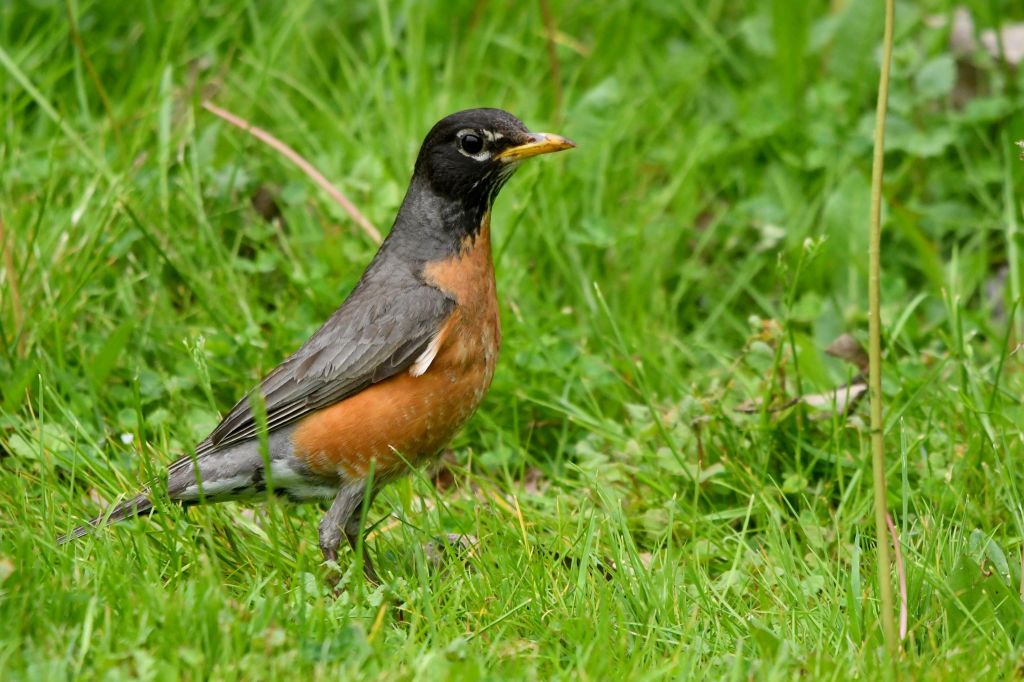
American Robin
Female American Redstart
Gray Catbird
American Goldfinch
Suddenly there was the sound of splashing off to my left! The Wood Ducks were back!! I quickly turned my camera in their direction, hoping my settings were all correct and zoomed in. There were two males and one female and they were already swimming away from me headed for the shelter of the reeds. It wouldn’t be long before they disappeared from view so I started snapping pictures as fast as I could, hoping for one or two good shots. These are such beautiful birds, particularly the males, with their iridescent colors of blue, green, chestnut, and purple; and their contrasting patterns of white around their neck, head and flanks. It would be so disappointing to miss a shot after all this time!
Male and Female Wood DucksMale Wood Duck
Not only did I have the right settings, the Wood Ducks stayed longer than expected for the photo shoot—AND I never got any ticks! It doesn’t get much better than that!
Yesterday, in a state of post-election grief, I went to the woods to find comfort, solace, and healing—as well as pictures! It’s my happy place, a place of refuge in both good times and bad.
One of the inviting trails at Kensington Metropark in Milford, Michigan
But yesterday it wasn’t just any woods, it was the Kensington woods in Milford, Michigan, where the songbirds are acclimated to people and expectantly perch in the trees along the trail hoping you will extend your arm and present them with a handful of birdseed. I knew the assignment and had come prepared. My pockets were bulging with sunflower seeds, raw peanuts, and dried mealworms—plus a red Tootsie Pop from one of the grandkids in case I got hungry. The tootsie pop, however, was not in the same pocket as the bird food!
Tufted Titmouse– one of many small birds willing to take food from my hand
Every time I stopped to take a picture, the songbirds would start flitting nearby expecting to be fed. At one of those stops, a chickadee landed on the far end of my telephoto lens and stared back at me waiting for his handout! (Unfortunately, I couldn’t get a picture!)
One of the beautiful little Black-capped Chickadees waiting to be fed
It was impossible for me to resist and I always reached into my pocket for more seeds. In order to get a picture or a video of the birds in my hand, though, I had to sling my ‘real’ camera, with its long 600mm lens and attached monopod over my shoulder, and pull out my cell phone. While I stood there with one hand outstretched with seed and the other trying to take a picture, I felt the occasional bounce of a little chickadee or a tufted titmouse landing on my monopod that was extended behind me like some sort of backwards fishing pole. I had to smile, knowing they were there waiting for me to feed them and trusting that I wouldn’t cause any harm.
Female Red-winged Blackbird waiting for a handout
As I stood there feeding the ‘littles’ (chickadees, titmice, and nuthatches), two very tall sandhill cranes came sauntering down the trail in my direction. They were in no apparent hurry, and probably knew that I wasn’t either. I expect they knew that a handout was a possibility, just like it was for the ‘littles’. It’s not particularly advisable to feed them, however, or the chipmunks for that matter. They can get a little too pushy if you don’t hand over the goods! For better or worse, virtually all the critters at Kensington know that humans come bearing gifts.
Two Sandhill Cranes sauntering down the trailSandhill Crane
The trail I was on at Kensington skirts a small lake called Wildwing. In the middle of that small lake were hundreds of migrating birds swimming about. They were not very close to shore and it was nearly impossible to get a decent picture, but with my 600mm lens, I was able to see American Wigeons, Ring-necked ducks, Red Heads, Buffleheads, Gadwalls, and a large contingent of mallards. It was a birding bonanza!
Male American WigeonMale Ring-necked DuckMale Red HeadMale Bufflehead Female GadwallMale Mallard
Along that very same trail, I was surprised to find a large flock of Rusty Blackbirds busily surveying the open ground for food and I quickly pointed my camera in their direction. It’s amazing how beautiful their feathers are when you can see them up close. Rusty Blackbirds get their name from the rusty coloration at the edge of their feather edges that shows up during the winter months.
Female Rusty Blackbird
Female Rusty Blackbird
Male Rusty Blackbird
The trail around Kensington’s Wildwing Lake is 1.75 miles long and, without the need to obsessively take pictures like I do, the average person could walk it in 40 minutes or less; maybe a little more if they stopped to feed the birds several times. I spent five blissful hours!
The Red Squirrels want handouts too!
For me, a walk in the woods is therapeutic. Taking pictures is therapeutic. Both are wonderful antidotes to the fear and anxiety that has consumed so many of us over the last several years. The walks in the woods and the picture-taking got me through COVID and hopefully they will get me through the next four years!
The Sandhill Cranes are always a joy to see!
White-breasted Nuthatch
Male Red-winged Blackbird
Sandhill Crane checking the ground for spilled seeds!
We’ve been back to our home state of Michigan for well over a month now after a three-month hiatus in Florida. I haven’t returned to my usual photography routine of taking pictures every day like I did in Florida or like I did through most of the pandemic years when all my regular routines were put on hold and I had time to pursue this hobby full time.
Male Rose-breasted GrosbeakEastern BluebirdAmerican RobinMale House FinchFemale Red-winged BlackbirdMale Red-winged Blackbird
My picture taking days have taken a nose dive since returning to Michigan. It’s not that I’ve lost interest, or sustained an injury, or had a spate of bad weather. It’s pickleball. I’ve been distracted by pickleball.
Blue JayFemale Northern CardinalMale Northern CardinalMale Barn Swallow
There are pickleball courts right next to our condo, and there’s a whole community of pickleball enthusiasts nearby who are readily available to play. It’s impossible for me to stay home if I know there’s a pickleball game going on. As a result, I haven’t gone on any ‘field trips’ this spring or gone for many picture walks.
A male Grackle enjoying my peanuts and seedsEastern TowheeWhite-throated SparrowWhite-crowned SparrowEuropean Starling
Mostly, I’ve been finding an hour or two here and there to stand outside our back door with my camera in hand to take pictures of all the usual suspects: woodchucks, woodpeckers, chipmunks, squirrels, white-tailed deer, and a wide variety of colorful songbirds. They’re all back there carrying on with their busy, productive lives even when I’m not there to document it.
Eastern CottontailCanada Goose and goslingsFemale MallardsYoung house sparrow begging for food!
The most interesting critter in our backyard has been the local woodchuck. I was standing outside our back door taking pictures of all the different birds landing in the nearby trees when I noticed movement about 50 feet from where I was standing. When I zoomed in on the mystery creature, I discovered it was a mama woodchuck transporting her little babies, one by one in her mouth from point A to point B. I’m not sure why she was moving them, but it was so much fun to watch! By the way, did you know that those little babies are called chucklings? I loved learning that little bit of trivia!
Mama woodchuck with one of her several babies
Then, the other day a red-headed woodpecker showed up! I rarely ever see them, and I’ve never seen one in our backyard! Getting a picture of a red-headed woodpecker was almost as exciting as getting one of a pileated woodpecker, but the pileateds are regular visitors to our yard, and the red-headed woodpecker was definitely not! So it was a great find!
The cutest little visitors are the chipmunks and the squirrels. They’re everywhere out there eating the fallen birdseed, digging holes everywhere in the grass, and constantly trying to steal birdseed from our second story feeders. But, they’re so darned cute and so photogenic I’m inclined to think of them as entertainment rather than irritating pests.
ChipmunkRed SquirrelFox SquirrelHot squirrel!
Among the most stunning creatures in our backyard are the wood ducks, the Baltimore orioles, the white-tailed deer, the yellow warblers and, perhaps, even our resident turkey. In all fairness, though, all the creatures I photograph are beautiful to me.
Wood Duck on Cherry Creek behind our houseBaltimore OrioleYellow WarblerOne of our local turkeys!
I feel quite lucky to have such a wide variety of interesting creatures right outside my back door and I treasure all the opportunities I have to photograph them.
White-tailed Deer wondering what I’m up to
There’s no need to travel far to be amazed.
White-tailed fawn at the edge of the small wooded area behind our row of condos
Note: Most of the pictures in this post were taken on earlier picture walks
I was sitting in my favorite chair at 5 a.m. on this cold November morning, enjoying a toasty fire, drinking a hot cup of tea, and contemplating the day ahead. Every once in a while, I’d look out the window to see if the sun had come up.
By 7:45, I could see just a hint of light on the very top of the trees along the far side of the creek behind our house. I wrestled with my choices for the day– stay warm and cozy inside the house, or go out into the cold November air and take pictures. The conditions were perfect: early morning light, no wind, and clear skies. I thought maybe a northern shoveler would unexpectedly drop by, or that a few wood ducks might swim out from the reeds as they sometimes do, or that a great blue heron would be scouting for fish along the opposite bank. I might even see a rare mink scurrying by. Anything was possible!
Male Northern ShovelerFemale Northern Shoveler
Great Blue Heron
Male Wood DuckFemale Wood Duck
American Mink
There was no choice, really; whether to stay inside or to go outdoors. The morning light beckoned. It would be impossible for me to stay home on such a beautiful day! There was such promise in the air! But, it was only 32 degrees! I wasn’t ready to face the cold! And getting dressed would be a challenge– because cold weather photography, where I might not move for hours on end, takes careful planning. Should I wear two layers or three? Do I need mittens or gloves? Boots or shoes? There were too many decisions to be made this early in the morning!
All bundled up for the cold on an earlier picture walk
By 8:15, though, I was out the door. The sun had risen a little higher in the sky, the water in the creek was perfectly still, and I planted myself in the very best spot I could find where the sun would be at my back.
Cherry Creek in the early morning light
I stood quietly and waited. The squirrels were scampering through the leaves behind me and running across the branches overhead. Now and then, I’d hear a red-bellied woodpecker tapping on one of the nearby trees. A handful of birds were greeting the new day with their joyful song while a solitary goose flew by.
Canada Goose
Not far from where I was standing, I could hear the familiar sound of the male red-winged blackbirds as they flitted among the cattails. They have a short, one-second song that starts with an abrupt note and turns into a musical trill. The females usually respond to the singing males with a chit-chit-chit sound, but I never heard their replies. Perhaps, the females have already flown south for the winter.
Male Red-winged Blackbird in the reeds along Cherry Creek
After about an hour of standing and waiting, I took a seat on the bench next to me; my hopes slowly dwindling. There had been no signs of any shovelers, wood ducks, or herons. I would have been happy at that point if even a mallard had floated by!
Female Mallard from an earlier walk
Eventually, the cold air settled into my bones, and I had run out of things to talk to myself about. I tried, instead, to concentrate on all the different birds I could see or hear in the trees around me, like the chickadees, tufted titmice, cardinals, robins, cedar waxwings, woodpeckers, sparrows, and blue jays. They provided a symphony of songs and a bit of entertainment as I sat watching for the elusive ducks and herons to appear on the creek.
Tufted TitmouseBlack-capped Chickadee
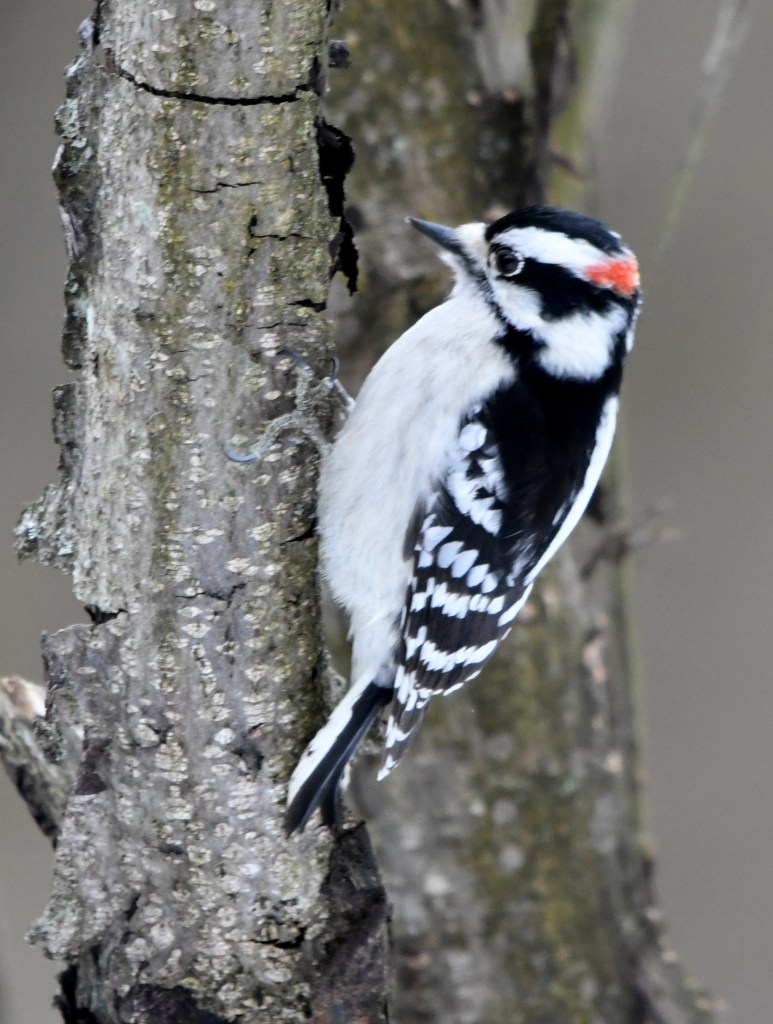
Downy Woodpecker
Female Red-winged BlackbirdFemale Cardinal
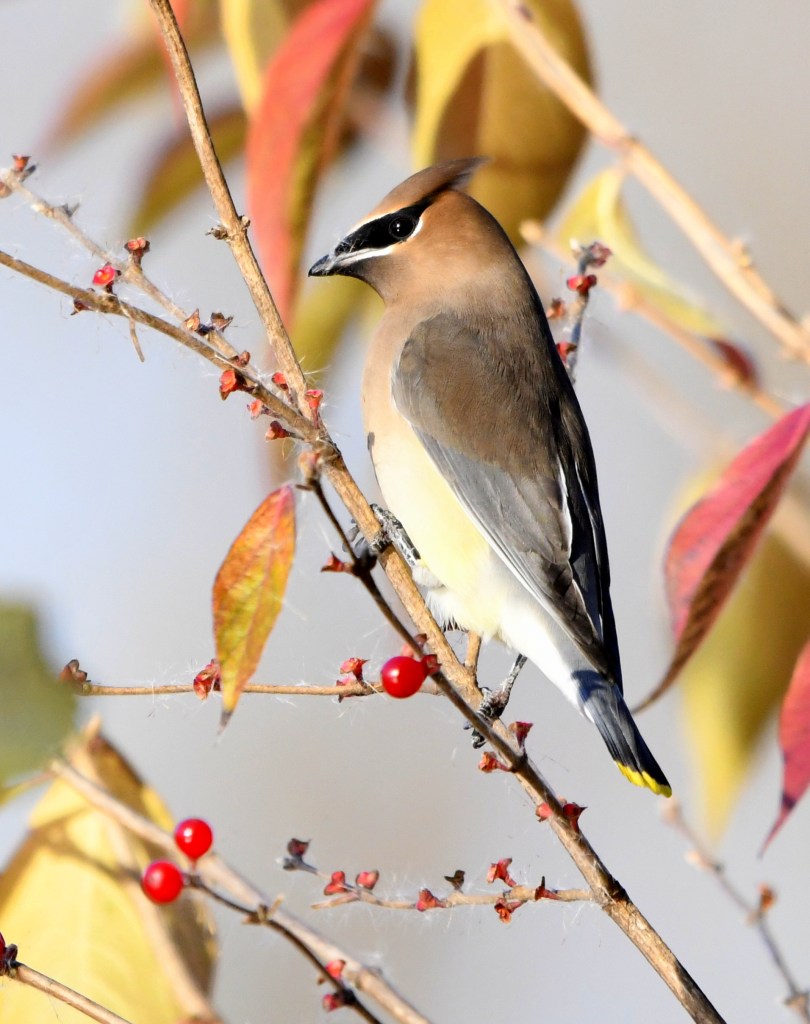
By 9:30, I was ready to throw in the towel and go for a walk in the sun so I could soak up some of its warmth. Before leaving my temporary roost, though, I moved closer to a nearby bush where I had been watching the cedar waxwings gobbling up berries, hoping I could maybe get a picture of them! With all the foliage obstructing my view, it was more of a challenge than I expected!
Cedar Waxwing enjoying the berries
After managing to get a few waxwing shots (and one fat robin), it was time to move on to more promising grounds. I headed over to the business park next door thinking I would find a red-tailed hawk, a migrating duck, or maybe even a bluebird. All I found were pigeons.
Three pigeons on a lamp post!
Where was everybody??
It was almost noon and the temperature had climbed from a chilly 32 degrees to a toasty 50. I was so HOT! I had taken off my hat, mittens, and scarf and stuffed them into the pockets of my coat; the pockets that were already jammed full with two rechargeable hand-warmers, one cell phone, and a set of keys. Eventually I had to take off the coat as well and tie it around my waist or I would totally disintegrate from the heat! It was time to head home.
A big fat Robin enjoying the same berry bush as the Cedar Waxwings
In the end, I didn’t have much to show for all my efforts: no wood ducks, no hawks, no shovelers, no mallards. It’s always disappointing when this happens, but I just can’t force the birds to show up when I want them to– or to get them to sit still in the right light while I adjust my settings.
On a particularly slow picture day, like this one, I have to remind myself that the most important thing is the walk itself, not the pictures. At my age (76), spending the day outdoors traipsing about is a gift; one that I treasure. Having my camera along, just makes all that exercise more interesting.
And that’s what keeps me going out the door–even on the least promising of days.
A few weeks ago, my husband and I made our first trip to the Arcadia Marsh Nature Preserve in Arcadia, Michigan. What a wonderful place to walk and see a wide variety of birds, plants, and butterflies at relatively close range! Over 250 species of birds have been identified at the marsh (17 of which are considered endangered or threatened) and at least 200 different species of plants have been recorded. Best of all, there is a wide, well-maintained ¾ mile boardwalk through the middle of the preserve that makes it easily accessible for everyone.
Arcadia Marsh Nature Preserve Boardwalk
Arcadia Preserve is one of only a few remaining coastal marshes along Lake Michigan’s Lower Peninsula shoreline. Sadly, most of all the original Great Lakes marshes have been destroyed, making restored marshes like this one extremely important ecologically. Thanks to the extensive restoration efforts by the Grand Traverse Regional Land Conservancy (GTRLC), countless volunteers and dedicated partners, this beautiful nature preserve is healthier than it has been in decades. As a result, Arcadia Marsh Nature Preserve has become known as one of the best birding locations in the entire state of Michigan!
Arcadia Marsh Nature Preserve Boardwalk
In my short, two-hour visit on September 15th, I was able to photograph eleven different birds, two of which I rarely ever see, one of which I have never seen in Michigan, one I’ve never seen anywhere, and one that’s usually so elusive that I rarely get to photograph it at all!
Rusty Blackbird
Up until about two years ago, I’d never even heard of a Rusty Blackbird and had no idea what they looked like. A fellow-birder/photographer had seen a few of them at one of our local birding spots, the Wolf Lake State Fish Hatchery. Not long afterwards, I went searching for them. When I happened upon a small group of birds I’d never seen before, I thought, this must be my mystery bird! It was the last time I’d see a Rusty Blackbird– until this visit to Arcadia Marsh.
Female Rusty Blackbird
According to the Cornell Lab’s website, All About Birds, “The Rusty Blackbird has undergone one of the sharpest and most mystifying recent declines of any North American songbird.” Some researches speculate that the severe hunting of beavers across hundreds of years has contributed to the reduction of suitable habitats for Rusty Blackbirds. Fewer beaver ponds mean fewer Rusty Blackbirds. Some attribute their decline to the loss of habitat caused by human ignorance or indifference. Others report that Rusty Blackbirds, particularly from the northeastern areas of North America, have been found with unusually high levels of mercury contamination; a contributing factor in all likelihood.
Savannah Sparrow
Not far from where the Rusty Blackbirds were perched, I watched a much smaller bird dart back and forth across my field of vision. It looked like a fairly nondescript bird from where I was standing on the boardwalk, but when I zoomed in, I could see a tiny bit of yellow above its eye. That got my attention! But it wasn’t until I returned home that I was able identify it as a Savannah Sparrow, a bird I’d never seen before!
Savannah Sparrow
Surprisingly, Savannah Sparrows are one of the most numerous songbirds in North America! They don’t visit backyard feeders, but they may come to your yard if you have open fields nearby. Or, if you keep a brush pile on your property, you might be lucky enough to see a small flock of them swoop down and take cover in the pile during migration or over the winter depending on where you live.
Cedar Waxwing
Also flitting about in the same trees as the Rusty Blackbirds and the Savannah Sparrows, were the Cedar Waxwings. These are such beautiful birds! Cornell Lab’s website All About Birds came up with one of the best descriptions I’ve found so far, “…the Cedar Waxwing is a silky, shiny collection of brown, gray, and lemon-yellow, accented with a subdued crest, rakish black mask, and brilliant-red wax droplets on the wing feathers.”
Cedar Waxwing
The one I found at the marsh was doing what waxwings do best, catching dragonflies out of the air and bringing them back to a nearby tree to eat.
Cedar Waxwing with a tasty dragonfly
Northern Harrier
Not far beyond the trees where I had been enjoying the Rusty Blackbirds, the Savannah Sparrows and the Cedar Waxwings, there was a large bird of prey flying low over the marsh, periodically diving into the vegetation and then reappearing. I wasn’t sure what it was, but it looked a lot like a Northern Harrier I had once seen in Florida a few years ago. I had never seen one in Michigan, but the Northern Harrier is a distinctive looking bird even from far away. It’s a slim, long-tailed hawk that likes to glide low over marshes and grasslands, holding its wings in a wide V-shape. Northern Harriers are mostly looking for small mammals and small birds, but they can also capture larger prey like rabbits and ducks!
Northern Harrier cruising low over the marsh
Great Egret and Great Blue Heron
Wading through the shallow marsh waters on the opposite side of the boardwalk as the Northern Harrier, I could see a Great Egret and a Great Blue Heron in search of their next meal. I have way too many pictures of Great Blue Herons, but very few of the Great Egret, especially here in Michigan. The Great Blue Herons can be found all over Michigan throughout the year, but the Great Egrets only pass through during migration.
Great Egret
The Great Egrets and the Great Blue Herons are both impressive looking birds, but the Egret is slightly smaller and more graceful looking. These two herons hunt by standing motionless or by wading ever so slowly through shallow water to capture a fish using a deadly jab with their large bills.
Great Blue Heron
Great Egrets were hunted nearly to extinction for their feathers in the late nineteenth century, sparking some of the first laws to protect birds. The National Audubon Society, one of the oldest environmental organizations in North America, uses the Great Egret as its logo.
Green Heron
Just below the boardwalk where I was standing, there was a beautiful, little Green Heron who was also waiting patiently, like his much bigger cousins, to catch a quick lunch. All three of these birds are masters in the art of patience. They can stand motionless seemingly forever waiting to stab or grab an unsuspecting fish, frog or tadpole with their dagger-like bills.
Green Heron
Most interesting is the fact that the Green Heron is one of the world’s few tool-using bird species! It often creates fishing lures with things like bread crusts, insects, or feathers, dropping them on the surface of the water hoping something tasty will take the bait!
Belted Kingfisher
Most of the time, this is the bird that’s hardest for me to ‘capture.’ It is very skittish, and I swear it knows that I’m on my way to take its picture long before I even leave the house! At the Arcadia Marsh, though, the Belted Kingfishers seemed oblivious to humans. I’m guessing these kingfishers are acclimated to all the foot traffic on the boardwalk and have learned to just ignore the movement. As a result, I was able to take a dozen or more pictures before this particular bird decided she wanted to go elsewhere to fish.
Female Belted Kingfisher
Belted kingfishers are one of the few bird species where the female is more colorful than the male, sporting a chestnut or rust-colored band across her chest. Males are all blue-gray and white. In the pictures below, the kingfisher on the left is female and the one on the right is male.
Red-winged Blackbirds
Red-winged blackbirds are one of the most abundant birds across North America. Wherever there’s standing water and vegetation, you’ll most likely see or hear a Red-winged Blackbird! In late February or early March, it’s the familiar sound of the returning Red-winged Blackbirds that warms my heart and foreshadows Spring’s impending arrival.
Female Red-winged Blackbird
Male Red-winged Blackbird
Song Sparrow
The Song Sparrow is a relatively plain looking, little bird that can be easily overlooked and underappreciated, but every time I see one belting out a song from the top of a tree or a nearby bush, I can’t help but call them endearing. Song Sparrows seem so earnest in their attempts to sing a beautiful song, that they can make any ordinary day feel happier!
Song Sparrow belting out a song!
Black-capped Chickadee
Last, but certainly not least, is the affable little chickadee. I never grow tired of trying to capture them. They are almost universally considered “cute” thanks to their oversized heads, tiny bodies, and insatiable curiosity about everything– including humans. Black-capped Chickadees are one of the easiest birds to attract to your feeders and one of the first birds to come to your outstretched hand for seeds.
Black-capped Chickadee
Feeding a Black-capped Chickadee by hand (taken at a different preserve)
Even if you’re not a birder or a photographer, the Arcadia Marsh Nature Preserve is worth putting on your bucket list if you just want a nice place to enjoy a little slice of nature with an easily accessible trail. Before your visit, check out this website for directions, rules, maps, and more detailed information:
We just returned from our first real get-away adventure in almost three years. For the better part of the last three years, we had stayed close to home waiting for the pandemic to end. When it was mostly over, and we were ready to travel, our aging dog could no longer go with us or stay in a kennel. She needed a great deal of care. On April 18th of this year, we had to say our final goodbyes. It was a bittersweet moment in time. After a stressful, isolating pandemic and a heart-wrenching year of doggie hospice, we needed to cut loose.
Our dear, little dog, Brandy who had a long, slow decline.
We headed out to the Driftless Area of Wisconsin. My husband, Mel, had registered to attend a Tenkara fishing get-together/campout near Westby, Wisconsin and I tagged along to take pictures. After three years of home-grown subject matter, I was eager to explore a new environment.
American RobinEastern Phoebe
A beautiful columbine growing along the roadside
Common YellowthroatCedar Waxwing
The Driftless area is approximately 8500 square miles of land, mostly in Southwest Wisconsin, that was untouched by glaciers during the last ice age. The term “driftless” indicates a lack of glacial drift, the deposits of silt, gravel, and rock that retreating glaciers leave behind. As a result, the landscape is characterized by steep, limestone-based hills, spring fed waterfalls, deeply carved river valleys, and the largest concentration of cold-water trout streams in the world! It was a perfect place for Mel to go Tenkara fishing.
Viceroy Butterfly
Common Whitetail dragonflyDot-tailed White-faced dragonfly
Monarch Butterfly
Tenkara is a method of fly fishing that originated in the mountains of Japan. It uses very long rods with fixed lengths of casting line attached to the rod-tip, and simple, wet flies as lures. This method of fishing was developed to catch trout in free-flowing rivers like the ones found in the Driftless Areas of Wisconsin. I don’t fish, but I was happy enough to go wandering down the back roads near where Mel was fishing to look for birds, butterflies, dragonflies, and flowers; but not GNATS!
Those little buggers came at me with a vengeance! They were in my eyes, ears, nose, and mouth. They were on my sweaty skin. They landed wherever they could find moisture! Gnats are drawn to the carbon dioxide we exhale, as well as the sweet, fruity smells of our shampoos and lotions. There’s no way to get away from them! I was just one giant, sweet-smelling moisture buffet!
Deer on the edge of the road who was curious about my presence
Eastern Tiger SwallowtailWild Geranium
American Toad looking grim!
I hustled back to the car as fast as I could to see if my insect repellent Buff would help. (https://www.buff.com/us/insect-shieldr-neckwear) A Buff is a long tube of thin material that you can pull over your head to cover everything but your eyes. My eyes were protected, at least somewhat, by my glasses. The Buff was a tremendous help; it allowed me take pictures, but it didn’t stop all the gnats who really wanted to get me from crawling into my Buff or going behind my glasses! I did have bug repellent on, but it was no match for these guys! Later, we went to a store and found a repellent that was recommended for gnats and it seemed to work for about an hour before needing to be replenished. It was a welcome relief!
Me and my Buff fending off the gnats!!
In spite of the gnats, and the unseasonably hot temperatures, it was good to be on the road again; to engage in our favorite hobbies in a new environment, to sleep outside in our tent and hear the barred owls calling, “Who cooks for you? Who cooks for you?” and to wake up in the morning to the sound of birds filling the air with their joyful noise. It was a welcome respite from the unwelcome ‘noise’ in our everyday lives.
Common CowparsnipEastern Forktail damselfly
Dot-tailed White-faced dragonfly in the obelisk position to cool off
Female House SparrowFemale House Sparrow
In just a few days, we’ll be on the road again; to the Boundary Waters of northern Minnesota for a five-day canoe trip with friends.
Can’t wait!
Great Blue Heron overhead (note the shadow of its head on the lower wing!)
A teeny tiny Ruby-throated Hummingbird high up on a utility wire!
One of the many joys of a picture walk is never knowing what I’ll find or who I’ll meet along the way. Yesterday, I met a dog named Norman. It brought a smile to my face. Why would anyone name a dog, Norman, I wondered? It seemed like a very formal moniker for such a small, scruffy little beast. So, I posed the question to the human attached to the other end of the leash, “Why Norman?”
“Well,” she said, “I named him after my dad who recently passed away.”
Black-capped Chickadee
KildeerTree Swallows
White-tailed deer, a common visitor on my walks
That was even funnier, I thought, to name a dog after your dead parent, but I kept my chuckle to myself. Instead, I shared the fact that my own father was also deceased and was also named Norman! For the life of me, though, I couldn’t even imagine naming a dog after my dead parent! It just didn’t seem right–and it conjured up an unappealing visual in my head of walking my dad on a leash and cleaning up all his messes!
Male Wood Duck
Earlier in the day, long before I met up with Norman, I had been walking along the creek behind our house hoping to find a wood duck in the early morning light. I expected one to swim out from the cattails along the bank, but it splashed down suddenly in the water next to me and jolted me out of my quiet reverie! Later, I was pleasantly surprised to find a female northern shoveler and a male blue-winged teal swimming in close proximity to the newly-arrived wood duck. What a great find! Both the shoveler and the teal are rare visitors to our creek!
Male Blue-winged TealFemale Northern Shoveler
Once the early morning light started to change, and no longer had that soft golden glow, I wandered through the woods adjacent to the creek and headed over to a nearby preserve where I hoped to find a loon. I had never seen a loon here in Michigan, but knew that one had recently been spotted on the lake at the preserve and hoped I’d get a picture!
Common Loon
It took me awhile to find the loon. It’s not a very colorful bird, and it does have a habit of swimming rather low in the water. Even on a relatively small body of water, like the one I was visiting, loons can be difficult to spot.
The painted turtles were out in droves!
Male Red-winged BlackbirdFemale Red-winged Blackbird
Male Mallard flying by
While I had my camera focused on the loon, something in my peripheral vision distracted me. It was an Osprey flying towards me on the left with a good-sized fish in its talons!! I turned to take its picture and didn’t have time to change the settings on my camera. I just started shooting as fast as I could and hoping for the best! In photography, this method of shooting is often called ‘spray and pray!’ Sometimes it works, sometimes it doesn’t. But it’s always worth a try.
My ‘spray and pray’ shot of the Osprey with the fish!
As I continued walking around the lake, I was delighted to find two great blue herons in relatively close proximity to one other! I’ve never seen two blue herons at the same time except at a rookery. A short time later, I spotted a third!
Great Blue Heron
One of the birds that never takes me by surprise is the Canada goose! It’s absolutely everywhere, but quite easy to overlook as a desirable photography subject. Even the most mundane of subjects, like the Canada goose, though, can make for a beautiful photograph given the right circumstances and a little bit of ingenuity. If nothing else, Canada geese are great subjects for practicing one’s photography skills; they’re not hard to find, they’re easier to photograph than smaller, flightier birds, and they really are stunning in their own right.
Canada Goose in peaceful repose only a few feet from where I was taking pictures of the wood duck
A busy little muskrat taking a snack break along the edge of Asylum Lake
On this particularly warm spring day, I also saw swans, turtles, grackles, and one very busy muskrat chewing away on something tasty; totally oblivious to my presence. Up in the trees surrounding the lake, there was a musical assortment of robins, chickadees, bluebirds, red-winged blackbirds, golden-crowned kinglets, yellow-rumped warblers, and one little brown creeper scurrying up a tree.
Golden-crowned KingletYellow-rumped Warbler
Eastern Bluebird
American RobinGrackle
LittleBrown Creeperscurrying up a tree
I always head out on these picture walks wondering what kinds of surprises I’ll find or who I’ll meet along the way. Yesterday, my best surprise was the osprey with the fish, but the funniest surprise was the dog named Norman, and the story of his name. I’m still smiling!
On February 12th, I saw my first red-winged blackbird for the season! It seemed too early, I thought. I didn’t expect them to return until March. Within a week, though, I heard a whole chorus of red-winged blackbirds singing in the cattails down by the creek behind our house. It’s the quintessential sound of spring and I love it! I wanted to throw open all our windows and soak up that first glimmer of hope that spring would soon be here in earnest.
Female Eastern BluebirdMale Dark-eyed Junco
Backyard Blue Jay in the early morning light
Male Northern CardinalFemale Northern Cardinal
But as I write this, I’m snuggled up in front of a fire, with a hot cup of tea close by, hoping we won’t lose power during the upcoming ice storm. All the schools are closed, and so are many businesses, hoping to avoid disaster. The ice storm might materialize, it might not. Such are the vagaries of winter in Michigan: one day it feels like spring, and the next day it feels like we’re living in Antarctica.
Canada Goose making a dramatic landing on the ice!
Canada Goose on iceMale Mallard trying to walk on ice!
Male Mallard flying in close!
I basically have a love/hate relationship with winter. I love the snow, but hate the long overcast days that bring the snow. I love getting pictures of all the winter birds that migrate through Michigan, but hate all the layers and layers of clothing I have to wear to get those pictures. I love a bright, sunny winter day as an antidote to all the gloomy ones, but it’s hard to get a good picture on a brilliant sunny afternoon against a snowy background.
Me all bundled up against the cold!
Young Trumpeter SwanCanada Goose
A happy looking female Mallard on a cold winter day in Michigan
Most of all, I miss the colors and all the warm-weather critters I love to photograph, like the big yellow butterflies, the swampy green frogs, the multitudes of colorful dragonflies, and the iridescent blue swallowtails that nest under the bridge in a nearby park.
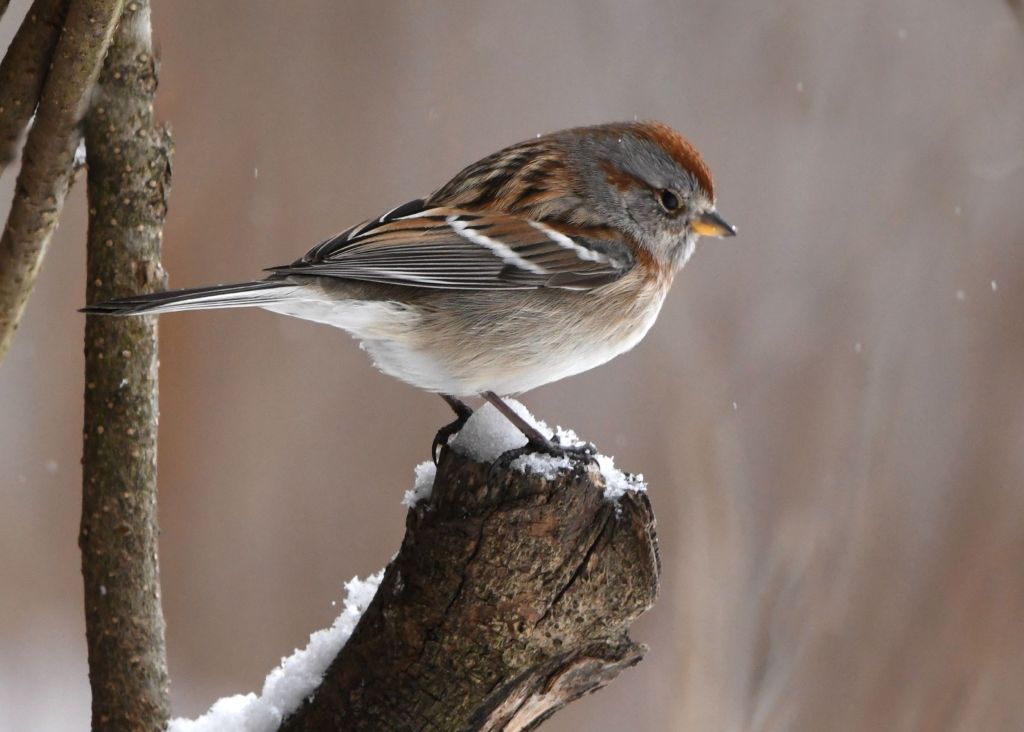
American Tree SparrowWhite-throated Sparrow
Male Hooded Merganser on a layover through Michigan
Male American Wigeon Male Lesser Scaup
Before the pandemic and before we had an aging, incontinent dog to care for, we went to Florida for a few months where I could soak up all the colors and all the interesting critters we never see in Michigan. I have taken pictures of the majestic roseate spoonbills, the brilliant purple gallinules, the pastel pink dragonflies, and a million different Florida flowers! It’s a wonderland of color that I had come to depend on to get me through the drab days of a Michigan winter.
Roseate Spoonbill in Florida
Purple Gallinule in FloridaMale Roseate Skimmer Dragonfly
Periwinkle Pinwheel (I think)
In the meantime, I have been out looking for whatever beauty I can find wherever I can find it, and taking lots of pictures. Whether it’s a chickadee in a snowstorm, a woodpecker on a sunny day, a snow-covered deer in our backyard, or a ubiquitous brown fox squirrel peeking out around a tree in the early morning light, it’s all good, and it’s all fun.
Sometimes, when I’m out on a picture walk, I think about all the things I’ve learned along the way that I didn’t know when I started out on this photography journey; things that can’t be found in the instructional manuals, YouTube videos, or ‘Dummy’ books; things like patience and planning.
Photo by a fellow photographer, Bill Krasean Wolf Lake State Fish Hatchery, Mattawan, Michigan
This past February, when it was still bone-chilling cold, I stood outside in shin-deep snow for the better part of two days on the off-chance that a leucistic Robin would re-appear in my friend’s backyard. It was a marginally idiotic thing to do given the unlikelihood that this particular robin would return to this particular yard and land anywhere remotely close to where I was standing! As far as I could tell, there was no compelling reason for him to return any time soon.
Black Crow on a snowy winter day in February
Leucism (pronounced loo-kiz-em or loo-siz-em) is a partial loss of pigmentation, which can make an animal have white or blotchy colored skin, hair, or feathers. The leucistic Robin on my radar that day was completely white except for a small patch of color on the top of its head.
White-throated Sparrow and a Fox Sparrow
Dark-eyed Junco and a House Sparrow
At some point during my second day of waiting, the elusive white robin landed high in a nearby tree and later flew to the edge of a neighbor’s roof! He appeared to be drinking water from the eavestrough and every time his head bobbed up to swallow, I tried to get a picture. After an excessively long bout of drinking, the thirsty bird stood quietly on the edge of the gutter so that I could get this clear, uncluttered shot. My patience had finally paid off!
The elusive white Robin on a cold, sunny day in February
The other thing instructional manuals sometimes fail to mention is the importance of planning ahead; not the kind of planning that involves decisions about what to wear on a cold, snowy day of picture-taking, or what mittens work best in sub-freezing temperatures, but what essential items you must have in your pockets!
The Grackles returned in early March
The Great Blue Heron stayed all winter and the Red-winged Blackbirds returned on the 1st of March
Mallards stay all winter and bravely cope with our unpredictable Michigan weather.
A few years ago, in June of 2018, I had been out on a picture walk all morning when a fellow birder alerted me to a rare Prothonotary Warbler flitting around in a bush near the edge of a small pond. I had never seen this particular bird before and really wanted a picture! Once I spotted its bright yellow body bouncing around from branch to branch, I held my camera as steady as possible and pressed the shutter– but there was no familiar ‘clickity, click, click’ of a camera taking multiple shots in rapid succession. My battery was utterly and completely dead!!
The Northern Pintails and the Redheaded Ducks were migrating through Michigan during February and March
On a very unseasonably warm day in March, the turtles came out to sun themselves. The turtle in the middle, with the distinctive yellow throat, is a Blanding’s Turtle. It is a ‘species of concern’ in Michigan
An American Coot and a Greater Scaup enjoying one of the open ponds at the Wolf Lake State Fish Hatchery
In a state of frantic desperation, I ran to my car, plopped the camera on the passenger seat, and raced home for another battery, hoping I’d return in time to get a picture of the warbler! In my hasty drive home, I turned a corner much too quickly and my well-loved camera with its attached telephoto lens went flying to the floor!!
My favorite Grackle picture Taken on a warm day in early March
The best I could do was to continue on my mission, fetch the battery, and hope that the camera wasn’t permanently damaged. Forty minutes later, I arrived back at the pond and searched for the tiny yellow bird once again. Not only was he still flitting around, my camera had survived the fall and I was able to capture the moment!! If only I had carried that extra battery in my pocket to begin with!
The Prothonotary Warbler that I almost missed!
The other lesson, if you can call it that, is practice. Over the last four or five years, I have taken thousands upon thousands of pictures. I absolutely do not need another robin, another frog, or another monarch for my ‘collection’; but every shot I take is an opportunity to learn something new, either about the creature I’m trying to photograph or about the camera settings I’m trying to use. I don’t have any ‘lifer’ birds or bugs, that I specifically go looking for; I’m pretty much content with whatever I find wherever I find it. In fact, that’s the very best part: finding the most extraordinary things in the least extraordinary of places.
The much-loved Sandhill Cranes returned in March to the delight of many!
I know there is much to be said about the importance of reading the owner’s manuals and studying the instructional videos before venturing forth on any new skill set, but the very best lessons, the ones that have stuck with me the longest, have been the ones I learned along the way by trial and error.