Backyard Birding in Winter

January 24, 2026

Most of the country is now in the midst of a huge winter storm. When I got up this morning, the temperature was -12°F! The wind chill factor yesterday was a whopping 19 degrees below zero!! But, hey, when the sun is shining, it doesn’t seem that cold– especially when you’re inside looking out!

Male Northern Cardinal on a frigid winter day!

When it’s this cold, I do love the challenge of trying to stay warm and taking pictures at the same time! I wear multiple layers of clothing, heated socks, clunky over-boots, a warm hat and mittens, and two hand warmers stuffed into my pockets. I don’t venture far from the house on days like this, though. I like to duck inside every once in a while for a warm-up. Besides, everything I need to see is right outside my back door.

Dressed for success!!

To bring the birds in a little closer to where I’m taking pictures, I sprinkle a handful or two of sunflower seeds, mealworms, and peanuts on a nearby tree stump. It’s fun for me to watch how long it takes the birds to find this stash, and to see who finds it first; usually it’s the Dark-eyed Juncos, or the Blue Jays.

Female Dark-eyed Junco waiting patiently for her turn at the seeds
blue Jay quickly scarfing down peanuts from our backyard tree stump

A little later, the Northern Cardinals show up on the stump, and sometimes the Common Grackles or the Red-bellied Woodpeckers. The Starlings are nearby raiding the peanuts from our platform feeder rather than the stump!

Female Northern Cardinal
Common Grackle
Red-bellied Woodpecker
Common Starling waiting for a turn on our platform feeder

In the nearby trees, I might also have the joy of finding a Pileated Woodpecker, a Northern Flicker or, on rare occasions, a Red-tailed Hawk or a Sharp-shinned Hawk!

Pileated Woodpecker
Yellow-shafted Northern Flicker
Red-tailed Hawk
Sharp-shinned Hawk that landed briefly

I love standing under the shelter of our second story deck and surveying our backyard for hours on end capturing the rhythm of the day; making mental notes about which birds are most likely to visit, who’s the bravest, what treat they like the best, and who’s the hardest to photograph.

Female Dark-eyed Junco on an empty stump!

The most common winter visitor to my tree stump is the Dark-eyed Junco. There are plenty of them around and they are ground feeders. They’re used to looking for food down below rather than up in the feeders overhead where most of the other birds like to go. Juncos also hop around in the snow next to the stump looking for seeds that other birds have dropped or knocked off the edge.

Male Dark-eyed Junco looking for seeds in the snow

One of the bravest birds, I think, is the Black-capped Chickadee. It seems fearless to me. On the rare occasions where I’ve tried feeding our backyard birds by hand, only the chickadees have taken me up on the offer. Surprisingly, the bigger birds have been much too wary. When I feed the birds by hand at the Kensington MetroPark in Milford, Michigan, the Chickadees are often the first to take food from my hand as well. Perhaps the bigger birds, like the Cardinals and the Blue Jays see my skinny little hand as too precarious a perch for them even with an offer of food!

The Black-capped Chickadees love peanuts!

The favorite food for most of the birds is definitely peanuts. Those disappear quickly, especially when the Blue Jays take over! They’ll grab 7 or 8 peanuts in quick succession and return for more! When they take this many peanuts at a time, most will be stored in their crop, an expandable pouch in the Jay’s esophagus that temporarily holds food. The crop allows Blue Jays to transport a large number of seeds or nuts to other locations and store them for future use. Before taking flight, I often see the Blue Jays carrying two or three additional peanuts in their beaks!

Blue Jay taking more than his fair share!

One of the potential ‘stump feeders’ that I love to see but rarely capture is the Carolina Wren. Every winter, except this one, I’ve had one come to the feeders on our deck where I could easily watch it from the comfort of my living room chair. This cute little wren came so regularly that I assumed it was the same bird year after year and I referred to it fondly as my Carolina Wren. I can’t say it ever landed on the stump, but it did occasionally sit nearby.

Carolina Wren sitting nearby

The most difficult birds for me to photograph have been the Black-capped Chickadees and the Tufted Titmice. They fly in, grab a seed, and disappear! I can barely spot them through the lens of my camera before they’re gone! I have dozens of ‘bird-less’ pictures to show for it! Once they’ve grabbed a seed, off they go to peck it open. If they land on an open branch, one that’s not obstructed by a tangle of other branches, I can sometimes get a decent shot. But these birds are small and quick and blend in perfectly with the trees. It’s so much easier to photograph a cardinal!

Black-capped Chickadee sitting on a limb that we attached to our deck for photo-ops like this!
Tufted Titmouse momentarily resting!

Most of the time when I’m backyard birding, only the ‘regulars’ show up (sparrows, juncos, jays etc.), but every once in a while, there’s a surprise, like the Sharp-shinned hawk that landed briefly, or the Cedar Waxwing that sat for a while in a nearby honeysuckle bush, or the Yellow-bellied Sapsucker that paused momentarily on our aging dogwood tree less than 10 feet from where I was standing! He was so close that I was afraid any movement on my part would scare him away.

Cedar Waxwing in the Honeysuckle Bush
Yellow-bellied Sapsucker on the Dogwood Tree

I’ve stood outside my back door taking pictures many, many times over the last several years through every season and all kinds of weather. It never ceases to amaze me how many different birds there are right in our own backyard; birds I’d never even heard of before, like White-throated Sparrows, American Tree Sparrows, Fox Sparrows, and White-crowned Sparrows!

White-throated Sparrow
American Tree Sparrow
Fox Sparrow
White-crowned Sparrow (May 2021)

There are also birds that, early on in my photography life, I didn’t even know were here in the winter like the goldfinches, robins, and bluebirds.

American Goldfinch
American Robin
Eastern Bluebird

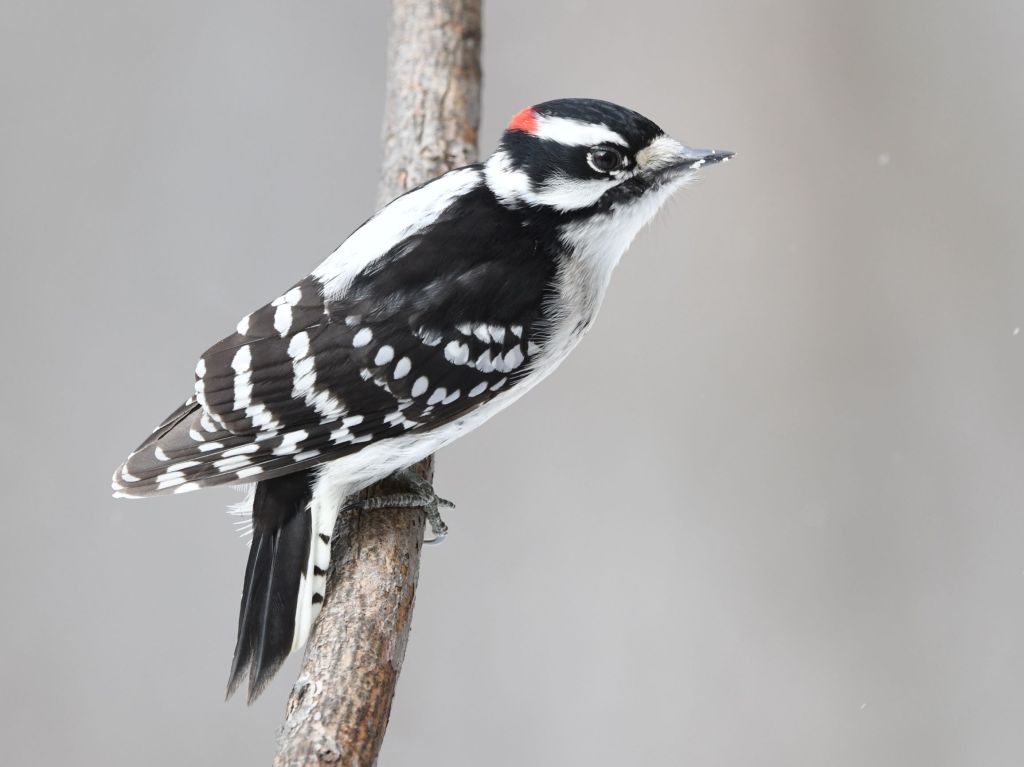
And there are the regular, everyday birds, like the House sparrows, House Finches and White-breasted Nuthatches that come to our yard, or the Downy and the Hairy Woodpeckers that regularly come to the feeders, or the occasional Red-breasted Nuthatch that I rarely ever see!

Female House Sparrow
Male House Finch
White-breasted Nuthatch
Male Downy Woodpecker
Male Hairy Woodpecker
Red-breasted Nuthatch

Once in a while, a few vagrants pass through our yard like this Oregon Junco I photographed in January of 2021, or this rare Orchard Oriole in May of 2021.

Oregon Dark-eyed Junco (January 2021)
Male Orchard Oriole (May 2021)

It never ceases to amaze me that so many different birds come to our backyard! It helps that we’re in a condo association where all of our yards are one big yard, where most of us have feeders hanging from our decks, where there are plenty of trees, and where a lovely little creek passes close by. In the warmer months, that creek is home to Wood Ducks, the occasional Northern Shoveler, and the usual mix of mallards and geese!

Enjoy!

Childhood Memories

January 25, 2023

A friend of mine, Jen Herro, recently posted her first blog, A Carpenter’s Garden, and it struck a chord with me. She is a watercolor artist with a passion for the natural world.  Our lives first became entwined when Jen asked if she could use one of the photographs I had posted on The Naturalist’s Notebook Facebook page as a reference piece for one of her paintings. We have never met in person, but through our shared passion for nature and art, it feels as if we’ve been friends forever.

In her introductory post, Jen tells about how her love for the outdoors began in childhood while visiting her grandparents’ cabin in the big north woods of Minnesota. Her grandfather, a naturalist, taught her how to “appreciate the wildness of the land,” how to paddle a canoe, start a campfire and make baked beans in a pot buried in the ground. It sounded like an idyllic childhood, and it made me wonder where my own love for the outdoors had come from.

Mute Swan Cygnet during a recent snowstorm

I didn’t have a grandfather who taught me how to canoe or build campfires, but I did have a dad who took me fishing. He was also the person who gently told my mother to “let her be” when I wanted to climb trees, play baseball, and wear blue jeans. Her preference would have been to see me in dresses, playing with dolls, and not running amok through puddles!

Six year old me worried about holding a fish I recently caught

My parents did make one grand and loving attempt at giving my brother and I outdoor experiences, though, by taking us camping.

We left home on a hot and humid summer day during the biggest mosquito convention ever, and drove ‘up north’ to find a campsite, pitch a tent, and spend a fun weekend away from home! Mother Nature had other plans. She wanted rain, lots of rain–so much rain that our borrowed tent leaked like a sieve. We were miserable.

I don’t remember going on any nature hikes that weekend, roasting marshmallows, or fishing with my dad, but I do remember slogging through the rain and mud with my nature-weary mother at 2:00 in the morning hoping to find an outhouse! That’s what stayed with me all these years, the rain and the outhouse! It wasn’t the camping experience any of us had hoped for, but it was, nonetheless, memorable!

Carolina Wren in our backyard
A sweet white-tailed deer in our backyard

So, it’s probably safe to say that my love of the outdoors didn’t come from my parents or even my grandparents, at least not in the way that it did for Jen.

What I had was the joy of growing up during the 1950s, when we spent our summer days playing outside with friends, climbing trees, catching bugs, looking for snakes, and exploring the nearby woods. We didn’t have cell phones or iPads to keep us entertained; we barely had a television! What we did have was each other, and the wide-open spaces of our neighborhood, and the nearby parks.  The true origins of my interest in Mother Nature remains a mystery, but the freedom I had as a kid to spend all day exploring and interacting with her, kept the love alive.

Belted Kingfisher during a recent snowfall

As an adult, I’ve mostly chosen outdoor adventure vacations, rather than leisurely indoor ones.   My husband and I have hiked in Scotland, England and Wales, and have backpacked more than a thousand miles on the Appalachian Trail. We’ve also enjoyed a good deal of biking, canoeing, and kayaking along the way.  But it wasn’t until I took up photography a few years ago, that the natural world really opened up for me. I found birds I’d never seen before, took close-ups of butterflies I’d only known from a distance, and examined the details of a thousand little dragonflies that only a good camera and a long lens could afford me.

A bird I’d never seen before! (some sort of Mallard Hybrid)
Eastern Tiger Swallowtail on Butterfly Bush (taken last summer)

It doesn’t really matter where my love of nature ultimately came from, whether it was a father who took me fishing, or a mother who just let me be, I have reaped its benefits my entire life. The countless hours I have spent outdoors have always brought me joy; being able to photograph what I love has been an unexpected bonus!

That’s all, folks!

Hungry for Spring

February 24, 2022

Young Trumpeter Swan flying through a snow squall

As I sit writing this piece, long before sunrise, on another cold and windy February day, I am contemplating the advisability of even attempting a picture walk. The weather forecast calls for 15 to 25 mile an hour winds with gusts over 40! On the other hand, temperatures might exceed 40 degrees —quite balmy compared to the below zero wind chill conditions I was faced with the other day! Usually, I can put on enough layers to stay warm, even on the coldest of days, but strong winds make for a much bigger challenge.

Blue Jay stirring up snow in a pine tree
Some Great Blue Herons will stay here throughout the winter, but many more will head south

Most days, I’m up for that challenge but, I must admit, I’m growing weary of it all. These long winter days, where I have to plan for so many weather contingencies, and have to wear so many layers, are weakening my resolve—especially during the past two years of this pandemic where we haven’t been able to venture far from home. The birds in my backyard are quite tired of me begging for a photo shoot.

Carolina Wren near my backyard feeder

For the next few days, though, my backyard birds can take a break while I babysit my grand-dog on the opposite side of the state. There are lots of new places to explore here and once the sun is up, I expect I’ll venture out in spite of the wind and in spite of the cold! I’d much rather be outside searching for the possibility of something new than sitting here on the couch.

Some people believe that the Robin is a “harbinger of spring”, but large numbers of them stay here all winter feasting on berries.

After writing those first few paragraphs, I did, indeed venture out– first to a nearby nature center and then to a nearby park.

Black-capped Chickadees are delightful little birds that can be found in Michigan all year round.

I found the usual assortment of birds at the nature center—chickadees, finches, cardinals, nuthatches and goldfinches, but it was a brand-new setting! When I arrived at my second destination, I really hit the jackpot! Beaudette Park in Pontiac, Michigan, had a very large pond of open water and it was teeming with a wide variety of waterfowl, some of which I’d never seen before!

Canada Goose coming in for a landing!
Some Sandhill Cranes stay here all year long

This time of year, it’s highly unusual to find open water in Michigan. Most lakes and ponds are frozen over.  This particular body of water had the ubiquitous array of mallards, swans and geese, but it also had mergansers, buffleheads, redheads, ring-necked ducks, goldeneyes and canvasbacks!! It was the canvasbacks I’d never seen before. I couldn’t stop taking pictures!

Male Canvasback at Beaudette Park in Pontiac, Michigan
Male Ring-necked Duck

Days later, I was still sorting through all the hundreds of pictures I took that day!

Male Wood Duck

Mallard Ducks are everywhere and they offer endless opportunities for interesting photographs!

In spite of all the inherent beauty to be found in a picture of freshly fallen snow and a colorful bird here and there, I am more than ready for the arrival of spring; ready to be free of these bulky winter clothes, grey skies, and frigid temperatures.  I’m beyond hungry for the colors to return, for the sweet smell of a newly mowed lawn, and for the sheer delight of a warm patch of sun on my bare skin!

I am more than ready to shed these bulky winter clothes and trade this colorless landscape for green leaves and spring flowers!

Great Backyard Bird Count

February 16, 2021

The 24th annual, four-day, Great Backyard Bird Count just ended yesterday. I had never participated in this event before and I’m not quite sure why. Maybe I thought it would be too time-consuming or that only experienced birders would be able to do it. Maybe I thought it would be too complicated. Whatever the reasons, none of them proved true. Over the course of four days, I counted most of the birds from the comfort of my easy chair, the rest by standing in our back yard, camera in hand!

American Robin
Cedar Waxwing enjoying berries

“The Great Backyard Bird Count (GBBC) is a free, fun, and easy event that engages bird watchers of all ages in counting birds to create a real-time snapshot of bird populations.” www.audubon.org

Blue Jay

“The massive international community science project, held over four days every February, collects data that provides scientists with a long-term record of bird distribution and numbers over time, helping to identify trends that might be associated with urbanization or climate change.” https://news.wttw.com/2021/02/12/global-great-backyard-bird-count-underway

Fox Sparrow

“By participating in the Great Backyard Bird Count, community scientists contribute data that we use to protect birds and the places they need, today and tomorrow. In return, studies tell us that pausing to observe birds, their sounds and movements, improve human health. Participating in the Great Backyard Bird Count is a win-win for birds and people.” https://earthsky.org/earth/register-participate-great-backyard-bird-count

Downy Woodpecker

“During the 2020 count, more than 250,000 checklists were submitted from over 100 countries, and a record 6,942 species were counted. That is a large proportion of the estimated 10,000 bird species that live on Earth today.” https://earthsky.org/earth/register-participate-great-backyard-bird-count

American Robin

The Northern Cardinal nearly always tops the list as the number one bird reported followed by Dark-eyed Juncos, Mourning Doves, Downy Woodpeckers, Blue Jays, House Sparrows, House Finches, American Crows, Black-capped Chickadees and Red-bellied Woodpeckers.

White-throated Sparrow

With the exception of the Black Crows, all of those birds were on my list but in a different order of frequency. I also found Robins, Goldfinches, Cedar Waxwings, Brown Creepers, Northern Flickers, Tufted Titmice, White-breasted and Red-breasted Nuthatches, Hairy Woodpeckers, White-throated Sparrows, Fox Sparrows, and one new addition, a Yellow-bellied Sapsucker!

Yellow-bellied Sapsucker

Even though it’s called a ‘backyard bird count’, you don’t really have to be in your own backyard. You can go for a walk and count the birds along the way or you can go to a park and sit on a bench with a hot cup of tea in your hand. But for this, my first ever Great Backyard Bird Count, I actually counted the birds in my own backyard. In terms of variety, it was probably the very best place for me to be. Over the course of the four day event, I identified eighteen different species of birds!

American Goldfinch

If you haven’t already participated in the Great Backyard Bird Count, put it on your calendar for February 2022. It’s easy and fun– and an immensely good thing for all our feathered friends!

American Robin

Happy birding!