Driving into Spring

February 12, 2025

When I was a child, I thought winter was everywhere; that everybody had snow and ice and gloomy, overcast days. I didn’t know that you could get in your car and drive for a thousand miles and spring would magically appear! It wasn’t until I retired that I fully appreciated the phenomena of packing up your bags and driving into spring!

My granddaughter, Emmy, enjoying winter like I once did

It’s not that I disliked winter as a child, I just didn’t know anything different. It’s not that I dislike winter as an adult. I love a sunny 30 degree day, with five or six inches of pristine snow, and a wide variety of birds to photograph right outside my back door. What I don’t like are the endless days of gray skies and slushy snow with the repeated bouts of freezing rain. It isn’t pretty, and it isn’t fun.

Winter as an adult!

So, several years ago, my husband and I decided to spend a few of those gloomy months away from Michigan and rent a house in Florida, choosing a different city each year: Del Ray Beach, Venice, St. Augustine, St. Petersburg, Panama City Beach, and Port Charlotte.

A beautiful Florida Limpkin in the Red Bug Slough near Sarasota, Florida
A Great Blue Heron in the late afternoon Florida sun
Red-breasted Merganser near St. Petersburg, Florida

For most of those years, our long drive into spring included two hapless dogs, Brandy and Corky; the four of us all crammed together in a small Toyota Prius for a 10 week stay in the sunshine state. The two dogs with their two cages, and all the other paraphernalia that dogs need, took up the entire back seat of our car! They barely had room to move. Sadly, both dogs are now gone but, somehow, we haven’t found any additional space in the car!

Brandy and Corky
The ‘hapless’ dogs stuffed into our back seat

We were in Port Charlotte in March of 2020 when news of the pandemic started to spread. It was a frightening time and we didn’t know what to do. As older adults, we were considered particularly vulnerable. What if one of us became seriously ill? What if we both became incapacitated? Who would take care of the dogs? Who would take care of us? Should we finish out our rental agreement or head home where we could be close to family and friends? Ultimately, we stayed in Florida, but we kept to ourselves.

A very colorful Painted Bunting at the Audubon Corkscrew Swamp Sanctuary near Naples, Florida
Purple Gallinule in Ollie’s Pond, Port Charlotte, Florida
Tri-colored Heron, St. Augustine, Florida

We wore the masks that our niece, Holly, had made for us, and avoided mingling with other people unless we had to buy groceries. Back then, we even wiped down all the boxes, bags, and cans that came into our house. We just didn’t know what we were up against. Our life-saving vaccines were still months away. Fortunately, Mel and I could still continue our solitary pursuits of walking, picture taking, and fishing. They were our lifelines.

Barred Owl, Circle B Bar Reserve, Lakeland, Florida
Sandhill Crane and offspring on the campus of the State College of Florida near Venice
Reddish Egret, St. Petersburg, Florida

When it was time to head home, we never stopped– except for gas and a few bathroom breaks. For more than twenty hours, we took turns driving, sleeping, and snacking. And for the next two years, while the pandemic raged on, we stayed home. We stayed home the following year as well because Brandy, our last remaining dog, was becoming more and more debilitated.

A Willet along the shore near St. Petersburg, Florida
A lovely pink Roseate Spoonbill in Ollie’s Pond, Port Charlotte, Florida
Glossy Ibis, Venice Rookery

Last year was our first time back to Florida after the pandemic, and we returned again this year. It’s wonderful to see the sun every day, and to soak up its warmth; to not have to wear masks or avoid other people, and to not have to wear seventeen layers of protective clothing just to go outside for a picture walk! I know I’ll be missing all sorts of  beautiful, snow-covered birds back in Michigan but…

I think I’ll manage!

White Pelicans in Ollie’s Pond, Port Charlotte, Florida

Birding Days in the Sunshine State

March 22, 2024

Most of the year I’m out taking pictures in my home state of Michigan, but I always look forward to our change-of-pace visits to Florida during the winter months where I can go looking for all the beautiful birds that I rarely, if ever, find in Michigan. This was our first trip back in three years; a welcome change after more than two years of COVID, and the deaths of our two very old dogs.

Brown Pelicans on the pier waiting for a handout from the fisherman

One of my favorite Florida birds to photograph is the brown pelican. It is both charmingly elegant and absurdly acrobatic. I have found them posing stoically on a pier waiting for a tasty handout from the fishermen, and I have watched in amazement as they soar into the air, contorting their bodies like pretzels, and then plunging head first into the water. What a fun bird to watch and photograph!

By comparison, Florida also has the American white pelican; an equally fun bird to photograph, but without the acrobatic skills of its cousins, the Browns.  White pelicans are scoopers not divers. They glide gracefully along the water and scoop up fish, often working cooperatively with their peers to herd a school of fish into a dense ball or toward shallow waters where it’s more difficult for the fish to escape. Cooperative herding catches more fish!

American White Pelicans sharing a funny joke in the early morning hours

A much smaller, less obvious shorebird that scurries about on the Florida coastlines is the willet. I’ve found at least one willet, usually more, on every one of my beach walks. They skitter tirelessly in and out of the waves searching for crabs, crustaceans, and mollusks in the water-soaked sands, and provide endless entertainment for me as I amble along the shore.

Willet hoping for a tasty snack to show up in the receding waves

Running around with the willets at an even faster pace, are the tiny, two-ounce sanderlings. It doesn’t seem possible that these little birds can run as fast as they do! Their little black legs are a blur as they race back and forth along the beach like cartoon characters, stopping only for a millisecond to probe the wet sand for crabs and other invertebrates left by the receding waters. Rachel Carlson, in her book Under the Sea Wind, poetically described the sanderling’s breakneck run as a “twinkle of black feet.” What a perfect description!

Sanderling on the run!

Mixed in with the willets and the sanderlings, I might also find the ruddy turnstone; a smaller bird than the willet but bigger than the sanderling. Its name aptly describes both its appearance and what it does! This is a stocky, reddish-brown shorebird that flips over stones, shells, and seaweed looking for food. Sometimes there are dunlins in the mix as well; a little shorebird that looks similar to the sanderling but is slightly bigger and has a longer bill.

Ruddy Turnstone
Dunlins

Then there are all the gulls, terns, and skimmers either flying overhead or taking a break along the shore!  I took hundreds of pictures the other day of the Forster’s terns soaring above the ocean waves, then plunging into the water to catch a fish; and hundreds more shots of the black skimmers gliding just above the surface of the water with their lower beak barely touching the water as they scooped up fish! It’s always a fun challenge trying to catch these birds in flight!

Forster’s Tern getting ready to dive
Black Skimmer

Another bird in flight that’s fun to catch is the Osprey. We have osprey in Michigan, but I rarely find them. In Florida, you can find them everywhere, hovering over both large and small bodies of water, preparing to plunge feet first into the water and grab a fish with their sharp talons!  I like to catch them as they emerge from the water, a good-sized fish in tow, lifting into the air with a thousand beads of water spinning off their feathers in all directions.

Osprey with his catch of the day!
Osprey with an even better catch!

When I’m not walking along the ocean beaches looking for birds, I’m stalking the smaller bodies of water in search of herons, egrets, ibises, storks, and the mostly elusive roseate spoonbills. On this particular visit to Florida, my first wood stork and spoonbill were standing at the edge of a retention pond, behind a locked fence along a busy roadway near a strip mall! It was not an easy picture to get!  The herons, ibises and egrets, on the other hand, have been much more cooperative!

Roseate Spoonbill at the retention pond
Snowy Egret
Great Blue Heron

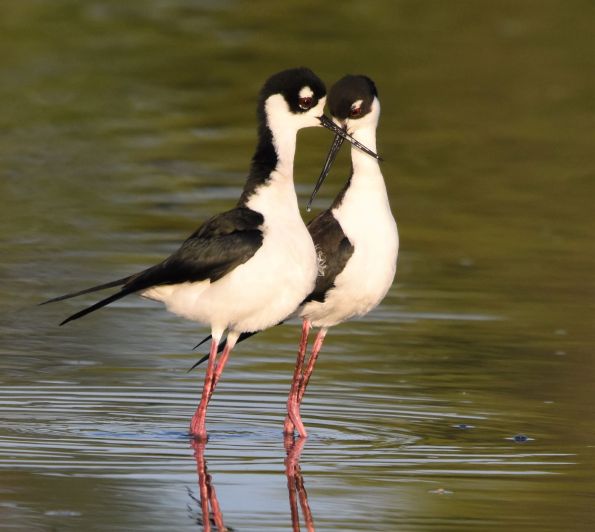
Then there are birds that I’ve seen on previous trips to Florida, but have yet to find here in St. Augustine; birds like the black-bellied whistling ducks, black-necked stilts, crested caracaras, glossy Ibis, gallinules, painted buntings, and sandhill cranes with their babies. To find some of those birds, Mel and I took road trip to the Merritt Island National Wildlife Refuge in Titusville, Florida.

Black-bellied Whistling Duck
Painted Bunting
Crested Caracara

Merritt Island is one hundred miles south of where we are now and is billed as “one of Florida’s premier birding sites.”  It was established in 1963 for the protection of migratory birds and provides a wide variety of habitats including coastal dunes, saltwater marshes, scrub, pine flatwoods, and hardwood hammocks. It is home to more than 1,500 species of plants and animals! 

Black-necked Stilt at Merritt Island National Wildlife Refuge

To get to Merritt Island, we left before dawn and arrived by 8:00 a.m. Mel and I wanted to have the entire day to wander around the refuge –and take a ridiculous number of pictures! We found black-necked stilts, common gallinules, reddish egrets, glossy ibises, roseate spoonbills, and a variety of other delightful birds. It was a day well spent!

Common Gallinule
Glosssy Ibis
Reddish Egret

In less than two weeks we’ll be heading back to Michigan; just in time for the daisies and the daffodils, the chatty red-winged blackbirds, the rose-breasted grosbeaks, and the comforting sounds of the spring peepers drifting through the screens on a warm April evening; all the sights and sounds I love to welcome me home!

Sandhill Crane and colt from our last trip to Florida in 2020

Standing Still

April 9, 2020

My picture walks began a few years ago as a way to combine a little exercise with a little picture taking. Over time, the walks have become less and less about exercise and more and more about picture taking—mostly because I stop so often to take a look that I never get very far!

Black-necked Stilts

On my walks to the various preserves and rookeries, I often see other photographers who have picked a spot to take pictures and they never move, preferring instead, to stay in one place forever! I used to think this would be an incredibly boring thing to do, that I would miss so much if I just stayed in one place.  But, over time, I’ve come to appreciate the benefits of just standing still.  

Sandhill Crane with offspring (called a Colt)
Green Heron

That’s not to say that I have ever parked myself in one spot for hours on end, but I have, on several occasions, stood in one place for a good hour or so. I have found that by parking myself in one place for a while, I become part of the landscape; the birds and the butterflies no longer notice me and go about their business as if I weren’t there. The elusive Kingfisher, which has been extremely hard for me to capture, will land on a nearby branch unaware of my presence; the Black-crowned Night Heron will perch on a fence right in front of me, and the Roseate Spoonbill, totally oblivious to my presence, will continue fishing less than 20 feet away!

Belted Kingfisher
Bald Eagle

When I do stand still for a while and just observe what is going on around me, I find it very calming. I am so absorbed in what I might find, that it’s easy to forget life’s worries.

Cattle Egrets

With the recent introduction of this deadly coronavirus into our lives, we are, as an entire planet, collectively standing still. We can look upon this time of isolation and social distancing as a colossal state of boredom, frustration and angst, or as an opportunity to more closely observe the life around us and to take stock of what’s truly important.

Marsh Rabbit

There is much that is beautiful to be found.

Black-necked Stilt

Be still. Be safe. Be well.

Red Saddlebags with Mites

March 26, 2020

In the midst of this global pandemic, I feel grateful that I can still go out for walks. No matter how anxious or stressed I am by all the heartache and suffering this pandemic has caused, if I can get out for a while and take pictures, I always feel better when I return.

Zebra Longwing
Monarch

I enjoy going to a wide variety of places in hopes of finding a wide variety of interesting things to photograph. But, when I’m limited in the number of choices I have, I just change the time of day that I go– which changes the light as well as the creatures who might be out and about. In the past ten days, I’ve been to nine places, two of which were repeat visits. No matter how many times I go, I always manage to find something that surprises or delights me. If nothing else, it’s all good photography practice. When I do find something unusual, it’s fun to do a little research later and find out more about it.  

White Pelicans
Great White Egret in the morning light

One thing that has really helped my research endeavors is an app called iNaturalist. When I don’t know the name of the bird or bug or plant I’ve photographed, I enter the picture into the app and, within a few seconds, I get back several suggestions as to what it might be. Once I am reasonably certain that I have correctly identified my subject, I go online for more information. That’s how I identified this dragonfly called a Red Saddlebags.

Red Saddlebags with mites

“ The red-mantled saddlebags or red saddlebags is a species of skimmer dragonfly found throughout the eastern United States. It has translucent wings with red veins, and has characteristic dark red blotches at their proximal base, which makes the dragonfly look as if it is carrying saddlebags when flying.”

One interesting thing that you can see on this dragonfly are tiny red dots. A few years ago, this phenomenon surprised me. You can’t really see them with the naked eye (unless, perhaps, the dragonfly is in your hand), so, I was quite surprised the first time I saw the red spots on a dragonfly when I had enlarged a picture on my computer. They’re called mites.

“…these bright red mites, from the tick family, are hitchhikers that feed on body fluids. They jump off when the host drops down over a new pond or wetland.”

Apparently, these mites have little or no adverse effect on their host dragonfly, unless you happen to be a male dragonfly with a body full of them, in which case, you might not be as successful as your friends during the mating process.

Snowy Egret
lily Pad Flower
Tri-colored Heron

Wherever you are in this world living through this pandemic, I wish you good health. If you are able, take a restorative walk outside now and then and look for something that surprises or delights you. If that’s not possible (or not particularly fun for you!), I hope these virtual walks serve a similar purpose!

Stay well.

great blue heron