January 24, 2026
Most of the country is now in the midst of a huge winter storm. When I got up this morning, the temperature was -12°F! The wind chill factor yesterday was a whopping 19 degrees below zero!! But, hey, when the sun is shining, it doesn’t seem that cold– especially when you’re inside looking out!

When it’s this cold, I do love the challenge of trying to stay warm and taking pictures at the same time! I wear multiple layers of clothing, heated socks, clunky over-boots, a warm hat and mittens, and two hand warmers stuffed into my pockets. I don’t venture far from the house on days like this, though. I like to duck inside every once in a while for a warm-up. Besides, everything I need to see is right outside my back door.

To bring the birds in a little closer to where I’m taking pictures, I sprinkle a handful or two of sunflower seeds, mealworms, and peanuts on a nearby tree stump. It’s fun for me to watch how long it takes the birds to find this stash, and to see who finds it first; usually it’s the Dark-eyed Juncos, or the Blue Jays.


A little later, the Northern Cardinals show up on the stump, and sometimes the Common Grackles or the Red-bellied Woodpeckers. The Starlings are nearby raiding the peanuts from our platform feeder rather than the stump!


In the nearby trees, I might also have the joy of finding a Pileated Woodpecker, a Northern Flicker or, on rare occasions, a Red-tailed Hawk or a Sharp-shinned Hawk!


I love standing under the shelter of our second story deck and surveying our backyard for hours on end capturing the rhythm of the day; making mental notes about which birds are most likely to visit, who’s the bravest, what treat they like the best, and who’s the hardest to photograph.

The most common winter visitor to my tree stump is the Dark-eyed Junco. There are plenty of them around and they are ground feeders. They’re used to looking for food down below rather than up in the feeders overhead where most of the other birds like to go. Juncos also hop around in the snow next to the stump looking for seeds that other birds have dropped or knocked off the edge.

One of the bravest birds, I think, is the Black-capped Chickadee. It seems fearless to me. On the rare occasions where I’ve tried feeding our backyard birds by hand, only the chickadees have taken me up on the offer. Surprisingly, the bigger birds have been much too wary. When I feed the birds by hand at the Kensington MetroPark in Milford, Michigan, the Chickadees are often the first to take food from my hand as well. Perhaps the bigger birds, like the Cardinals and the Blue Jays see my skinny little hand as too precarious a perch for them even with an offer of food!

The favorite food for most of the birds is definitely peanuts. Those disappear quickly, especially when the Blue Jays take over! They’ll grab 7 or 8 peanuts in quick succession and return for more! When they take this many peanuts at a time, most will be stored in their crop, an expandable pouch in the Jay’s esophagus that temporarily holds food. The crop allows Blue Jays to transport a large number of seeds or nuts to other locations and store them for future use. Before taking flight, I often see the Blue Jays carrying two or three additional peanuts in their beaks!

One of the potential ‘stump feeders’ that I love to see but rarely capture is the Carolina Wren. Every winter, except this one, I’ve had one come to the feeders on our deck where I could easily watch it from the comfort of my living room chair. This cute little wren came so regularly that I assumed it was the same bird year after year and I referred to it fondly as my Carolina Wren. I can’t say it ever landed on the stump, but it did occasionally sit nearby.

The most difficult birds for me to photograph have been the Black-capped Chickadees and the Tufted Titmice. They fly in, grab a seed, and disappear! I can barely spot them through the lens of my camera before they’re gone! I have dozens of ‘bird-less’ pictures to show for it! Once they’ve grabbed a seed, off they go to peck it open. If they land on an open branch, one that’s not obstructed by a tangle of other branches, I can sometimes get a decent shot. But these birds are small and quick and blend in perfectly with the trees. It’s so much easier to photograph a cardinal!


Most of the time when I’m backyard birding, only the ‘regulars’ show up (sparrows, juncos, jays etc.), but every once in a while, there’s a surprise, like the Sharp-shinned hawk that landed briefly, or the Cedar Waxwing that sat for a while in a nearby honeysuckle bush, or the Yellow-bellied Sapsucker that paused momentarily on our aging dogwood tree less than 10 feet from where I was standing! He was so close that I was afraid any movement on my part would scare him away.


I’ve stood outside my back door taking pictures many, many times over the last several years through every season and all kinds of weather. It never ceases to amaze me how many different birds there are right in our own backyard; birds I’d never even heard of before, like White-throated Sparrows, American Tree Sparrows, Fox Sparrows, and White-crowned Sparrows!


There are also birds that, early on in my photography life, I didn’t even know were here in the winter like the goldfinches, robins, and bluebirds.


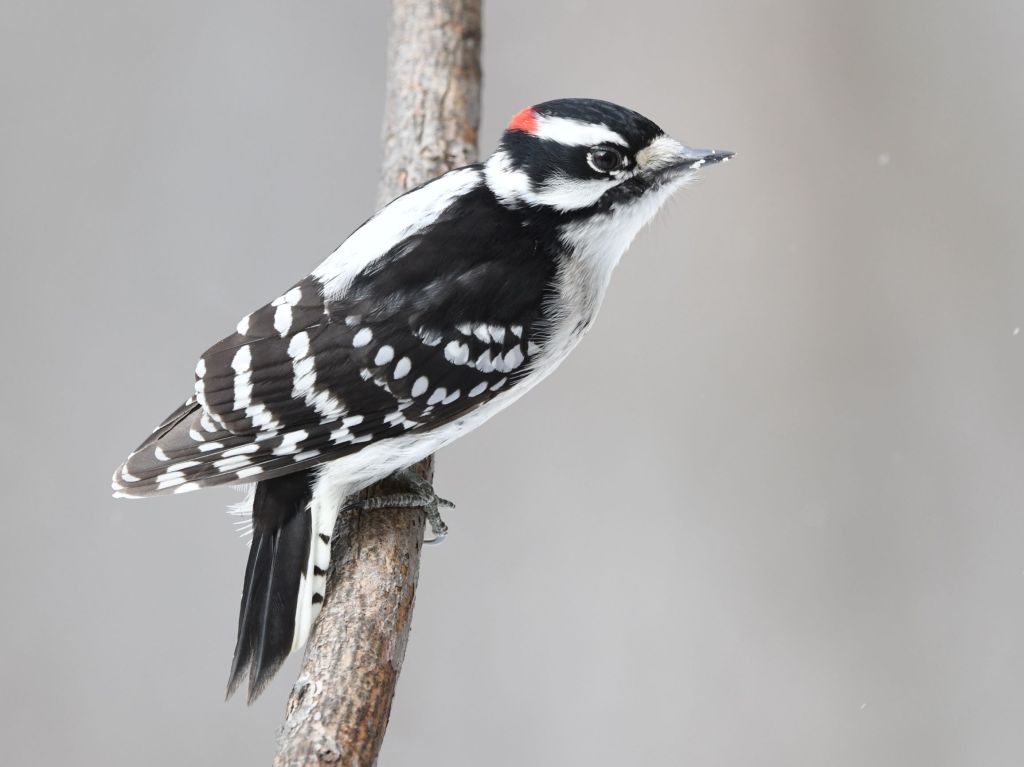
And there are the regular, everyday birds, like the House sparrows, House Finches and White-breasted Nuthatches that come to our yard, or the Downy and the Hairy Woodpeckers that regularly come to the feeders, or the occasional Red-breasted Nuthatch that I rarely ever see!


Once in a while, a few vagrants pass through our yard like this Oregon Junco I photographed in January of 2021, or this rare Orchard Oriole in May of 2021.


It never ceases to amaze me that so many different birds come to our backyard! It helps that we’re in a condo association where all of our yards are one big yard, where most of us have feeders hanging from our decks, where there are plenty of trees, and where a lovely little creek passes close by. In the warmer months, that creek is home to Wood Ducks, the occasional Northern Shoveler, and the usual mix of mallards and geese!
Enjoy!