All the things I did not know

July 18, 2026

There are so many things I didn’t know before falling into this nature photography hobby that it’s actually impossible to cover them all. Here is just a sampling of some of my favorite discoveries!

Out on a Picture Walk with a Nikon D500 camera, a Sigma 150-600mm lens,
and a monopod holding everything up!

It’s never been enough to just take a picture and move on. It’s never been enough to just know the names of the plants and creatures that show up in front of my lens. I’ve always needed to know what makes them special and why they do the things they do. Why do dragonflies point the tips of their ‘tails’ toward the sun on a hot summer day? Why do some birds flail around on the ground? Why do grackles puff out their chests and point their beaks upwards? Almost every picture I’ve taken needs an answer.

Eastern Amberwing dragonfly

Did you know that there are more than 5,000 species of dragonflies? That they were some of the first winged insects to evolve 300 million years ago and that they used to have wingspans of two feet or more? I had no idea!

Blue-eyed Darner dragonfly

It wasn’t until I started taking pictures that I learned dragonflies and damselflies come in multitude of colors; red, pink, blue, green, yellow, gold, purple, black… almost every color you can imagine.  I had barely paid them any notice before going on picture walks!

Common Green Darner dragonfly
Roseate Skimmer dragonfly
Spangled Skimmer Dragonfly

When I found a dragonfly pointing the tip of its tail toward the sun on a hot summer day, I wanted to know why.  What I found out was fascinating! This is how dragonflies regulate their body temperature and prevent overheating! Their handstand-like posture is known as an ‘obelisk pose’. By aligning their tails directly with the sun’s rays, a dragonfly minimizes the surface area of its body exposed to solar radiation!

Male Blue Dasher dragonfly in the ‘obelisk pose’
Female Blue Dasher dragonfly in the ‘obelisk pose’

When I first saw a bird flailing around on the ground like this Black-capped Chickadee, I thought it was injured. When I approached to see if I could help, it flew away! Why was it on the ground in the first place??

Black-capped Chickadee ‘anting’

The behavior this chickadee was engaged in is called “anting.” Birds will intentionally cover themselves with ants in order to benefit from the formic acid that ants release when they’re disturbed. The acid helps with controlling parasites, soothing irritated skin, and serves as a natural insecticide or fungicide!

A very beautiful Common Grackle

Before photography took over my life, I didn’t know that grackles could be so beautiful or that they could establish dominance, attract a mate, or settle a dispute by merely pointing their beaks in the air. It’s called ‘the grackle stance’, ‘sky pointing’, or ‘bill tilting’. Grackles tip their bills straight up, extend their neck as far as they can, and puff out their chests to look as large and as intimidating as possible. The one who holds that stance the longest, wins the dispute! If they’re trying to impress the females, the grackle who lasts the longest or looks the most fit, takes home the girl!

Common Grackles demonstrating the ‘grackle stance’

American Bullfrogs are my favorite amphibians and I’ve taken hundreds of pictures of them over the years.  It wasn’t until recently that I learned you could tell a boy frog from a girl frog by the size of their ears! Look for a circle next to the bullfrog’s big, bulgy eyes. It’s called a tympanic membrane, a tight patch of skin that acts like an eardrum. If that circle is bigger than the frog’s eye, it’s a boy!

Boy Bullfrog with a very big tympanic membrane!

Some butterflies, like monarchs, also have ears! They don’t look anything like our ears or a frog’s ears, but they do have specialized, drum-like membranes called tympanal organs located at the base of their forewings that allow them to ‘hear’ the vibrations of fluttering wingbeats made by approaching predatory birds!

Female Monarch butterfly

You can’t tell the sex of a butterfly by its ears like you can a bullfrog, but you can tell a boy monarch from a girl by two black dots. Male monarchs have two prominent black spots (scent glands) on their hind wings that are used to attract mates. Female monarchs do not.

Male Monarch butterfly

I had never seen a turtle like this one before (with its bright yellow neck) until I took a picture. It has a interesting life history, a threatened existence, and a compelling reason for us to protect it.

Blanding’s Turtle

This is a Blanding’s turtle and, unlike most other creatures, it shows virtually no signs of biological decline as it ages. A 90-year-old turtle remains as healthy, active, and reproductively viable as a 20-year-old! Researchers who have been studying this ‘fountain of youth’ feature of the Blanding’s turtle are looking for ways to delay age-related diseases in humans, such as hypertension, Type 2 diabetes, cataracts, macular degeneration, Alzheimer’s disease, and Parkinson’s.   

Blanding’s Turtle

Unfortunately, the Blanding’s turtle is listed as Endangered, Threatened, or a species of Special Concern in most of the areas where it resides. Sadly, it faces the same or similar threats as many other species with whom we share this planet: habitat loss and fragmentation, predation, climate change, and pesticide use. So many plants and animals that we destroy hold the secrets to a better life for us. What harms them, harms us.

Bee Balm

One of my favorite plant discoveries has been ‘bee balm’, also known as monarda. Given the right conditions, bee balm grows abundantly in the wild, but can also be grown in your garden. It’s a wonderful little plant for attracting hummingbirds, bees, and butterflies. But there’s another insect that loves bee balm just as much: a hummingbird moth! This fascinating insect is a little bigger than a bee but smaller than a hummingbird, and has been mistaken for both. It likes the same flowers as bees and hovers in front of them like a hummingbird to gather nectar.  

Hummingbird Clearwing Moth on Bee Balm

Before taking pictures, I didn’t know that some robins stayed here all winter. I thought, like everyone else, that they were the true ‘harbingers of spring’.  But, on my wintertime picture walks, I discovered them up in the trees eating berries! If robins can find enough berries over the winter, they won’t migrate. We tend to think of them as just spring and summer birds because that’s when we are more likely to see them; out on our lawns pulling up worms!

American Robin enjoying winter berries
American Robin enjoying juniper berries in the winter
Springtime Robin pulling up worms!

Surprisingly, Robins and other berry-eating birds, like Cedar Waxwings, can become intoxicated if the berries they’re gulping down are fermented!

Cedar Waxwing enjoying Juniper Berries

One of my biggest bird surprises was finding cuckoos in Michigan! I didn’t even know we had cuckoos anywhere in the United States, let alone Michigan (at least not the feathered kind)! My only ‘cuckoo’ experience had been in Scotland years ago! But Scotland and Michigan host completely different species. Scotland has a Common Cuckoo; Michigan has the Black-billed Cuckoo and the Yellow-billed Cuckoo.  Even though we rarely see these birds, cuckoos are good to have around. Our Michigan Cuckoos love eating spongy moth caterpillars (formally known as gypsy moth caterpillars) which defoliate our trees and kill the weakener ones.

Black-billed Cuckoo
Yellow-billed Cuckoo

In just a few weeks I’ll be on the hunt for one of my favorite insects, the Praying Mantis. I love finding them and taking their picture because, unlike any other insect on the planet, a Praying Mantis can turn its head 180 degrees and look me straight in the eye! How weird is that?

Praying Mantis staring back at me!

There seems to be an infinite number of plants and creatures that I never knew about before walking out my door ten years ago, camera in hand, to go on my first picture walk—and I expect there’s an infinite number left waiting to be discovered!

In search of another interesting subject!

I learn something new every time I go out!

Colorado Rocky Mountain High

Mel and I have just returned from a vacation in Colorado where we both enjoyed pursuing our passions—fly fishing for him, nature photography for me.

August 28-29

Hitchcock Nature Center, Honey Creek, Iowa

Our four day, twelve hundred mile car journey from Michigan to Colorado took us through the states of  Indiana, Illinois, Iowa and Nebraska. According to Google Maps, it’s only a 16 hour journey— that is if you don’t stop to sleep or eat or go to the bathroom! We did all of the aforementioned, plus took a side trip to Honey Creek Iowa where we spent two days in a cozy little cabin on the grounds of the Hitchcock Nature Center. While at the nature center, we took pictures walks along the  Fox Ridge Run Trail and the Boardwalk Trail.

Great Spangled Fritillary on Field Thistle

August 30- September 2

Ft. Collins, Colorado

From Honey Creek, Iowa we headed through Nebraska to Fort Collins, our first Colorado destination.

Fort Collins is well known for its excellent fly fishing opportunities and a multitude of natural areas to explore. Over the course of our stay in Fort Collins, Mel went fishing several places along the Cache La Poudre River, while I took picture walks along the Hewlett Gulch Trail, the Fossil Creek Reservoir (twice) and at the Colorado State University Annual Trial Flower Garden. Mel joined me for picture walks on one of my visits to the reservoir and at the university flower garden.

Cache La Poudre River where Mel was fishing
(He took this picture while he was fishing and you can see the tip of his rod in the lower right corner.)
I was surprised to find White Pelicans in Colorado!
This one, as well as hundreds of others were hanging out at the Fossil Creek Reservoir in Fort Collins
Red-legged Grasshopper– one of hundreds at the Fossil Creek Reservoir
Barn Swallows waiting to be fed!
Fossil Creek Reservoir is a huge tract of land! That’s me in the lower left corner!

Beautiful flowers and butterflies from the Colorado State Annual Trial Garden…

Painted Lady butterfly

September 3-5

Estes Park, Colorado

As soon as we arrived in Estes Park, Mel headed to the fishing shops and I headed out looking for pictures to take. Surprisingly, the Knoll-Willows Nature Preserve is right in town and only a stone’s throw from where we parked! Within a minute or so of commencing my walk, I spotted a huge bull elk lounging in the underbrush along the edge of the preserve! A little farther down the sidewalk, were several of his girlfriends. Apparently, elk are a very common sight right in Estes Park!

Bull Elk lounging around right in downtown Estes Park!
Hmmm. No dogs allowed. What’s up with that??
“Hey, good lookin’, what’s cookin’?”

In front of the Visitor’s Center at Estes Park, the Hummingbird Moths and the Hummingbirds were a delight to watch…

Sunset in the Rocky Mountains
California Poppy

September 5, 2019

Rocky Mountain National Park to Steamboat Springs

We spent the day driving through the scenic, breathtaking Rocky Mountain National Park to reach our second Colorado destination, Steamboat Springs. Mel and I stopped several times through the mountain route to take in all the spectacular views– but I never took any scenery pictures (they tend to be disappointing compared to the real thing), preferring instead to look for the smaller things like birds and butterflies and mammals.

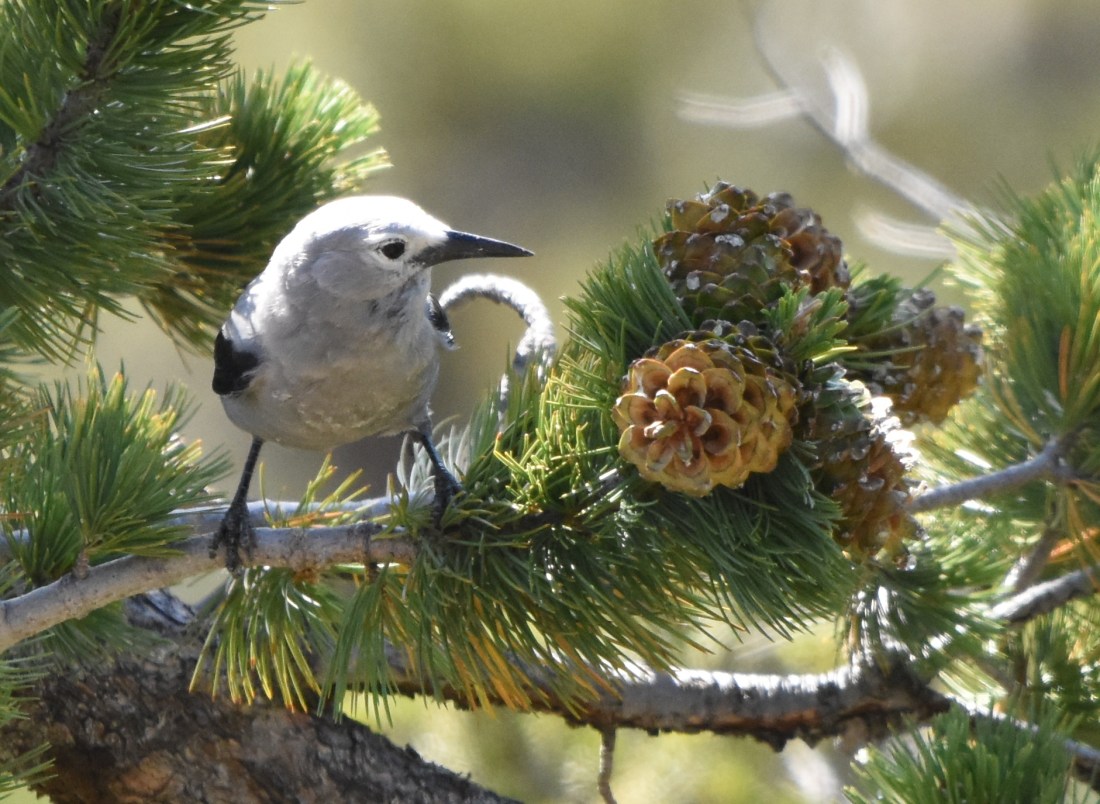
Clark’s Nutcracker
(Clark’s Nutcrackers are mainly found in mountains at altitudes of 3,000–12,900 ft in conifer forests.)
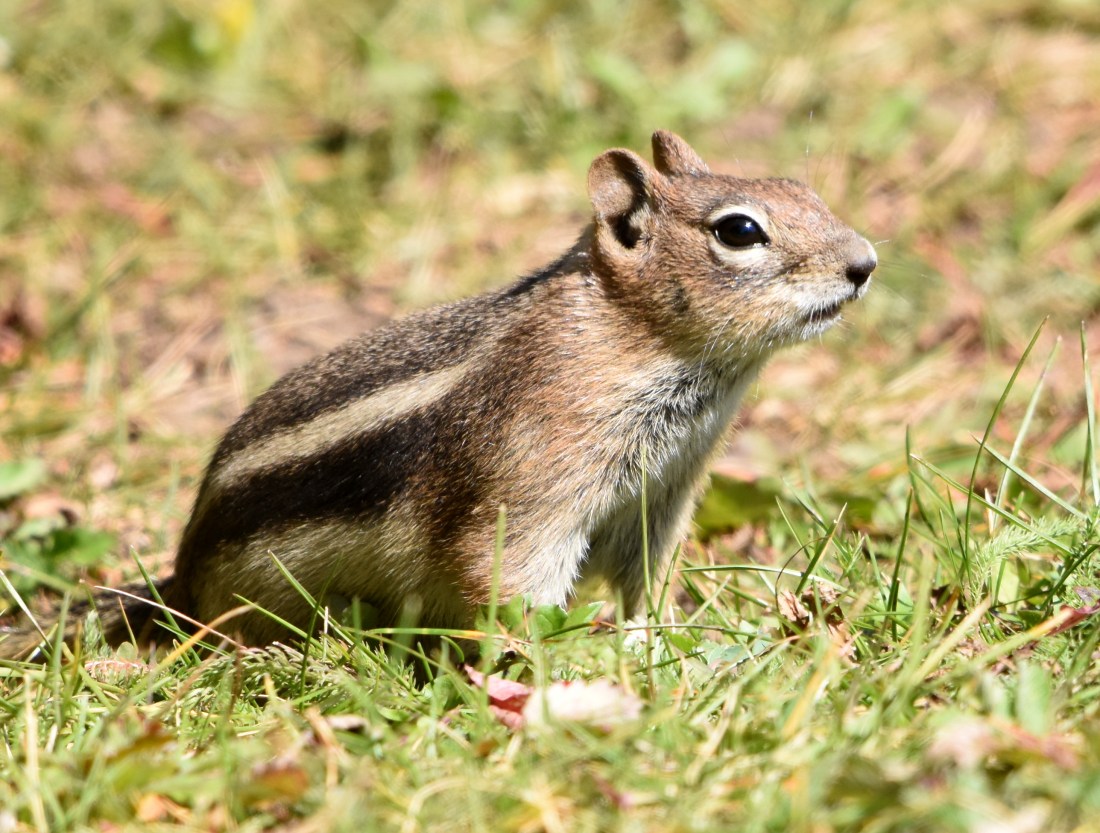
Gold-mantled Ground Squirrel in the Rocky Mountains
This little critter looks a lot like a chipmunk but is much bigger– kind of like a chipmunk on steroids!

September 5-9

Steamboat Springs, Colorado

While Mel went fishing in the Yampa River, I went walking along the Yampa River Trail, a 7.5 mile multi-use trail that runs through the heart of Steamboat Springs and along the Yampa River. Along that trail, I found other points of interest like the Rotary Park Boardwalk and the Yampa Botanic Park, both of which were wonderful places for a quiet retreat as well as multiple picture opportunities.

Yampa River
Black-billed Magpie along the Yampa River Trail
Coronis Fritillary (I think) on coneflower

On one of the days that Mel didn’t go fishing, we took a drive up to Fish Creek Falls together for a picture walk and later spent hours at the Yampa Botanic Garden taking pictures of all the beautiful flowers, birds and visiting insects.

White-lined Sphinx Moth (or Hummingbird Moth) in the Yampa Botanic Garden
Townsend’s Warbler up near Fish Creek Falls

Stunning flowers from the Yampa Botanic Garden…

Mel fishing the Yampa River

September 9-12

Colorado Springs, Colorado

Colorado Springs was our last destination in Colorado and we made the best of the time we had. As soon as we arrived on the afternoon of the 9th, we went for a picture walk in Palmer Park on a trail that turned out to be rockier and slipperier than we expected. Not many pictures got taken—we were too busy watching our footing!

Cassin’s Vireo (I think)
One of the few pictures I took at Palmer Park because I was too busy watching my footing!

The following morning we headed out to the Garden of the Gods, which is known for its enormous, awe-inspiring geologic formations, including tall rock spires or hoodoos, and steep cliffs. It’s a major tourist attraction and well worth the visit.

Garden of the Gods, Colorado Springs

After our visit to Garden of the Gods, Mel dropped me off at the Bear Creek Nature Center to take pictures all afternoon while he explored the fishing shops, bookstores and coffee shops around Colorado Springs.

Rock Wren at Bear Creek Nature Center

On Wednesday, our last full day in Colorado, Mel dropped me off at the Cheyenne Mountain Zoo where I spent a delightful five and a half hours taking almost 800 pictures of the zoo animals and of the native birds that were flitting about in the nearby trees!

Baby Wallaby in his mama’s pouch– one of my favorite pictures from the zoo
This baby wallaby is around 7 months old and barely fits in the pouch anymore!
Here you see his head and legs sticking out!
Mom and baby wallaby hanging out together
The Wallaby baby hopped around for a few minutes before scurrying back to the safety of his mother’s pouch.

The meerkats were great fun to watch. They are both curious and comical!

“What’s up, buttercup??”
The meerkat on the right walked into the scene, laid down and decided to strike this rather suggestive pose!
Their antics were so much fun to watch!
Moose
I had been hoping to see a moose in the wild in Colorado, but this is the closest I got!
Parakeets in the Budgie House at the zoo.
Okapi
Also known as the forest giraffe, Congolese giraffe, or zebra giraffe, native to Africa.
A young warthog (native of Africa)
Red River Hog– native of Africa

The best part of going on vacation, besides getting away from every day routines, is finding things I’ve never seen before (and taking pictures!), eating things I’ve never tried before and meeting new people I’ve never met before.