I am a 78 year old retired teacher with an avid interest in hiking and photography. I am not a professional photographer, but spend almost every day exploring the natural world, taking pictures and honing my skills. When I review the pictures I have taken, I love researching information about the things I have found-- and then sharing my results with others. The time I have spent walking in the woods (including 4 months on the Appalachian Trail at 68) has always been somewhat therapeutic. When I added photography to the mix a few years ago, it quadrupled the therapeutic effect! Opening pictures on my computer at the end of the day is like opening presents. There are always surprises! It allows me to see so many details that were not visible to my naked eye! I have learned so many new things about birds and bugs, reptiles and mammals that I never knew before--and I have also found, that when I share with others, I invariably learn something new!
At the very end of the day yesterday, I wandered over the Wolf Lake State Fish Hatchery in Mattawan, Michigan. I hadn’t been there in quite awhile and I wondered what I might find.
This beautiful plant is a new one for me. It’s called a Great Willowherb.According to my app, iNaturalist, this is an American Black Elderberry
Not long into my walk, I saw (and heard!) a couple of Eastern Kingbirds flying overhead. They were squawking pretty insistently and hanging out near a tree where I had frequently seen them last year. With all the squawking and hovering, I figured there must be babies nearby, so I decided to stick around for awhile, but not too close. Once I stood still, the birds did too. They found branches to sit on and, except for a few forays into the air to catch bugs, they stood guard– or at least that’s what I assumed they were doing.
Mom and Dad Kingbird keeping watch
Several times during my bird ‘vigil’, I attempted to pull myself away. But I just couldn’t. There’s something about a beautiful bird sitting cooperatively in a tree on a clear, sunny afternoon, that makes it hard for me to leave. So I didn’t.
The eastern kingbird (Tyrannus tyrannus) is a large tyrant flycatcher native to North America. The call of the Eastern Kingbird is a high-pitched, buzzing and unmusical chirp, frequently compared to an electric fence!
My patience eventually paid off! Hidden deep in the leafy branches of the tree were the two little birds that mama and papa had been squawking about earlier. The two ‘babies’ were sitting quietly on a branch tucked away safely in the middle of the tree. Fortunately, there was a rather large opening in the branches which gave me a pretty clear view of the babies (once I noticed them!) and I proceeded to take an excessive number of pictures. But, if I hadn’t been obsessed with taking so many pictures, I never would have seen the Third Bird! Three baby Kingbirds! What a treat!
Two baby Kingbirds hiding in the treeThe Third Bird!Vigilant parent keeping watch
It’s easy for me to stop taking pictures of something when the lighting isn’t just right, or the subject is moving too fast, or I can’t quite get the right angle for a good picture, but when everything is ‘just right’, like it was for these little birds and their parents, I find it nearly impossible to pull myself away.
The ‘big picture’. The Third Bird is hidden in the lower left corner, the other two babies are top center, and one of the parents is in the middle right just below the two babies. These birds aggressively defend their territory, even against much larger birds.
Eventually, though, I just had to move on so that I could enjoy the rest of my walk through the hatchery before the late afternoon shadows grew too long and too dark for any more pictures.
Widow Skimmer DragonflyQuestion Mark ButterflySlaty Skimmer DragonflyWidow Skimmer Dragonfly
Today Mel and I went in search of somewhere different to take pictures so we drove north of Kalamazoo for about an hour and looked for a preserve that I had found online. The description I had read sounded great and the reviews were good, but when we arrived, the trail didn’t look very promising. We were deposited at the end of a cul-de-sac by our GPS and were facing a very narrow path through a heavily wooded forest. We were actually looking for more open spaces– and water if possible. Both features would be better for finding birds and bugs and flowers. So, we drove 10 or 15 miles east looking for another park I’d found online and ended up at the East Paris Park Nature Loop in Kentwood. This park has an .8-mile paved trail that passes through wetlands, ponds and a small forest. Perfect!
Swamp RoseTeaselTurtle bones at the edge of the pond (Mel’s shot)
Monday July 1, 2019
I only had a small window of opportunity to go for a picture walk today so I grabbed my camera late in the day and walked over to Western Michigan University’s Business Technology and Research Park, which is right next door to where we live. Aside from the shortcut I had to take through a patch of tall grass, the business park is paved. Usually I prefer a dirt path to a paved one, but these days, with all the rain we’ve had, I’ve been gravitating towards un-muddy, paved trails. I have also been gravitating towards paved trails because the dirt paths, if they are narrow, usually have tall grass skirting the edges and are prone to have ticks. I do not want to be bitten by a tick. They carry Lyme’s disease. Mind you, I’d walk through a whole field of tall, wet, sticky weeds if it meant getting a good picture, but I’m not a fan of a pointless stroll.
Barn Swallow
Coneflower
Red Milkweed Beetle
goldfinch
Tuesday July 2, 2019
Because we’ve had so much rain lately, I decided, once again, to find a paved rather than a dirt trail for my picture walk and I ended up in Portage on my favorite section of the bike trail. No sooner had I started down the trail when I was caught off-guard by a brief but unexpected rainfall. Not knowing how long the rain would last, I started frantically searching for a way to keep my camera dry and spotted a nearby trashcan that had a lid! Fortunately, I never had to resort to placing my well-loved traveling companion in a bin full of banana peels, sticky pop cans and ants, but I was close!
The Portage bike trail wanders through wooded areas and ponds and is usually a really good place to find birds and other critters. Besides the ubiquitous ducks and geese, I’ve sometimes spotted Great Blue Herons, Green Herons, Cedar Waxwings, and an occasional mink!
Common Whitetail, male
Ebony Jewelwing
Little bunny munching leaves in the grass
Today’s bonanza, however, was of the amphibious kind— lots and lots of frogs! Grumpy frogs, sad frogs, croakers and jumpers! Did you know that a jumping frog often lets out a loud squawk before catapulting itself into the air?? On more than one occasion, when I have been walking in quiet contemplation, I have been jolted back to reality by the unexpected “SQUAWK” of a frog leaping into the water! It always takes me by surprise!
Contemplative Bullfrog
Perturbed Frog
Sad Frog
Bloated Frog
Wednesday July 3,
2019
Today, against our better senses, Mel and I decided to go for a late afternoon walk through one of our nearby preserves, the Wolf Tree Nature Trail. It was so, so unbearably hot that we didn’t last long at all. I was about to say here that I’ve never ever felt that hot, sticky and miserable in my life, but I had. It was 4 years ago in the deep, south, when Mel and I were backpacking on the Appalachian Trail. It was 90 hot degrees and very humid, just like today– only we had the added discomfort of carrying 30 pound backpacks and walking uphill. Today was almost that miserable, but not quite! At least today I could go home to air conditioning and a refreshing shower! Back then we were five days stinky with no shower in sight!
Broad-leaved Sweet Pea
Yellow Coneflower
Bluejay
Deptford Pink
Sulphur Cinquefoil
Juvenile Robin
Dot-tailed Whiteface Dragonfly
Wild Raspberries
Field Sparrow
Hairy Vetch
Columbine
Bee on Coneflower (Mel)
Thursday July 4, 2019
I walked back to WMU’s campus again today for a late afternoon walk and it was still hot– but not as hot as yesterday. Thank goodness! If I had gone home early, there’s so much I would have missed—flowers, dragonflies, birds, butterflies, and a sweet young deer less than 10 feet from me! What a treat!
A sweet young deer who was unconcerned about my proximity
Coneflower
Deptford Pink (Mel’s macro shot)
Monarch Butterflies in the throes of passion!
Halloween Pennant
Little Wood Satyr
Noisy Red-winged Blackbird!
Coneflower
Coneflower
Eastern Amberwing
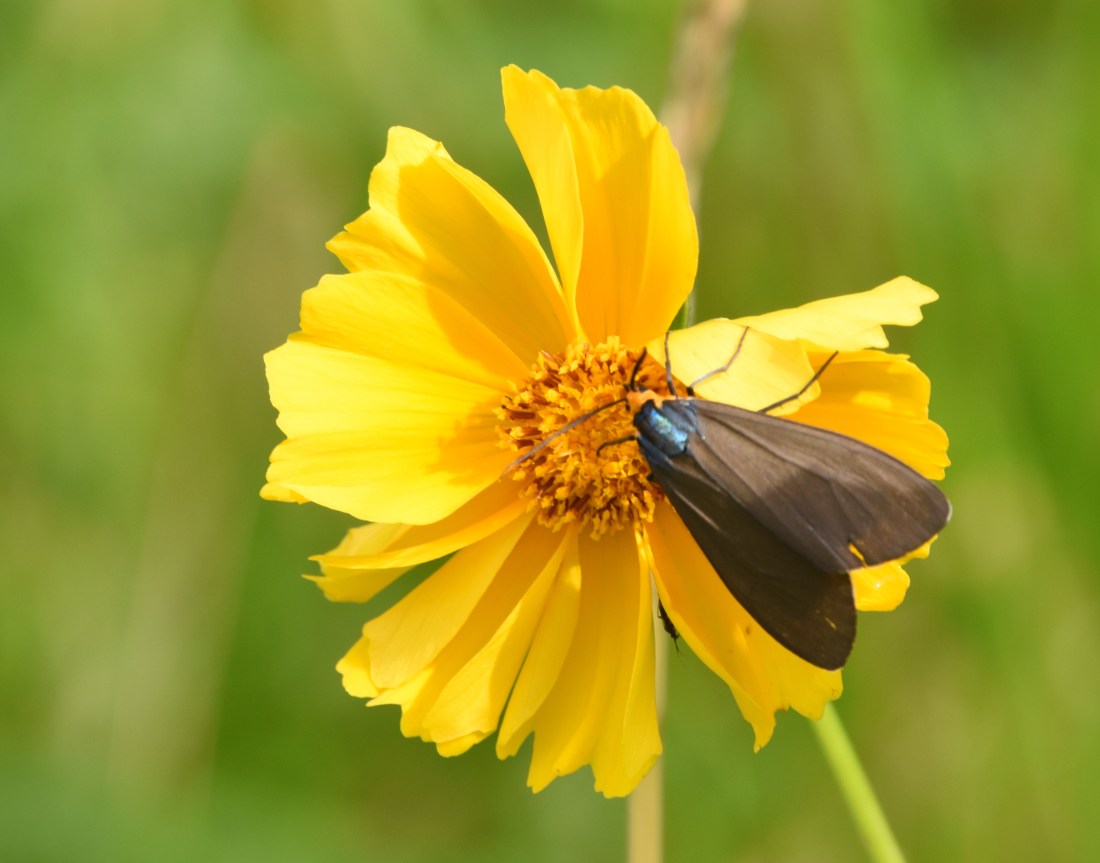
Virginia Ctenucha Moth
Juvenile Robin
Common Whitetail, female
Coneflower
Red-winged Blackbird, female
Friday July 5, 2019
Mel and I both headed out late in the day to the nearby Al Sabo Preserve bike trail. Once again we chose a paved trail in order to avoid the tall grasses and muddy patches on the non-paved trails. It was still hot, but not unbearably so and we lasted more than an hour and a half. The fields along both sides of the bike trail were covered in tall grass and wildflowers and were exploding with dragonflies– Halloween Pennants, Calico Pennants, Widow Skimmers, Twelve-spotted Skimmers, Pondhawks, and a totally new one for me, a beautiful Spangled Skimmer! I couldn’t believe how many dragonflies there were! I’ve really never seen so many in one place at one time! It was great fun trying to ‘capture’ them in all of their artistic poses!
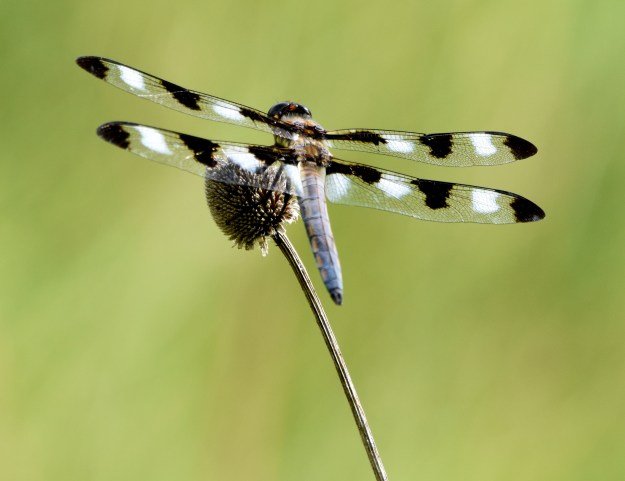
Twelve-spotted Skimmer, male
Blue Dasher, female
Dot-tailed Whiteface
Spangled Skimmer, femaleSpangled Skimmer, male
Coneflower
Butterfly Weed
Tiger Lily
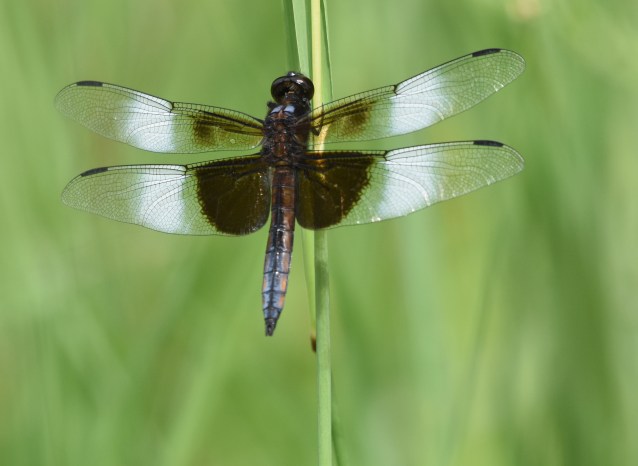
Widow Skimmer, male
Widow Skimmer, female
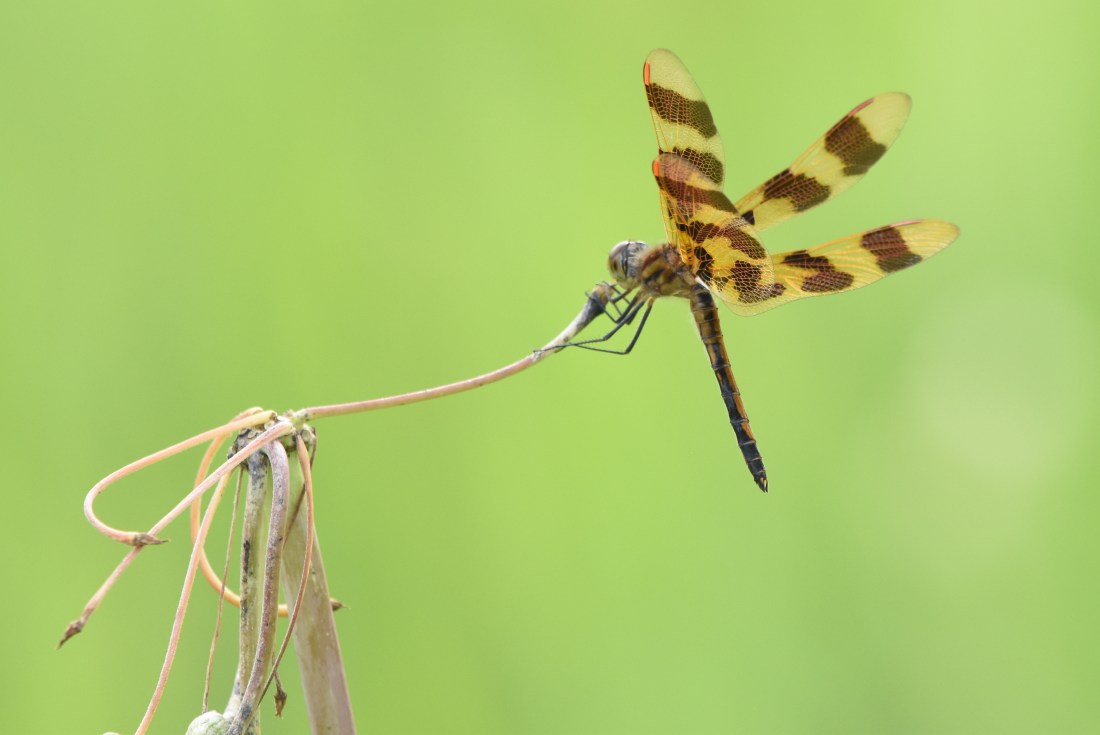
Halloween Pennant
Calico Pennant
Halloween Pennant taking the microphoneVirginia Ctenucha Moth on Lance-leafed Coreopsis (Try to say THAT fast five times!)
Hopefully, better weather is in our future—but, to live in Michigan is to always hope for better weather!
One of my very favorite places to visit here in Michigan for bird watching and photography is the Kensington Metropark Nature Center in Milford: https://www.metroparks.com/facilities-education/kensington-nature-center/ Any time I travel to the other side of the state to babysit our grandson, I love stopping at Kensington to walk the nature center trails– with a pocketful of birdseed.
Barn Swallow along the boardwalkBlue Dasher along the boardwalkGrackle along the boardwalkGreat Blue Heron just before landing in front of me on the boardwalk!!Great Blue Heron that landed on the boardwalk right in front of me!
The trail I like best at the Nature Center meanders around Wildwing Lake. On the eastern edge of the lake is a long boardwalk from which you can see a small island that that is home to a very busy heron rookery. A rook is defined as “a common Old World gregarious crow that nests and roosts in usually treetop colonies”. A rookery is defined as “a breeding place or colony of gregarious birds or animals…” “Gregarious” seems to be one of the operative words here and the herons in this rookery were definitely gregarious!
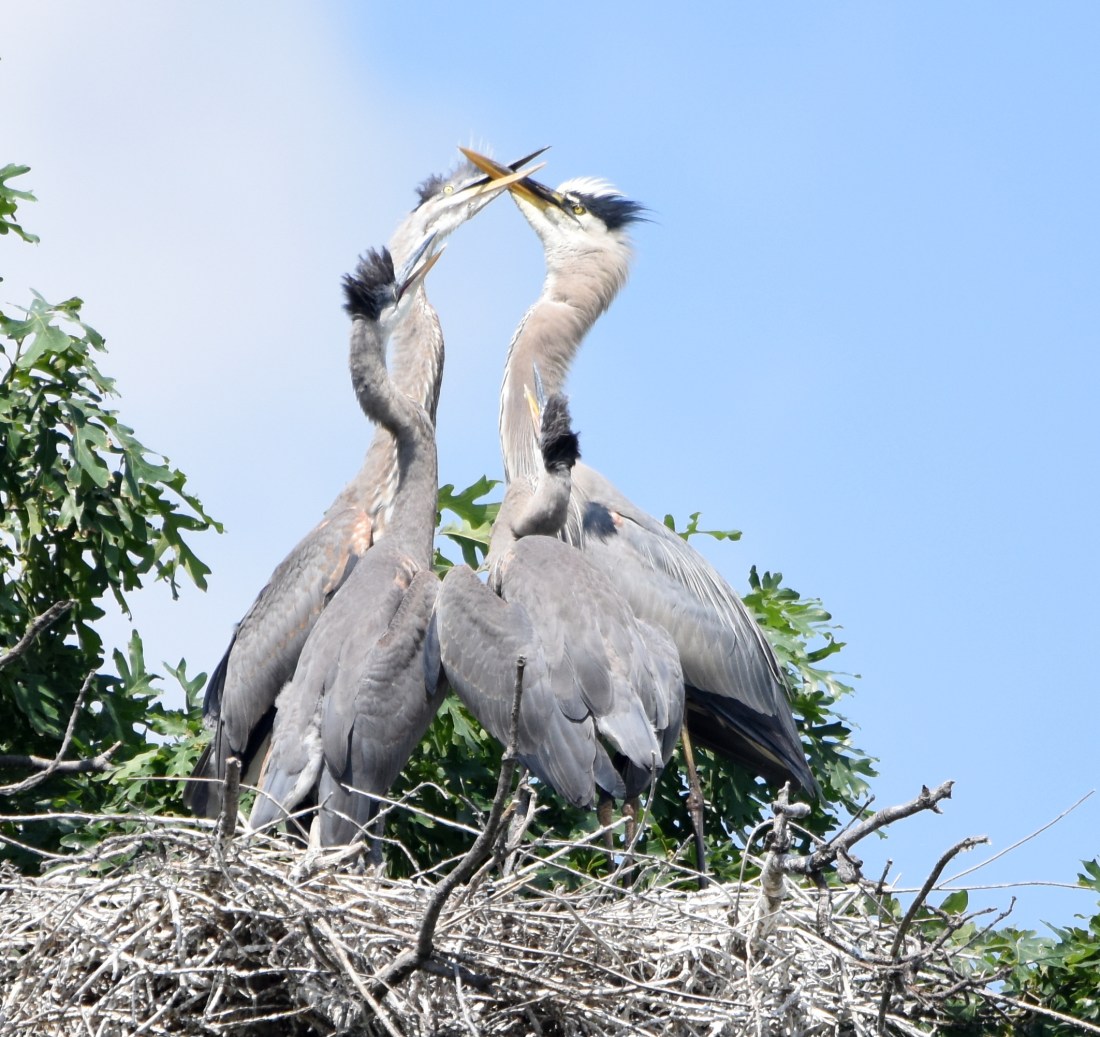
Mama and the kids in the rookery!The Great Blue Heron kids in the rookery looked like Muppet Puppets to me!The Great Blue Heron kids
It was quite a happy surprise for me to find that there were still youngsters in the nests—which I hadn’t expected. I thought they might have all fledged by now. The youngsters I saw, though, were almost as big as the adults and were still dependent on them for food—which, for the parents, looked like a full time job! All those big mouths to feed!
Sure look like Muppet Puppets to me!All of the kids want to be fed NOW!!Feed me!!!Food Fight!!
Through the eye of my 600mm lens, I could see a lot of sibling squabbling going on high up in the treetops as the young birds waited impatiently to be fed. Even if you didn’t have a telephoto lens or a pair of binoculars, you could still surmise what was going on by of all the squawking!
It was quite a show up there—with all the parents flying back and forth to the nests, ‘babies’ testing out their wings, and dozens of rambunctious nest-mates poking and pecking at each other! I found it hard to tear myself away.
Running out to catch some lunch for the kidsComing back in with food!Flying back outLooking for fish
Eventually, though, I wanted to continue on my way around the lake because I was hoping I might find the ‘famous’ Sandhill Crane couple who have been raising a Canada goose ‘baby’ along with their own biological ‘child’. It’s quite a heartwarming story that I’ve been following on the Birding Michigan Facebook page but that you can also read about here: https://www.audubon.org/news/this-sandhill-crane-couple-adopted-baby-goose. Unfortunately I never found the Goose/Crane family and was left wondering if the goose will stay with his Crane family forever or eventually join a flock of Canada geese. Time will tell…
These two beautiful Sandhill Cranes came walking towards me, but they were not the couple who had adopted a Canada Goose
The other thing I didn’t see today, which really surprised me, were the songbirds that usually flutter around me in the trees along the path hoping that I’ll hold out a handful of seed for them. Every other time I’ve walked these trails, the chickadees, nuthatches, titmice, woodpeckers and other birds have flown around my head or landed on nearby trees trying to get my attention. I always bring a pocketful of seeds because I love having their little birdy feet rest gently on my hand as they carefully decide which treat they like best.
More ‘babies’ ready to leave the nest– almost!
Even though I didn’t see many songbirds today, I’d stop periodically and extend my hand hoping they would see the seeds, but they didn’t. Only one adorable little chickadee was on the ball. Where were all the rest of my birdies?? Was it too hot? Was it the wrong time of day?? Did I have bad karma? I have no idea, but, I must say, the poor turnout was quite disappointing!
Still looking for food!
The walk itself, though, was NOT disappointing and I took over 500 pictures! By the end of my walk, I felt quite rejuvenated — in spite of the oppressive heat .
A couple of days ago, Mel and I decided to take advantage of a rare five minute spate of good weather here in Michigan and headed over to one of our favorite picture walk spots, the Wolf Lake State Fish Hatchery. It’s only about 10 miles from our home and, with two dozen ponds, it’s a great place to find birds, butterflies, dragonflies, turtles, frogs and snakes, so we are frequent visitors.
Male Tree Swallow
On his particular day, though, I was hard pressed to find anything new or interesting to photograph. Over the years, I’d already taken pictures of every single red-winged blackbird, most of the dragonflies, and all of the geese. I was hoping for a surprise.
Juvenile Tree Swallow sitting in a Mulberry Tree
About an hour into my walk, having only gotten a few flowers and a red-winged blackbird, I was about to call it a wrap. But when I turned the corner on one of the last ponds, I spotted two small birds perched low on a branch about 25 feet away. Taking extreme caution not to scare them, I slowly raised my camera so that I could zoom in on them before they had a chance to fly away. Only they didn’t. So I kept snapping. Every once in awhile, they would flutter their wings, squawk a bit, and open their mouths wide hoping to be fed. These were young tree swallows that had already fledged the nest but were still being fed by their parents.
Two little cuties looking back at me!“Hey, when do you think dad’s coming back with food?”“I’m really hungry, aren’t you???”“MOM! DAD!! We’re hungry!!”
Once I realized that they were waiting to be fed, I hoped I could get a few shots of the parents feeding them– but getting a shot like that would require keeping my camera focused constantly on the two little ones, which would be really hard for me to do without a tripod. My camera, with it’s long 600mm lens, weighs more than six pounds, and to hold it up to my eye for an extended period of time like that would be hard on my back—but I really, really, wanted that shot! So I became my own tripod.
“Here comes the food!!”“Oh, man!! He missed us!!”“Look! There he goes!”“Don’t leave now! They’ll be back soon!”
First I got down on one knee and propped my elbow on the other knee– which relieved my back and steadied the camera—for a minute, until my foot and hip started to fall asleep. So I assumed tripod position #2 and sat down on the ground with both elbows propped on both knees. It worked great– for about 5 minutes. So I went back to what I always do, I stood up.
“Here comes dad with dinner!”“Feed ME! Feed ME!“How soon do you think he’ll be back??”
“Thanks, Dad! You’re the best!”This is the wrong swallow coming in! It’s a Northern Rough-winged Swallow, not a Tree Swallow!I couldn’t tell if the kids were hoping for food no matter who made the delivery, or if they were yelling at the intruder!
Eventually, I got the shots I wanted of dad flying in to feed the kids– but I had hoped to get even more. Unfortunately, the ‘tripod’ I was using had a manufacture date of 1947 and was about to expire!
Yesterday. It. Did. Not. Rain. I say this because it seems like it’s been raining forever! So a day without rain seems like nothing short of a miracle. I was prepared to take full advantage of the miracle and the endless possibilities! Should I go for a picture walk at a new preserve or should I go to an old one? Should I drive 40+ miles or stay closer to home? Should I go early in the day or wait until the afternoon? After a long, animated discussion with myself, I decided to go someplace in the afternoon to a place I’d been before that was not close to home– Bernard W. Baker Sanctuary in Bellvue, Michigan, a mere 44 miles away.
Song Sparrow– up close and personal!
Widow Skimmer
It’s pretty hard to convey in words how excited I get anticipating another picture walk—especially if it’s someplace I’ve never been before, or someplace I haven’t been in a long, long time. But the possibilities are endless– even if it’s somewhere I’ve been a million times before! Will I see a new bird or butterfly or moth? Will I get a picture that I’m really, really pleased with? Will the weather cooperate or will it rain on my parade?
Common Whitetail, female
Northern Crescent
Viceroy Butterfly
Virginia Ctenucha (ten-oo-cha) Moth
Yesterday, the trail ahead was so incredibly quiet– just the sound of the wind and the birds to soothe me. And I was surrounded by wildflowers– thousands of delicate yellow blossoms interspersed with tall, deep purple lupine. Flitting around among the flowers were a variety of butterflies and ethereal looking dragonflies. Then, against a perfectly blue sky I saw cardinals, bluejays, yellow warblers, orioles, kingbirds, sparrows and rose breasted grosbeaks. I didn’t get pictures of most of them, but I sure enjoyed watching them.
Lupine among the yellow Coreopsis
Eastern Kingbird
Common Yellow-throat, female
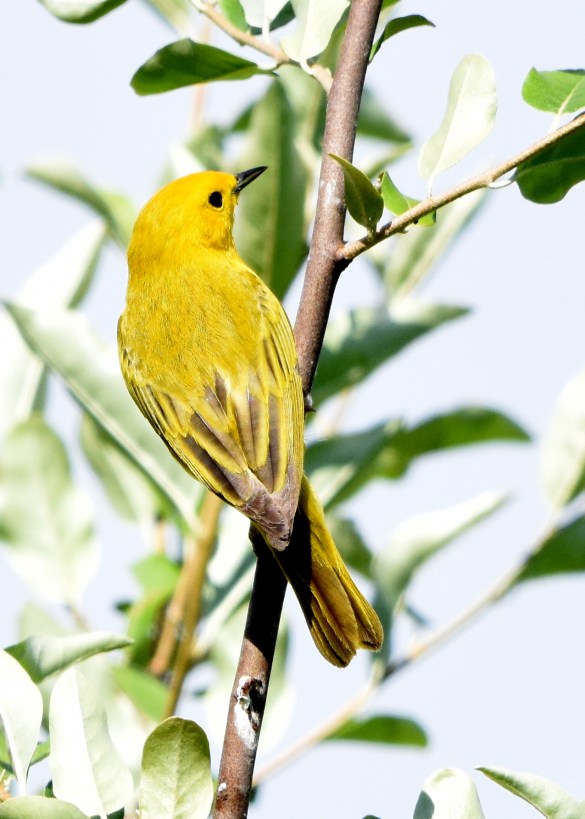
Yellow Warbler
One bird that I did manage to capture was a tree swallow. There were dozens of them flying overhead scooping up insects as they went. I was eager to see if I could get a good shot of one of them in flight– it’s a fun photographic challenge. The swallows, however, were not happy with my plan. Apparently, I was way too close to their nest boxes and they immediately started to dive bomb my camera! I couldn’t believe how fast they were and how close they came to the tip of my lens before veering off! It was unnerving– but I got the picture, both literally and figuratively, and left them alone.
Tree Swallow in flight
Tree Swallow in the nest box
When I go through my pictures at the end of each day, I often turn to Mel with a smile on my face and say, “It’s just like going on a treasure hunt!” I never know what I’m going to find or where I’ll find it, but I almost always bring home something that delights me—sometimes a picture, sometimes a story, sometimes both.
As I was out walking today, I started thinking about what advice I would give others who might be interested in going on picture walks of their own. The first thing that came to mind was to walk slowly and stop often. It’s what I do every time I’m out taking pictures and it feels very therapeutic—like an antidote to all the stress in the world today.
A beautiful Common Yellow-throat out in the meadow
House Wren
Juvenile American Robin
When this brilliantly colored Bluebird flew past, I thought at first it was an Indigo Bunting!
By walking slowly, I have time to notice all the little things going on around me—a caterpillar climbing up a stem, a small butterfly perched on a flower, a hummingbird taking a break. When I walk slowly, I also try to walk as quietly as I can. If the path is covered in dry, noisy leaves, I look for a grassier edge where I might move more quietly. Walking slowly and quietly also means that I’ll be less likely to scare away the critters that I might like to photograph.
I came upon this chipmunk so quietly that he didn’t realize I was only a few feet away!Red-spotted Purple ButterflySilver-spotted Skipper ButterflyGreat Blue Heron fishing in the mucky water
On any given picture walk, I stop dozens if not hundreds of times—to look around, to observe what’s going on around me, to take in my surroundings– all 360 degrees of it (including the sky above me!). Sometimes I find a place to sit for awhile. It’s amazing how much is happening around me that I am mostly unaware of when I’m on the move or thinking of other things.
Tiger Swallowtail
Bumblebee
Red Admiral Butterfly
Spatterdock Darner Dragonfly (I think)
Silver-spotted Skipper Butterfly
Wild Indigo
One of the ‘mantras’ running through my head when I’m out taking pictures is “Shoot the way your shadow goes!” In other words, make sure the sun is behind me. I’m always looking for my shadow when I’m out taking pictures and I often choose which way to turn so that my shadow is in front of me, or at least pointing in the direction of the most favorable pictures.
Young Sandhill Crane
Twelve-spotted Dragonfly
Bluet Dragonfly
Sad-faced Box Turtle!
Perhaps because I’m relatively new to nature photography, I take an excessive number of pictures– hedging my bets in favor of getting at least one good shot out of the bunch! With digital photography, there’s nothing to lose with this approach—other than the long hours one might spend sorting through and editing so many pictures. For the most part, though, I enjoy the process.
Twelve-spotted Dragonfly
Lupine
Scrawny Robin with a mouthful of worms
Barn Swallow on a white bridge
The other thing I’ve learned along the way is to ‘assume nothing’. Just because a bird is small and brown, doesn’t mean it’s just another sparrow, or just because a bird is red, doesn’t mean it’s just another cardinal. If it IS a sparrow or a cardinal, it doesn’t mean I shouldn’t take a picture. Even though sparrows and cardinals are as common as ticks and I already have a million pictures of them, it’s all good practice– and you know what they say about practice!
Baby Goose
Eastern Bluebird with a mouthful of grubs and spiders (?)
Teasel in the waning sunlight
So, walk slowly, stop often– and take a lot of pictures!
The other day, Mel and I were invited to be part of a ‘peregrine falcon watch team’ in downtown Kalamazoo. There were three teenage peregrine falcons who were ready to fledge, or leave the nest, within the next few days.
Two of the three juvenile Peregrine Falcons getting ready to fledge
“Since 2010, Peregrine Falcons have
been returning to the Fifth Third Bank building in downtown Kalamazoo for
nesting. Thanks to the bank, the Michigan Department of Natural Resources, and
the efforts of Audubon Society of Kalamazoo (ASK), in 2014, the birds
successfully nested in and fledged four chicks from the nesting box installed
by the ASK. Then, in January 2015, two cameras and a microphone were installed
so that you can now catch live footage as the Peregrine Falcon web camera
captures each moment.” https://www.kalamazoofalcons.com/
Peregrine Parent
Peregrine Parent
The nest is on about the 10th floor of a downtown bank building and we would be watching from the roof top of a nearby parking structure. Our job was to see if any of the teenagers took their first flight, and if they did, where they landed and if they were successful—meaning they didn’t crash and burn or land so far down that they couldn’t fly back up to the nest. If they did land on the ground or got hurt, our job was to call Gail and then do our best to rescue the bird or keep it safe until she arrived. A rescue would involve wrapping the bird gently in a towel, putting it in a ventilated covered box and waiting until Gail could return it to the nest on the side of the bank building. Access to the nest requires going to the 10th floor of the bank building, accessing one of the offices, climbing through a window, and dropping into a deep window well.
Bringing home the bacon!
Feeding the kids
Not surprisingly, Mel and I brought our cameras to this falcon watch assignment. My favorite shots on the first day (although they weren’t the best shots in terms of sharpness) were of the young falcon who was captivated by a carpenter bee zooming all around him. It reminded me of a small child who was totally distracted from the task at hand!
Young falcon distracted by a carpenter bee!
By the very end of my very first watch day, none of the birds had fledged. So I went again the next day, but not early enough! One of the birds had taken flight by 7:30 a.m. and I didn’t get there until 11:00!
Getting ready to fly
Watching the street below
After the peregrine took off, it was unclear where he had landed and the folks who had been keeping an eye on him, spent a long time trying to find him. Fortunately, one of the ‘falcon watchers’ lives in the condo unit adjacent to the bank where the nest is located. He tracked down the maintenance worker for the building who readily provided access to the roof where they spotted our young flyer!
Long view of the juvenile falcon on the ledge
Close-up of the bird on the ledge
Parent keeping watch overhead
Parent keeping watch overhead
By the time I arrived, flyer number one was perched on the edge of a building overlooking one of the busiest and nosiest streets in Kalamazoo– which made us all worry even more that he might take flight again and land in the road. Gail was keeping an eye on him from down on the street while I was keeping watch from the parking garage to see if either of the remaining birds decided to fly. Nobody did.
Parent flying high
Then I went down to the street with Gail and watched the bird on the ledge while someone else watched the other two birds from the parking garage. After an hour or two, I traded places with the person on the parking garage and the bird on the ledge decided to fly! Darn! I missed it! He had flown from his street side perch to a metal tower closer to the parking garage– but I never saw him fly in! Double darn! I did however get a few pictures of him once he landed.
The first falcon out of the nest lands on a metal tower
By 7:00 p.m. of the third day, I was reluctant to leave because I had really, really wanted a picture of one of the juveniles in flight. It was not to be! Oh well, it was a fun watch (albeit tedious at times) and I got an inordinate number of falcon pictures in the process!
Today is the last day of May, but the first day of the entire month that I can remember having no rain at all in the forecast!! Given this rare opportunity, Mel and I didn’t waste any time throwing our camera bags in the trunk of the car and heading out the door by 7:30 a.m. Our destination: South Haven, Michigan– less than an hour away. Our plan: to have fun—and maybe take a few pictures!
Red-tailed Hawk (Kellogg Bird Sanctuary)
Red-winged blackbird chasing a red-tailed hawk!
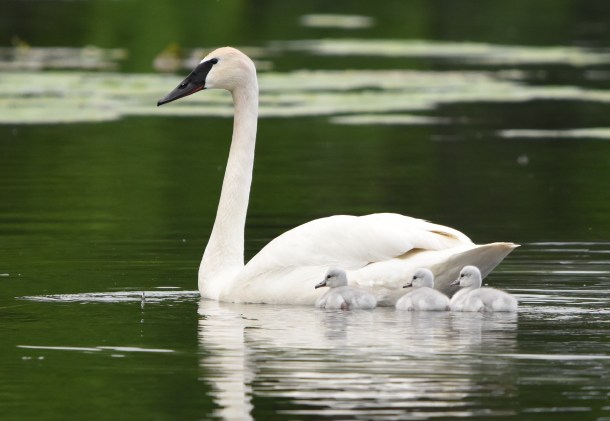
Trumpeter Swan and three cygnets (Kellogg Bird Sanctuary)
Canada Goose (Kellogg Bird Sanctuary)
Wood Duck (Kellogg Bird Sanctuary)
Our day started out with a tasty breakfast at Six Chicks Scratch Kitchen, followed by a picture walk around our favorite park– where we had once spotted a red-headed woodpecker, and were optimistic about finding him (or maybe his 2nd cousin). Ha!! We didn’t even find a robin!
Great Crested Flycatcher (Ott Biological Preserve)
Song Sparrow (Ott Biological Preserve)
Northern Flicker (Ott Biological Preserve)
We then took a leisurely walk to the end of the South Haven pier and were delighted to watch as the Friends Good Will tall ship set sail into beautiful Lake Michigan.
On the way to our next picture walk destination, the Kal-Haven Trail, we spotted a huge gaggle of Canada geese—which is totally unremarkable in and of itself, but I spotted a couple of orange beaks in that gaggle and yelled, “Stop the car! Stop the car!” Turns out, our mystery beaks belonged to three rather large Greylag Geese, which are native to Europe and the UK, but not here. Hmm.
Greylag Geese ” The ancestor of most domestic geese, the greylag is the largest and bulkiest of the wild geese native to the UK and Europe.
Our last walk of the day was through a nearby nature preserve where we had hoped to get a few more pictures of birds and flowers and bugs. What we got was mostly bugs–as in mosquitoes, who wanted to eat us. It was as good a time as any to head back home and feed the dogs!
Eastern Bluebird (Kellogg Bird Sanctuary)
Common Grackle (Kellogg Bird Sanctuary)
Surprisingly, the sun was still shining when we returned home around 5:00. Knowing that I still had at least another two hours of sunlight left before our perfect sunny day would be over, I grabbed my camera again and went back outside– this time I just walked next door to Western Michigan University’s Business Technology and Research Park. It’s a good thing I did– or I would have missed the red-winged blackbird taking a break in Einstein’s hair, and the barn swallows sitting nicely on a branch, and the deer grazing in the field, and the great blue heron catching fish in the pond! That’s the thing I always wonder about– what am I missing if I don’t go out??
Red-winged Blackbird in Einstein’s hair! (WMU’s Business Park)
Robin with a mouthful (WMU’s Business Park)
Barn Swallow (WMU’s Business Park)
Beautiful Lupine (WMU’s Business Park)
female red-winged blackbird (WMU’s Business Park)
Barn Swallow (WMU’s Business Park)
Mute Swan doing a little house cleaning! (WMU’s Business Park) Barn Swallow (WMU’s Business Park) Mallard (WMU’s Business Park)
For all the rainy days leading up to this one coveted dry one, I managed to find blocks of time here and there when I couldtake short picture walks—at Wolf Lake State Fish Hatchery, the Ott Biological Preserve, Kellogg Bird Sanctuary, or our very own deck! There’s always something interesting to see– but I sure hope Mother Nature comes up with some better circumstances in which to see them!!
Female red-winged blackbird (Wolf Lake State Fish Hatchery)
Tree Swallow (Wolf Lake State Fish Hatchery)
Gosling (Wolf Lake State Fish Hatchery)
Flycatcher (Wolf Lake State Fish Hatchery)
Five Turtles (Wolf Lake State Fish Hatchery)
Wild Geranium (Wolf Lake State Fish Hatchery)
Columbine (Wolf Lake State Fish Hatchery)
Bleeding Heart (Wolf Lake State Fish Hatchery)
Yellow Warbler (Wolf Lake State Fish Hatchery)
Female red-winged blackbird (Wolf Lake State Fish Hatchery)
The beautiful, and very accessible boardwalk at Magee Marsh
American Redstart, male
American Redstart, female
A beautiful Cape May Warbler
Magnolia Warbler
Canada Warbler
In spite of the unpredictable weather, my husband and I managed to get in at least four hours of picture-taking at Magee Marsh every day of our three day visit. I took so many pictures of so many birds that it’s taken me almost as many hours to go through them as it did to take them—probably more! On one day alone, I took over 700! Between the two of us, Mel and I captured almost 40 different varieties of birds! What a treat it was to see so many– and so close at hand!
Blackburnian Warbler
Black-throated Blue Warbler, female
Bay-breasted Warbler
Male Cardinal
Eastern Wood PeeWee
On one of our birding days, Mel and I also spent a few hours at the Trautman Nature Center, which was just a matter of stepping out the door of the lodge where we were staying and taking a short walk to the nearby Nature Center and its beautiful 2 mile boardwalk through the marshes and fields.
Black and White Warbler
Gray Catbird
Chestnut-sided Warbler
Black-capped Chickadee
Philadelphia Vireo
Yellow Warbler
Swainson’s Thrush
Trautman Nature Center didn’t have the swarms of migrating birds like Magee Marsh, but I was really happy with the few things that I did find — Eastern Screech Owls, a Bald Eagle, a Great Egret and a few good shots of a great blue heron.
Great Blue Heron
Adult Screech Owl
Juvenile Screech Owl
Two Juvenile Screech OwlsGreat Blue HeronBald Eagle
Red-winged Blackbird
Tree Swallow
After Trautman, we grabbed a quick lunch and headed over to
Magee for one last, memorable visit.
Baltimore Oriole
Cedar Waxwing
Prothonotary Warbler
Red-eyed Vireo
Willow Flycatcher
Admittedly, there are an inordinate number of pictures here, but it was sooo hard narrowing them down! I tried to stick to just one of each kind– but it sure wasn’t easy! Enjoy!
Warbling Vireo
Northern Parula
Eastern Wood PeeWee
Note: I’ve done my best to label these birds correctly, but if you find any errors, please let me know. Thanks.
A month ago Mel and I went to a Woodpecker Festival in Middleville, Michigan, where we met lots of birdy people like ourselves. When we had lunch with a couple of those folks, they told us about a wonderful birding place in Ohio called Magee Marsh (https://www.mageemarsh.org/).
Black-throated Blue Warbler, male
Black-throated Blue Warbler, female
Magnolia Warbler–a new catch for me!
American Redstart, female
House Wren
“Magee Marsh, situated on
the southern shore of Lake Erie, is a prime stopover for North American
warblers during spring migration. Every year thousands of birders,
photographers, and nature lovers flock to this location in spring to witness
the unforgettable spectacle of large songbird concentrations preparing to
migrate across the great lake toward their breeding grounds in the north. Magee
Marsh is just one of those special places that you have to come back to year
after year.”
Baltimore Oriole, male
Yellow Warbler
Canada Warbler
Blackpoll Warbler
Common Yellow-throat Warbler
As soon as we got home from the Woodpecker Fest, we checked our calendars and booked a room for four days in May at the Maumee Bay Lodge and Conference Center in Oregon, Ohio– which was also recommended to us by our bird people (https://www.maumeebaylodge.com/). It looked kind of fancy and expensive but the non-weekend, off season rate for old people (aka Senior Citizens) was perfect! And, it was only 2 ½ hours from home!
As soon as we arrived yesterday at 1:00, Mel and I headed straight for the marsh because we basically had to ‘make hay while the sun shines’. The weather was expected to be intermittently rainy for the duration of our stay and, since it wasn’t currently raining, we hurried down the road about ten miles to the marsh before something changed!
Scarlet Tanager
Tree Swallow
Luckily, it never rained yesterday. Today, however, it’s raining cats and dogs and I am patiently (or maybe not so patiently) waiting for it to stop so we can go back to Magee.
We spent almost four hours yesterday wandering the beautiful Magee Marsh boardwalk– snapping pictures all the while! The nearby trees and bushes were just teeming with birds, mostly warblers, that were singing and chirping and flitting this way and that in their quest for food or nesting materials or love. And, even though the birds were plentiful and near at hand, they were hard to capture. Small birds are constantly on the move! I’d no sooner locate one and they’d be gone! Or, I’d snap a picture and they’d be gone between the instant I’d pressed the shutter and the camera took the picture. They’re that fast!
Brown-headed Cowbird, female
Swainson’s Thrush
Tennessee Warbler
Yellow Warbler
Warbling Vireo
Walking through the marsh was a magical experience! Most
birders are reverentially quiet as they walk silently among the trees hoping
not to scare the birds and speaking in whispers to fellow birders. It’s almost
like being in a church. Many of us were in awe of all the different birds flitting
around and I was equally thrilled with all the new birds I saw— like the Magnolia
Warbler, the Blackburnian Warbler, the Blackpoll Warbler and the Canada Warbler! Some birds I’d never even
heard of before, like the Bay-breasted Warbler and the Chestnut-sided Warbler. Mel
also caught a Prothonotary Warbler, which I’ve only seen once before! It was an
very exciting day!
Chestnut-sided Warbler
Bay-breasted Warbler
Prothonotary Warbler
Blackburnian Warbler
Wilson’s Warbler
I almost forgot to mention how weird it felt to be among ‘my own kind’! Most of the time when I’m out taking pictures, people stare at me or make comments about the size of my lens! At Magee Marsh, virtually everyone had a long lens. Some people even had super-ginormous lenses with flash extenders mounted on a monopods! I was no longer self-conscious about my comparatively small equipment– that is, until someone, who thought I knew that I was doing with my long lens, would ask me, “What bird is that you’re shooting?” and I’d very self-consciously reply, “I have no idea!”