It’s another cold and rainy October day as I write this– not a day for pictures, but a day for bird watching from my easy chair! I am perfectly situated for this endeavor, with the fireplace in front of me, a large sliding glass door next to me, and a hot cup of tea snuggled between my hands. Just outside that sliding glass door is a second story deck where we have bird feeders filled with sunflower seeds, suet and peanuts. Today, there’s an entertaining assortment of sparrows, nuthatches, titmice, finches, grackles, blue jays, woodpeckers, cardinals, and black-capped chickadees taking full advantage of our all-you-can-eat buffet.
Our lovely fall colors before winter comes in earnest!
Dark-eyed Junco and an Eastern Phoebe
The Robins stick around all winter but we don’t often see them once the snow flies.
One of the last painted turtles I’ll see until spring, and a pied-billed grebe with its catch of the day!
Unfortunately, this rainy, gloomy weather has persisted for days on end now, with only intermittent bouts of sunshine, so it’s been difficult to squeeze in a picture walk. On the days where I have managed to get outdoors with my camera, it’s been so much harder to find things to photograph; gone are the colorful butterflies and dragonflies, gone are the beautiful fields of wildflowers, and gone are the fickle birds who only enjoy Michigan when it’s warm! What I am finding instead are the migrating birds, the ones just passing through on their way to Florida or other sunny havens—like the sandpipers, the northern shovelers, the greater yellowlegs, the gadwalls, and the white-crowned sparrows. Truth be told, I’m a fickle bird as well, and would scurry off to Florida in a heartbeat– were it not for this horrible pandemic!
Northern Shoveler
Greater Yellowlegs and a Killdeer on the mudflats at the Wolf Lake State Fish Hatchery
Solitary Sandpiper
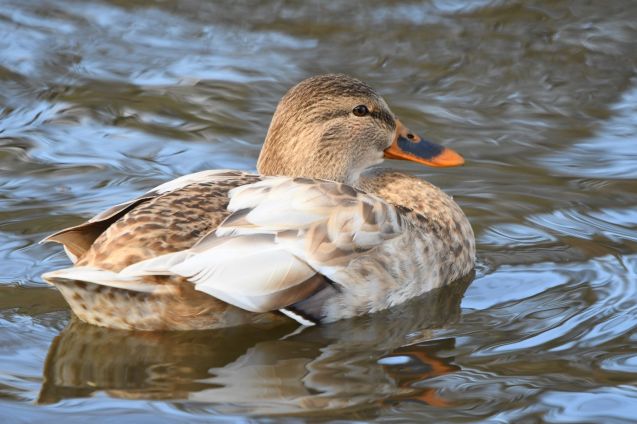
Female Mallard and a Male Gadwall
White-crowned Sparrow
In spite of the colder, darker days ahead and the loss of so much color, I still look forward to my quiet, solitary forays into the ‘wild’ to see what Mother Nature has left for me. It will get bitterly cold in the days ahead and the snow will eventually blanket everything. I will have to dress warmer, look harder and wait longer for one bird or another to show up, so I give myself pep talks: “It’s good to be out in nature! It’s good to be out walking and breathing the fresh air! It’s good to have an outdoor hobby!” But sometimes, even the best pep talks in the world won’t stand a chance when the mercury drops below freezing and even my camera doesn’t want to go outside!
Swamp Sparrow and a Field Sparrow
My grandson feeding one of the friendly Black-capped Chickadees at Kensington Nature Center
Eastern Bluebird and a Yellow-rumped WarblerSandhill Cranes are a common sight (and sound) these October days.A Red-tailed Hawk on the hunt
The other day, I was talking with a friend about this hobby of mine that I love–nature photography; about picture walks, about writing a blog, about being outdoors every day. After listening to me ramble on enthusiastically, she said, “It really checks off all the boxes for you, doesn’t it?”
“Well, yes, I guess it does,” I replied. And then proceeded to get lost in my head visualizing all of those tiny boxes…
Red-eyed Vireo
Eastern-tailed Blue and a Monarch
Box Number One is the ‘exercise box’. I get out and go for a picture walk almost every day. I may not walk fast and I may not walk far, but I do get up and out the door for three or four hours at a crack–sometimes more. At age 73, that might be considered an accomplishment!
Autumn Meadowhawk and an Eastern Phantom Cranefly
Eastern Bluebird
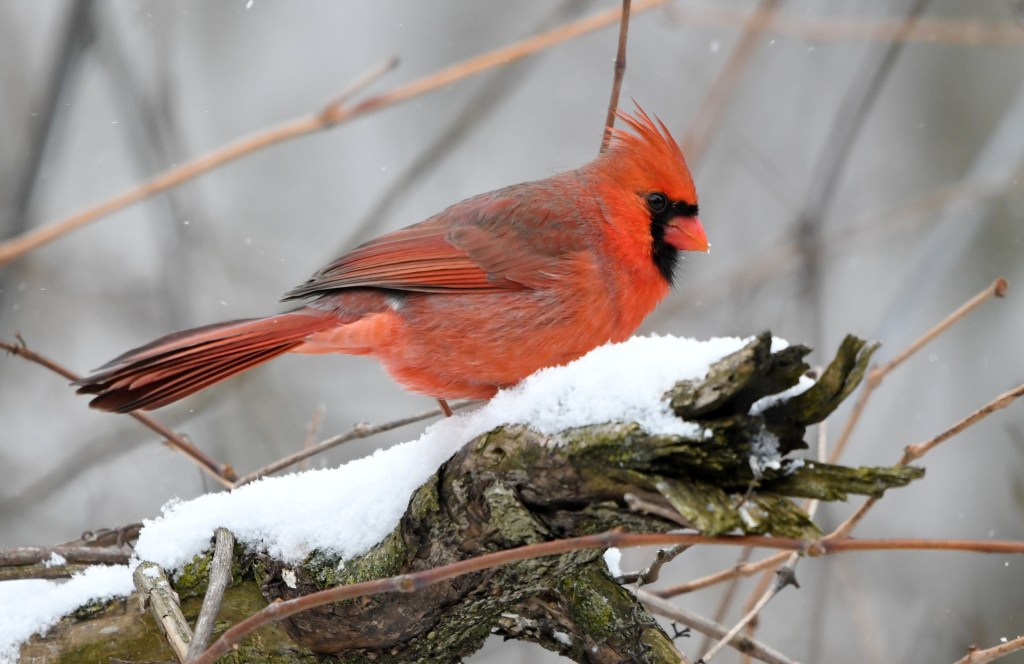
Cardinal and Cedar Waxwing
Box Number Two is ‘connecting with nature’. As soon as I arrive at the woods or fields where I’ll be taking pictures, a sense of calm washes over me as I get ready to explore all the possibilities that lay ahead. I am so focused on looking for things to photograph, that I totally forget about anything that might have worried me before I left the house. A picture walk feels so much like a form of meditation that I decided to Google the words “photography as meditation” to see if anything came up. I was quite surprised to find that not only had articles been written on this topic, there was actually a book with the same title, ‘Photography as Meditation’!!
Backlit Plant and a Brown Creeper
Bog Walk
Fall Leaves and a Red-legged Grasshopper
Box Number Three is ‘making connections with others’. One of the things I really like to do after taking my pictures, is to share them with others. There are so many interesting things to see out there! When I share what I’ve found with others, it starts a conversation. Those pictures and those conversations lead to writing a story, such as this blog, which then leads to Box Number Four.
Eastern Phoebe
Great Blue Heron
Solitary Sandpiper and a Pectoral Sandpiper
Palm Warbler and a White-breasted Nuthatch
I love to write. I love pulling my thoughts together and putting them down on ‘paper’. Writing things out forces me to clarify what I’ve seen and what I’ve learned. My hope is that those stories prove interesting or educational or somehow beneficial to someone else. If nothing else, though, the stories I write serve as ‘memory keepers’ for me when, years from now (or maybe next week!) the details of a particular walk will have eluded me!
Fox Squirrel
Small Copper Butterfly and a Swamp Milkweed Leaf Beetle
There are certainly other boxes that could be checked off, such as ‘picture walks vacation destinations’ and ‘picture walks creative projects’, but the four I’ve described are at the very top of my list and are all the motivation I need to get out the door for another day of exploration.
This poem by Wendell Berry was posted recently by a friend and it really resonated with me, especially during these very stressful and troubling times. It speaks volumes about the peace we can find in nature and of the comfort it can provide.
Great Blue Heron
There’s nothing more that I can add to this beautiful poem, so here are a few of my wild things to enjoy vicariously…
Pied-billed Grebe and Great Blue Heron
American Bullfrog
Virginia Ctenucha Moth and Male Widow Skimmer Dragonfly
Cabbage White and Common Buckeye Butterflies
Carolina Wren
House Sparrow and Black-capped Chickadee
Eastern Phoebe and White-breasted Nuthatch
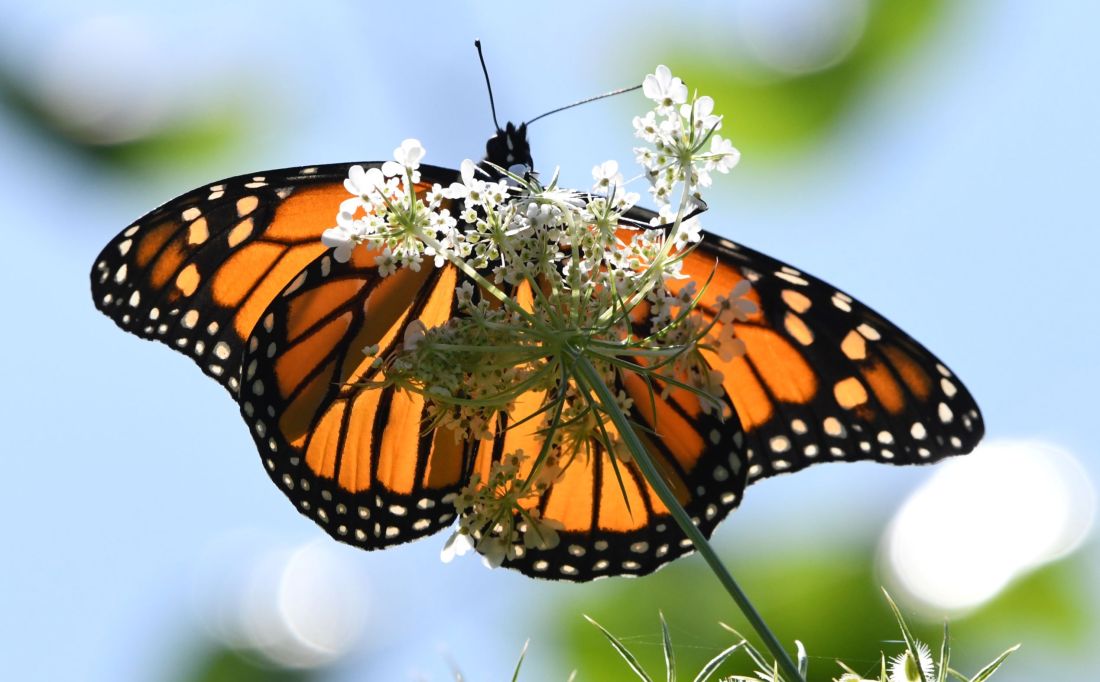
Male Monarch Butterfly
Red-legged Grasshopper, White-faced Meadowhawk Dragonfly, Familiar Bluet Damselfly and a Halloween Pennant Dragonfly
Cicada and a Purple Coneflower
Praying Mantis
Painted Lady Butterfly and Spotted Spreadwing Damselfly
I love going out in the cool morning light for a picture walk, especially during these hot summer days when the afternoon temperatures have been well into the 90s! But our lovely summer days are quickly coming to an end, a bittersweet reminder that fall and winter are close at hand. I am looking forward to the cool, crisp days of fall, but am acutely aware that they will come at a price– all the colorful butterflies, dragonflies and frogs that I love to photograph will soon be gone. Come winter, the world will be even more monochromatic.
Eastern Tiger Swallowtail
Autumn Meadowhawk and Eastern PondhawkAmerican Bullfrog
Common Jewelweed and a Redbud leaf
That said, my walk the other morning was a perfect blend of Summer and Fall. It was deliciously cool in the morning, sunny and warm by the afternoon; much too cold for the frogs and dragonflies as the day began, but plenty warm a few hours later for all my favorite creatures to be out sunning themselves!
Blue Dasher
Differential Grasshopper and a Widow SkimmerMonarch Butterfly
Black Saddlebags and a Blue DasherBlack Elderberry
Knowing full well that colder weather is nipping at my heels, I’ve been out nearly every day for at least a couple of hours trying to capture what’s left of summer. Because of the pandemic, we haven’t traveled far and I’ve been limited to visiting the same preserves and natural areas closest to home many times over. When I’m in the midst of taking my 700th picture of a monarch or a blue dasher or a bullfrog in the same preserve I’ve been to hundreds of times, I stave off the potential monotony of it all by telling myself “It’s all practice, Jeanne, It’s all practice”– It’s a different day and a different light, every shot I take is a new challenge!
Barn Swallow
Common Buckeye and a Silver-spotted SkipperPainted Turtles
Female Baltimore Oriole
The silver lining to going back to the same places over and over again is that I really get to know its inhabitants; a case in point is the Wolf Lake State Fish Hatchery. I’ve been going there at least twice a week for years—and even more so during this pandemic. It’s a wonderful place to explore with dozens of ponds and lots of wildflowers. I’ve been there so many times that I know the best places to look for frogs; the most likely places to find the swallows perched on limbs, and which ponds the kingfishers favor most. I thoroughly enjoy this knowledge and this familiarity —but I am still longing for a change of venue.
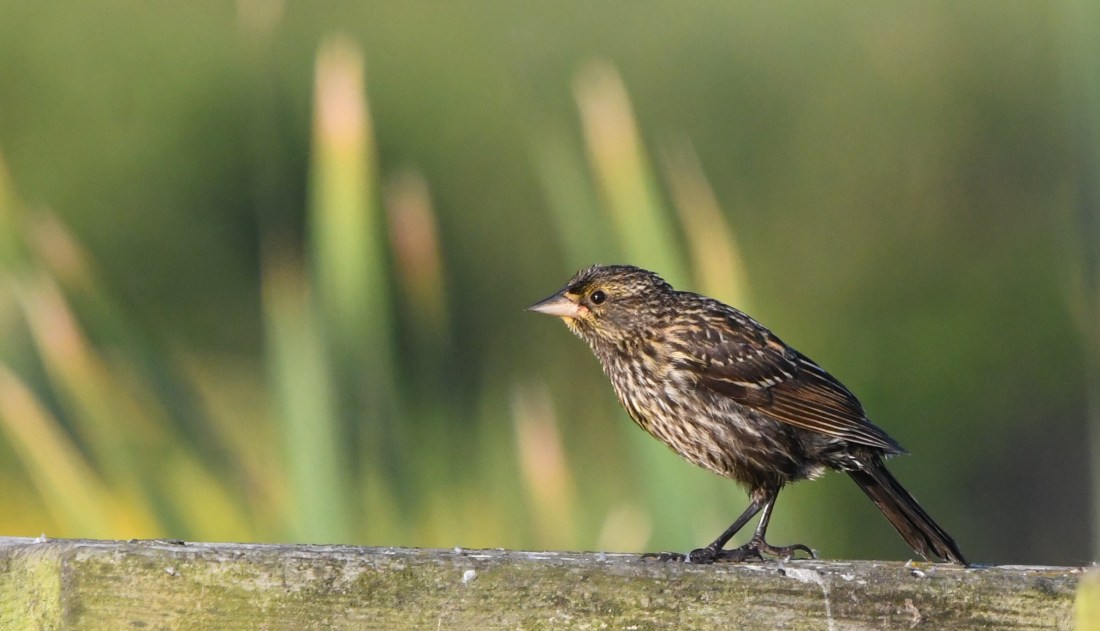
Female Red-winged Blackbird
American Goldfinch and a Ruby-throated HummingbirdEastern Kingbird
Bull Thistle and Sneezeweed
Female Rose-breasted Grosbeak and a Starling
Hopefully, by this time next year, the world will be open again and we can all feel safe in our travels—however small those travels may be.
My favorite time of day for going on a picture walk is early, early morning– just as the sun is coming up. It’s a quiet, peaceful time of day when the rest of the world is not yet awake and not yet making noise. It’s a time of day when it’s easier to hear the birds and easier to notice the movement of the grasses where a wiggling bug or bird might emerge.
One of my favorite early morning shots was this little chipmunk perched in a tree with an abundance of colorful flowers in the background.
Hibiscus and a Sumac branch
Monarch
Oftentimes, there’s a mist across the water that adds to the dreaminess of an early morning walk. If I’m lucky, I’ll catch a dragonfly or two laden with dew drops and not quite ready to fly, or a spider web sparkling in the sunlight. The morning sun has a way of making everything look fresher and brighter and more saturated. The problem is, the morning sun doesn’t last long and I always feel like I’m racing against it for a few good shots.
Familiar Bluet Damselfly on a dewy blade of grass
Early morning mist on the pond at the Wolf Lake State Fish Hatchery in Mattawan, Michigan
Barn Swallow
Eastern Tiger Swallowtail
The race begins long before I leave the house. In truth, it starts the night before when I lay my clothes out in the guest room so that, come morning, I can get ready without waking up my better half. In order to win my race against the sun in these waning days of summer, I need to be out the door by 6:00 or 6:30 a.m., depending on how far I have to drive. If I leave later than I should have, then the race becomes literal!
I love finding the frogs when I’m out on a walk. Sometimes, it’s a bit like a Where’s Waldo challenge!
Great Blue Heron and a female MallardCarpenter Bee working a flower
Spider web laden with dew and an Eastern Kingbird
Once I arrive at my destination, the race continues– because I want to be everywhere at once before the sun is too high in the sky. If you’ve never been in a race against the sun, it’s hard to explain the urgency—or the delight, if you win!
Monarch
Calico Pennant Dragonfly and a Northern Rough-winged Swallow
(All of the pictures in this post were taken in the early morning sun.)
As I pondered what to write today, I was thinking back on my short but immensely gratifying photography journey.
Barn Swallow and a Belted Kingfisher
Juvenile Barn Swallow
Eastern Kingbird and Willow Flycatcher
It started innocently enough in the fall of 2016, when my husband asked me what I wanted for Christmas. I had no idea! But, he likes finding things that surprise me, so I gave it some thought. What I came up with was “a better camera”. For many, many years, all I had was a very small, pocket-sized, Canon Powershot.
Brown Thrasher and Female Red-winged Blackbird
Willow Flycatcher
Gray Catbird and a Cedar Waxwing
Once I told Mel about my ‘better camera’ idea, he went to work researching it. What he came up with was another model of the Canon Powershot –but a bigger, better version with a built-in zoom lens. I now refer to this camera as my ‘gateway drug’! As soon as I realized what was possible with a better camera, I was hooked!
Eastern Giant Swallowtail on Bull Thistle and a Great Spangled Fritillaryon Coneflower
Eastern Tiger Swallowtailon Butterfly Bush
Monarch on Butterfly Weed and a Red-spotted Admiral on Queen Anne’s Lace
It wasn’t long before I was outdoors nearly every day taking pictures of birds, butterflies, frogs, turtles– anything I could find that grabbed my attention. Eventually, though, I started musing about what I might be able to do with an even better camera—one that could capture the birds that were even farther away, and would also have a faster response time.
Blue Dasher and a Twelve-spotted Skimmer
Slaty Skimmer
Male Eastern Pondhawk
Since Mel enjoys doing the research and I do not, he’s the one who went to work looking for another camera, one that would take a detachable telephoto lens. What he came up with was a Nikon D3400 and a 75-300mm lens. Once it arrived, I was out the door!
Snowberry Clearwing Moth (aka hummingbird moth)on Spotted Knapweed and BeeBalm
Painted Turtle
American Bullfrog and Pokeweed
I think another year went by, maybe less, and I found myself wanting to capture creatures that were even farther away. Mel took off on another search and came up with a 150-600mm lens from Sigma that would probably do the trick. But it was much longer and much heavier than the one I currently had and I was hesitant. When it arrived, I was still hesitant. It just seemed too big and too heavy for me to handle comfortably. But I was eager to take close-ups and quickly overcame my reluctance. I have not put it down since!
Spicebush Swallowtail on Butterfly Weed and a Viceroyon Button Bush
Eventually, the constant lifting and focusing with a lens that size made my back ache and I reluctantly added a monopod to my set up. It’s a bit of a bother sometimes to have the monopod attached, but I can now focus on a subject for an indefinite amount of time without having to give my back a break.
This insect was a huge surprise! It’s a female BOTFLY laying an egg on a blade of grass. I’ve never seen one before and didn’t know we even had them in the U.S.!
After the Nikon D3400, came a Nikon D5600, which is what I have been using for the last couple of years. This camera and I have gone on a picture walk together nearly every day and I have taken hundreds of pictures with it on each of those walks. Periodically, I have checked to see how much ‘shutter life’ it had left.
Juvenile Great Blue Heron and Halloween Pennant Dragonflies mating
My D5600 had been given a shutter life of 100,000 shots. When I last checked, I had taken well over 151,000 pictures! I felt as if we were on borrowed time and decided to start looking for a new one.
Eastern Tiger Swallowtail (dark morph) and a Pearl Crescent Butterfly
Red-tailed Hawk
Once again, Mel returned to the drawing board to find a camera that was well suited for wildlife photography. What he found was a Nikon D500. It arrived a just a few days ago and we have already become fast friends!
Red-spotted Admiral and a Silver-spotted Skipper
With a shutter life of 200,000 shots, I’m looking forward to many years and many pleasant journeys with my newest walking companion!
Every time I pick up my camera bag and head out the door, I feel like I’m going on a treasure hunt. The treasures I find might be as simple as a single flower with the sunlight shining through, an intricate dragonfly wing, a reflection of a bird on the water, or a baby bird waiting to be fed. It’s all good– and it all serves as a powerful antidote for what is not so good during these troubled times.
Here are my favorite treasures from the past few weeks. I’ll let them tell the story…
American Bullfrog
This Bullfrog is one of my favorite treasures from the past few weeks. First of all, I love bullfrogs! They have such expressive faces and funny little bodies! This particular bullfrog was one of many at the Spirit Springs Sanctuary in Marcellus, Michigan.
When I arrived at the sanctuary shortly after dawn, the whole pond was an orchestra of bullfrog voices– a deep baritone ‘galumping’ sound that echoed all through the nearby woods. It was music to my ears!
What surprised me about this frog was that he was perched at the top of a four foot tree stump in the middle of the water. All of his friends, however, were playing it safe along the shore. What a maverick!
Black Swallowtail Butterfly on Milkweed
Another treasure was this Black Swallowtail Butterfly that conveniently landed right in front of me on a beautiful milkweed blossom. Well, it only became ‘convenient’ after I had traipsed through high weeds and brambles, risking ticks and scratches, to at least be in the vicinity of the few butterflies I saw flitting around! After that, it was a convenient shot!
Flower in the sunlight
I love the way sunlight plays with the flowers. This picture was originally over-exposed. I was shooting into the sun and my settings weren’t right. So, I experimented with it while I was editing and just kept making it darker and darker until I had this. I just liked the way it looked.
In the early morning light. when there’s absolutely no wind, it’s fun trying to get a perfect reflection! This Canada Goose wasn’t the least bit interested in my picture taking goals and I had plenty of time to experiment with my settings.
Tawny Emperor Butterfly
I must have taken a hundred pictures of this Tawny Emperor Butterfly trying to get a decent picture. It was so windy that this little emperor had all he could do just to hang onto the leaf and I had all I could do to snap a picture at just the right moment when there was a nano-second of calm. I also had my shutter speed set really high!
Snowberry Clearwing Moth (aka hummingbird moth)
For me, finding a Hummingbird Moth like this one is always a treasure. Normally, it’s hard to capture a picture of one of these moths because they flit around so quickly and their wings are a blur, but this one decided to rest for a minute or two and I was able to get a clear picture.
Female Widow Skimmer
Dragonflies never cease to amaze me. They are not only beautiful, they are engineering marvels.
“Dragonflies are like helicopters. Or, it might be more accurate to say helicopters are like dragonflies because helicopters were designed to mimic dragonfly abilities. Dragonflies can fly in any direction (up, down, forward, backward) or simply hover. All four wings move independently and can rotate on an axis for incredible flight control. They can make hairpin turns mid-flight, changing direction instantly–and they can fly upside-down.”
Silver-tailed Petal-cutter Bee
As soon as I saw this insect I knew I’d never seen one before (or noticed may be a more accurate word). It looked kind of like a bumble bee but some things were quite different– like the smooth black back and the fuzzy yellow underside. The head didn’t look quite right for a bumble bee either. When I got home and used my iNaturalist app to identify it, I found out that it was probably a Silver-tailed Petal-cutter Bee. These bees cut petals off of flowers to line the walls of their nests (There are also Leafcutter Bees.)
Eastern Tiger Swallowtail
This Eastern Tiger Swallowtail is such a beautiful insect and butterflies, in general, are incredible creatures– having the ability to transform themselves from caterpillars to butterflies.
“In Chinese culture, butterflies often symbolize having a long and healthy life. In Russia and in Ireland, butterflies are sometimes seen as the souls of departed loved ones waiting to pass through purgatory. In Greek mythology, butterflies are meant to show the souls of loved ones. In various Native American mythology, butterflies symbolize the human spirit.”
Spiderwort
This stunning little plant has a rather ugly little name– Spiderwort! It is a very hardy North American native perennial with quarter-sized flowers that only last a day. As the petals fade, they become almost translucent, giving Spiderworts their other common name, Widow’s Tears.
This scrawny little bird was clinging to a spindly branch when I first saw him. I thought maybe he had fallen from a nest. I kept waiting for a parent to appear and come to the rescue.
Eventually, the little bird flew up into a nearby pine tree where Dad came to the rescue and brought his little offspring a bite to eat. (Bird ID: Cardinal)
Last but not least was this little treasure– a baby bird floundering around in a bush wondering what to do. I thought it had fallen from a nest but after 20 minutes or so, it flew up to a nearby pine tree where it was eventually fed by its very attentive Dad (a Cardinal).
So, if you’re looking for the perfect antidote to a stressful day, or the perfect complement to an otherwise happy one, go on a treasure hunt!
Every time I’m out on a Picture Walk I learn something new– sometimes it’s a new bug or a new plant; sometimes it’s a new animal behavior; and sometimes it’s just a matter of looking at familiar things in a new and different way.
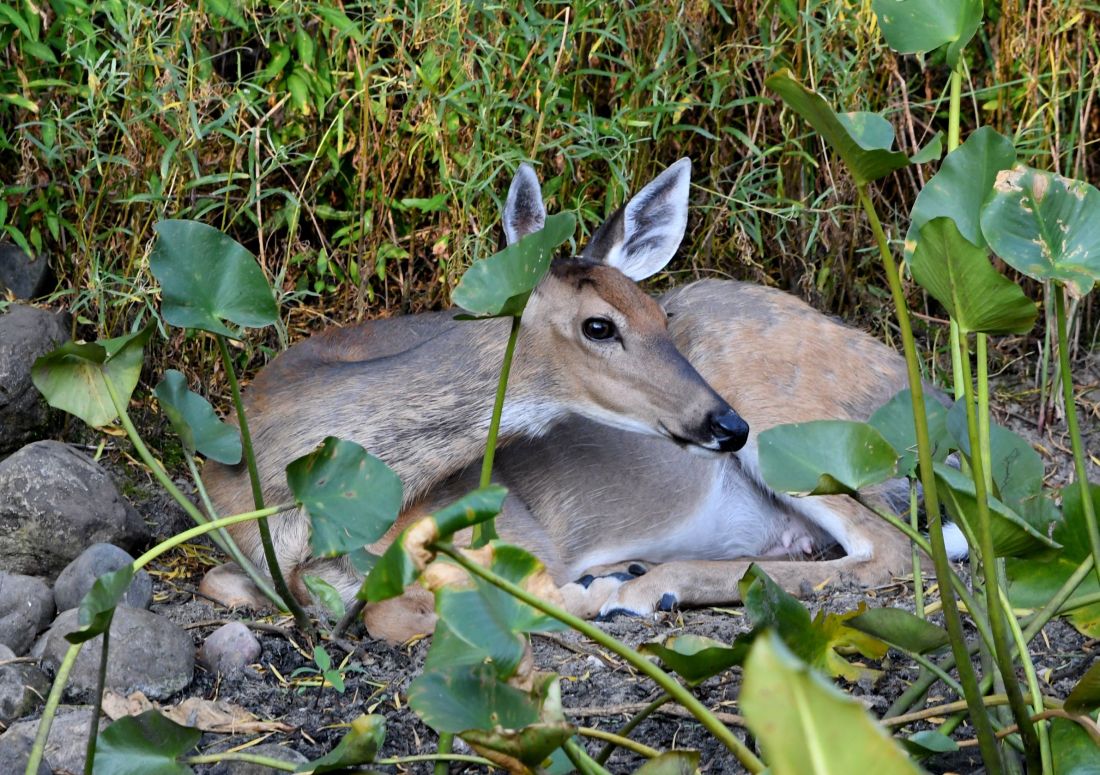
White Tail Deer looking as curious about me as I was about him!
Let’s start with the dragonflies. Before my picture taking hobby began a few years ago, I didn’t know that there were over 5,000 different species in the world or that they have been around for over 300 million years! Back in the ‘old days’, dragonflies were enormous– with wingspans of nearly 30 inches! By comparison, the largest dragonfly in the world today has a wingspan of less than 8 inches, and most of the dragonflies that I have found have wingspans of 3 inches or less.
Blue Dasher Male and Blue Dasher Female Dragonfly
Halloween Pennant Dragonfly
Common Whitetail Male and Common Whitetail female Dragonflies
The other thing I didn’t know about dragonflies, beside the fact that there are so many of them, is that male and female dragonflies often look distinctly different—they can even be different colors! Dragonflies, in fact, come in a wide variety of colors including blue, green, red, yellow, orange, black, pink, and brown. I never knew that before taking my picture walks!
Ruby Meadowhawk and Slaty Skimmer Dragonflies
Dot-tailed Whiteface Dragonfly
Twelve-spotted Skimmer male and Twelve-spotted Skimmer female Dragonflies
I’ve also had lots of bird surprises—the biggest one coming just a couple of days ago when a Common Grackle landed right in front of me with a very large tadpole in its beak. The tadpole was so big that I thought, at first, it was a fully grown frog–and then I noticed the long tail! I had no idea that Grackles were meat eaters! This prompted me to do a little research…
“The Common Grackle eats mostly insects, berries, seeds, fruit, and bird eggs, although it is also known to eat frogs, fish and snakes. You could say it will eat whatever food it can find!”
Common Grackle with giant tadpole for breakfast!
Then there’s the Robins. Even though I have seen Robins around me all my life, I really didn’t know much about them. For starters, I had no idea they liked grape jelly! The other day, though, I caught one gulping it down at our Oriole feeder! What was going on? When I looked for answers, I was surprised to find out that Robins not only like jelly, some of them have even been known to bring worms to the feeder and dunk them in the jelly before swallowing them!! Who knew?
American Robin
Speaking of worms, I also learned that even with a beak-ful of them, a Robin can dig for more and not lose the ones he already has! Like this!
American Robin
Another bird I’m familiar with, and have photographed often, is the Green Heron– but I knew little about them! The most amazing thing I found out along the way is that this bird is a tool user!! While I have not observed this behavior myself, I hope someday to have that opportunity!
“The Green Heron is one of the world’s few tool-using bird species. It often creates fishing lures with bread crusts, insects, and feathers, dropping them on the surface of the water to entice small fish.”
Green Heron
Last but not least, one of my favorite creatures of the pond, is the very large and very noisy, American Bullfrog. I love hearing them ‘croak’ (which has been described as a “deep, booming, Jug-o’-rummm!” sound), and I love seeing their goofy, expressive faces. What I didn’t know about them, though, is that they have teeth! Really! It’s not a full set of teeth like we have but “North American bullfrogs have teeth in the roof of their mouth and a muscular tongue capable of flipping prey into their mouth.”
I have been on so many picture walks since I last wrote that I’m having a hard time choosing which pictures to post and which ones to cast aside. At this time of year, there are so many beautiful things to photograph that it’s hard to stop taking pictures! The woods and the fields are bursting with new life, and so many colors!! I take hundreds of photos every time I’m out on a walk because almost everything grabs my attention!
Flowers currently in bloom: Lupine, Lance-leaved Coriopsis, and Clover
Spiderwort
Blackberry, Clematis and Deptford Pink
Sometimes, my husband, Mel, and I go on picture walks together. He often shoots with a close-up lens, while I almost always use a 600mm telephoto lens. When we go out together, it’s nice to have a mix of shots—he finding the tiniest of bugs or the finest of detail, and me zooming in on creatures well beyond the tip of my camera. We see the world around us through a different lens—both literally, figuratively!
Left: Mel’s close-up of a Baltimore Checkerspot Caterpillar, Center: Mel’s close-up of a Canada Thistle Bud Weevil, Right: My shot of a Baltimore Checkerspot Butterfly
Mel’s close-up of a female Blue Dasher
Left: Male Widow Skimmer Dragonfly, Right: Spatterdock Darner Dragonfly
Female Blue Dasher
Left: Female Slaty Skimmer, Right: Male Slaty Skimmer
The pictures here were gleaned from 14 different photo shoots at seven different locations over the course of about two weeks. All these pictures were taken in relatively close proximity to where we live: Wolf Lake State Fish Hatchery (10 miles), Western Michigan University’s Business Technology and Research Park (.5 miles), West Lake Nature Preserve (10 miles), Chipman Preserve (14 miles), Pierce Cedar Creek Institute (35 miles), Kalamazoo Nature Center (10 miles) and downtown Kalamazoo for a Peregrine Falcon watch (2 miles). We’re lucky to have so many natural resources so close at hand!
Two of the juvenile falcons whose nest is on the 13th floor of a bank building in downtown Kalamazoo
Left: American Goldfinch, Right: Tree Swallows
Female Red-winged Blackbird
Wherever I take pictures, I tend to walk as slowly and as quietly as possible so that I don’t overlook anything, and so I don’t scare anything away! Surprisingly, even turtles out in a pond, far from where I am walking, will know that I’m coming long before I arrive and slip quietly into the water from wherever they are perched! Bullfrogs, sitting hidden in the grass along the shore, will leap in fright if they know I’m on my way. I’ve been startled out of my skin on more than one occasion as they catapult themselves into the nearby water and let out a loud ‘squawk’! When I do happen upon an animal or an insect that hasn’t noticed my arrival, I feel as if I’ve really accomplished something!
Left: American Bullfrog, Right: Common Snapping Turtle
Snapping Turtle making a run for it as I approached!
Shooting Butterflies in the wind!
No matter where I go or what I find, my picture walks are making this pandemic bearable. There is comfort in knowing that I have places nearby where the cycle of life quietly ambles on and the birds still find reason to sing.
A cheerful little House Wren with lots of songs to sing!
Amid the hundreds of thousands of deaths across the globe due to COVID-19, the senseless and horrific deaths of black men and women at the hands of white racists here in the states, the rioting across our country as the result of those crises, and the ‘leadership’ of a president who continues to fan the flames of hate and intolerance, it’s often hard to find joy.
This one daisy standing alone in a dark field reminded me of how hard it is to find joy when everything looks so bleak.
Most days, what saves my soul from total despair are my picture walks. When I’m out and about on a trail with my camera, the sadness of the world falls away as I look for things to photograph that capture my attention, my curiosity or my heart. It feels like a form of meditation.
A Flycatcher and a Goldfinch
A Nessus Sphinx Moth (aka Hummingbird Moth)
Baltimore Oriole and a Gray Catbird
A Barn Swallow and a Tree Swallow
Yellow Warbler
The Cambridge English Dictionary defines meditation as, “the act of giving your attention to only one thing, either as a religious activity or as a way of becoming calm and relaxed.”
A Brown Thrasher and an Eastern Kingbird
White-tailed deer looking coy
Once I spot something that looks interesting or beautiful or odd, there’s no room in my brain for any worries other than how to get the best shot that I can. It’s a game of sorts really–one that I never seem to tire of. Did I get the settings right? Should I change where I’m standing? Can I get a little closer without scaring the animal away? When I do get most of those things right, and the picture turns out clear and crisp and appealing, I feel like I’ve accomplished something.
The Bullfrogs always bring a smile to my face!
Columbine
Green Heron
A Painted Turtle and an American RobinMourning Dove
In addition to feeling like I’ve accomplished something, my picture walks are good therapy. At the end of a very long day of unrelenting heartbreak in the news, I can take to the trails to unwind and re-focus, both literally and figuratively, to find all the beauty that still remains.
A Gosling and a pair of MallardsSpotted Sandpiper
Mute Swan
A Red-winged Blackbird and a Tree SwallowNorthern Map turtle shedding its scutesLupine