A Regular Walk Interrupted

March 24, 2019

Mel and I left the house yesterday afternoon hoping to go on a ‘regular walk’ (as opposed to a ‘picture walk’ where we would take our cameras). The plan was to leave the cameras at home this time. But I quickly developed second thoughts. What if I saw a once-in-a-lifetime bird and I didn’t have my camera with me??

“I won’t carry it on our walk”, I said to Mel, (in my least convincing voice). “I just want to have my camera in the car in case we see an owl or something.” (Thinking that we rarely see owls anyway and they’re not likely to move even if we did see one, so I’d have plenty of time to go back to the car and get my camera. Right? No. It was a dumb idea)

The closer we got to the park, the more doubts I had. Of course I was going to take my camera with me! What would be the point of leaving it in the car??? But, I wouldn’t stop and take pictures of every ant, butterfly and bird that I saw! Really!!  I wouldn’t! We had to get our ‘mileage’ in.

I was doing pretty well, I thought –until I spotted an unusual bird about 20 feet away! It was a Yellow Crowned Night Heron– out in the open!  It’s not that I’ve never seen a Yellow Crowned Night Heron before or that I haven’t gotten a picture of one, but they’re usually tucked away in the brush and are hard to photograph–so I’ve never really gotten a good shot at one. This was my chance!

Yellow Crowned Night Heron

“The Yellow Crowned Night Heron is a difficult bird to see. It is called a Night Heron because of its nocturnal habits. It likes cool sleeping spots and nesting over still water. It seems to pick dark shade deep in the woods or caves at the edges of lagoons or in a gallery of trees that stand in water.” https://animalcorner.co.uk/animals/galapagos-yellow-crowned-night-heron/

This one was on the edge of the brush in plain view and not at all spooked by our presence. We had been walking along a paved bike path and maybe he was just used to people passing by. I was able to get dozens of wonderful pictures without moving an inch closer.

That’s the treat I would have missed sharing had I left my camera in the car!

It’s not that there weren’t other fun things to photograph on our walk, like the Ospreys, the Scarlet Skimmers, the Red Shouldered Hawk, the Little Blue Heron, and the Pin-tailed Pondhawk, but that Yellow Crowned Night Heron was the highlight of my day!

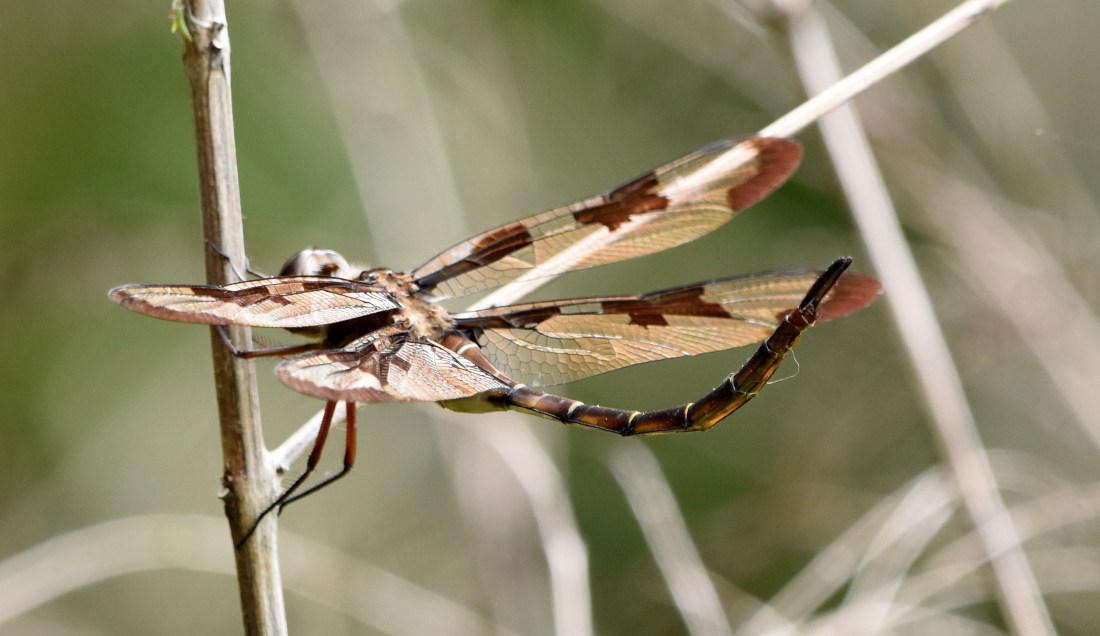
Scarlet Skimmer
Little Blue Heron caught in the wind
Little Blue Heron before he turns blue!
Osprey with fish for lunch
Osprey squawking overhead
Giant osprey nest high in a tree

Three Things

March 22, 2019

I went in search of three very specific things today: An alligator with a dragonfly on his eye, an anhinga on a nest, and a yellow butterfly on a red bottlebrush flower. I didn’t just make this stuff up to torture myself, Mel and I had been to the Sawgrass Lake Park yesterday, without our cameras, and had seen all three of these things. We had purposely left our cameras at home knowing that we would never get a decent walk in if we took them with us. Conversely, we also knew that we would come to regret that decision. And we did. I wanted to go back today to see if there was any chance at all to find what we missed.

First, I went in search of the alligators. Luckily, alligators don’t move very much and they tend to have favorite resting spots, so my chances of finding them again were pretty good. As it turns out, I found three! They were sunning themselves in the water below the boardwalk where I had found two of them yesterday–and there were dragonflies everywhere! All I had to do was wait long enough for one dragonfly to land on one alligator. Luckily, that didn’t take very long. But, the picture didn’t end up being as interesting as I thought it would–mostly because the contrast wasn’t good. Oh well, it was fun trying.

Giant alligator enjoying the sun across the stream

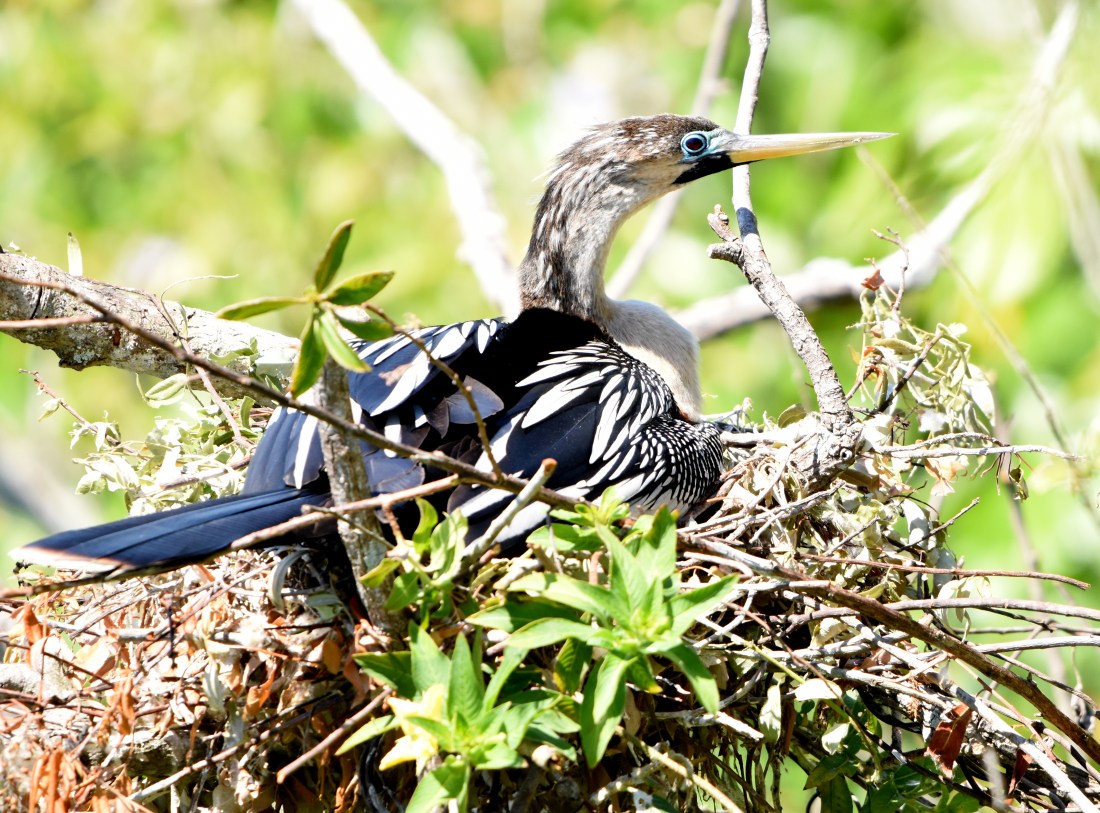
Off to the second thing on my list– an anhinga sitting on a nest. This wasn’t quite as impossible as it sounded either, because, unless the babies in the nest had hatched and flown away since yesterday, mama anhinga would probably still be there–and she was! Click! Click! Click! Got it! On to goal number three: yellow butterflies on a red bottle brush flower.

Anhinga sitting on her nest

Once I found my bottle brush plant, I made sure that the sun was behind me and my camera was on the right settings. BINGO!! There they were! Just like they been sent the memo and were expecting me to return for a photo shoot! Click! Click! Click! Later, I found out that the big yellow butterflies are called Cloudless Sulphurs.

Cloudless Sulphur on a red Bottlebrush plant
White Peacock Butterfly that was still able to fly!!

Once I had accomplished my three picture tasks, I ran into Mel down on the ground shooting grasshoppers and honey bees with his macro lens. I stayed around for awhile and shot so many nearby butterflies that I had to literally drag myself away so that I wouldn’t end up with 5000 pictures of butterflies that would need sorting later.

Mel with his macro lens shooting bees and grasshoppers
Mel’s Eastern Lubber Grasshopper

Instead I found a Little Blue Heron eating a lizard, a gopher tortoise eating grass and a dragonfly or two enjoying the sunshine.

Mallard mixed with a Black Duck or a Muscovy Duck or who knows what!

All in all, a very good day for a picture walk!

One more shot of the beautiful White Peacock Butterfly

Prince Baskettail and the Royal Terns

March 21, 2019

Prince Baskettail and the Royal Terns sounded like a great name for a new rock band, I thought– or maybe just a blog.   It tickled me, at any rate, that one of the new dragonflies I found yesterday was called ‘Prince Baskettail’!  What an odd name for a dragonfly! Later, I found another bit of royalty called a Queen–a Queen Butterfly that is, followed by a Monarch…but not a single Viceroy. To round off my regal assortment of princes, queens and monarchs, I found a Royal Tern– who happened to be a bird, not a butterfly or a dragonfly! Oh well, he had the right title, so he fit right in!

Prince Baskettail Dragonfly
A Royal Tern

All of these wonders of nature were found at the Circle B Bar Reserve in Lakeland, Florida—a place I never would have known existed had it not been for a chance encounter at a different preserve where a woman stopped to comment on the size of my lens! I get this a lot, and it’s somewhat embarrassing, but the woman just wanted me to know that she had seen lots of people like me (with big lenses) at Circle B Ranch and asked if I had ever been there. I had not. But it sounded like I should.  So, Mel and I headed out the very next day cameras in hand.

Blue Dasher
Blue Faced Darner
Two layers off, one more to go as the day warmed up!

Once we arrived, however, I thought maybe I had made a big mistake. It was ‘cold’ and it was windy.  I had to start out the day with a sweater, a windbreaker and a jacket! Maybe a different day would have been better, I lamented. Not surprisingly, though, it got warmer as the day progressed and I eventually had all of my extra layers tied around my waist.

Circle B Bar Reserve is an area of protected land covering 1,267 acres and is named after the cattle ranch that once occupied the site. The preserve is home to an impressive array of birds such as white ibis,  roseate spoonbills, sandhill cranes, great blue herons, tricolored herons, whistling ducks, and bald eagles, as well as other wildlife like alligators, bobcats, snakes, gray squirrels, river otters and wild hogs.

Anhinga with a huge fish!
Anhinga with an even bigger fish!!

Circle B Ranch is a wonderland of birds, butterflies and dragonflies! Mel and I spent the better part of our day wandering the trails near Banana Creek Marsh taking an almost endless stream of pictures. There was so much to see and enjoy! At the end of our five hour picture marathon, we had taken well over a thousand shots! Oh my! It’s been really hard sorting through all of them trying to decide which ones to post and which ones to leave out. There were so many stories to tell!

Huge alligator across the marsh!

My favorite catch of the day, a Barred Owl!

What a great place to enjoy the out of doors! Five thumbs up for the Circle B Bar Reserve!

More Unexpected Surprises

March 18, 2019

Almost everywhere I go to take pictures, there are unexpected surprises. Today Mel and I went back to Weedon Island Preserve where we have been several times before. Mel wanted to fish and I wanted to go for a walk—oh, and maybe take a few pictures along the way.

Weedon Island Preserve is a lovely place to walk, with seemingly endless boardwalks through otherwise impenetrable thickets of mangrove trees. I wasn’t expecting to find much in the way of song birds or dragonflies to photograph along the boardwalks– they just don’t seem to hang out in the mangrove trees, but I had my camera with me anyway, because, on previous visits, I have captured a few shorebirds, ospreys and gopher tortoises.

The seemingly endless boardwalk through the mangroves

As I exited the first long boardwalk without a single picture, though, I decided to follow a path I hadn’t taken before, and I wondered where it might take me. Not very far down the trail, I found out– more birds than I had ever seen before in this preserve! There were Great White Egrets, White Ibises, Snowy Egrets, Tricolored Herons and one bright pink Roseate Spoonbill– all busily foraging for food in the swampy waters of a huge mangrove thicket alongside the trail. Between all the scurrying and all the thickets, it was quite difficult for me to get a decent picture! But, from the pictures I did manage to get, you can see how incredibly dense a mangrove thicket is!

Tricolored Heron on the hunt!

It was fascinating to just watch and listen. When the Great Egrets weren’t looking for food, they were flitting about and making quite a racket!

Great Egrets make dry, croaking sounds, nasal squeals, and other harsh calls. They are particularly vocal during breeding season as they go about establishing territories, courting, forming pairs, and maintaining pair bonds.

I guess that’s what all the ruckus was about!

Great White Egret in the mangrove thicket

The Roseate Spoonbill, on the other hand, was quietly searching for food as it moved through the shallow waters swinging its head from side to side and sifting the muck with its wide, flat bill.  He kind of reminded me of the hose on a vacuum cleaner swishing this way and that sucking up everything in his path! Periodically, he would hop up on a limb and I’d try to get a picture of him before he quickly leapt back into the water for another round of foraging.

In between the Great Egrets and the Roseate Spoonbill, were the Snowy Egrets and the Tricolored Herons. There was actually so much going on, that I was having a hard time staying focused on the picture at hand! I have no idea why this particular spot was so incredibly popular, but I knew it was rare and I hung around for a very long time taking hundreds of pictures (Sometimes referred to as the “spray and pray” method –take a million pictures and pray that one turns out!)

In all, I walked around the preserve for about four hours, and that spot was the only place where I got any pictures at all—other than an armadillo I saw foraging in the dirt on my way back to the car, and one shot of Mel fishing on the pier that I took from high up in an observation tower on the boardwalk about an eighth of a mile away.

Foraging Armadillo
Mel fishing on the pier

Between the large cache of birds and the foraging armadillo, it was an unexpectedly good day for pictures!

Great White Egret

Beach Walk

March 17, 2019

I don’t often go to the beach to take pictures—mostly because the sun is so glaringly bright as it reflects off the sand and water that it’s really hard for me to tell if I’m getting a good picture or not. It didn’t help that we had arrived in the middle of the day and the sun was particularly harsh, but I headed out anyway to see what I might find.

When I first looked down the long stretch of beach ahead of me, I almost changed my mind about walking there. I didn’t see a single bird– but I wasn’t quite sure where else to walk, so down the beach I went.

All of a sudden, birds seemed to pop out of nowhere! Surprisingly, they had been on the beach all along, but had been lying low in the sand and were very well camouflaged. I didn’t know what birds they were at the time, but found out later that the larger one was a Willet and the smaller ones were Sanderlings.

Willet hunkered down in the sand

Willets are often seen alone. They walk deliberately, pausing to probe for crabs, worms and other prey in sand and mudflats, or to pick at insects and mollusks. When startled, they react with a piercing call, often opening their wings and running rather than taking flight.

A well-camouflaged Sanderling in the sand

The Sanderling is one of the world’s most widespread shorebirds. Though they nest only in the High Arctic, in fall and winter you can find them on nearly all temperate and tropical sandy beaches throughout the world.

Willet looking for food
Sanderling along the shore

Farther down the shore was a much bigger bird, the Great Egret—also known as the common egret, large egret,  great white egret or great white heron. He had a long, skinny, unfamiliar fish in his mouth.

Great Egret with a long, skinny fish in its mouth

The elegant Great Egret is a dazzling sight in many a North American wetland. Slightly smaller and more svelte than a Great Blue Heron, these are still large birds with impressive wingspans. They hunt in classic heron fashion, standing immobile or wading through wetlands to capture fish with a deadly jab of their yellow bill. Great Egrets were hunted nearly to extinction for their plumes in the late nineteenth century, sparking conservation movements and some of the first laws to protect birds.

Mel told me later that the fish was called a ‘lizard fish’. Its name refers to its mottled brown and whitish coloration, long slender body, large pair of eyes, and wide gape mouth lined with numerous small teeth. If it had legs, it might be confused with a real lizard!

Later, I saw the same Great Egret, or maybe it was his friend, hunting down grasshoppers in the scrubby areas adjacent to the shore. Interesting diet, I thought, which led me to look up more…

The Great Egret eats mainly small fish but also eats amphibians, reptiles, birds, small mammals and invertebrates such as crayfish, prawns, shrimp, polychaete worms, isopods, dragonflies and damselflies, whirligig beetles, giant water bugs, and grasshoppers. Who knew??

The Great Egret dropped his catch!

Once I was up in the scrub area of the shore, it was a whole different world—populated by butterflies, bees, wasps, grasshoppers and cactus flowers! Beautiful I thought! Much of what I saw, though, was new to me and, once again, I had to go on another kind of search later trying to figure out what everything was.

Mangrove Skipper on Lantana
Monk Skipper on a thistle-type plant
Gulf Fritillary on Lantana
Noble Scoliid Wasp
Cactus Flower

My beach walk certainly turned up a lot of unexpected surprises!

Beach walk!

In Search of the Reddish Egret

March 15, 2019

Yesterday I went in search of a Reddish Egret. I had seen my first one a few weeks ago at Weedon Island Preserve, but it was too far away to get a good picture. More recently, Mel and I were walking along the beach in downtown St. Pete when I spotted another one, but this time, I didn’t even have my camera!  Later, when I looked up information about Reddish Egrets, I found out that they are “one of the rarest egrets in north America.” No wonder I haven’t seen very many!! So,  I packed up my camera and headed back down to the beach to spend the waning hours of yesterday’s sunlight looking for my needle in a haystack.

Osprey bringing home dinner!

While I was walking along the shoreline to where I had last seen ‘my egret’, I tried taking pictures of the Pelicans as they flew gracefully in and out of Coffee Pot Bayou where there is a small island covered with all sorts of nests and all sorts of birds—egrets, roseate spoonbills, great blue herons, cormorants, and pelicans. Because of the island’s location, there’s a steady stream of birds, particularly pelicans, flying in and out of the bayou. As I stood on the edge of the inlet taking pictures, though, I felt as if I were in an arcade shooting decoys as the  birds kept popping into view on a regular basis. I took a lot of pictures, but many were out of focus because it’s a real challenge getting a sharp picture of a moving bird using a long lens and no tripod– but I always enjoy trying!

Incoming Pelican!
Beautiful Brown Pelican in Tampa Bay

As I walked further down the beach closer to where we had last seen the Reddish Egret, I continued to shoot various birds flying through the air hoping that at least a few of the pictures would be sharp enough to save.

Brown Pelican
Osprey on the hunt

As I was trying to focus in on one particular incoming bird, I realized that ‘my’ Reddish Egret was flying right at me! It happened so fast that I didn’t get a picture of him in flight, but I did get a second chance when he landed nearby! What luck!  I started snapping pictures right away and kept moving quietly closer and closer, but taking care not to disturb him. This egret was obviously used to people! He paid absolutely no attention to me and I was able get within maybe 20 feet or so of the tree where he had landed.

Reddish Egret

After awhile, a young boy came nearby to do some cast netting along the shore and the egret flew right over to him– hoping to enjoy whatever fell out his net I suspect. But, when this ‘mooching plan’ didn’t work out (because the boy didn’t catch anything), the egret went fishing on his own—which was quite entertaining to watch.

“The Reddish Egret stalks its prey—mostly small fish—more actively than other herons and egrets. The birds first locate their quarry by sight, then the dance begins. They dash, lurch, and zig-zag after their prey, often holding their wings over the water as they hunt. This shadow-casting strategy is thought to reduce glare and help the egret more accurately sight and spear its prey.”

My favorite picture of the Reddish Egret running around erratically looking for something to eat!

What a treat!! I felt extremely fortunate to not only find ‘my egret’ but to observe him for such a long time as he went about his daily business!

Another Day in Paradise

March 14, 2019

Mel and I have been in Florida for almost two months now and have been to most of the local nature preserves and trails multiple times– plus a few of the far away ones at least once. It’s getting harder and harder to find new places to visit, especially when we are reluctant to battle the traffic. But yesterday, we headed out early in the morning hoping to avoid ‘rush hour’ and drove northeast for about 40 miles to Morris Bridge Park in Thonotosassa, Florida.

Edit “Another Day in Paradise”

White Ibis in the ‘jungle’

We arrived at Morris Bridge early enough to enjoy a few minutes of the ‘golden hour’ of sunlight as it illuminated a beautiful anhinga. Its wings were spread wide to capture the morning rays. What a lovely sight! We just kept snapping pictures hoping to catch at least one that we might be happy with.

Anhinga in the morning sun

A little farther down the boardwalk and through the dense mangroves, I spotted a limpkin pecking around for oysters and apple snails. Most of the time he was so deep into the shade that he was hard to photograph. Eventually, though, he wandered into a little patch of sunlight and I took a few shots.

The Limpkin diet  “is almost exclusively apple snails, which it deftly finds and opens with the aid of a bent and twisted bill tip, leaving characteristic piles of unbroken snail shells.” I attempted to get an artistic shot of one of these empty, unbroken apple snail shells but failed to notice, when I took the picture, that there was an ugly pop can tab right next to the shell! (But it’s good for size comparison!)

After Morris Bridge, we headed down the road to Lettuce Lake Park. The unusual name of ‘Lettuce Lake’ comes from the floating plant life in the lake that seemed to resemble lettuce for the person who originally named the lake. Hmmm. I would have gone with something a little more interesting, I think.

At any rate, it was a great place to visit! Even though Mel and I didn’t see many birds yesterday, we kept busy trying to capture damselfies and dragonflies–of which there were many! Picture this: both of us perched on the edge of the boardwalk with our long 600mm lenses leaning over the railing and down into the swamp while other visitors would stop and look to where our cameras were pointing wondering where the heck the alligators were! When we tried to point out to them an all-but-invisible damselfly, we got mostly blank looks–probably because a 600 meter lens looks like overkill for a damselfly, or a more likely scenario: alligators are just much more interesting to most people.

Question Mark Butterfly

Just before leaving the park, I spotted a small songbird in the tree ahead of me and hoped my camera was on the right settings as I clicked away. Surprisingly, it was and I captured  a relatively decent shot of a bird I’ve never even heard of before, let alone seen– a Northern Parula!!

Northern Parula

This small warbler is often hard to see as it forages in dense foliage of the treetops. Northern Parulas hide their nests inside hanging Spanish moss in the South, where they are impossible to spot except by the actions of the parent birds.

Anhinga on the look out!

Between the stunning anhinga at Morris Bridge Park, the abundant sunshine, and the elusive Northern Parula, it felt like the old song lyrics,‘Just another day in Paradise’!

Anhinga in the morning light

Beauty All Around

March 11, 2019

We tried to find someplace new to visit today that wasn’t too far away and so we ended up at a small pond about 10 miles from where we are staying called the Carillon Conservation Pond Trail. The pond is nestled in among office buildings and has a paved trail all the way around. It seems to be a popular place among workers to go for a walk or a run or take a snack break. Mel and I just enjoyed a leisurely stroll with our cameras trying to capture all the beautiful colors of birds, dragonflies and flowers.

The first thing that caught my attention was an anhinga resting on a bush out on a small island in the middle of the pond. The black and white feathers on these birds are stunning!


The anhinga, sometimes called snakebird, darter, American darter, or water turkey, is a water bird of the warmer parts of the Americas. The word anhinga comes from the Brazilian Tupi language and means devil bird or snake bird.

Another beautiful bird out near the pond today was the Boat-tailed Grackle. If you just see these birds flying around, you don’t realize how iridescent the feathers of the male boat tail grackle are. It isn’t until you see them in the sunlight that you notice the lovely deep shades of blue and purple.

Boat-tailed Grackles are large, lanky songbirds with rounded crowns, long legs, and fairly long, pointed bills. Males have very long tails that make up almost half their body length and that they typically hold folded in a V-shape, like the keel of a boat. Males are glossy black all over. Females are dark brown above and russet below. Eye color ranges from dull brown along the western Gulf Coast to bright yellow along the Atlantic Coast.

Boat tailed Grackle

We also saw a tri-colored heron, another stunning shore bird with colorful feathers.

The Tri-colored Heron is a mix of blue-gray, lavender, and white. Unlike other dark herons, it has a white belly. Breeding birds have small white plumes extending from the back of the head, a bright blue patch of skin around the bill, and pink legs.

A Tri-colored Heron in Breeding Plumage
Tri-colored Heron in Breeding Plumage

Another bird we spotted, but almost missed because its feathers provide such good camouflage, was a Wilson’s Snipe.

Wilson’s Snipes are medium-sized, pudgy shorebirds with short, stocky legs. The bill is straight and very long (several times the length of the head). They forage by methodically probing in muddy ground for earthworms and other invertebrates. Their heads move up and down somewhat like a sewing machine running at slow speed.

It was also lovely to hear and see the Red-winged Blackbirds today. They are a sign of spring in our home state of Michigan and we wouldn’t normally be hearing them at this time of year!

Red-winged Blackbird

This next bird, the pied billed grebe, is a favorite of ours and I often take a picture– even though I have dozens already. Today, though, I was captivated by the pattern on the water that made it look like the grebe was swimming through Venetian blinds!

Pied Billed Grebe

But the birds weren’t the only beautiful things today! There were dragonflies, damselflies and flowers to amaze us as well–Scarlet Skimmers, Orange Bluets, Pickerel Weed and Duck Potato! (By the way, I use the Merlin app and the iNaturalist app to identify many of the birds, insects and other critters that I am not familiar with. There are so many I don’t know, but I’m learning as I go!

It really is amazing how much beauty you can find even in a very small space!

Florida’s Red-bellied Cooter

The Secret Lives of Insects

March 10, 2019

Even though Mel and I went for a very short walk today in terms of distance (less than a mile), we spent an inordinate amount of time (hours) taking pictures– of butterflies, dragonflies, damselflies and turtles—but not a single bird!! We just didn’t see them!

The most interesting thing we saw on our walk today was a pair of monarch butterflies down on the ground either killing each other or engaged in ‘coitus’ (as Sheldon on Big Bang would say!). Mel had seen these two butterflies flitting about just moments before he heard a ‘thump’, after which the two butterflies fell to the ground. (So much drama!) The butterfly on the bottom (probably the girl) was not moving, but the one on top (probably the boy) was quite active. When all was said and done, the boy flew off and the girl looked dead. She was flat on the ground stiff as a board. So I slowly approached to take a closer look, and suddenly she popped up and flew away! I must say, I have never seen butterflies mate in quite this fashion before! How fascinating!

The other interesting activity I observed today was a large eastern pondhawk dragonfly devouring a damselfly! Wait what?? Cannabalistic dragonflies? What next? As it turns out, damselflies in love. I caught several of them in the act—which is not an easy thing to do! Damselflies aren’t much bigger than a large hat pin. They are hard to find even in the best of circumstances (unless you see them moving), but I’ve been trying to capture them using a 600mm telephoto lens and I have back up at least 6 feet just for the camera to achieve focus!! It’s kind of like looking for a needle in a haystack once I put the lens up to my eye and try to re-locate what I had barely seen with my naked eye just moments before.

Eastern Pondhawk eating a damselfly!
Damselflies mating
Three damselflies–two mating and one waiting!!

All in all an exciting day of sex and cannibalism!

Blue Dasher

Shoot the Way Your Shadow Goes

March 8, 2019

Mel and I have been out on so many picture walks since we arrived in Florida that it seems like we should be running out of new and interesting things to photograph. It’s definitely true that we’re finding it harder and harder to get pictures of things that we haven’t already seen– but it’s still possible! Today, for example, I saw two new dragonflies I hadn’t seen before (a Scarlett Skimmer and a Pin-tailed Pondhawk), one new butterfly (Horace’s Dusty Wing) and one new damselfly (Mel’s catch: a Rambur’s Forktail).*

But, when neither of us can find something new, we look for ways to take pleasing or interesting pictures of the things we are already familiar with—like the ospreys, green herons, egrets, cormorants, moorhens–and honeybees! Mel and I both enjoy the challenge of seeing whether we can be successful in finding the right settings for the subject at hand– and then holding the camera steady enough to get a sharp picture! It feels like such an accomplishment when we do get it right!

There are so many things I’ve learned along the way just by trial and error—like anticipating my shots. I didn’t used to do that.  If I’m walking into a shady area, I change my settings and then take a few practice shots so that I’m ready if a bird should flutter into view. Conversely, I change the settings again if I walk into sunlight.  I’ve also learned that I need to keep checking the settings on my long lens –making sure that none of the controls have moved accidentally. Too many times I’ve come home gravely disappointed because the ‘sliders’ for Focal Length or Optical Stabilization have moved out of place and the pictures I thought might have been good, are really blurry.

Eastern Pondhawks mating

Of all my little reminders and rituals though, “Shoot the way your shadow goes!” is my favorite. I made it up as an easy and alliterative reminder to make sure that the sun is behind me and my shadow is in front of me for the best possible pictures.

*I identify the birds and bugs we find as best I can using the resources I have available, but if you see any errors, please let me know.

Great White Egret