In a Frog’s Eye

May 8, 2019

Nature photography is both a fun and challenging hobby. The fun part is abundantly clear to me, but may be less apparent to those who don’t care for being out of doors, or don’t share the same enthusiasm for photography.

Yellow Warbler

One of the very best parts of being outdoors every day taking pictures is its therapeutic effect. This may not be true for everyone who spends time walking among the trees taking pictures, but when I am looking and listening intently for creatures I’d like to photograph, there’s absolutely no more room left in my brain for anything else– like the gut-wrenching headlines we have been bombarded with every day. I’m completely engaged and totally zoned out when it comes to taking pictures of wildlife– which explains, in part, why this is such an addictive hobby.

Tree Swallow with his head on backwards!

The other addictive part of nature photography is sorting through all the pictures on my computer at the end of the day and discovering minute details that I could not have seen with my naked eye– like the time I enlarged a photo and I saw my own reflection in a frog’s eye!

Female Red-winged Blackbird

The challenging parts of nature photography have to do with three basic things: the weather, the ticks and my own safety.  The weather here in Michigan is either too hot, too cold, too wet or too windy. Once in awhile, though, we get lucky, and it’s “just right”!

Sandhill Crane
Common Yellow Throat

The ticks, on the other hand, are never right! They’re nasty little critters that carry Lyme Disease.

Lyme is one of the fastest growing infectious diseases in the United States and Western Europe. If untreated, it can become a severely debilitating illness affecting multiple organs, including joints, heart, brain and other parts of the central nervous system.

Goslings

Before the threat of Lyme Disease, I had never been concerned about walking through tall grass or sitting on the ground to enjoy a sunny day, but I do now. I still walk through tall grass or overgrown weeds if it means getting a good picture, but not without thinking twice about the possibility of a tick latching onto me. I take all the necessary precautions, like spraying myself down with bug juice, checking myself for ticks afterwards, and showering as soon as I get home– and so far, they’ve left me alone.

Love is in the Air! (Tree Swallows)

As for my own personal safety, the most mundane of challenges is the ground itself– it has any number of hidden holes, protruding roots and brambles just waiting to trip me up as I walk along gazing up in the trees looking for birds. On more than one occasion, I have found myself splatted face down on the ground, camera in hand, because I was looking up instead of down. Fortunately, neither my camera nor my body has had to undergo any repairs!

Cardinal
Dryad’s Saddle (I think)

Last but not least, is my vulnerability as a woman walking alone in isolated or semi-isolated areas. My vulnerability never keeps me from going out anywhere, but it often gives me pause—as I expect it does for many women.  To mitigate my risks, I take the following things with me on my walks: pepper spray, a cell phone, a whistle, an ID bracelet with the names and phone numbers of three family members and a list of any drugs I’m allergic to. In addition to all that, my husband has a ‘where’s my wife’ app which gives him my location at any given time. Fortunately, I’ve not had to put any of those things to use!

Green Heron
Female Red-winged Blackbird
Starling

Between Raindrops

May 3, 2019

Female Red-winged Blackbird

I’ve been on a week’s worth of picture walks—in between days of rain and snow and wind. Periodically, there have been bouts of sunshine! I’ve worn winter clothes, summer clothes  and rain gear—all in the same week!  Welcome to Michigan! With such erratic weather, I’ve stayed close to home and squeezed in walks between the raindrops and the snowflakes.

In spite of the challenges presented by the weather, it’s been fun to document spring as it slowly unfolds and the return of all the migratory birds. One of my favorite close-to-home places to document changes is the Wolf Lake State Fish Hatchery. It’s less than 10 miles from our home and, with more than a dozen ponds, it’s the perfect bird magnet. The hatchery is not only a haven for herons, ducks, geese and other waterfowl, but the surrounding trees and reeds are also attractive to a large variety of smaller birds, like swallows, sparrows, bluebirds, orioles, warblers, finches, flycatchers and the ubiquitous red-winged blackbirds —to name a few! When the weather gets warmer, there will also be tons of butterflies, dragonflies, turtles and frogs. Nirvana!

Tree Swallow on the Wolf Lake State Fish Hatchery sign
Bald Eagle
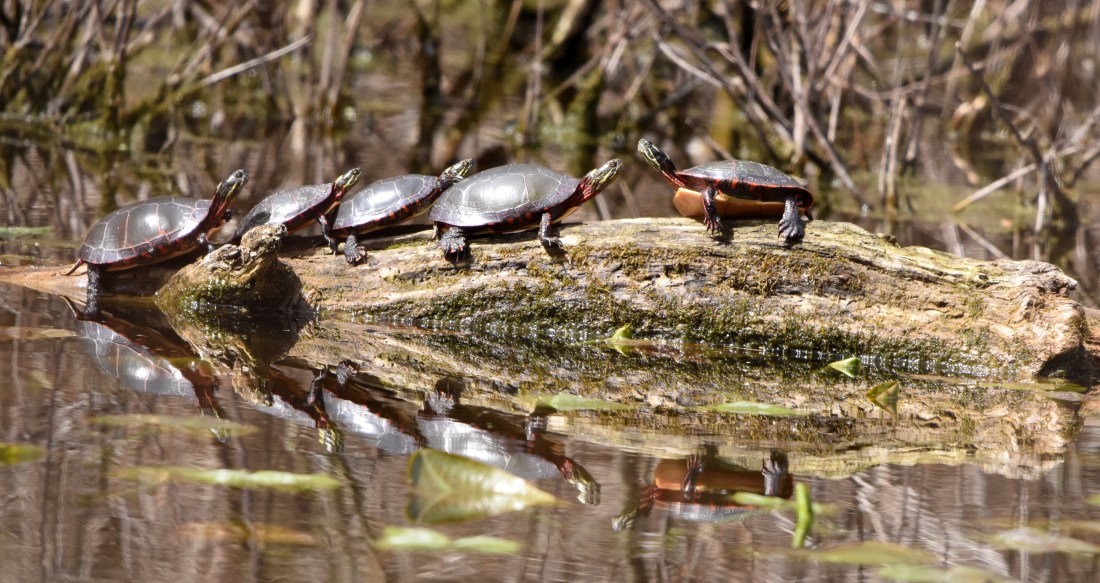
Turtle Convention

Another close-to-home place I like to visit is Kleinstuck Preserve, a small oasis of wildlife tucked in between neighborhoods that has a small marsh and lots of trees— a perfect home for woodpeckers, owls, warblers and other woodland creatures.

Ruby Crowned Kinglet
Yellow Warbler
Forster’s Tern
Northern Rough-winged Swallows
Canada geese engaging in an unusual behavior. They appeared to be pursuing another goose.

Tree Swallow
Cedar Waxwing

My closest-to-home favorite place to observe and photograph wildlife is our backyard. We live along a creek and near a woods so all I do some days is just walk out the door or stand on our deck. I take pictures of everything!  Even if I’ve taken a hundred pictures of a chickadee, I’ll take another one if I’m shooting on a different day or a different place or a different time. It’s all practice—and sometimes I get a picture that I like even better than the last one that I liked the best!

Downy Woodpecker

I  have so many nature areas close to home that even on a bad weather day, I can usually  find an hour or so of calm when the rain or wind or snow has stopped and I can squeeze in a bit of a picture walk.

Cardinal

Woodpecker Fest!

April 27, 2019

Mel and I were up and out the door shortly past dawn so that we could attend the Ninth Annual Thornapple Woodpecker Festival in Middleville, Michigan. Neither of us had ever been to a Woodpecker Festival, nor had we ever heard of such a thing, but it sounded like fun!

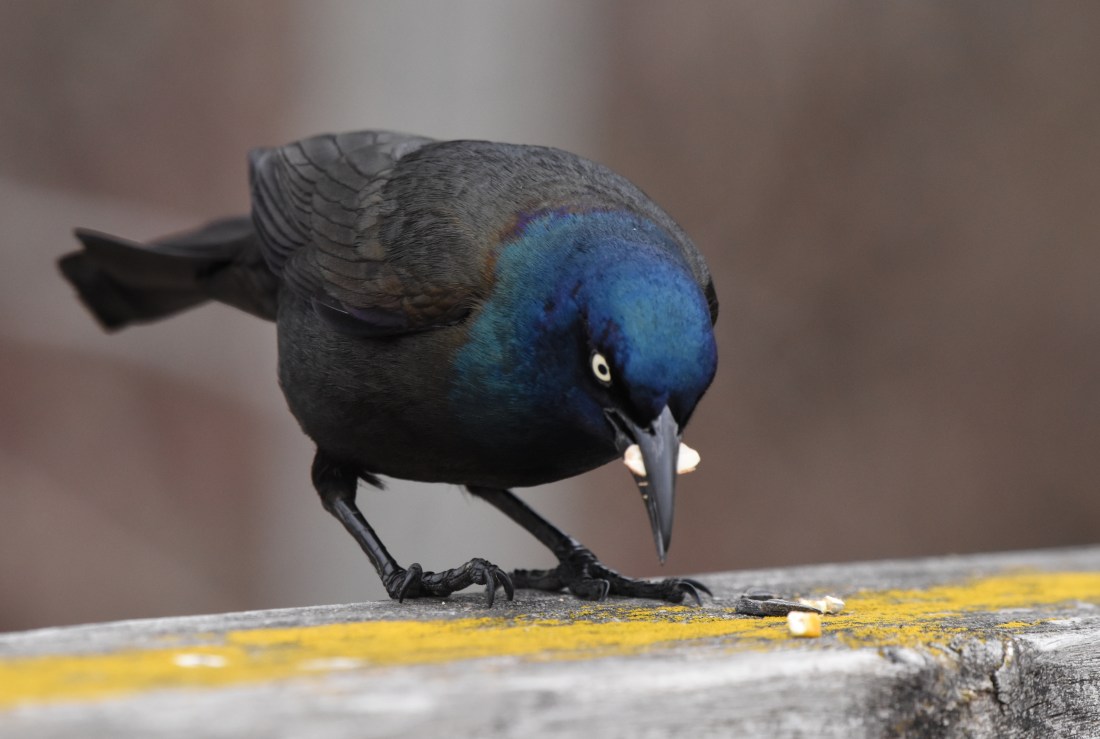
Common Grackle

We arrived at the Village Hall in Middleville in just under an hour and immediately joined a presentation on bird identification followed by one on bird photography. No matter how many times we go out birding or taking pictures, there’s always something new to learn and we enjoy talking with fellow enthusiasts about our common interests.

Female Red-winged Blackbird

Afterwards, Mel and I headed out the door with several other participants, bundled up in our winter jackets, hats and mittens, to wander the nearby trail looking for woodpeckers and other birds that might happen along. The trail conveniently follows the edge of the Thornapple River and is bordered on the opposite side by a large marsh– a perfect place for birding! There were plenty of trees, lots of underbrush and plenty of water.

Black-capped Chickadee
Female Brown-headed Cowbird

To help us in our search for birds, there were experienced birders all along the trail who had spotting scopes and/or binoculars and who were eager to point out all of the birds that we might otherwise miss. Experienced birders know what birds are in the area just by their vocalizations, their flight pattern, or a barely visible shape in the trees. It was great having their input!

Tree Swallow

Because this was first and foremost a Woodpecker Festival, the guides pointed out a variety of woodpeckers along the way. The best find for us was the Red Headed Woodpecker, which we rarely ever see. Our next favorite was the Pileated Woodpecker—which we would have missed altogether had it not been for one of the guides. The bird was so far across the marsh that I could barely see it let alone get a decent picture. To our credit, Mel and I found the Red-bellied Woodpeckers and Downy Woodpeckers on our own!

Downy Woodpecker

But the birds I liked finding the most were the warblers. There were dozens of them flitting around in all the trees and brush along the trail–Yellow-rumped Warblers, Palm Warblers and Yellow Warblers. They were in constant motion and hard to photograph—but every once in awhile I convinced a few of them to take a short break so I could take a picture!

Yellow-rumped Warbler (see the patch of yellow on his rump?)

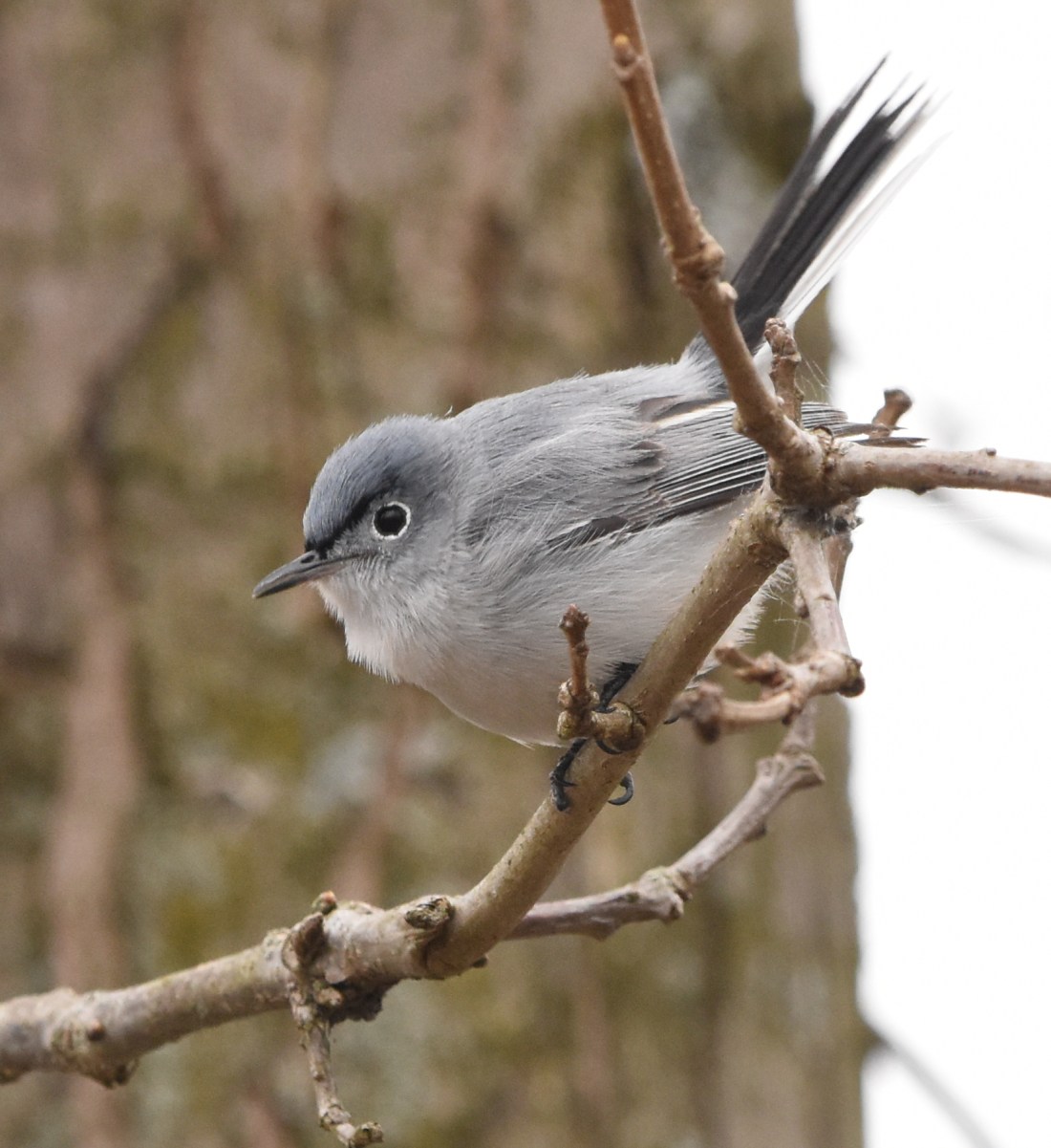
Also with the help of one of the guides, I was able to get a million or more pictures of a Blue-Gray Gnatcatcher– a bird I’ve never even seen before. The person who was helping us with this endeavor had an app on her phone with the gnatcatcher’s song. As she played the song, this curious little bird kept coming closer and closer by flying from one tree to the next hoping to see what bird might be singing. It was pretty amazing to watch! Eventually, he came in close enough for me to get some really good shots! Sweet!

Blue-gray Gnatcatcher
At first I thought he was choking on a stick, but he must be trying to choke down a very long grub or something!
Blue-gray Gnatcatcher

In addition to all the woodpeckers, warblers and gnatcatchers, Mel and I also saw Tree Swallows, Barn Swallows, Brown-headed Cowbirds, Wood Ducks, Red-winged Blackbirds, Robins, Song Sparrows, Common Grackles and a Sandhill Crane—plus a muskrat and a mink!

It was the best day ever! (Not unlike all the other ‘best days ever’ that we’ve had outdoors!) We learned a lot, met some new birders, and found out about a number of other places we’d like to visit that would be great for future birding adventures—and photography!

Common Grackle

This and That

April 21, 2019

Over the last few weeks, I’ve taken several walks to a variety of parks, preserves or natural areas with not much to show for any one location—but collectively, there’s enough to make a story.

Last Tuesday, I took a late afternoon walk through Historic Bridge Park in Battle Creek and continued walking along a section of the North Country Trail for awhile. The Historic Bridge Park is very unique in that it has five historic bridges dating back to the late 1800s. Each bridge has been carefully relocated to this site.  The main attraction is Charlotte Bridge, a 182 ft. structure that spans the main entrance.  Historic Bridge Park is a pretty little place to visit, but most of the birds were hiding and absolutely none of them wanted a picture taken–only one butterfly and a few plants cooperated.

Charlotte Bridge (I borrowed this picture from the Historic Bridge Park website)
Skunk Cabbage– This plant is prolific in swampy areas very early in the spring and has earned its name
because of the distinctive “skunky” odor that it emits when it blooms. It is not a true cabbage. “Skunk cabbage was used extensively as a medicinal plant, seasoning, and magical talisman by various tribes of Native Americans. While not considered edible raw, because the roots are toxic and the leaves can burn the mouth, the leaves may be dried and used in soups and stews.” (Wikipedia)

On two of my walks, I just wandered the trails near our home and was happy to find a nice variety of birds over the course of a couple of days– Yellow-rumped Warblers, Ruby-crowned Kinglets, Eastern Phoebes, Downy Woodpeckers, Cardinals, Robins, Golden Crowned Kinglets, Northern Rough-winged Swallows, and one Hermit Thrush. The Rough-winged Swallows and the Hermit Thrush were both new to me. The Hermit Thrush is apparently just migrating through and according to the Cornell website
“…you’ll likely hear their mournful, flute-like song, oh, holy holy, ah, purity purity eeh, sweetly sweetly long before you see them.” I feel really lucky to have spotted him because I don’t remember hearing any “holy, holy’ lyrics prior to taking his picture!

These Northern Rough-winged Swallows as well as dozens of their companions were swooping back and forth overhead. I caught these two resting momentarily high in a tree and my bird app identified them as Rough-winged Swallows. The Cornell website describes their behavior this way: “Twists and turns low above water bodies and open areas, taking insects in midair. Flies with slower and more deliberate wingbeats than other swallows. Often perches on wires and exposed branches to preen.”

Yellow-rumped Warbler, also known as a ‘butter butt’

Of that group of birds, the most difficult one to photograph was the Ruby-crowned Kinglet. The Cornell Lab of Ornithology describes the Kinglet this way:

“A tiny bird seemingly overflowing with energy, the Ruby-crowned Kinglet forages almost frantically through lower branches of shrubs and trees.”

I couldn’t agree more! This little bird flitted around so quickly that I’d no sooner locate it through the lens of my camera and it was gone! Added to the difficulty of getting the bird to sit still was getting it to come out from behind all the branches!  I stood in the same spot for nearly an hour trying to capture him before I finally succeeded! Unfortunately, I never caught a glimpse of the ‘ruby crown’ which is a distinctive feature of the male Kinglet, but is usually concealed.

Ruby-crowned Kinglet

Today, I visited Bow in the Clouds Preserve and Chipman Preserve which are both close to home. It was such a beautiful, beautiful spring day—the best we’ve had so far—and I was hoping there would be lots of birds to photograph. There weren’t. It was just too early in the season, I guess, to see more than the occasional bird, butterfly or dragonfly. So, once again, I didn’t get many pictures, but I had a relaxing, restorative walk through both of these lovely preserves.

Turkey Vulture overhead looking for lunch!
Turtles sunbathing (can you find the fifth one?)

Racing the Rain

April 17, 2019

Ever since we returned from our warm winter retreat in Florida, I have been struggling with Michigan’s capricious weather. In the short time that Mel and I have been home, it has been rainy, snowy, windy, hot and cold—sometimes all in the same day! Today’s forecast called for temperatures in the 40s with both wind and rain.

Common Grackle– such beautiful colors!!

I really, really wanted to take a picture walk at Kensington Metropark Nature Center on my way to visiting my grandson on the other side of the state.  It’s a two hour drive to the park and the rain wasn’t expected until 1:00.  If I left at 9:00, I could still take pictures for two hours before the rain. But, if I left at 7:00, I could take pictures for four hours!  By the time I arrived at the park, the rain prediction had been pushed back to 2:00, by the time I left, the rain wasn’t expected until 8:00!  Wow! I dodged that bullet! It’s not often that I win the weather game!

Female Red-winged Blackbird

The threat of rain was my biggest concern, but I also had to think about the cold—and the wind. So, I dressed in layers —a long sleeved t-shirt, a fleece sweater, a windbreaker, and a medium weight spring jacket, plus a knit hat and mittens, and a raincoat in my backpack! Good grief! Michigan weather is a lot of bother!!

Common Grackle enjoying some of my treats

The reason I go to such lengths to visit this particular nature center is the birds. For better or worse, the birds at Kensington Park are well-acclimated to people and see them all as a potential food source. I must admit, it’s quite delightful to be walking down the trail and have birds flitting around me hoping that I’ll have seeds to share. My pockets were stuffed to capacity!  Every now and then, especially when a chickadee would drop by to remind me,  I’d  dig into one of my pockets and hold out my offering. It’s really quite heartwarming to have a tiny little bird trust you enough to take seed from your hand.

Black-capped Chickadee
checking out my selection!

When I sat down on a bench to eat my lunch, I sprinkled seeds on the ground around me and watched as the Nuthatches, Tufted Titmice, Grackles, Red-winged Blackbirds, Red-bellied Woodpeckers, Downy Woodpeckers, Blue Jays, Cardinals, and the ever-present Chickadees enjoyed the feast. What a treat!

There are a few signs posted here and there asking visitors not to feed the Sandhill Cranes, but I suspect that people either don’t see the signs or choose to ignore them because there are at least a couple of the cranes who will walk right up to you hoping for a handout. I didn’t feed them, but I sure enjoyed seeing them up close!

Sandhill Crane in flight

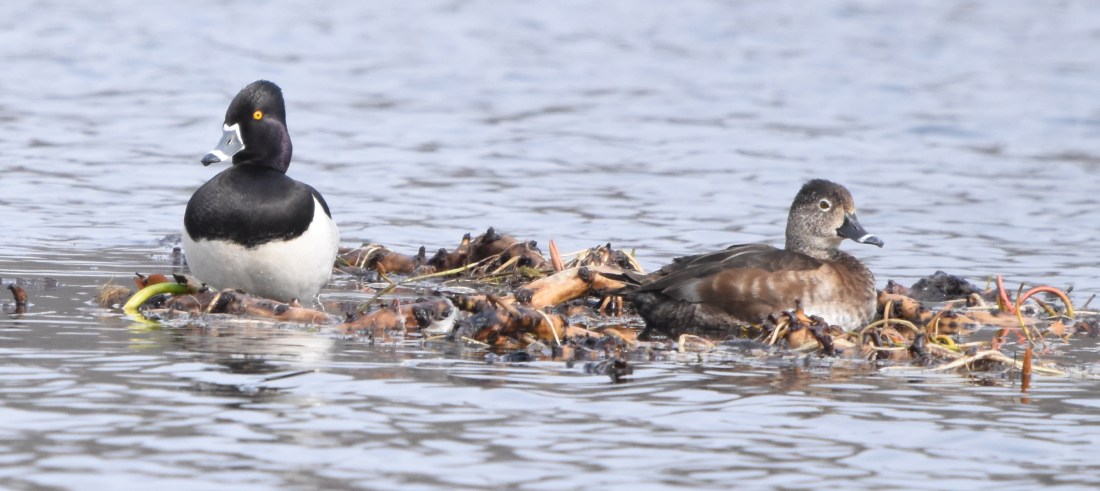
In addition to all the songbirds and Sandhill Cranes that you can expect to see at Kensington, there’s a large population of waterfowl that congregate on the small lake– including Canada Geese, Great Egrets, Great Blue Herons, Wood Ducks, Ring-necked Ducks, Blue-winged Teals and Mallards.

Blue-winged Teals
Ring-necked Ducks
Wood Ducks

The biggest attraction for visitors, though, is probably the Heron Rookery located on a small island within viewing distance from the wooden boardwalk along the edge of the lake.  There are dozens of very large nests high in the trees where the Great Blue Herons come to raise their young. On today’s visit, I watched as a few of herons flew into the very tops of the trees with nesting materials in their mouths. Their perches seemed quite precarious! Sometimes the herons would land in the shallow waters near the boardwalk where I was standing to look for fish, to preen their feathers –or maybe to just take a break from their noisy kids!

Great Blue Heron bringing in nesting materials
Great Blue Heron
Great Blue Heron on a precarious perch
Great Blue Heron

With all those wonderful things waiting for me to enjoy, is it any wonder I was eager to get out the door by 7:00, drive two hours on a busy highway, and contend with Mother Nature’s moodiness just to spend a few hours in the woods?? Nope! No wonder at all!

Muskrat Love

April 14, 2019

After months of warm, sunny weather in Florida, it was hard to wake up this morning to freezing temperatures and snow on the ground here in Michigan! Happily though, I’m sitting in front of a warm fire thinking about our sunny walk yesterday through our local bird sanctuary and all the beautiful birds that Mel and I saw along the way.

The Kellogg Bird Sanctuary is one of our favorite places to visit. Besides the fact that there are always birds to see, it’s a lovely place for a leisurely walk around the lake. Even in the wintertime, you can find geese or swans or ducks gathered there. In the warmer months, the lake attracts any number of other waterfowl that are either hoping to stay for awhile or just passing through.

Mallard Duck, Male
Canada Goose
Blue Winged Teal
Great Blue Heron

On yesterday’s walk, we had the pleasure of seeing Canada Geese, Trumpeter Swans, Mallards, Wood Ducks, Blue Winged Teals, and a few Great Blue Herons. In addition to all these native birds, the bird sanctuary provides a home for a number of non-native birds including a very colorful Mandarin Duck and an elegant Black Swan and a few Whooper Swans. The Whooper Swan (pronounced Hooper) is a large Eurasian swan whose counterpart here in the states is the Trumpeter Swan.

Mandarin Duck

Besides all the larger more obvious birds, I always hope to see a variety of the small songbirds. I did hear a lot of singing going on, but not many of the birds seemed willing to go out on a limb for me and pose for a picture.

The ubiquitous but delightful Sparrow
Four against one!

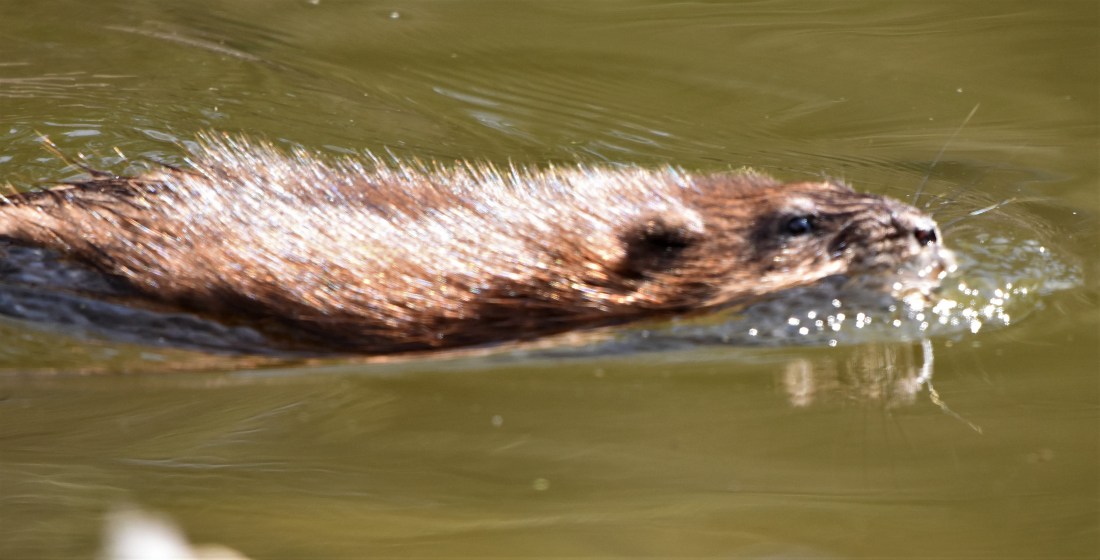
The biggest surprise of the day, though, was the muskrat. I wasn’t surprised to see him swimming in the water in the afternoon, but I was surprised to see him walking around. I’ve only ever seen the tops of a muskrats, and only momentarily as they swam past me and then dipped quickly under the water again.

Muskrat swimming

This particular muskrat had been swimming in the lake when I first saw him but had entered a nearby pond via an underground channel. His goal, I soon discovered, was to reach a low hanging duck feeder along the fenced enclosure. Since I had never witnessed muskrat behavior on land before, I decided to stick around and see what he was up to. I watched in fascination as he made numerous attempts to reach the food in a perch that was just a little too high for him reach easily. Eventually, though, he succeeded in fitting his chubby little body into the feeder and eating to his heart’s content.

Success!!

Because I had never given much thought to the secret lives of muskrats, I knew virtually nothing about them– so I decided to do a little digging. I found the usual mundane information about size (16-28 inches including the tail) and weight (1.3 to 4.4 pounds) and habitat (wetlands), but it was a tiny paragraph at the very end of a Wikipedia article that really caught my attention…

“Muskrats have sometimes been a food resource for North Americans. In the southeastern portion of Michigan, a longstanding dispensation allows Catholics to consume muskrat as their Friday penance, on Ash Wednesday, and on Lenten Fridays (when the eating of flesh, except for fish, is prohibited); this tradition dates back to at least the early 19th century.”

What??? I grew up on the southeast side of this state AND I grew up Catholic But we NEVER consumed muskrat during Lent– or EVER for that matter. I’d never even heard of such a practice! I needed to dig a little deeper…

“The custom of eating muskrat on Ash Wednesday and Fridays in Lent apparently goes back to the early 1800s, the time of Father Gabriel Richard, an early missionary in Michigan whose flock included French-Canadian trappers. Legend has it that because trappers and their families were going hungry not eating flesh during Lent, he allowed them to eat muskrat, with the reasoning that the mammal lives in the water.” (Lukowski, Kristin (March 8, 2007), “Muskrat love: Friday Lent delight for some OKed as fish alternative”, Catholic News Service, Catholic.org, archived from the original on March 26, 2013, retrieved March 31, 2013)

http://www.catholic.org/national/national_story.php?id=23328

And there you have it! Apparently it’s true. (But I think I’ll stick to just watching muskrats swim and eat for the time being, thank you very much!)

Home Again

April 12, 2019

We arrived home to Michigan yesterday evening from our two and a half month hiatus in warm, sunny Florida. Thankfully, it wasn’t raining, snowing or hailing when we arrived home (as would have been typical for Michigan), but it was cold enough for me to put on a winter jacket when we unloaded the car!  The rains came later!

Busy little red squirrel

Today, I had hoped to get everything unpacked, washed and put away before going for a bit of a picture walk at the end of the day. By day’s end, I had successfully completed most of my ‘TO DO’ list, but the picture walk almost didn’t happen.  It had been so incredibly windy all day long that I wasn’t sure whether the birds would even be out and about on such a day—and, if they were out, how would I ever be able to hold my camera steady enough (with the 600mm lens) to take their picture?

Hello Deer!

I can’t say that the wind ever died down completely, but it did let up now and then– so I was able to capture a few familiar sights on my ‘welcome back’ walk through the woods around our neighborhood. The ‘welcoming committee’ for this walk included several deer, a few robins and cardinals, a pair of wood ducks, several Canadian Geese, a few squirrels, an Eastern Phoebe, a Downy Woodpecker and a Yellow-rumped Warbler, otherwise known as a ‘butter butt’! It was a much better turnout  than I ever expected given the weather!

Daffodils–a sure sign of spring!
Cardinal singing his heart out!

Before making our long car trip back to Michigan, though, we had stopped to visit friends in North Carolina who invited us on a couple of hikes through two local preserves. The most notable discovery on these two hikes was a very long black rat snake slithering straight up a tree!

I’d never seen a snake do that before and was curious about how that was even possible. Here’s what I found out…

“Snakes use “concertina locomotion” to climb trees – the act of gripping with some parts of the body while pulling or pushing with other parts of the body in the general direction of movement. This push/pull motion is made possible by scales that are keeled, or ridged. Unlike smooth scales, keeled scales have raised ridges on the center of each scale which enables the snake to get a grip on rough surfaces, much like a tire with a good tread grips the road better than a bald tire.”

Once this snake made it up to a branch and settled in for a few minutes, he opened his mouth extremely wide and appeared to be yawning– so I looked up information about snakes yawning.

“One reason snakes ‘yawn’ is to prepare themselves for a hearty meal, especially when their prey is considerably larger than their head!”

This snake, however, did not appear to have any prey in view, so I looked for another reason.

“A more recently discovered reason for mouth gaping is that it allows them to pick up chemical cues from their environment like many mammals in the animal kingdom.”

Maybe he was picking up chemical cues from all the human creatures staring up at him and taking pictures!!

The Last Picture Walk

April 5, 2019

Yesterday I took my last picture walk of our Florida vacation. Today, we packed up our things and tomorrow we start on our long journey back to Michigan. I had needed one last picture walk before we left so, at the end of a very long day yesterday, I drove down to the beach hoping to find some of the shorebirds I had seen a few days ago–when I didn’t have my camera in tow.

The lighting on the water was perfect and the birds were plentiful. It was amazing, I thought, just how many different birds were actually gathered in one small stretch of beach near downtown St. Petersburg. At first glance, all I saw was this big mess of little brown birds! But as I started taking pictures, it became abundantly clear that there were actually several different varieties of shorebirds running about.

A big ‘mess’ of little brown birds!

By day’s end, I had seen Mottled Godwits, Sanderlings, Semi-palmated Plovers, Least Sandpipers, Western Sandpipers, Short-billed Dowitchers, Willets, Ring-Billed Gulls, Laughing Gulls, Black Skimmers, Lesser Scaups, Cormorants, Reddish Egrets, Pelicans, and a Great Blue Heron. But since I’m more of a photographer than a birder, I welcome any corrections if my labels on these birds are incorrect!

Willet
Mottled Godwit

I was trying to ‘shoot’ everything I saw—the swimmers, the waders, the dabblers and the skimmers. It was so hard for me to stay focused on just one!  Then, I tried to get the flyers! But, oh my goodness that was hard to do! They’d zoom in and zoom by so fast that I ended up with a lot of pictures that were out of focus! Surprisingly, though, a few actually turned out– and I was quite happy about that!

Brown Pelican

My biggest thrill for the day, though, was seeing ‘my’ Reddish Egret again. I had gotten some really good shots of him a few weeks ago along this same shoreline, but yesterday the lighting was even better than before and his antics even sillier—twisting, turning and jumping erratically like a ballerina on steroids as he tried to catch a fish. What an entertaining performance to watch!

… and he finally caught his fish!

Eventually, though, my ‘golden hour’ of sunlight faded and I reluctantly headed back to the house faced with the daunting, but exciting, task of sorting through the nearly 800 pictures I had taken!

Reddish Egret (Juvenile)

Photo Journal

March 31, 2019

I’ve been out on a week’s worth of Picture Walks and haven’t had time to write a blog about any of them.  Today, though, I woke up with the brilliant idea that maybe I could just do a ‘photo journal’—lots of pictures, not much writing. That way I could still share the pictures, but not spend hours and hours on the writing part. Perfect! And even though I’ve posted many of these pictures on Facebook already, I feel like a blog is less fleeting, more like a book– and that I’ll still be able to find it a year from now! Enjoy.

Sunday March 24th Philippe Park, Safety Harbor, Florida

Mel’s shot of Large-flower Pink Sorrel
(this is actually a very tiny flower and it looks more purple than pink to me!)
Common Buckeye Butterfly
Yellow Crowned Night Heron

Monday March 25th Sunken Gardens, St. Petersburg, Florida

Mel’s Peregrina

Flamingo

Tuesday March 26th Silver Springs State Park, Silver Springs, Florida (see blog ‘Wild Monkeys!)

Wednesday March 27th Sawgrass Lake Park, St. Petersburg, Florida

Anhinga on her nest
Banded Watersnake
White Ibis

Thursday March 28th Coffee Pot Park (Just a regular walk today. No pictures)

Friday March 29th Florida Botanical Gardens, Largo, Florida

My favorite picture from our visit to the Florida Botanical Gardens, a beautiful Northern Flicker
Monarch

Saturday March 30th Crescent Lake Park, St. Petersburg, Florida

This is my favorite picture from yesterday’s walk at Crescent Lake–
an osprey flying off with his catch of the day!!
Eastern Amberwing Dragonfly
A Green Heron who just caught an Eastern Amberwing for a snack!
Muscovy Ducklings
Crested Mallard (see blog post ‘Duck with a Do’ for the story)

Sunday March 31, Largo Central Park Nature Preserve, Largo, Florida

Eastern Screech Owl –my first!
The obligatory Florida Alligator picture!
Limpkin on the hunt
Mel shooting bees from the boardwalk at Largo Central Park Nature Preserve today

And that’s what a week’s worth of Picture Walks looks like!

Wild Monkeys!

March 27, 2019

Kayaking down the Silver River

Not long after we arrived in Florida, Mel had read on his Florida Kayaker Forum that people were kayaking down the Silver River and taking pictures of wild monkeys! Wild monkeys?? I didn’t even know there were wild monkeys in Florida—but I wanted to go see for myself. So yesterday was the day we finally decided to make the long two and a half hour drive to Silver Springs State Park and rent a tandem kayak. Mel would paddle in the back and I would take pictures in the front!

Kayaking down the Silver River

Prior to 2013, when the state of Florida bought out the Silver Springs ‘amusement’ Park and merged it with the adjacent state park, canoes and kayaks weren’t allowed along the Silver River. Only the special  glass bottom boat ‘jungle cruises’ had access.

Glass Bottom Boat

The glass bottom boats have been in operation in the park since 1878, and continue today with charming replicas of those vintage tour boats. The monkeys, on the other hand, didn’t become a part of the history of Silver Springs until 1930 when ‘Colonel’ Toohey, who operated a “jungle” tour, placed six rhesus macaques monkeys, indigenous to Central and East Asia, on an island in the river. He didn’t know that these monkeys were good swimmers and they easily escaped the island to flee into the nearby woods where they thrived and multiplied!

The monkeys are a great tourist attraction, but are also a continuing problem. They aren’t as afraid of humans as other animals, and can be quite aggressive. Not surprisingly, a big part of the problem are the tourists– who sometimes feed them. And, as happens with other wild animals (like the alligators here), people are then seen as a source of food. The park has had to close on a few occasions in the recent past due to ‘monkey attacks’. In addition to the physical harm these monkeys can cause, it is believed that about 30 percent of the monkeys carry herpes B, a rare and highly virulent virus that can be deadly to humans.

In spite of all the problems these monkeys present, I sure enjoyed seeing them and taking pictures!

Alligator catching some rays!
Limpkin

Before doing my research on the history of Silver Springs, there was a lot I didn’t know. The following paragraph contains some of the most interesting things I didn’t know. Some of the shows mentioned here were part of my growing up years, but I had no idea they were all filmed in Silver Springs, Florida!!

In the 1930s, six of the original Tarzan movies, starring Johnny Weissmuller, were filmed on location at Silver Springs. In the late 50s and 60s, the clear water made this the perfect location to film more than a 100 episodes of “Sea Hunt,” starring Lloyd Bridges. “Creature from the Black Lagoon” was filmed here; so were scenes from movies ranging from “Rebel Without a Cause” to James Bond’s “Thunderball.”

Manatee coming up for air! It swam right under our kayak!
Mama Wood Duck and her babies

Despite the long drive and all the traffic delays around Tampa, it was the best day ever!